- The paper demonstrates that quantum geometric contributions from critical states can dominate the superfluid weight in quasicrystals.
- It employs dual real-space and momentum-space approaches to decompose conventional intraband and geometric interband contributions.
- Numerical results on quasicrystal models and the Aubry-André-Harper model confirm the robust enhancement of superfluidity by critical state geometry.
Quantum-Geometric Superfluid Weight in Quasicrystals with Critical States
Introduction
The interplay between quantum geometry and superconductivity has emerged as a central theme in condensed matter physics, particularly in systems where nontrivial band topology or spatial structure gives rise to unconventional superconducting properties. The paper "Quantum-geometric origin of superfluid weight in quasicrystals with critical states" (2606.09989) rigorously investigates how the quantum geometric tensor, specifically its real part known as the quantum metric, governs the superfluid weight in quasiperiodic systems hosting critical states. By articulating both real-space and momentum-space approaches to superfluid weight, the work demonstrates that in quasicrystals, geometric contributions can surpass the conventional (intraband, effective mass-based) terms, especially when critical states dominate.
This provides a unified framework clarifying the geometric mechanism of superfluidity in aperiodic materials and offers insight into the nontrivial enhancement of superconductivity observed experimentally in quasicrystals.
Theoretical Framework
Quantum Geometry and Superfluid Weight
The quantum geometric tensor encapsulates the local geometry of Bloch wavefunctions in Hilbert space, with its real part—the quantum metric—characterizing the distance between quantum states. In the context of multiband superconductors, prior theoretical developments have revealed that the superfluid weight receives both a conventional intraband contribution and an interband geometric contribution, which is mediated by the quantum metric [Peotta2015, Liang2017]. The geometric component is critical in flat-band and topological systems, where the effective mass is divergent or ill-defined, yet phase stiffness and supercurrent persist due to interband processes.
The present work extends this quantum-geometric approach to systems lacking translational invariance—namely, quasicrystals—where Bloch's theorem is inapplicable and critical states, exhibiting neither ballistic extension nor Anderson localization, are prevalent.
Hubbard Model in Quasiperiodic Systems
The primary setting is the attractive Hubbard model on a quasicrystalline lattice, instantiated as the two-dimensional Ammann-Beenker tiling, and the one-dimensional Aubry-André-Harper (AAH) model for comparative analysis. The Bogoliubov-de Gennes mean-field treatment allows computation of the superfluid weight tensor from the Kubo formula, exploiting both real-space basis (open boundary conditions) and a generalized momentum-space formulation (periodic boundary conditions), thereby permitting decomposition into conventional and geometric contributions.
Numerical Results
Superfluid Weight in the Ammann-Beenker Quasicrystal
For the Ammann-Beenker quasicrystal, the density of states (DOS) features a sharp zero-energy peak, attributed to confined, strictly localized states, superposed on a fractal background of critical states with power-law spatial decay. By systematically analyzing the superfluid weight Dxx as a function of interaction strength ∣U∣/t and effective chemical potential μ~, it is shown that geometric contributions dominate across a broad parameter regime.
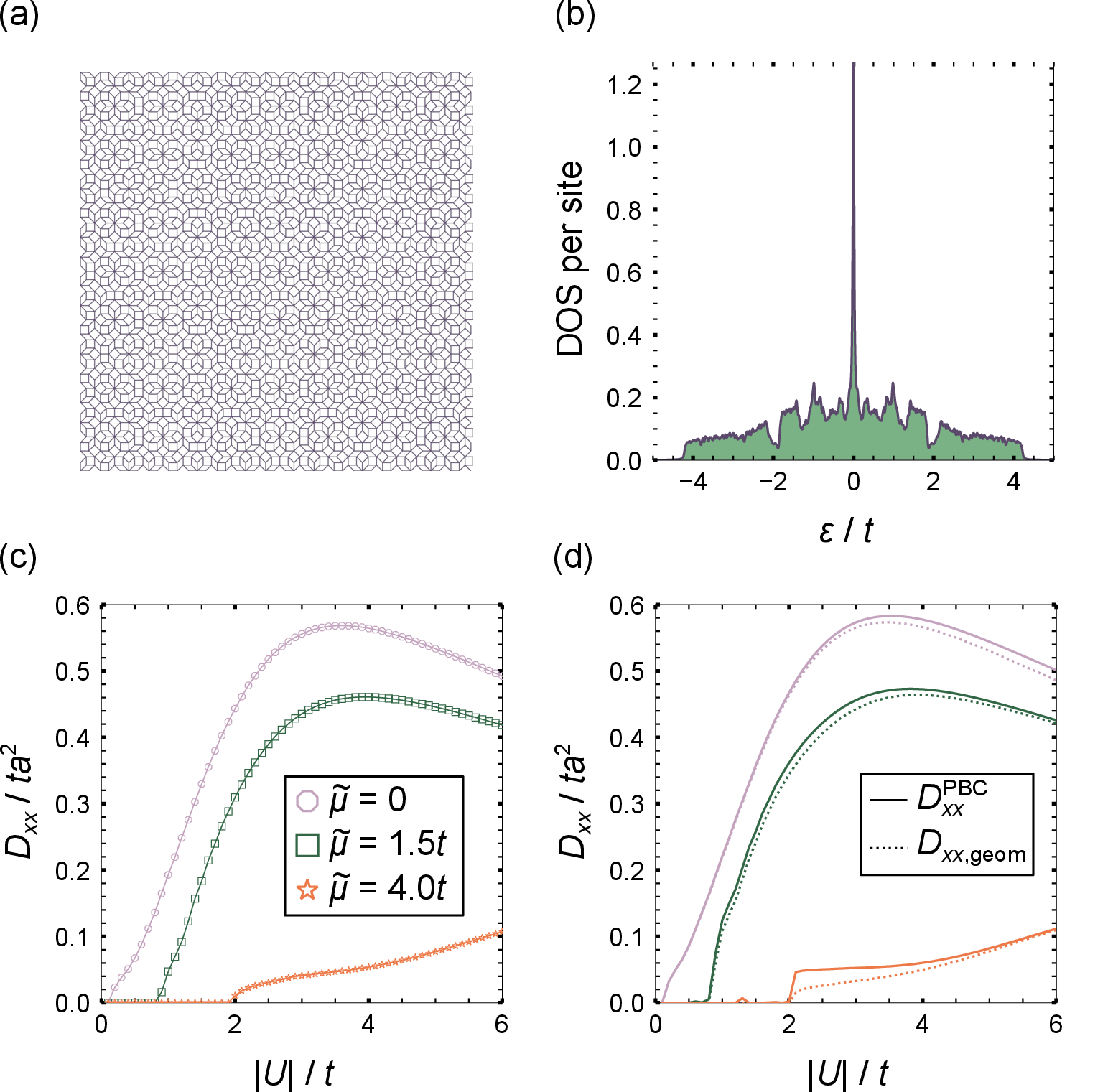
Figure 1: (a) Ammann-Beenker quasicrystal structure. (b) DOS per site of the tight-binding model. (c) Superfluid weight with open boundaries as a function of ∣U∣/t for different μ~. (d) Superfluid weight with periodic boundaries, separately showing conventional and geometric contributions.
Linear scaling of superfluid weight with ∣U∣ at weak coupling for μ~=0 directly parallels known results in flat-band superconductors and is a signature of quantum geometry dominance [Peotta2015, Aleksi2016]. Importantly, the predominance of the geometric term persists even when the chemical potential is shifted outside the region dominated by strictly localized states, indicating a substantial geometric effect arising from critical (neither extended nor localized) wavefunctions. The off-diagonal elements of the superfluid tensor are negligible due to a near four-fold rotational symmetry.
The calculations under periodic boundary conditions, which enable rigorous separation of contributions, confirm that Dxx≃Dxx,geom, particularly notable at high μ~, where confined states do not contribute. This underlines the universality of geometric enhancement in true quasiperiodic environments where critical states are overwhelming.
Aubry-André-Harper Model and the Critical State Transition
The one-dimensional AAH model provides a clean testbed for exploring the relationship between localization, multifractality, and superfluid weight. As the strength of the quasiperiodic potential λ is tuned, the system transitions from a metallic regime of extended states (∣U∣/t0), through a critical regime (∣U∣/t1), to a localized one (∣U∣/t2). The evolution of the multifractal dimension ∣U∣/t3 across the spectrum quantifies this transition.
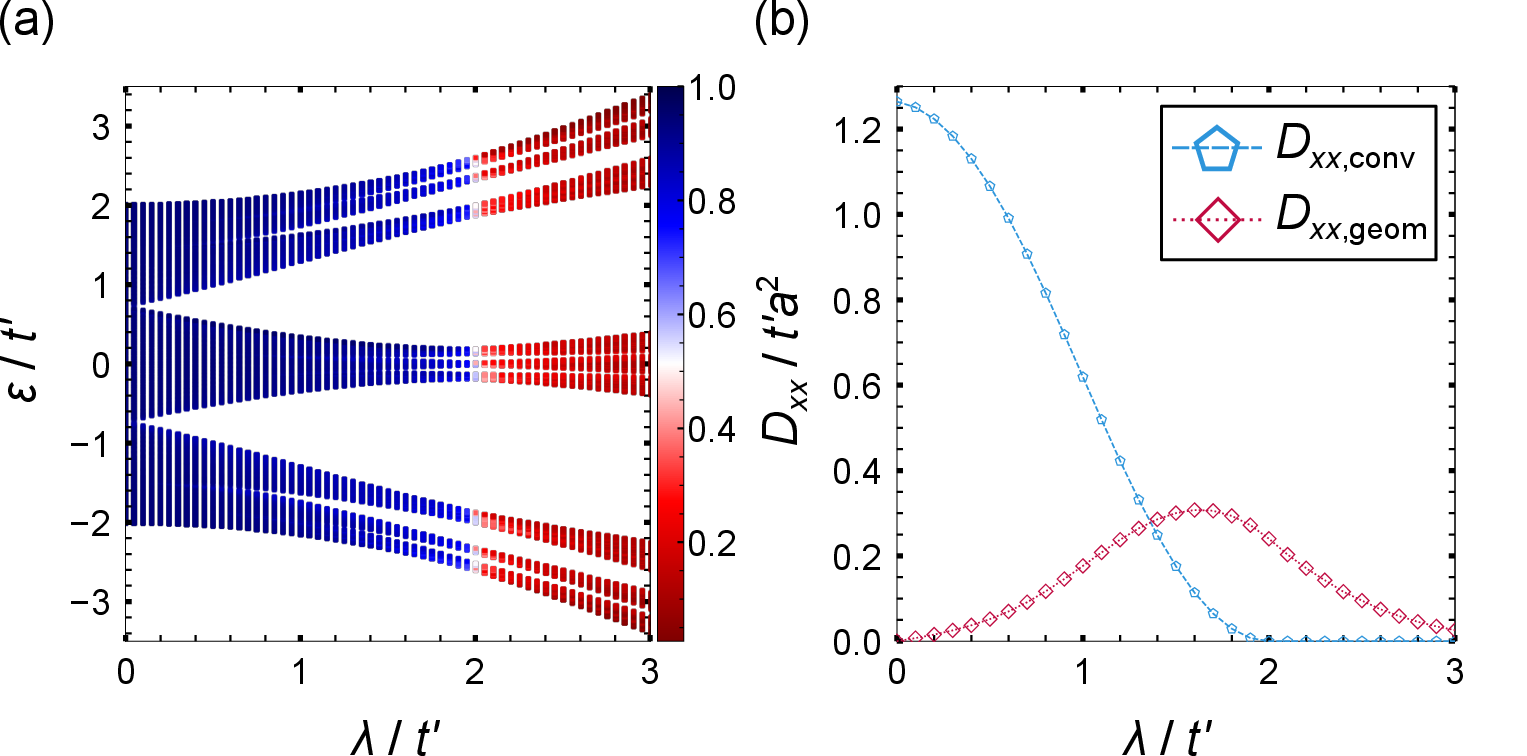
Figure 2: (a) Energy spectrum of the AAH model with color indicating multifractal dimension ∣U∣/t4. (b) Conventional (blue) and geometric (red) superfluid weight at ∣U∣/t5 versus ∣U∣/t6.
Below the critical point, the conventional contribution to superfluid weight diminishes with increasing ∣U∣/t7, while the geometric contribution increases—reflecting the growing significance of interband processes as bands are broken up by the quasiperiodic potential. At the transition, where all states are critical, the conventional term vanishes identically and the superfluid weight is entirely geometric, mirroring the quasicrystal results. In the localized regime, both contributions decay, but the geometric term remains dominant until strong localization sets in and superfluidity is completely suppressed.
Discussion and Implications
The paper establishes that quantum geometric effects, quantified via the quantum metric and arising from critical states, are a robust and, in many regimes, the dominant mechanism setting the superfluid weight in quasiperiodic systems. This challenges the conventional wisdom that associates superfluidity exclusively with delocalized, coherent wavefunctions and extends the applicability of quantum geometric superconductivity to aperiodic matter.
From a theoretical standpoint, these findings generalize the quantum-geometry-induced superfluidity originally explored in flat-band and topological superconductors [Torma2022, Hu2024], establishing that even in the absence of translational symmetry or well-defined topological invariants (e.g., Chern numbers), quantum geometry remains essential for the emergence of phase-coherent transport.
On the practical side, the experimental realization of quasicrystals with critical-state-dominated spectra in ultracold atom optical lattices [Viebahn2019, Sbroscia20] provides a viable route to test these predictions. Since interaction strengths are tunable in such systems, the predicted linear scaling of the superfluid weight with ∣U∣/t8—a direct consequence of quantum geometric effects—can be probed in a controlled setting. Early experimental reports of superconductivity in real quasicrystals [Kamiya2018, Tokumoto2024, Terashima2024] further motivate investigations into optical, magnetic, and transport signatures of geometric superfluidity beyond mean-field theory.
Conclusion
By providing a detailed formulation and exhaustive numerical analysis of superfluid weight in quasicrystals, this work (2606.09989) demonstrates that geometric contributions originating from the quantum metric of critical states are the principal determinant of superfluid phase stiffness in these systems. The absence of translational invariance or flat bands per se does not preclude dominant geometric superconductivity—the existence of critical (multifractal) states suffices. These conclusions open up new directions for understanding unconventional superconductivity in aperiodic and disordered systems, and suggest rich new physics at the intersection of quantum geometry, localization, and many-body coherence.