- The paper reveals that tuning spin–spin coupling and skew angle in a two-spin Skew Ising model distinctly modulates the performance of Carnot and Otto cycles.
- The paper employs detailed phase diagrams to show how equilibrium entropy changes and nonequilibrium energy shifts determine engine versus refrigerator regimes.
- The paper identifies critical coupling parameters where efficiency and cooling performance cross over, offering practical insights for quantum device engineering.
Thermodynamic Behavior of Quantum Carnot and Otto Cycles in the Skew Ising Model
Introduction
This work provides an in-depth analysis of quantum heat engines and refrigerators utilizing a two-spin system governed by a Skew Ising model as the working medium. The model incorporates both spin–spin coupling and magnetic field anisotropy induced by a skewed (tilted) magnetic field. The study elucidates the distinct operational regimes and performance characteristics of quantum Carnot and Otto cycles, revealing qualitative differences between entropy-driven universal equilibrium thermodynamics and spectrum- and nonequilibrium-population-dominated behavior. Central to the analysis is the explicit role of the spin–spin interaction and skew angle; these parameters tune quantum correlations and state hybridization, profoundly impacting the engine and refrigerator characteristics.
Model Description
The two-spin Skew Ising model is governed by the Hamiltonian
H=−JSz(1)Sz(2)−hsin(α)Sx−hcos(α)Sz
where J is the coupling strength, h the magnetic field magnitude, and α the skew (anisotropy) angle. The spectrum resides in a four-dimensional Hilbert space, and the competition between J and h as energy scales, together with the anisotropy from α, enables significant flexibility in thermodynamic cycle engineering. The skew component (sin(α) term) hybridizes the eigenstates, thereby modifying both eigenenergies and thermal occupation probabilities. Phase diagrams are constructed as a function of J, h, and J0, using the occupation probabilities in the Boltzmann distribution and evaluating entropy and work at the key points of the cycles.
Carnot Cycle: Equilibrium Phase Structure
The analysis of the quantum Carnot cycle emphasizes its fundamentally equilibrium and entropy-centered nature. For the Skew Ising working substance, the Carnot cycle strictly follows quasi-static transformations, with heat exchanges in the isothermal strokes set by the change in von Neumann entropy. The heat engine versus refrigerator regimes are delineated by the sign of J1 (difference in entropy between key cycle points); thus, the phase boundary is given by the simple equilibrium condition J2.
The operational phase diagram as a function of J3 and J4 for various skew angles reveals smooth and regular transitions between engine and refrigerator operation. The phase boundaries are only weakly sensitive to the spectral fine structure but instead trace the evolution of the entropy landscape, which is a direct function of the population distribution determined at equilibrium.
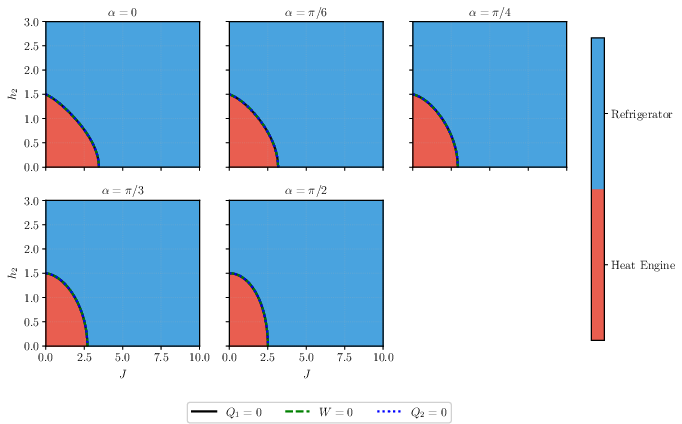
Figure 1: Operational phase diagram of the quantum Carnot cycle in the Skew model; engine and refrigerator regimes as a function of J5 and J6, for J7, J8, J9, h0.
Anisotropy (via h1) and the interaction h2 enter only indirectly by modifying the equilibrium populations and degeneracies, thereby deforming but not dramatically restructuring the phase boundaries. The Carnot efficiency remains at the universal bound h3, irrespective of the microscopic details.
The quantum Otto cycle, in contrast, is inherently sensitive to the microscopic energy landscape and the nonequilibrium population changes induced by abrupt magnetic field modulations. The work and heat expressions explicitly involve both eigenenergies and the difference in occupation probabilities. Consequently, the phase diagram becomes highly structured, with fine-tuned parameter dependence reflecting both static and dynamical quantum effects.
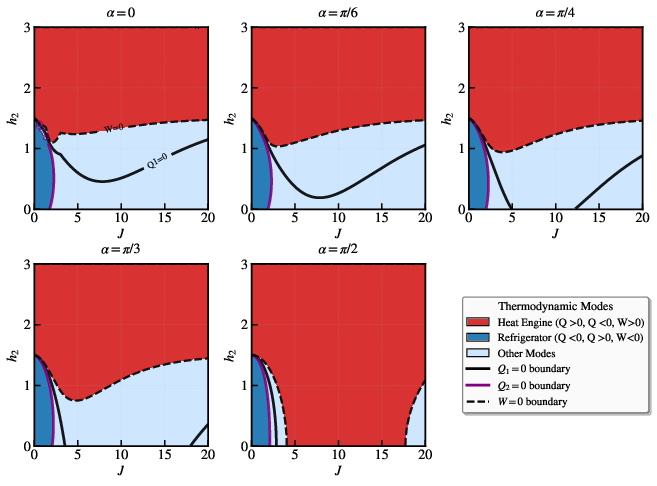
Figure 2: Otto cycle phase diagram under the Skew model, showing how engine and refrigerator regimes vary with skew angle h4 and coupling h5.
As a function of h6, the regime boundaries deform non-smoothly, with intricate shapes arising from crossing points in the energy spectrum and nonequilibrium-induced population imbalances. The system traverses engine and refrigerator regimes in a way that is strongly modulated by both interaction strength and anisotropy.
The efficiency h7 and coefficient of performance (COP) exhibit pronounced nonmonotonic dependence on h8. There exists a critical value h9 demarcating weak- and strong-coupling regimes; at α0, the efficiency attains a minimum, reflecting the crossover from interaction-perturbed to strongly split spectral branches. Weak interactions lead to significant state mixing and reduced energy selectivity, suppressing efficiency, while strong coupling reorganizes the energy spectrum, enhancing gaps and improving both work extraction and cooling.
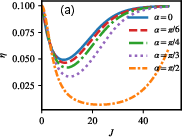
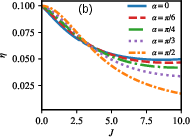
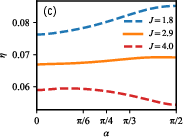
Figure 3: Efficiency α1 of the quantum Otto cycle as a function of coupling α2; minimum at α3 indicates a weak- to strong-coupling crossover.
The COP behaves complementarily—maximized when population redistribution aligns optimally with the restructured energy spectrum, revealing the duality between work and heat extraction. Notably, tuning the skew angle α4 smoothens the weak/strong coupling crossover, indicating that anisotropy introduces hybridization, thereby distributing thermal occupation more uniformly among energy levels.
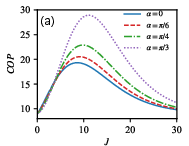
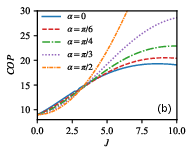
Figure 4: COP as a function of coupling α5; maxima correspond to optimal refrigeration conditions, dictated by interplay of α6 and field α7.
Theoretical and Practical Implications
These results underscore a fundamental difference between the Carnot and Otto cycles in the quantum regime when multi-level interactions and anisotropy are included. The Carnot cycle remains dictated by universal thermodynamic constraints—robust to system-specific details—but the Otto cycle's performance is directly modulated by microscopic Hamiltonian properties, with operationally meaningful crossovers and degeneracies.
The findings have clear implications for quantum device engineering:
- Thermodynamic optimization: By leveraging the competition between α8 and α9, it is possible to tune the working substance into a regime of enhanced efficiency or refrigeration COP. Anisotropy (skew angle) can be used to smoothen operational transitions and control hybridization.
- Design principles: Multi-level, interacting quantum systems permit nontrivial thermodynamic behavior—including phase-like crossovers and optimal working points—absent in simple two-level or uncoupled models.
- Experimental relevance: Spin–spin coupled platforms, especially in trapped ions or solid-state spin clusters exposed to controllable transverse fields, represent feasible candidates for realizing these effects. Fine-tuning J0 and J1 allows for experimental control over efficiency landscapes and regime boundaries.
Future research directions include:
- Incorporating open quantum system effects such as dissipation and decoherence, to assess the robustness of crossovers and phase boundaries under realistic conditions.
- Extending to larger interacting clusters and nonintegrable models to probe collective effects, quantum criticality, and many-body localization on quantum thermodynamic cycles.
- Exploring optimal coupling protocols and finite-time control for practical implementations of quantum engines and refrigerators.
Conclusion
This work presents a systematic study of the thermodynamic properties of quantum Carnot and Otto cycles using a two-spin Skew Ising model, broadening the understanding of interaction- and anisotropy-driven phenomena in quantum thermodynamic machines (2606.09911). The Carnot cycle exhibits entropy-based universal boundaries, while the Otto cycle features a complex interplay between energy spectrum and population dynamics, leading to strong parameter dependence and operational crossover phenomena. The findings highlight that optimal operation of quantum thermal machines is not simply achieved by minimizing interactions; instead, deliberate tuning of competing energy scales and anisotropy can be exploited to maximize efficiency or cooling performance. These insights establish a roadmap for both theoretical investigations and experimental realizations of advanced quantum thermodynamic devices.

