- The paper introduces a robust AWPI controller for compensating excess path length in millimeter-wave adaptive optics.
- It employs SVD-based decoupling to transform the MIMO control problem into tractable SISO loop-shaping challenges.
- Simulation results demonstrate effective disturbance suppression and rapid recovery from actuator saturation.
Control-Theoretic Foundations for Millimeter-Wave Adaptive Optics
This essay rigorously summarizes the methodology, analysis, and results of “Control problem in millimeter-wave adaptive optics” (2606.09515), which addresses the synthesis and implementation of robust control architectures for Excess Path Length (EPL) compensation in large submillimeter telescopes. The framework is motivated by practical demands for real-time metrology and wavefront correction in next-generation telescopes such as AtLAST and LST, where environmental disturbances—primarily low-frequency, large-scale deformations—set fundamental limits on imaging fidelity.
System Model and Wavefront Sensing
The paper begins with a formal control-theoretic abstraction of the millimeter-wave adaptive optics (MAO) system. The plant consists of an optical drive system actuating telescope optics with position commands, modeled as a vector first-order system. The sensing layer utilizes a wavefront sensor that measures spatially-sub-sampled EPL fluctuations between a set of radiators on the primary (M1) and the focal plane, implemented via micro/mm-wave interferometry.
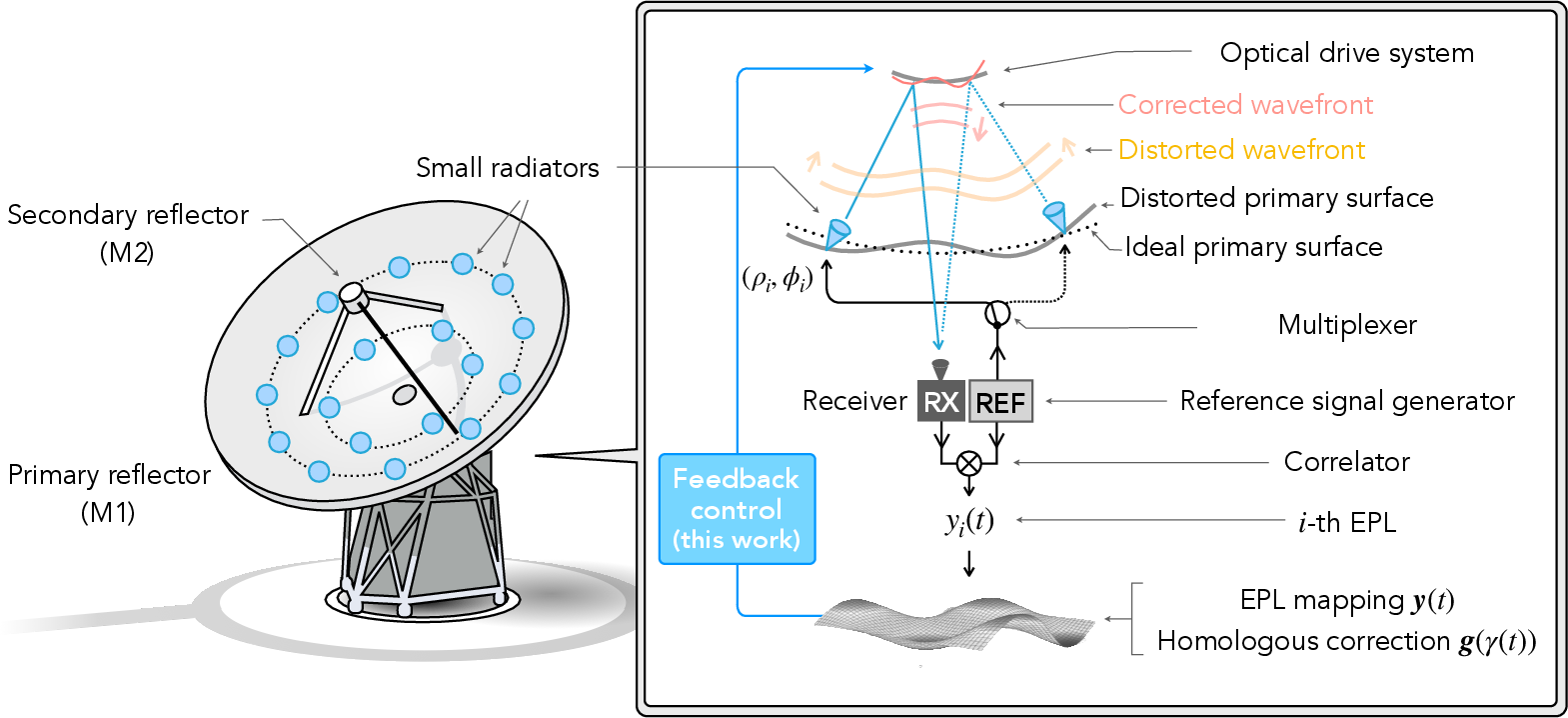
Figure 1: Schematic of the wavefront sensor and control system for mm-wave adaptive optics, including EPL measurement principle and drive system actuation.
The measurement process is notionally linearized by a measurement (or influence) matrix M, which encapsulates actuator-to-sensor coupling. This establishes a multi-input, multi-output (MIMO) control setting, with vector-valued drive inputs and EPL sensor outputs.
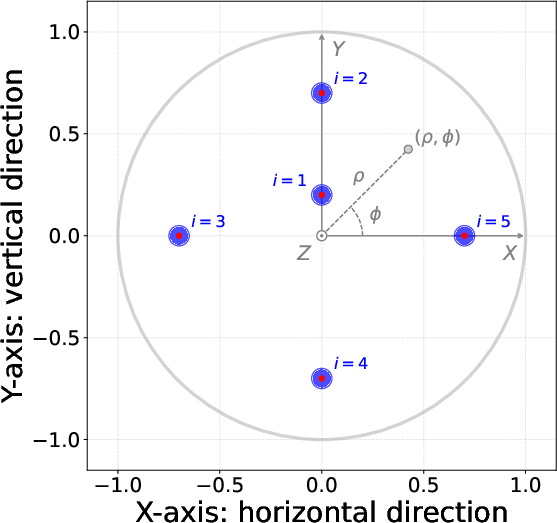
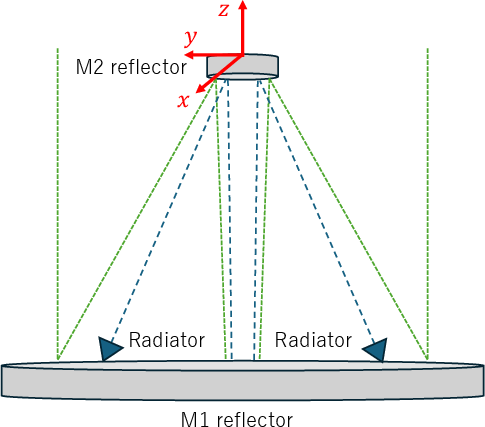
Figure 2: Radiator positions on a circular M1, showing the spatial configuration for discrete EPL sampling.
The central control objective is cast as an asymptotic disturbance suppression problem. EPL fluctuations arise from both known homologous deformations and unknown external disturbances (thermal, wind, etc.). Residual error after subtracting modeled contributions is decomposed via SVD into “suppressible” and “insuppressible” components, the former being those in the span (image) of M. Suppressibility is entirely governed by the geometric structure of M. Given this, the goal is to design a stabilizing controller that ensures the residual in the suppressible directions decays to zero for any constant (static) disturbance.

Figure 3: Plant model block diagram, showing mapping from vector drive inputs to EPL outputs including disturbances and response delays.
Controller and Loop-Shaping Design
To address actuator saturation and steady-state error due to persistent disturbances, an anti-windup proportional-integral (AWPI) control law is constructed. The control synthesis proceeds by reduction to decoupled SISO loop-shaping problems along the principal axes of M, facilitated by an explicit SVD-based decoupling stage. The AWPI law includes a local anti-windup feedback path to mitigate integrator windup on saturation events, thereby ensuring rapid recovery and continuity.
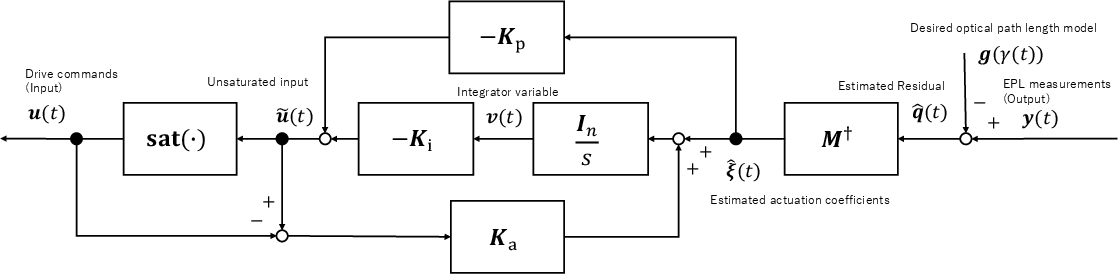
Figure 4: Block diagram for the AWPI controller, with explicit saturation nonlinearity, PI structure, and anti-windup loop.
Loop-shaping rules are derived analytically to guarantee both phase and gain margins, with cross-over frequencies and bandwidths systematically bounded in relation to system sampling and mechanical time-constants. The design admits digital (discrete-time) realization via forward/backward difference schemes.
Bode analysis of both the open-loop transfer function and sensitivity function underpins parameter selection, providing explicit conditions under which asymptotic disturbance suppression and robustness to delay are achieved.
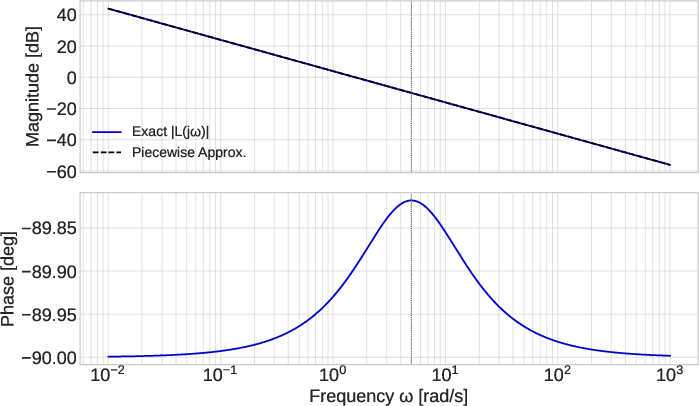
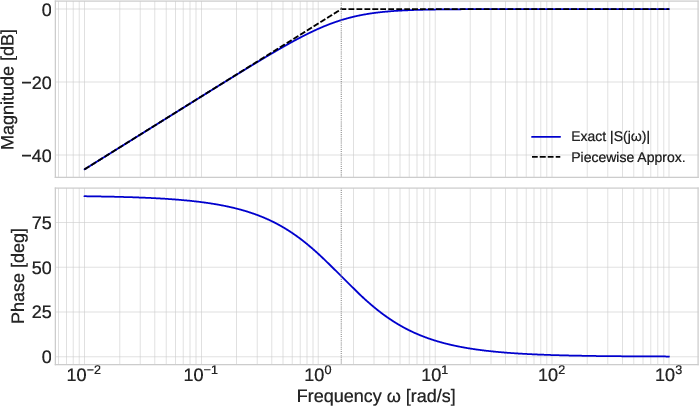
Figure 5: Bode diagram of open-loop transfer, illustrating crossover localization and margin analysis via piecewise linear approximation.
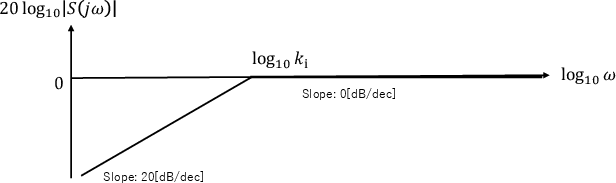
Figure 6: Sensitivity function Bode plot, confirming low-frequency suppression bandwidth induced by the integral action.
Directionality and Geometric Constraints
A critical theoretical insight is that disturbance rejection is fundamentally directional; the system cannot suppress disturbances orthogonal to Image(M). To quantify this, the cosine similarity index is introduced as a metric for evaluating the suppressibility of any particular spatial mode (e.g., Zernike mode) by projecting it onto Image(M).
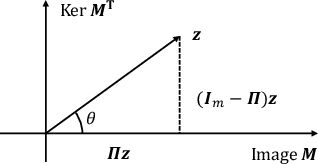
Figure 7: Visualization of cosine similarity index, geometrically interpreting modal suppressibility as projection onto the actuator image subspace.
This geometric reasoning leads to an operational algorithm for optimizing radiator placements and evaluating controller effectiveness on physically meaningful aberration modes.
Engineering Extensions: Manual Focus and Artificial Disturbance Tests
Practical operation is enhanced by an explicit focus adjustment scheme, which incorporates manual offsets without disrupting integral feedback. The controller formulation is also amenable to artificial disturbance injection for systematic control tests—critical for commissioning and ongoing validation in a telescope environment.
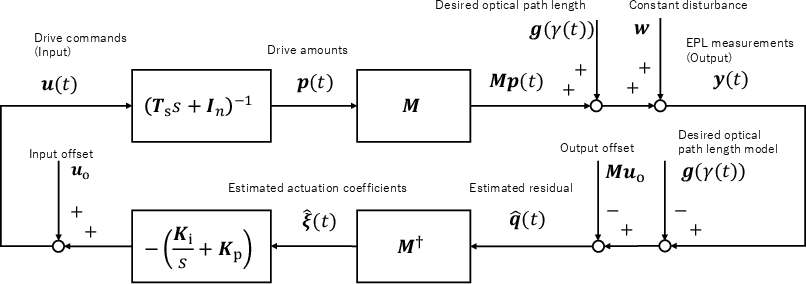
Figure 8: Manual focus adjustment loop, showing the mechanism for observer-inserted offsets that bypass the integral control layer.
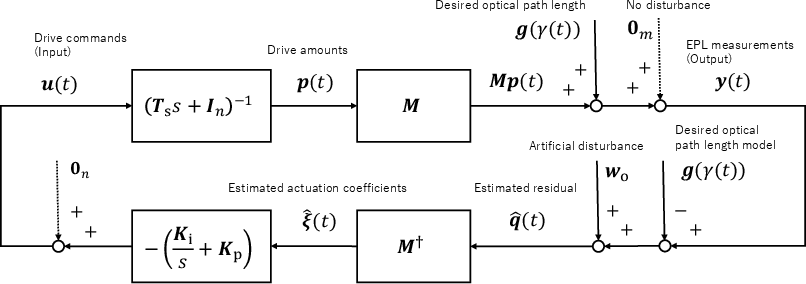
Figure 9: Block diagram for artificial disturbance injection used in transient performance evaluation.
Numerical Validation: Asymptotic and Spectral Disturbance Suppression
The paper implements the full architecture in simulation for a 3-axis M2 drive with a five-radiator EPL sensor. The plant and controller parameters are selected according to the established analytical bounds. Simulated results demonstrate:
- Asymptotic suppression of constant disturbances within the controllable subspace.
- Stability and rapid recovery of the integral state due to anti-windup feedback during and after saturation events.
- Direction dependence of suppression: only disturbances with large projections onto Image(M) are attenuated.
- Frequency-dependent suppression of colored (von Karman) wind disturbances, with the controller bandwidth tightly matching the theoretically computed sensitivity function.
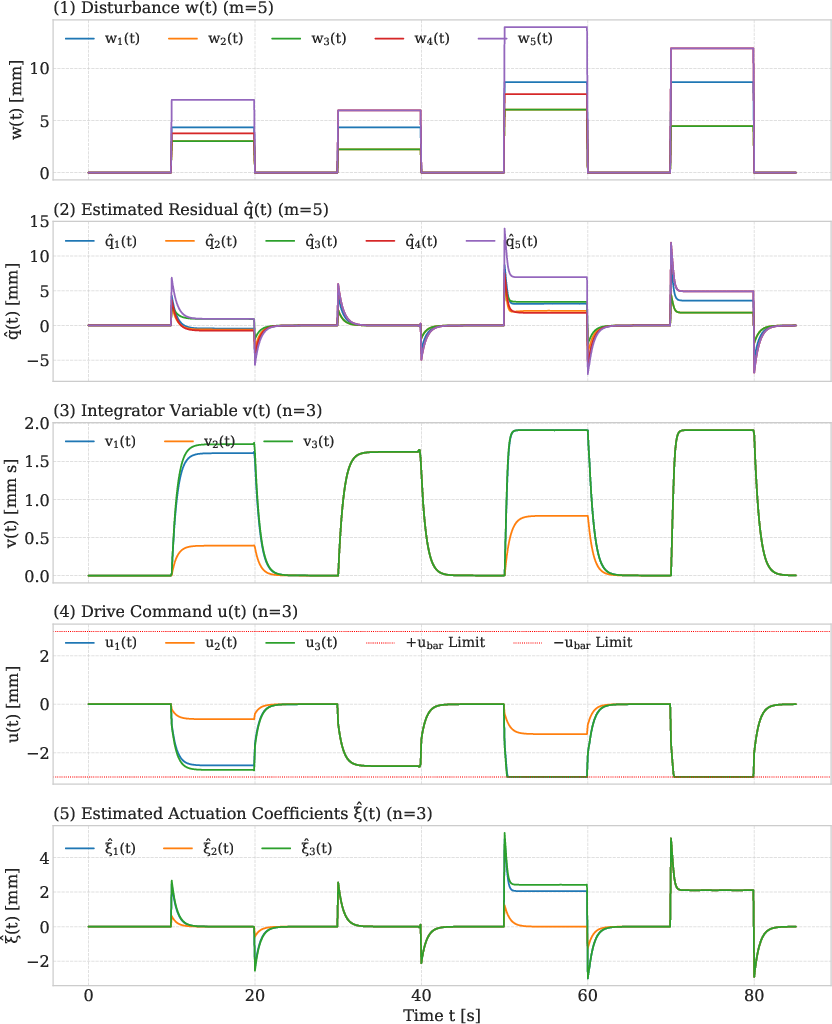
Figure 10: Simulation time series demonstrating disturbance suppression, input saturation, and anti-windup effect for various disturbance directions and amplitudes.
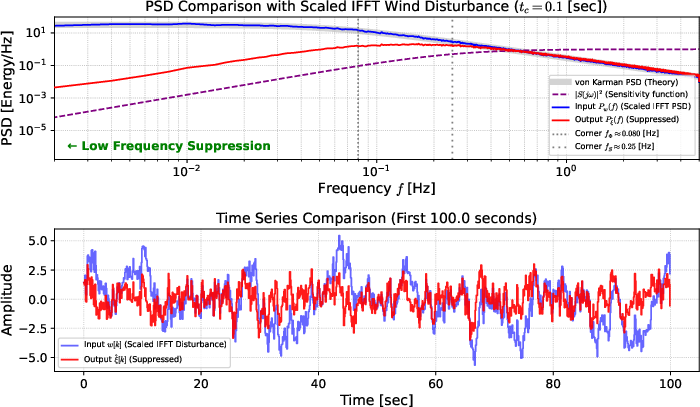
Figure 11: PSD analysis of wind disturbance suppression: theoretical and empirical spectra confirm broadband attenuation up to sensitivity crossover frequency.
Theoretical and Practical Implications
The theoretical results decisively characterize the fundamental limitations of discrete, actuator-limited EPL control: the controllable subspace is strictly defined by the properties of M. The cosine similarity index is a critical metric for both system design (e.g., sensor/actuator layout) and runtime evaluation (mode suppressibility), with direct implications for high-fidelity imaging.
Practically, the AWPI architecture, supported by simulation-derived parameterization, promises robust and operationally safe adaptation to dynamic environmental disturbances, ensuring both the safety of large opto-mechanical systems and the optimization of on-sky performance.
Future Directions
The demonstrated control formalism is extensible to denser sensor arrays and more complex, coupled drive systems. Future theoretical work will address non-stationary and multi-modal disturbances, extension to higher-order actuator/sensor dynamics, and closed-loop adaptation under evolving astronomical and environmental conditions. Additionally, deploying the formalism in fielded telescopes with real-time performance monitoring and adaptive sensor allocation strategies represents a consequential step.
Conclusion
This paper rigorously connects abstract MIMO control theory with the specific requirements of millimeter-wave adaptive optics in large telescopes. Through explicit model analysis, AWPI controller design, directionality metrics, and detailed simulation, it provides a practically implementable and theoretically grounded path to robust EPL correction under complex disturbance environments. The methodology, with its focus on geometric control constraints and operational reliability, is broadly applicable to advanced metrology-enabled astronomical instrumentation.