- The paper presents HyperGraph U-Net, which integrates parallel hierarchical pooling and a novel higher-order convolution to enhance hypergraph neural networks.
- It uses PHPool/PHUnpool operators based on modularity-driven hierarchical clustering, effectively preserving both local and global structural features.
- Empirical evaluations demonstrate improved performance in reconstruction, classification, and anomaly detection across diverse benchmarks and real-world datasets.
HyperGraph U-Net: A Parallel Hierarchical Approach for Hypergraph Representation Learning
Introduction and Motivation
This paper introduces the HyperGraph U-Net (HGUN), a novel framework for hypergraph neural networks (HyperGNNs) that generalizes the celebrated U-Net architecture to non-Euclidean, higher-order domains. The authors address a fundamental challenge in hypergraph representation learning: existing HyperGNNs based on flat convolution and message passing provide limited receptive field and frequently lose critical mesoscale structural information when adapted to hypergraph-level or long-range node-level tasks. The absence of principled pooling and unpooling operators for hypergraphs has until now prevented the development of U-Net-style architectures in this domain.
To resolve this, the work proposes Parallel Hierarchical Pooling (PHPool) and PHUnpool operators derived from hierarchical clustering on hypergraphs, alongside a novel higher-order convolution, HGXConv, that captures cross-node interactions within hyperedges via multiplicative mixing. The HGUN framework demonstrates clear advances in hypergraph compression-reconstruction, hypergraph classification, and node-level anomaly detection benchmarks, exhibiting performance benefits and theoretical guarantees regarding structural fidelity, expressiveness, and equivariance.
Architecture and Methodological Innovations
HyperGraph U-Net Framework
The architecture consists of an encoder-decoder topology reminiscent of classical U-Nets, adapted for hypergraphs. Each encoder stage combines an HGXConv layer with PHPool, progressively coarsening the input hypergraph (Figure 1). The decoder mirrors this structure, using PHUnpool to upsample the embedding and reconstruct node-level features or hypergraph topology as needed. Skip connections are employed to combine multiresolution information across layers, ensuring granular features are accessible at each decoder stage.
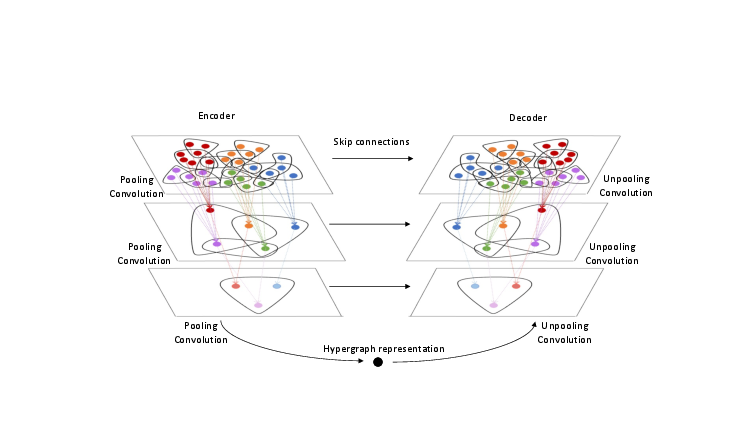
Figure 1: The proposed HyperGraph U-Net architecture combines hierarchical pooling/unpooling with cross-convolution for robust hierarchical feature learning in hypergraphs.
Parallel Hierarchical Pooling (PHPool) and PHUnpool
A central contribution is the design of PHPool/PHUnpool, based on a modularity-optimized hierarchical clustering dendrogram (Figure 2). Cluster assignments at all levels are determined in a single pass using a greedy algorithm that maximizes hypergraph modularity, enabling parallel specification of layer-wise pooling operators. This global, simultaneous approach (as opposed to sequential, layer-wise pooling) is shown theoretically to retain greater mutual information and empirically to reduce topological distortion, especially as network depth increases (Figure 3).
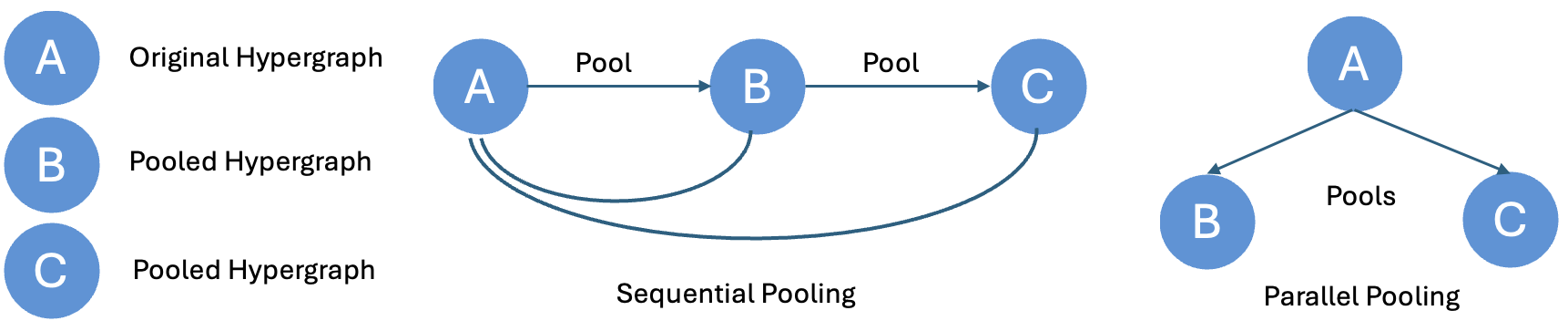
Figure 3: Parallel pooling preserves more information compared to standard sequential pooling, as formalized by mutual information arguments.
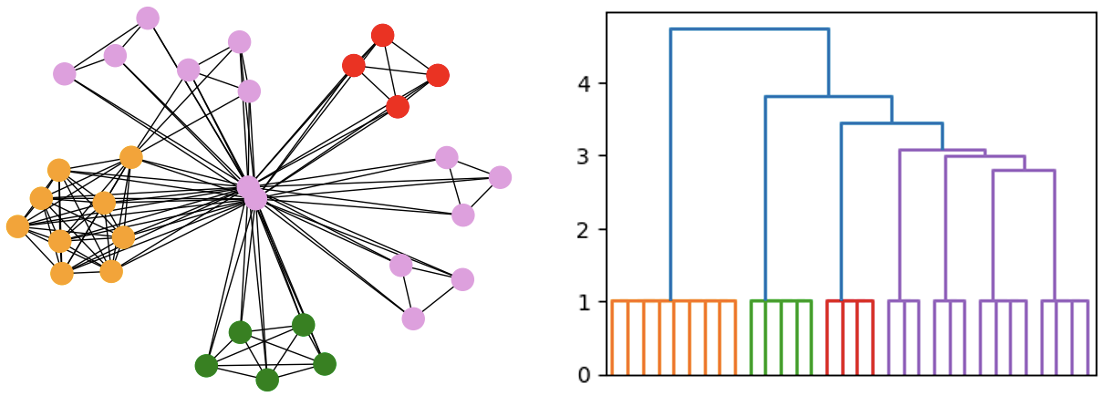
Figure 2: Example of an ego-network and its hierarchical clustering dendrogram; cluster labels at resolution 3 highlight the global modular structure captured by PHPool.
The PHPool approach is general and can be combined with any HyperGNN backbone. Hyperedges in the pooled hypergraph are reconstructed using maximal clique finding on the coarsened adjacency, ensuring that higher-order relationships among aggregated clusters are faithfully preserved.
HyperGraph Cross Convolution (HGXConv)
To capitalize on the higher-order nature of hypergraphs, the HGXConv operator generalizes message passing by employing an element-wise geometric mean (in log-domain: sum-then-exp) across node features within each hyperedge. This multiplicative aggregation, in contrast to traditional summation or averaging, enables explicit modeling of joint node effects and collective interaction patterns, expanding the expressive power of the network. The two-stage HGXConv propagates node features to hyperedges, then back to nodes, followed by feature fusion (concatenation) for each node.
This mechanism proves robust for both reconstruction and classification: compared to prior two-stage methods, HGXConv captures mixed-order functional groups (e.g., molecular rings, social communities) more naturally, as also supported by downstream experimental results.
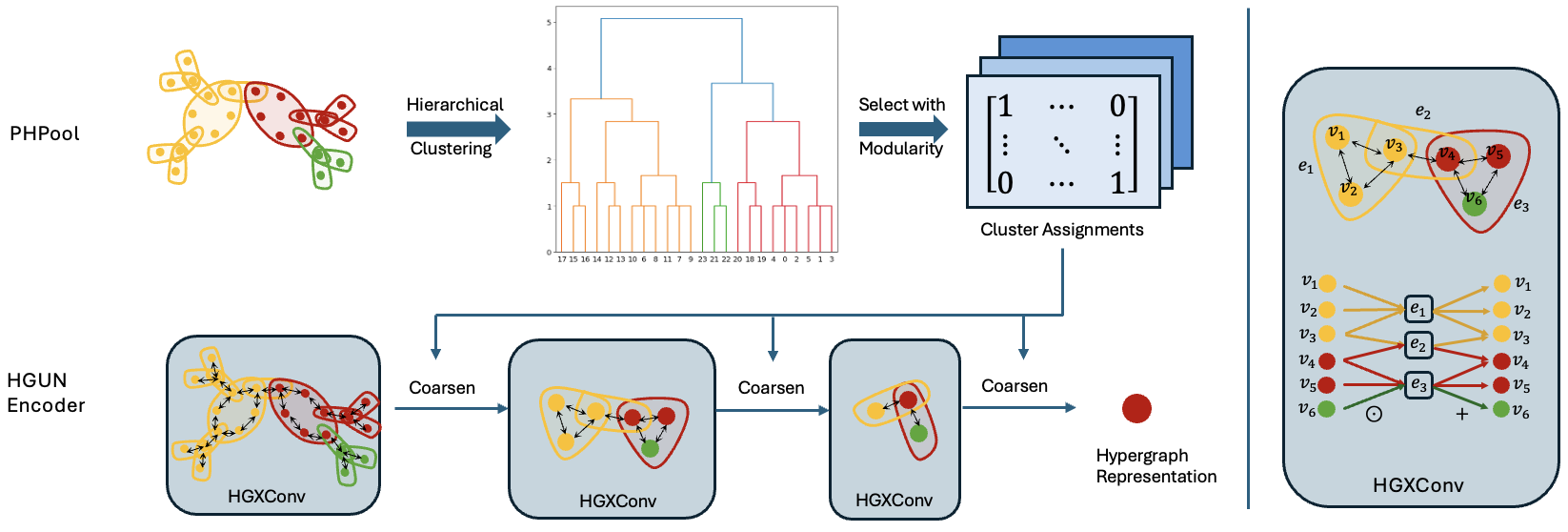
Figure 4: Overall architecture showing PHPool combined with HGXConv for encoder block construction. Hierarchical assignments are injected to drive coarsening at each layer.
Theoretical Properties
Complexity: PHPool executes in O(N2+T(K+N+δv2C)+LNlogN) time, where N is the number of nodes, K hyperedges, T hierarchy thresholds, and C≪N average cluster number. Dendrogram construction is a one-time preprocessing step, and proposals for further minimizing this cost via approximation/distributed clustering are discussed.
Permutation Equivariance: The authors formally prove that the end-to-end architecture (including pooling, unpooling, and convolution layers) is permutation equivariant with respect to node reordering—a critical requirement for meaningful hypergraph representation learning.
Expressiveness: Under mild conditions on pre-pooling message passing and cluster assignments, the PHPool operator is shown to maintain the expressive power of preceding layers, ensuring that non-isomorphic hypergraphs remain distinguishable post-pooling.
Information Loss: A formal proposition establishes that, when first-level coarse cluster assignments are matched, parallel pooling incurs less information loss (in the sense of mutual information) than typical sequential pooling.
Experimental Evaluation
Hypergraph Reconstruction
The authors design synthetic tasks on canonical network topologies (ring, grid, pyramid, community) to test the ability of various pooling operators to compress and later reconstruct node-level signals. PHPool+HGNN consistently yields lower MSE and visually more faithful reconstructions compared to node-dropping (TopKPool) or sequential cluster-based (MinCut) methods. TopKPool results in severe local structure loss, especially in community graphs, while MinCut preserves global shapes but distorts boundary details. PHPool most effectively retains both local and global network geometry.
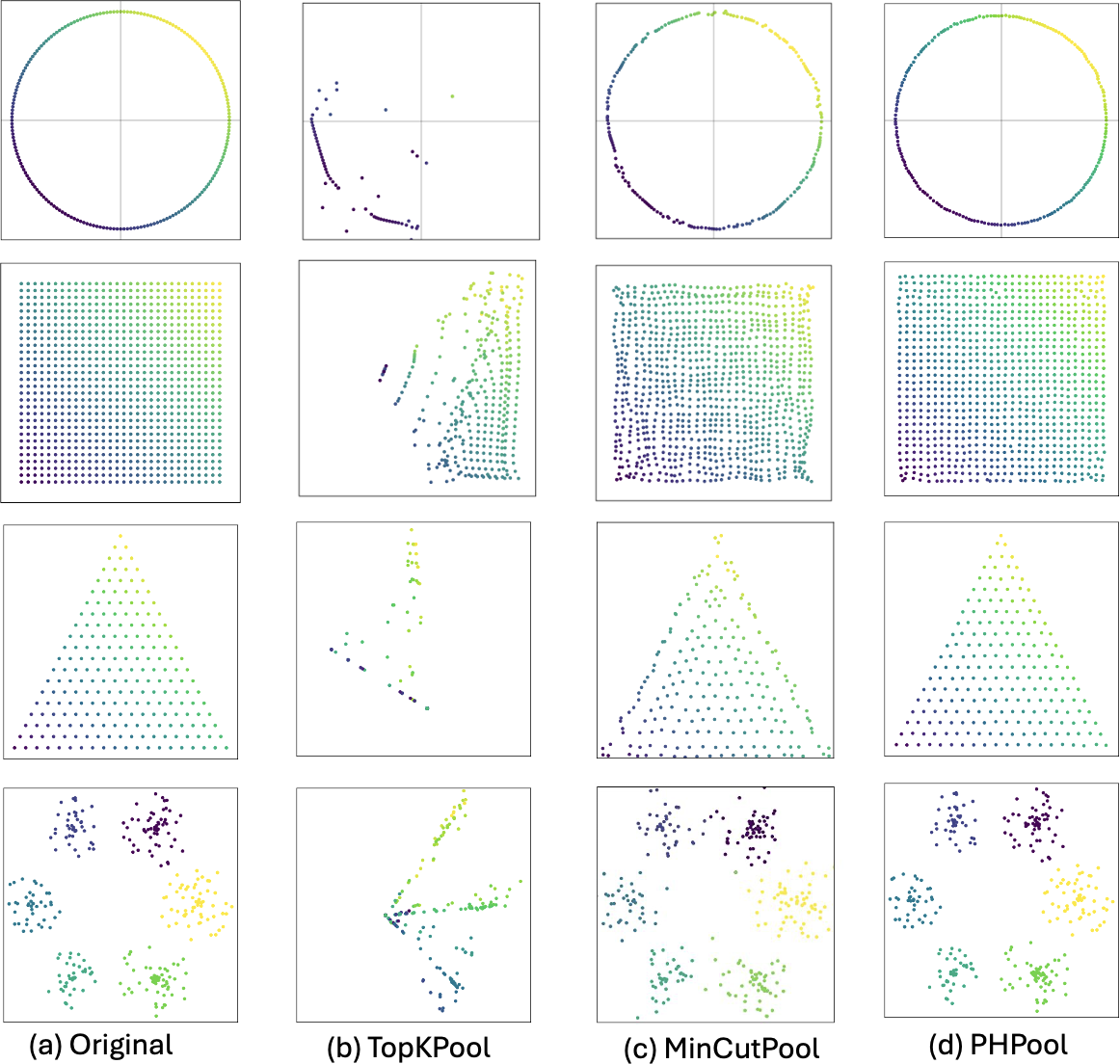
Figure 5: Signal reconstructions on ring, grid, pyramid, and community hypergraphs showing superior structural preservation of the PHPool autoencoder.
Hypergraph Classification
On social and bioinformatics benchmarks (IMDB-BINARY/MULTI, COLLAB, MUTAG, PROTEINS, D&D, NCI1), HGUN (PHPool+HGXConv) achieves top or near-top accuracy across all datasets, frequently outperforming existing GNN/HyperGNN backbones as well as state-of-the-art graph U-Net baselines. Notably, the PHPool operator universally boosts backbone performance regardless of the convolution used. The encodings are shown to be robust to architectural depth, outperforming node-drop pooling at larger depths where information loss from node exclusion becomes critical.
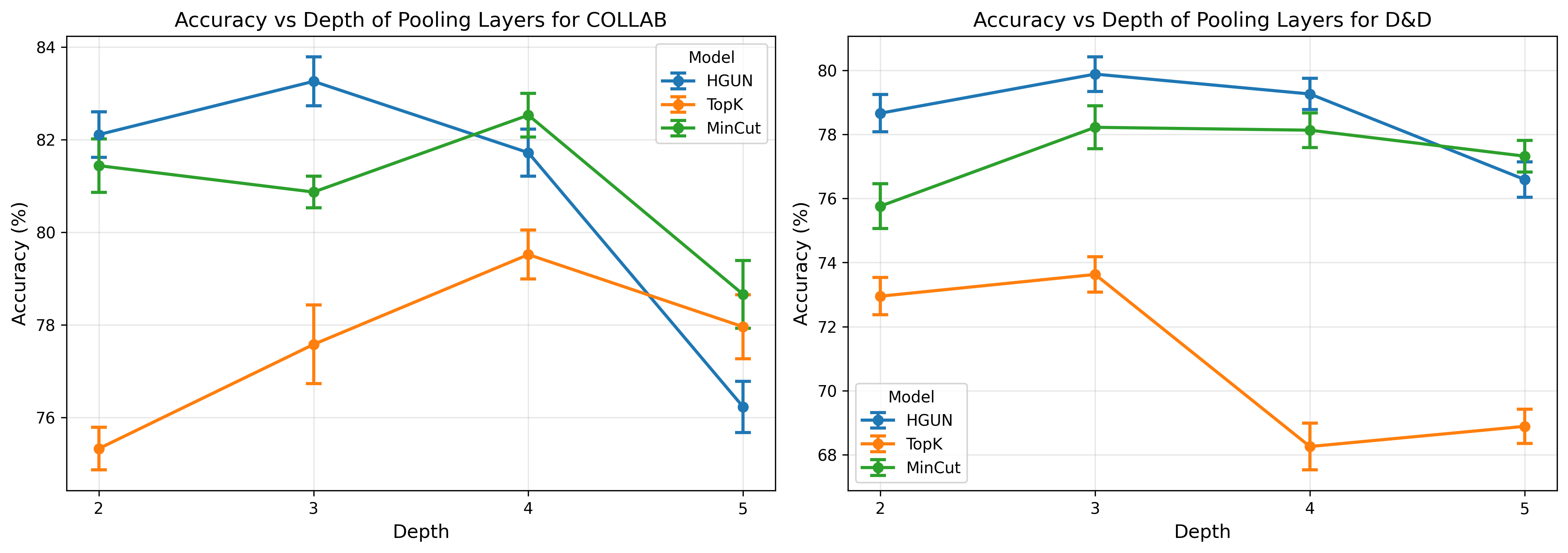
Figure 6: Effect of network depth on classification accuracy for various pooling methods—PHPool demonstrates greater stability and optimal performance at moderate depths.
Anomaly Detection
On large-scale real-world datasets (Yelp, Amazon), the HGUN model sets new state-of-the-art marks in F1-macro, precision, and GMean, outperforming prior GNNs, node-drop/cluster pooling graph U-Nets, and other HyperGNN variants. Even though recall can occasionally lag specialized anomaly detection GNNs, the overall results underline the benefit of hierarchical, higher-order poolings in learning discriminative node representations for rare-event detection.
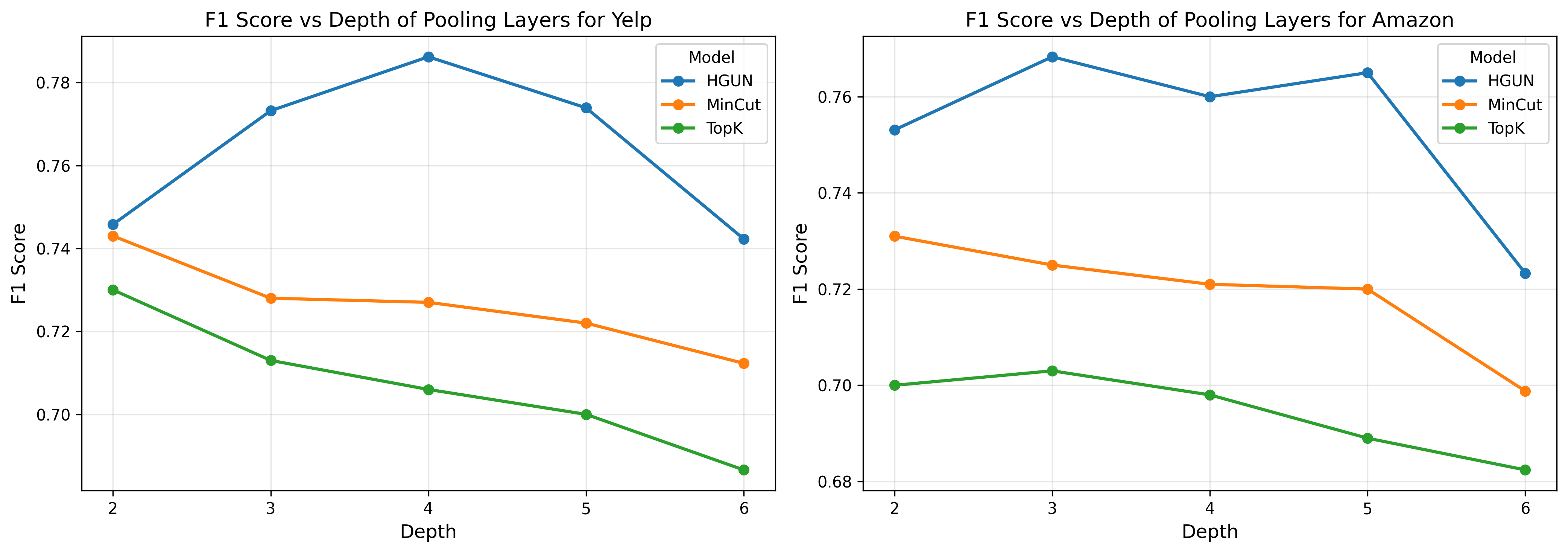
Figure 7: F1 scores with respect to network depth show consistent outperformance of HGUN over graph-based node-level anomaly detectors across both Yelp and Amazon datasets.
Computational Efficiency: The hierarchical coarsening in intermediate layers also yields per-epoch runtime improvements (e.g., 13–19% faster on large datasets over no-pooling baselines).
Implications and Future Directions
This work establishes hierarchical U-Net architectures as highly effective for hypergraph-based representation learning, addressing both theoretical and empirical gaps in the current state of HyperGNN research. The proposed parallel, modularity-driven pooling/unpooling design improves information retention and enables deeper, more robust architectures, paving the way for application in domains with rich, multi-relational higher-order structure (bioinformatics, network science, social systems, recommendation).
Future work could explore:
- End-to-end trainable soft clustering assignments that adapt to node features and downstream tasks
- Scalable dendrogram construction for large hypergraphs (e.g., via approximation or distributed clustering)
- Alternative quality functions to modularity for pooling in hypergraphs with overlapping communities or heterogeneous structures
Conclusion
HyperGraph U-Net advances the design of hypergraph neural networks by introducing a parallel hierarchical pooling methodology and higher-order multiplicative convolution, yielding improved accuracy, robustness to depth, and reduced information loss in both node-level and graph-level tasks. Its demonstrated empirical gains and theoretical guarantees highlight its utility for hierarchical and multi-scale hypergraph analysis, while the general design readily supports integration with future backbone improvements and task-adaptive clustering schemes.
Reference: "Beyond Convolution: Advancing Hypergraph Neural Networks with Hypergraph U-Nets" (2606.09051)