- The paper introduces estimate collapsibility and strong d-convex hulls as a new framework for localized causal effect estimation in CPDAGs.
- The methodology reduces variable dimensions by up to 96% while maintaining estimator fidelity through efficient, polynomial-time algorithms.
- Empirical evaluations on synthetic and real-world networks demonstrate significant speedups and exact inference equivalence compared to standard methods.
Estimate Collapsibility of Causal Effects in CPDAGs via Strong d-Convex Hulls
Introduction and Motivation
Estimation of causal effects in high-dimensional graphical models, specifically completed partially directed acyclic graphs (CPDAGs), remains a central challenge in causal inference. Observational data typically enables identification of the Markov equivalence class of DAGs, represented as a CPDAG, rather than the true underlying DAG. Direct enumeration of all consistent DAGs and valid adjustment sets for effect estimation (e.g., via IDA algorithms) is computationally intractable at scale. The present work advances a novel notion of estimate collapsibility, characterizing minimal variable sets that support accurate and consistent estimation post-marginalization, thus permitting local rather than global inference while maintaining estimator exactness. This is achieved by introducing and operationalizing strong d-convex hulls to identify minimal collapsible sets, with efficient algorithms that generalize to CPDAGs.
Preliminaries: Causal Graphs and Collapsibility
The paper builds upon the formalism of Causal Bayesian Networks (CBNs), where causal relationships are encoded in DAG structures and associated conditional distributions. Causal effects are defined via interventional distributions, such as P(Y∣do(X=x)), typically estimated through standard graphical adjustment criteria (e.g., back-door). However, when only a CPDAG is available through structure learning, enumeration over its Markov equivalence class is necessary.
The study rigorously delineates multiple forms of collapsibility—conditional independence collapsibility (CI-collapsibility), model collapsibility, and estimate collapsibility—with the latter focusing on invariance of MLE-based marginal inference after variable marginalization. It is shown that estimate collapsibility is a strictly stronger property than model collapsibility, especially pertinent for MLEs over interventional distributions.
Strong d-Convex Hulls: Definitions and Theoretical Properties
To algorithmically identify minimal collapsible sets, the authors introduce strong d-convex hulls as a graph-theoretic construct. A subset R in DAG G is defined as strongly d-convex if it lacks inducing paths (as generalized from undirected graphs) and satisfies a stringent linear ordering among parents of certain nodes. This property is shown to be both necessary and sufficient for estimate collapsibility: inference on the strong d-convex hull is statistically equivalent to inference on the full network for the target set R.
The strong d-convex hull is proven to be unique and minimal, ensuring the dimension-reducing property is both well-defined and computationally tractable. Crucially, characterizations are extended beyond DAGs to any member of a CPDAG's equivalence class.
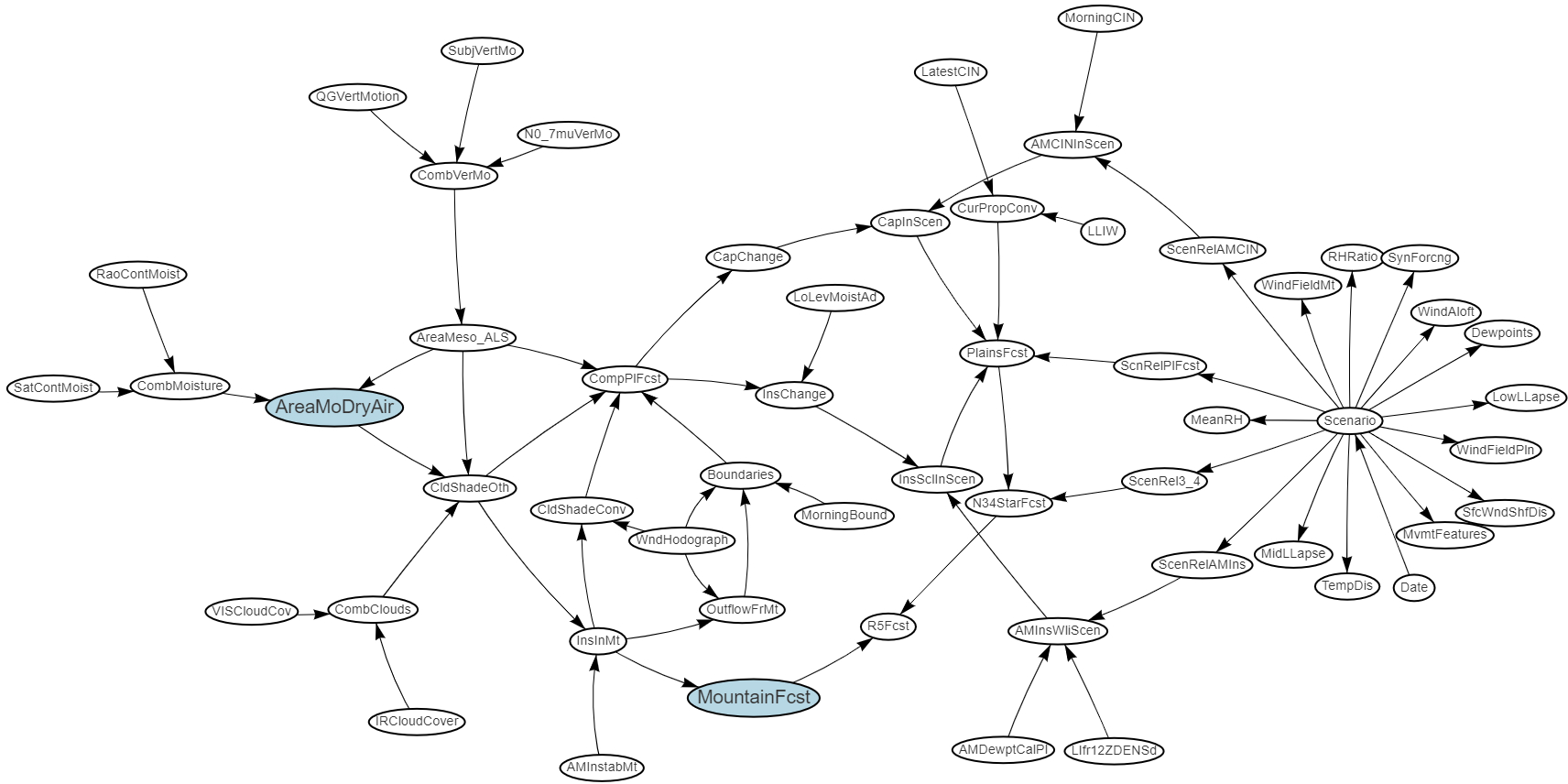
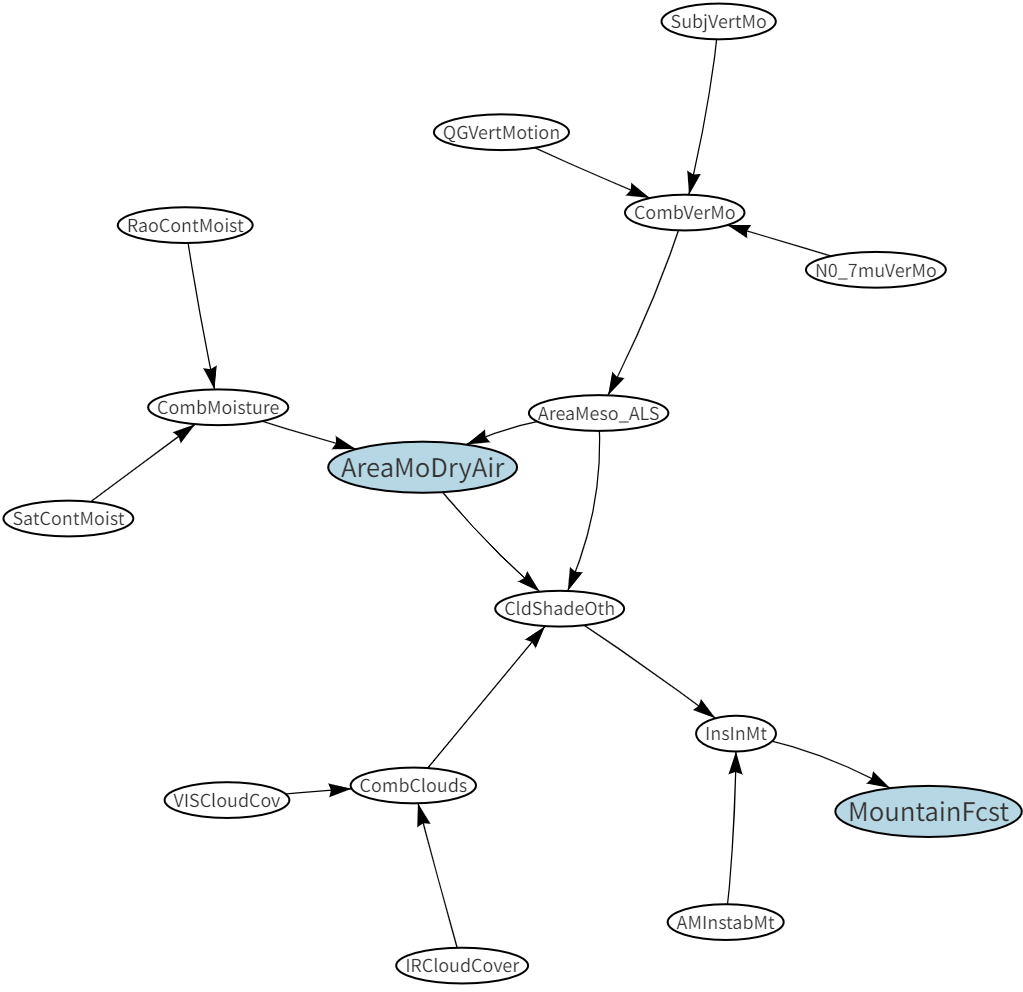
Figure 2: (a) The full Hailfinder network (56 variables) and (b) a minimal collapsible subgraph (16 variables) containing the variables of interest.
Algorithms for Strong d-Convex Hull Identification
The work presents several polynomial-time algorithms for identifying d-convex and strong d-convex hulls in both DAGs and CPDAGs. The key idea is to iteratively absorb nodes lying on shortest inducing paths between non-adjacent target nodes, and to enforce the linear ordering condition to guarantee strong d-convexity. The time complexity scales as O(k2∣V∣4), where k is the target size and ∣V∣ is the total variable count, remaining manageable for practical applications.
The algorithms are illustrated on canonical networks, demonstrating substantial reduction in variable dimension (e.g., from 56 to 16 nodes for a typical weather forecasting BN).
Collapsibility in Causal Effect Estimation: Theory and Extension to CPDAGs
A primary theoretical contribution is demonstrating that estimate collapsibility, defined via strong d-convex hulls, robustly commutes with back-door adjustment for interventional effect estimation in both DAGs and CPDAGs. For any pair (X,Y) and any valid adjustment set within the strong d-convex hull, the estimated causal effect matches the estimation obtained from the full graph.
This result is extended to CPDAGs: collapsibility properties are shown to be invariant across all DAGs in the equivalence class, enabling safe reduction of the variable set prior to running IDA-like algorithms. This yields a reduced space of both variables and DAGs to enumerate, dramatically mitigating computational bottlenecks.
Empirical Evaluation: Probabilistic Reasoning and Causal Estimation
Four comprehensive experimental regimes are conducted:
- Model dimension reduction: The collapsibility-based strategy consistently prunes up to 75–96% of variables from standard benchmarks, e.g., collapsing 56-variable models to 16-variable subgraphs without loss for the query of interest.
- Exact probabilistic reasoning: After collapsing, KL-divergence between local and global inference is negligible (<10−17), with substantial speedups and node reduction ratios.
- Causal effect estimation: On synthetic random graphs (sizes up to 100 nodes, multiple edge densities), the proposed Subgraph IDA (SIDA) achieves perfect recall and precision (≈1.0) relative to standard IDA, with speedups that increase with network size (up to R0 for R1).
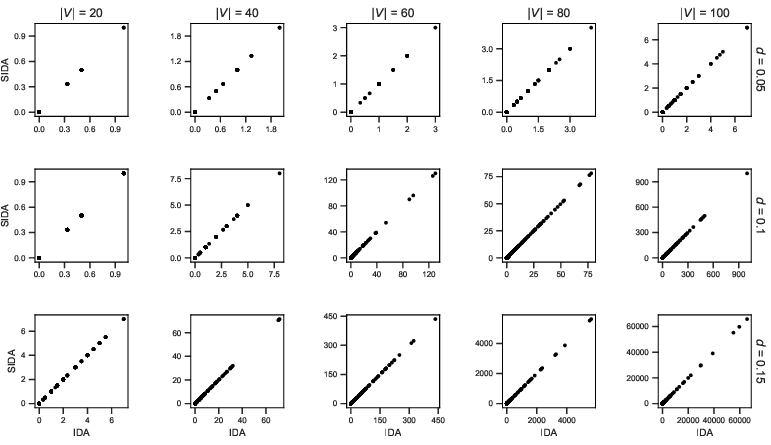
Figure 4: Causal effect estimation agreement between SIDA and IDA across varying graph orders and densities.
- Scalability on real-world Bayesian networks: On established benchmarks (e.g., Sachs, Alarm, Munin1), SIDA matches IDA precisely on all non-zero effects detected, with speedup factors rising to over R2 on the largest models. Small loss in recall is restricted to negligible/zero effects, confirming soundness.
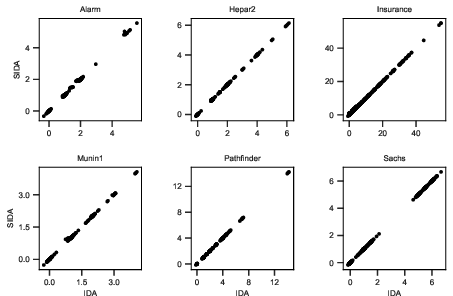
Figure 6: Causal effect estimation consistency and efficiency of SIDA versus IDA on various real-world BN structures.
Practical and Theoretical Implications
The collapsibility-based methodology enables localized inference for both probabilistic and causal queries in high-dimensional graphical models, yielding orders-of-magnitude decrease in computational time and memory requirements without sacrificing estimator fidelity. This is especially impactful for large-scale causal discovery and estimation workflows, such as biomedical, genomics, or interdisciplinary systems applications where DAG/CPDAG models exhibit high variable counts and underlying sparsity.
Theoretically, the results clarify the distinction between model and estimator-level collapsibility, offering a precise graphical criterion (strong d-convexity) that is checkable and operationalizable algorithmically, and which robustly extends to the equivalence-class uncertainty inherent in CPDAGs.
Conclusion
This work rigorously formalizes estimate collapsibility in CPDAGs via strong d-convex hulls and presents practical, efficient algorithms for identifying minimal collapsible sets. These tools enable local, dimension-reducing inference and exact causal effect estimation in graphical models, offering substantial gains in scalability and computational efficiency. Future work may extend these concepts to address adjustment in the presence of latent variables, explore applicability to settings with non-indirect effects (i.e., when R3 and R4 are adjacent), and to more general types of adjustment sets and causal queries.

