- The paper introduces PAI, a dual-branch augmentation that remedies amplitude insensitivity by integrating Euclidean distance and raw amplitude scores.
- It replaces cosine scoring with Euclidean metrics and leverages calibrated magG and T2 scores to capture spikes and level shifts in time-series data.
- Empirical results show significant performance gains, with up to a 15% improvement in VUS-PR and robust transferability across diverse TSAD benchmarks.
Motivation and Problem Statement
Current state-of-the-art approaches for univariate Time-Series Anomaly Detection (TSAD) are dominated by representation-based models, which leverage learned embeddings of patches or subseries for downstream anomaly ranking. Despite their success in modeling contextual and pattern-based outliers, these models are shown to be amplitude-agnostic in their final scoring mechanism: important amplitude cues such as spikes, level shifts, and intensity changes are frequently normalized away or not utilized by typical scoring functions. This limitation creates a systematic failure mode, particularly for amplitude-dependent anomalies, which are common in real-world TSAD applications such as network monitoring, finance, and industrial systems.
PAI: Architectural Overview and Methodology
To address the amplitude-information bottleneck, the paper introduces PAI, a lightweight, model-agnostic augmentation to the scoring layer of representation-based detectors.
The PAI workflow operates as a dual-branch extension to standard representation-based TSAD models. In the first branch, it replaces the commonly used cosine distance in the representation-bank scoring with a Euclidean distance, thereby capturing both angular and radial components of the learned embedding and partially restoring amplitude sensitivity.
In parallel, PAI computes two train-calibrated raw-amplitude scores:
- Pointwise Median/MAD Deviation (magG): Sensitive to transient spikes and outliers.
- Local Mean-Shift Score (T2): Detects window-scale level shifts.
These scores are independently normalized and then fused through a calibrated weighted sum with the representation-bank score to produce the final anomaly score.
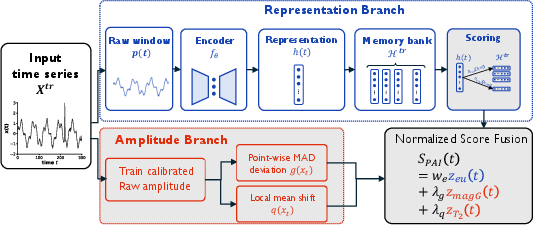
Figure 1: PAI augments existing representation-based TSAD methods by incorporating explicit amplitude-aware scoring via two parallel branches—Euclidean distance and raw amplitude statistics.
Diagnostic Study: Cosine vs. Euclidean Scoring
A key diagnostic is the explicit comparison between cosine- and Euclidean-based scoring within the same representation space. If the embedding norm encodes useful amplitude information, Euclidean scoring should strictly improve anomaly ranking, indicating amplitude cues are present but unused. Empirical analysis demonstrates that variance in gains across base models (PaAno, DCdetector, TS2Vec, TSPulse) reflects their differing tendencies to encode amplitude sensitivity in the representation norm, aligning with preprocessing (e.g., input normalization) or architectural choices.
Empirical Results
Experiments target challenging TSAD benchmarks: TSB-AD-U-Eva and TAB UV. PAI is applied to four prominent representation-based models (TS2Vec, DCdetector, TSPulse, PaAno), as well as raw-signal statistical baselines. The key findings are:
Score-Component and Anomaly-Type Breakdown
Detailed ablation studies reveal that:
- Explicit amplitude terms are largely uncorrelated with original representation-based scores, confirming their substantial complementarity.
- The greatest metric gains are for amplitude and hybrid anomalies (combining amplitude and shape changes).
- For pattern-only anomalies, when temporal shape is discriminative and amplitude is not, the additional terms give smaller or occasionally negative deltas.
These findings highlight the necessity of explicit amplitude-aware scoring particularly for applications where amplitude events are central.
Cross-Corpus Transfer and Computational Analysis
The PAI method generalizes effectively across TSAD corpora. Application to the larger and more diverse TAB UV benchmark exhibits consistent improvements in both metric values and the qualitative behavior of anomaly ranking. The computational overhead of the extra scoring branch is negligible, with no additional learned parameters, trivial inference runtime, and no impact on representation-learning training procedures.
Limitations and Future Directions
While PAI robustly augments amplitude-sensitive detection, it is less impactful for pure pattern anomalies where amplitude cues are non-informative or potentially distracting. The current formulation is restricted to univariate time series; direct extension to multivariate or cross-channel contexts remains an open area. Further, while current fusion is fixed-weight, adaptive fusion or context-aware weighting may provide gains for datasets with high anomaly-type diversity.
The explicit separation and transparent integration of amplitude cues demonstrated in PAI may inform improved architectures for hybrid TSAD tasks, as well as applications outside time series, such as video or multimodal anomaly detection where marginal statistics carry critical information often lost in deep representations.
Conclusion
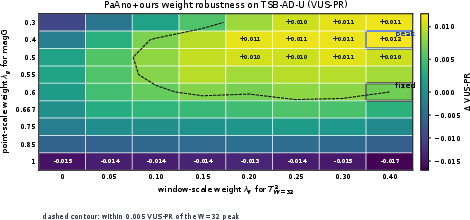
The PAI scheme directly addresses a critical shortcoming of representation-based TSAD: amplitude invariance in anomaly scoring. By integrating both representation and raw-signal amplitude information through a modular, computationally efficient fusion at the scoring layer, PAI significantly improves univariate TSAD performance, especially on amplitude-dependent anomalies. The approach is model-agnostic, robust to weight setting, and easily transferable across benchmarks, opening avenues for further hybrid and multivariate anomaly detection research (2606.08935).