- The paper introduces the first analytic four-parameter rotating NS–NS vacuum solution in Double Field Theory with independent dilaton and H-flux charges.
- It employs an SO(2) S-duality transformation to generate closed-form NS–NS fields, unveiling non-Kerr frame-dragging and polar repulsion effects.
- The paper uncovers classical degeneracies in multipole moments and hints at a non-Riemannian phase, expanding theoretical frameworks in string theory.
Exact Four-Parameter Rotating NS--NS Vacuum in Double Field Theory
Introduction and Motivation
This work establishes the first explicit four-parameter, rotating vacuum solution in the pure NS--NS sector of closed string theory, constructed within the framework of Double Field Theory (DFT). Unlike previous rotating solutions in related contexts (such as Kerr--Sen and the broader EMDA class), the presented solution provides analytic forms for all three NS--NS fields—metric gμν, two-form Bμν, and dilaton ϕ—with independent dilaton and H-flux charges, in the absence of a Maxwell sector. The construction exploits a compact SO(2) S-duality transformation acting on a rotating Einstein–scalar seed and delivers a solution parameterized by (m,j,q,ζ). The resulting geometry exhibits a rich structure, particularly in the static limit, the multipole structure, and curvature properties, with implications for non-Riemannian extensions in DFT and classical degeneracies reminiscent of fuzzball proposals.
Construction via SO(2) S-duality and Solution Structure
The solution is generated by applying a compact SO(2)ζ⊂SL(2,R) S-duality (which preserves asymptotic flatness) to the rotating Einstein–scalar Bogush–Gal'tsov seed, itself an extension of the Fisher–Janis–Newman–Winicour–Wyman static solution. The S-duality rotates the real dilaton into an axion/dilaton combination, followed by a Weyl rescaling to string frame and dualization to obtain the Kalb–Ramond field.
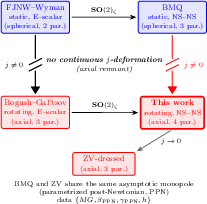
Figure 1: The solution-generating square. Compact S-duality maps Einstein-scalar seeds to NS--NS descendants, with the rotating branch acquiring a Zipoy–Voorhees structure with H-flux in the static limit.
The four-parameter family (m,j,q,ζ) is implemented in the quasi-isotropic chart, yielding closed-form expressions:
- The metric inherits the Kerr-like form modulated by a conformal warp factor from the dilaton, with Bμν0 encoding the scalar hair's angular modulation.
- The dilaton profile is purely radial and of fractional-power type in the auxiliary function Bμν1, parametrically controlled by Bμν2 and Bμν3.
- The Kalb--Ramond field yields a three-form Bμν4 that is purely electric.
- The Bμν5-invariant first integral provides a conserved quantity unifying the dilaton and axion charges.
Geometry and Multipole Structure
Static Limit and Geometric Memory
Taking the static limit (Bμν6) of the solution does not reproduce the spherically symmetric Burgess–Myers–Quevedo (BMQ) geometry but instead lands on an axial (Zipoy–Voorhees, ZV) branch, with the Bμν7-flux inducing an oblate deformation of the spatial geometry. This geometric memory (i.e., retention of axiality in the absence of rotation) is not observed in general relativity (where the Kerr solution limits to Schwarzschild) or in EMDA-type extensions (where the Maxwell sector ties the extra charges and restores sphericity).
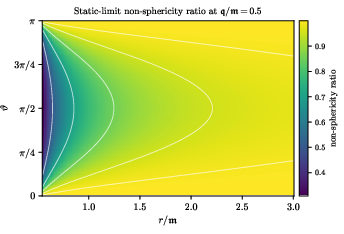
Figure 2: The static-limit non-sphericity ratio as a function of radius and angle, highlighting the persistent oblate deformation due to Bμν8-flux and scalar hair.
Multipole Degeneracy and Higher Moments
The leading asymptotic (PPN) charges—including effective mass Bμν9, and PPN parameters ϕ0 and ϕ1—are identical between the axial ZV branch and the spherical BMQ branch for a given choice of ϕ2. This degeneracy is lifted at the quadrupole (ϕ3) and higher multipoles, as encoded in the ϕ4 (angular) dependence of the metric and curvature invariants. This construction provides an explicit realization of classical degeneracy of gravitational and dilatonic multipoles at fixed monopole data, signaling limits to asymptotic uniqueness in the pure NS--NS sector.
Stringy Rotational Effects and Polar Repulsion
Lense–Thirring Corrections
The off-diagonal metric component ϕ5 receives a non-Kerr ϕ6 correction proportional to the dilaton charge ϕ7, giving rise to stringy modifications in frame-dragging effects not accessible in pure GR. For purely axionic configurations (ϕ8), this correction vanishes, consistent with corresponding shifts in the PPN parameters.
Polar Repulsion and Supercritical Threshold
Rotating solutions with sufficiently large ϕ9 develop a regime where polar geodesics cannot reach the curvature singularity at the Kerr horizon locus. In this "supercritical" phase, the rotation axis at the shell remains regular in curvature while Riemannian metric components diverge, opening the possibility for a non-Riemannian DFT description at the shell. This polar repulsion is a direct consequence of the negative kinetic term of the dilaton in string frame and does not occur in the BMQ or EMDA families.
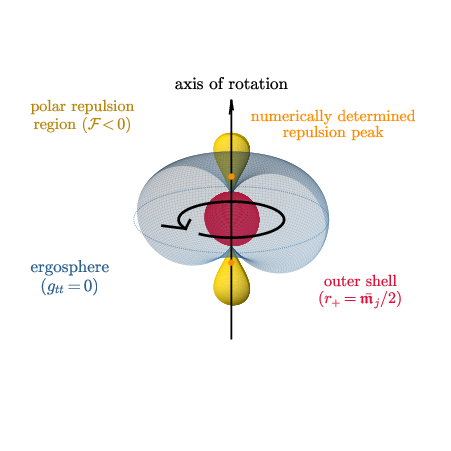
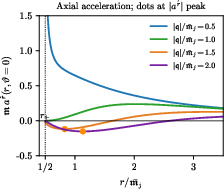
Figure 3: Visualization of polar repulsion: the ergosurface (blue), outer shell (red), and regions of outward acceleration (gold) displaying polar evacuation in the supercritical H0 regime.
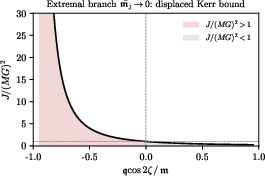
Figure 4: Displaced Kerr bound in the extremal branch, with H1 shifting above or below unity in accordance with the dilaton charge, a phenomenon absent in pure Kerr.
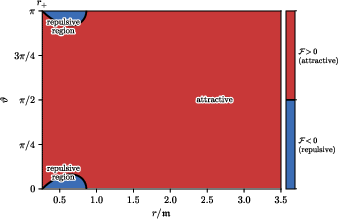
Figure 5: Distribution of repulsive (blue) and attractive (red) regions in H2; the black contour marks transition between attraction and repulsion.
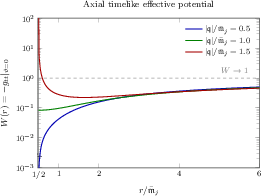
Figure 6: Axial timelike effective potential H3 as a function of H4 for subcritical, critical, and supercritical H5; the inner barrier at the shell blocks access for sufficiently large H6.
Implications and Relation to Broader Frameworks
Distinction from EMDA Families and Non-Riemannian Phase
This NS--NS solution exists outside of the Killing-tensor families (e.g., Kerr--Sen, GGK/GK) due to the decoupling of scalar and Maxwell charges; in those frameworks, axidilaton charge is locked to the electromagnetic charge, whereas here H7 is free in the absence of a Maxwell sector. The supercritical shell's degenerate behavior in H8 but regularity in the DFT fundamental variables hints at a non-Riemannian phase in DFT, an avenue not realized in previous work but essential to a full non-Riemannian description of the shell.
Classical Degeneracy and Fuzzball-like Features
The asymptotic degeneracy among inequivalent geometries (sharing H9 data but differing at higher multipoles) is evocative of the fuzzball paradigm. While the work does not provide a microstate count, it establishes the kinematical foundation for constructing multiple geometries at identical monopole charges, governed by distinct higher moments.
Observational and Theoretical Prospects
The deviations from Kerr in frame-dragging and polar geodesics provide dynamical probes for stringy hair, although current astrophysical constraints (such as solar-system PPN bounds) limit detection to scenarios where NS--NS scalar hair is dynamically significant (e.g., in strong-field compact objects). The non-Riemannian shell structure is a candidate window into DFT-specific gravitational phenomena, suggesting a need for further study of geodesic completeness and boundary conditions in non-Riemannian regions.
Conclusion
This paper presents the explicit construction and analysis of an exact, four-parameter, rotating NS--NS vacuum solution in Double Field Theory, extending the class of known analytic black hole and hair solutions beyond Maxwell-supported frameworks. The main innovations include the analytic solution of all NS--NS fields, demonstration of geometric memory in the static limit, emergent classical degeneracies at fixed monopole data, and the identification of polar repulsion and non-Riemannian signatures. These results provide a fertile ground for further exploration—both in the context of strong-field astrophysics and the theoretical development of DFT's solution space and non-Riemannian sectors.