- The paper demonstrates that disk reflection within a lamp-post geometry reproduces the hard X-ray polarization of NGC 4151 using advanced GR radiative transfer models.
- It constrains key parameters such as corona height (<9 r_g), disk inclination (~60°), and black hole spin (a* = 0.75) through coordinated polarimetric and spectroscopic analysis.
- The study challenges slab-like corona models by showing that energy-dependent polarization alignment arises solely from disk reprocessing effects.
Disk Reflection as the Origin of the X-ray Polarization of NGC 4151: An Expert Review
Scientific Context and Motivation
The question of the geometry, location, and physical properties of the X-ray corona in type-1 active galactic nuclei (AGN) has driven much recent work in high-energy astrophysics. While classical X-ray spectroscopy delivers limited information on coronal structure, X-ray polarimetry holds promise for breaking key degeneracies. The Imaging X-ray Polarimetry Explorer (IXPE) enabled measurements of X-ray polarization in AGN, yielding previously inaccessible constraints on emission region geometry, scattering, and relativistic effects. NGC 4151, a prototypical Seyfert 1.5 AGN, yielded the first high-significance X-ray polarization detection in a non-jetted AGN, including a well-resolved polarization angle and energy-dependent polarization degree. Previous interpretations favored slab-like extended corona models. This paper presents the first physically self-consistent test of disk reflection as the primary origin of the observed polarization within the lamp-post geometry, incorporating detailed, relativistic radiative transfer and spectropolarimetric modeling. The analysis leverages two long IXPE observations, contemporaneous XMM-Newton and NuSTAR spectroscopy, and advanced codes ({\tt KYNSTOKES}, {\tt stokes_torus}), directly confronting current models of AGN corona/disk physics.
Observational Campaign and Data Overview
The dataset consists of two ∼700 ks IXPE observations (2022, 2024), each with overlapping XMM-Newton/EPIC-pn and NuSTAR exposures. The light curve reveals strong inter- and intra-observational variability, with a 30% flux difference between epochs and short-term variability amplitude factors exceeding 1.7.
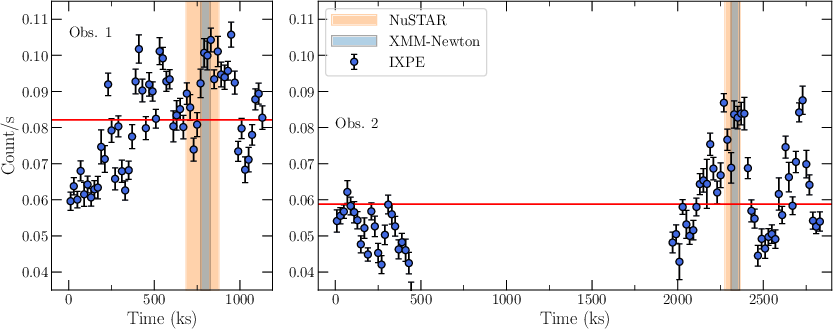
Figure 1: IXPE 2–8 keV light curves of NGC 4151 for both epochs, with intervals of simultaneous XMM-Newton and NuSTAR coverage indicated.
Both exposures were analyzed using consistent extraction regions and rigorous background treatment, ensuring reproducible polarimetric and spectroscopic products. Contemporaneous spectral data were uniformly processed using optimal binning schemes and state-of-the-art calibration.
Physical Modeling Framework
The study employs advanced models capable of directly predicting the observed Stokes I, Q, U spectra under general relativistic transfer in a rotating Kerr space-time. The ``lamp-post plus torus'' geometry is adopted, with a compact, isotropically emitting, unpolarized corona illuminating a thin, ionized accretion disk and a distant, optically thick torus.
The combination of {\tt KYNSTOKES} and {\tt stokes_torus} enables the separation of disk-reflection-induced polarization and distant reprocessing, including the effects of partial-covering absorption. An additional energy-dependent soft polarized power-law component is introduced to account for observed polarization at E<4 keV. The models include all relevant relativistic effects (energy shift, light bending, frame dragging, rotation of polarization angle) and ionization-dependent reflection, as well as empirical absorption and emission features as constrained by high-resolution spectra.
Polarization Results and Parameter Constraints
Simultaneous fitting of binned IXPE Stokes spectra yields a robust description of the polarization vector as a function of energy, detector, and epoch. The hard X-ray polarization (E>4 keV) is consistently aligned parallel to the radio jet and displays a plateau in polarization degree (∼6--7%), while a marked drop and shift in polarization angle occurs at lower energies.
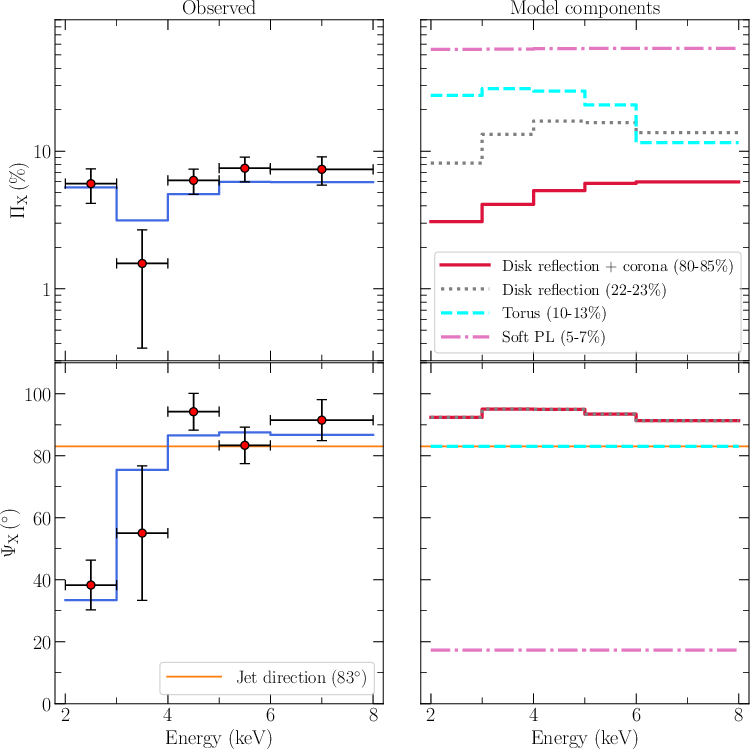
Figure 2: Polarization degree and angle as functions of energy (left: total, right: model components), demonstrating hard/soft dichotomy and spectral components' flux contributions.
The model achieves an excellent fit with χ2=105 for 77 d.o.f., and places stringent constraints on corona height (h<9rg, 3σ) and torus opening angle (I0). The disk reflection, with an inclination of I1 and spin I2, contributes I320% of the I4–I5 keV flux; the soft component, while contributing only 1–5% of flux, exhibits polarization degree I6 and angle shifted by I7I8 relative to the disk. The polarization angle is strongly sensitive to both disc geometry and observer orientation, driving a robust lower limit on inclination (I9).
Strong, energy-dependent constraints on these parameters are further illustrated:
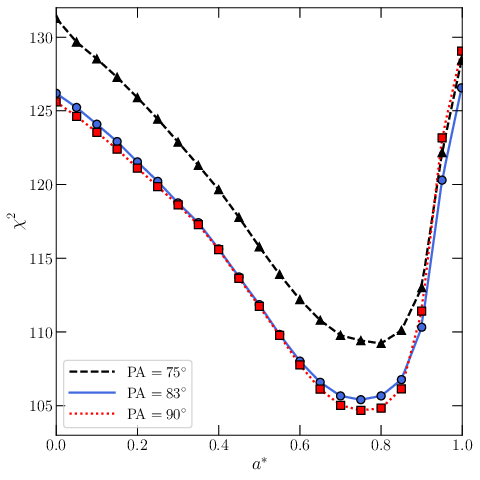
Figure 3: Q0 vs. spin parameter for various system position angles, highlighting limited sensitivity to high Q1 but favoring Q2.
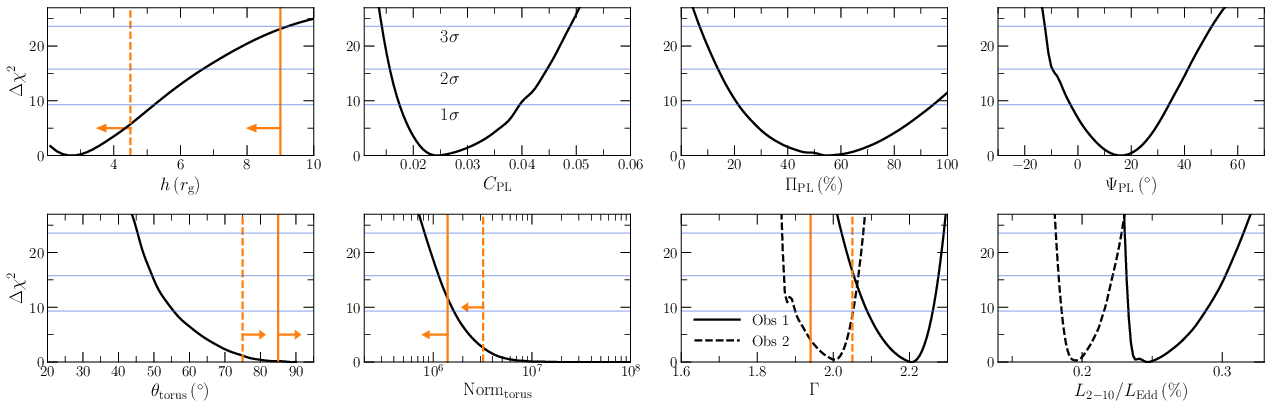
Figure 4: Q3 confidence contours for key free parameters (corona height, torus angle, power-law fraction, etc.), showing parameter degeneracies and simultaneous spectral/polarimetric compatibility.
The fits confirm that disk reflection alone, given the best-fit geometry, suffices to reproduce the entire hard X-ray polarimetric signature without requiring significant direct polarization from the Comptonization region itself, in contrast to previous slab corona models.
Spectroscopic Modeling and Energetic Consistency
The same physical configuration provides excellent fits to contemporaneous XMM-Newton/NuSTAR spectra over Q4–Q5 keV using {\tt KYNSED} (an efficient relativistic disk reflection model using XILLVER tables). The analysis yields corona heights (Q6 in 2022, Q7 in 2024), photon indices Q8 (lower in high-flux states), and disk reflection fractions of 17–23% in the IXPE band, all in close agreement with polarimetric modeling. Relative torus reflection normalizations are consistent, though only limits are obtained due to degeneracy with narrow emission features.
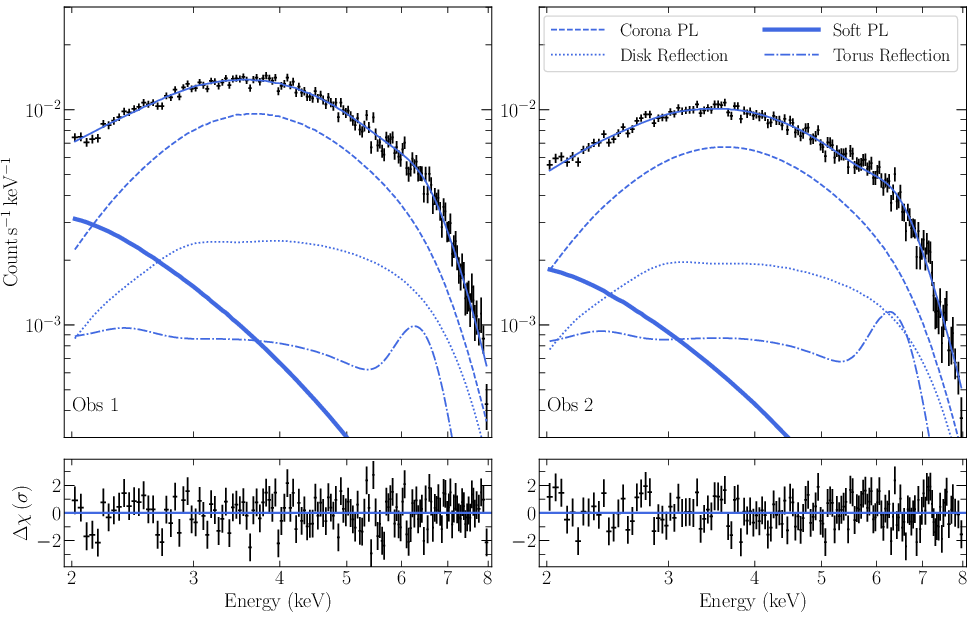
Figure 5: Time-integrated IXPE energy spectra for both epochs, with decomposed contributions from direct, disk-reflected, torus, and soft-power-law components and respective residuals.
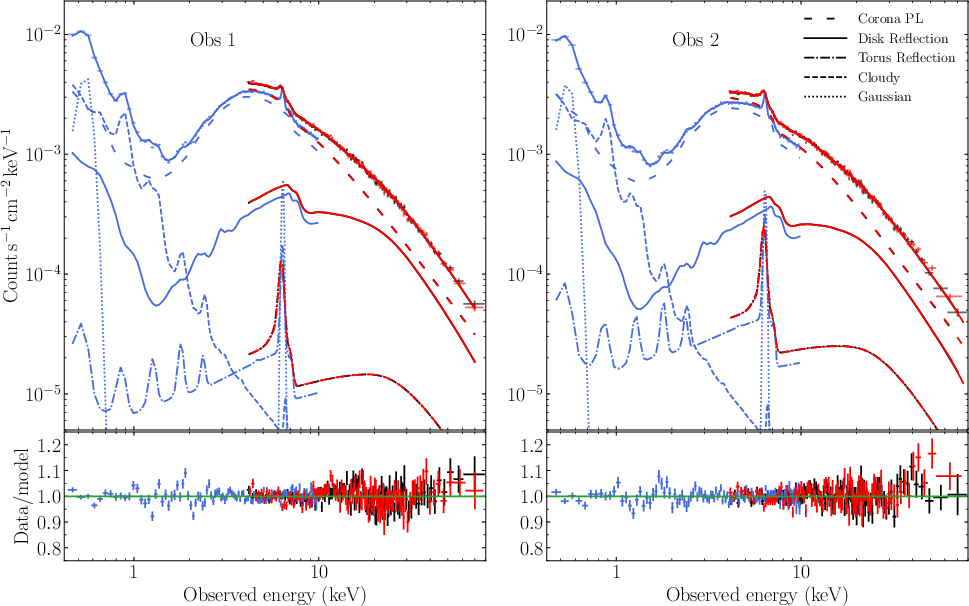
Figure 6: Joint XMM-Newton (blue) and NuSTAR (black/red) spectral fits for both epochs, demonstrating model consistency at Q9 keV, modest residuals at soft energies.
Residuals at U0 keV (amplitude U1–U2\%) are attributed to calibration uncertainty and unresolved spectral complexity, but do not challenge the global model's physical interpretation.
Origin of the Soft X-ray Polarization
The soft polarized component (U3 keV) is statistically required by the data and displays a polarization angle distinct from both disk reflection and torus. The paper evaluates several physical origins:
- Partial covering by clumpy BLR/torus: Selective absorption can obscure disk regions with different local polarization angles, leading to spectral/energetic decoupling of net polarization.
- Energy-dependent opacity effects: Rapid photoelectric opacity decline at higher energy in partially neutral absorbers manifests as a sudden transition between perpendicular and parallel polarization states.
- Scattering in dusty pc-scale structures: Supported by recent interferometry, scattering outside the nucleus provides an energetically minor but highly polarized component, with orientation dependent on outflow/torus axis.
The GR transportation of polarization vectors across the disk is also shown to produce observed swings for plausible partial coverer configurations.
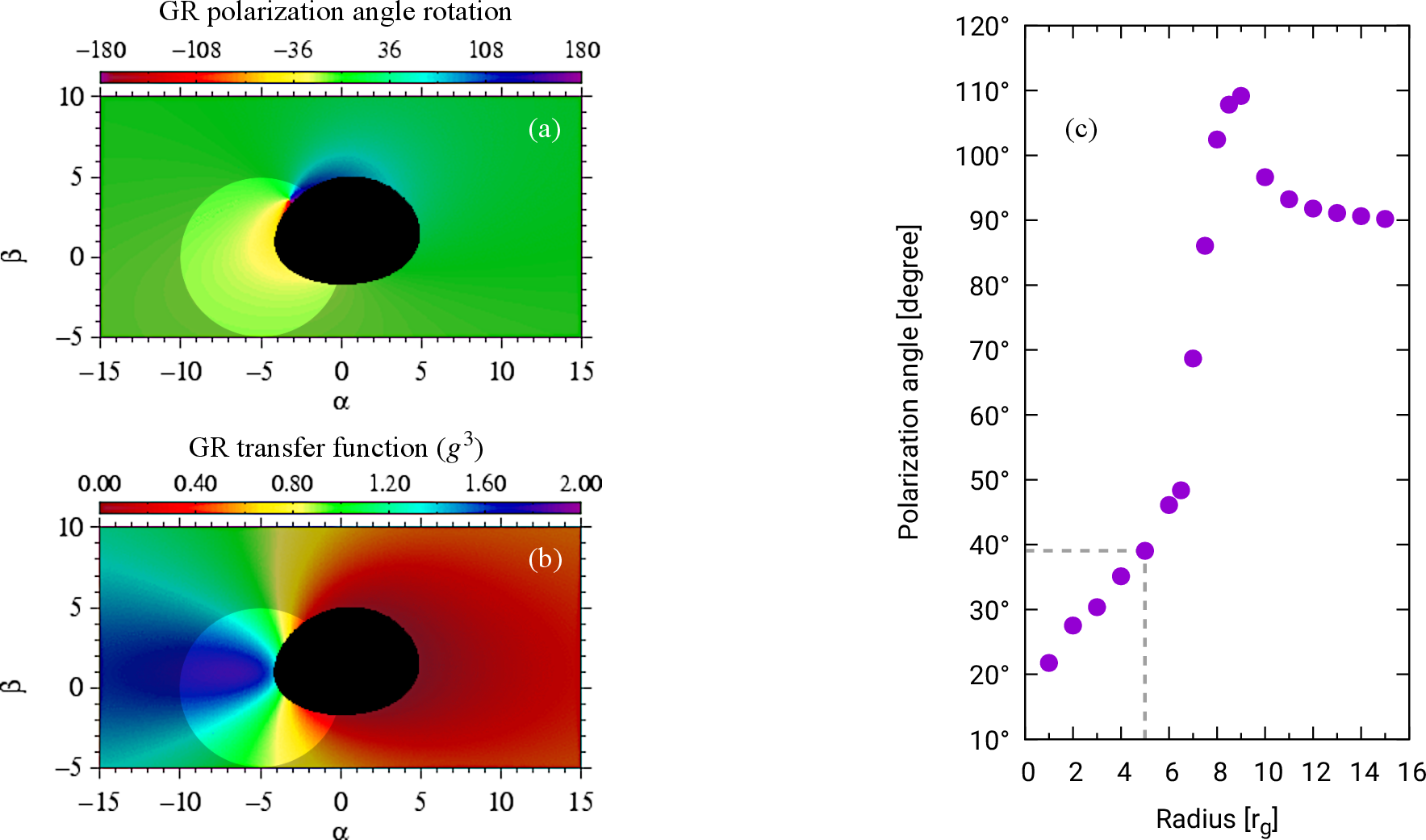
Figure 7: (a) Color-mapped GR rotation of polarization angle across the inner disk for U4, U5; (b) GR transfer function (cubic U6-factor); (c) Modeled observed polarization angle as a function of "unobscured" region size/location.
Implications for AGN Disk-Corona Geometry
The results robustly challenge previous interpretations attributing the hard X-ray polarization to slab-like coronae, showing that disk reprocessing alone can account for the polarization fraction and orientation in NGC 4151 if a lamp-post geometry with U7 and U8 is adopted. This is a nontrivial contradiction to models requiring intrinsic coronal polarization fractions U9, as even equatorially extended (slab) configurations struggle to reach the observed values when fully relativistic transfer is included. Notably, no significant polarization is observed in type-1 AGN with lower inferred inclinations, further supporting model inclination dependence.
The study also demonstrates that energy-resolved X-ray polarimetry jointly with time-resolved spectroscopy tightly constrains corona dimensions, disk orientation, and black hole spin—a critical advance over prior phenomenological approaches, and an essential step toward population studies leveraging future polarimetric missions.
Conclusions
This work demonstrates that disk reflection, under relativistically consistent modeling within the lamp-post geometry, fully explains the observed IXPE X-ray polarization of NGC 4151 at E<40 keV, reproducing both the amplitude and alignment of the polarization vector and matching broadband spectral properties from XMM-Newton and NuSTAR. The data require a compact corona (E<41), high-inclination disk (E<42), and significant disk reflection fraction (17–23%), while the hard X-ray polarization is dictated entirely by scattering off the disk surface. The soft polarimetric component is interpreted as arising from energy-dependent absorption, partial covering, or extended scattering. These results contradict exclusively coronal-origin scenarios and reinforce the diagnostic power of high-quality X-ray polarimetry for accretion flow geometry and black hole parameters. Future IXPE observations of additional high-inclination Seyferts and X-ray binaries in variable reflection states will further test these conclusions and extend the broader understanding of accretion in AGN.

