- The paper demonstrates that inversion symmetry breaking at rocksalt surfaces induces chiral phonons with distinct angular momentum and measurable orbital magnetic moments.
- Density functional theory calculations on NaCl, RbF, and CsH slabs reveal surface-localized phonon branches that modify conventional phonon dispersions.
- The study highlights that opposing chirality at the top and bottom surfaces creates planar magnetic sheets, offering novel insights into surface magnetoelectric phenomena.
Chiral Surface Phonons in Rocksalt Crystals: Symmetry Breaking and Magnetization
Introduction and Motivation
The paper "Chiral Surface Phonons" (2606.08820) investigates the emergence of chiral phonons at the surfaces of crystalline materials, specifically analyzing the consequences of surface-induced inversion symmetry breaking in prototypical high-symmetry AB rocksalt compounds. The study combines symmetry analysis with density functional theory (DFT) calculations to probe phonon modes in slabs of NaCl, RbF, and CsH, revealing the ubiquitously chiral nature of surface phonons and their implication for surface magnetism.
Previous research has established the centrality of chiral phonons—phononic excitations with a well-defined rotational sense and finite angular momentum—in non-centrosymmetric crystals, linking them to phenomena such as the phonon Zeeman effect, the phononic Einstein-de Haas analogue, and phonon-driven magnetization switching. By focusing on surface-induced symmetry breaking, this paper extends the paradigm to materials whose bulk phases are strictly inversion symmetric, highlighting that surfaces universally host chiral phonon modes with associated magnetic moments.
Bulk and Surface Phonon Structures
DFT calculations of bulk NaCl (space group Fm3ˉm) demonstrate six phonon branches—acoustic and optical, each split into transverse and longitudinal modes, with doubly degenerate transverse modes as expected for rocksalt structures.
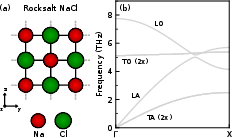
Figure 1: Bulk phonon dispersion and crystal structure for rocksalt NaCl illustrates acoustic and optical branches, with transverse and longitudinal character.
In slabs of NaCl (11-layer, (001)-oriented), symmetry breaking at the surfaces increases the number of phonon branches due to out-of-plane confinement, leading to discrete phonon subbands and surface-localized modes. Surface phonons are quantified by the surface localization metric $\phi^{\mathrm{surf}_{\mathbf{q} \nu}$, identifying modes strongly confined to the outermost layers.
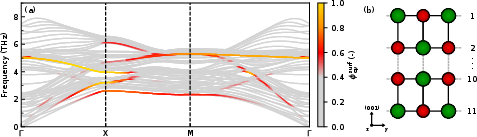
Figure 2: Slab phonon dispersion color-coded by surface localization ϕsurf reveals surface-localized phonons and slab geometry.
Surface phonons predominantly appear at the low-frequency edge of phonon subbands, retaining their bulk band character but displaying enhanced localization due to reduced coordination of surface atoms.
Chiral Phonon Emergence at Surfaces
Chiral phonons are characterized by their angular momentum J and helicity q⋅J^. The study calculates the angular momentum for all slab phonon modes, revealing pronounced chiral surface phonons along the X−M direction in the Brillouin zone. Notably, the highly localized surface mode at ∼4.0 THz exhibits strong right-handed chirality at the slab's top surface, which reverses sign at the bottom surface due to inversion symmetry.
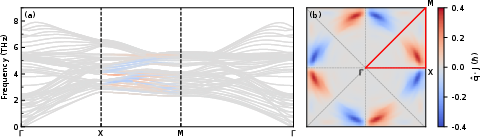
Figure 3: Slab phonon dispersion color-coded by phonon chirality q⋅J^, with Brillouin zone maps detailing chirality distribution.
Symmetry analysis shows chiral phonon modes are forbidden along mirror-symmetric directions (Γ−X and Γ−M), but allowed throughout the rest of the Brillouin zone. Away from high-symmetry lines, chiral surface phonons are pervasive, and surface chirality reverses across mirror planes, substantiating their presence as a direct consequence of local inversion symmetry breaking.
Atomic displacement analyses of these chiral modes reveal circular motion of either Na$\phi^{\mathrm{surf}_{\mathbf{q} \nu}$0 or Cl$\phi^{\mathrm{surf}_{\mathbf{q} \nu}$1 ions on the surface layers, depending on the mode frequency; the lower-frequency mode at $\phi^{\mathrm{surf}_{\mathbf{q} \nu}$2 THz is dominated by the heavier Cl$\phi^{\mathrm{surf}_{\mathbf{q} \nu}$3 ions. The handedness of ionic motion is opposite at the two surfaces, confirming the achiral nature of the aggregate slab.
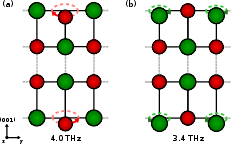
Figure 4: Atomic displacement patterns for chiral surface phonons at $\phi^{\mathrm{surf}_{\mathbf{q} \nu}$4 THz and $\phi^{\mathrm{surf}_{\mathbf{q} \nu}$5 THz, highlighting circular motion of Na$\phi^{\mathrm{surf}_{\mathbf{q} \nu}$6 and Cl$\phi^{\mathrm{surf}_{\mathbf{q} \nu}$7 ions respectively.
Surface Magnetization from Chiral Phonons
Chiral surface phonons create orbital magnetic moments through their dynamical multiferroic character, resulting from circulating ions that act as microscopic current loops. The phonon magnetic moment $\phi^{\mathrm{surf}_{\mathbf{q} \nu}$8 is proportional to the angular momentum and gyromagnetic ratio of ions.
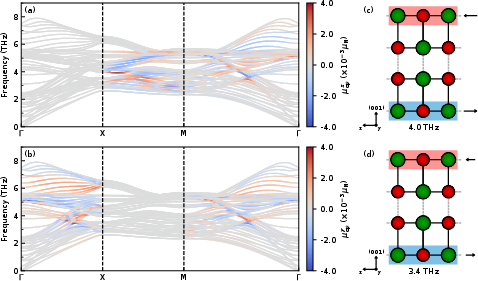
Figure 5: Slab phonon dispersion color-coded by magnetic moment components ($\phi^{\mathrm{surf}_{\mathbf{q} \nu}$9, ϕsurf0); in-plane surface magnetism distribution for chiral modes at ϕsurf1 THz and ϕsurf2 THz.
The largest magnetic moments are associated with chiral surface phonons involving circular motion of Naϕsurf3 ions at ϕsurf4 THz; Clϕsurf5 ion-dominated modes generate smaller moments, consistent with their larger mass. Despite opposite handedness of motion for Naϕsurf6 and Clϕsurf7, their charge difference ensures identical magnetic moment orientation. The localization of chiral surface phonons confines generated magnetism to surface layers, producing planar in-plane magnetic sheets with reversal at opposing surfaces. Cycloidal surface modes also contribute to surface magnetic moments, even outside the chiral regime.
Generality Across Rocksalt-Structure Materials
The authors extend their analysis to RbF and CsH slabs, finding similar surface-localized phonon modes and chiral surface phonons with finite magnetic moments. As the mass difference between cation and anion increases, the acoustic-optical gap becomes more pronounced, but the ubiquity of symmetry-induced chiral surface modes persists.
Implications and Prospects
The results establish that surface-induced inversion symmetry breaking universally generates chiral phonons in crystalline materials, independent of bulk symmetry. These modes can contribute finite angular momentum and magnetic moments exclusively localized at the material's surfaces, potentially impacting surface-sensitive magnetic and transport measurements. The connection to the phonon angular momentum Hall effect, where heat flow accumulates oppositely oriented angular momentum and magnetization at opposing surfaces, is direct; however, surface chiral phonons are not constrained by transport geometry, allowing arbitrary surface angular momentum orientations.
This paradigm extends considerations of phononic angular momentum and dynamical magnetism to all surfaces and interfaces, with implications for future experiments probing surface magnetization, phonon-mediated magnetoelectric effects, and surface-sensitive spectroscopies. The theoretical lower bounds on phonon magnetic moments highlight ongoing experimental challenges and discrepancies, motivating refined theoretical and experimental investigations.
Conclusion
Surface-localized chiral phonons are a universal consequence of surface-induced inversion symmetry breaking in crystalline materials, even for bulk inversion-symmetric compounds. These modes, characterized by finite angular momentum and associated orbital magnetic moments, form planar sheets of in-plane magnetization, reversing across opposing surfaces. The study elucidates the symmetry principles governing chiral surface phonons and their magnetic signatures, with broad implications for surface physics and magnetoelectric phenomena. Extensions to additional rocksalt compounds reinforce the generality of the findings, establishing surface chiral phonons as a fundamental feature of crystalline solids.

