- The paper introduces a non-overlapping Schwarz domain decomposition that reduces inner iterations from 9–10 to 2–3 and eliminates redundant interface solves.
- It integrates finite element methods with a Point-DeepONet architecture, enabling interpolation-free, physics-consistent operator inference on irregular, unstructured domains.
- Numerical tests demonstrate bounded error, rapid convergence, and efficient auto-regressive performance across static, hyperelastic, and dynamic regimes.
Non-Overlapping Schwarz Hybrid Finite Element–Neural Operator Framework for Solid Mechanics on Irregular Domains
Introduction and Motivation
This paper presents a hybrid computational framework that innovates on the integration of finite element methods (FEM) with neural operators (NO) for simulations in solid mechanics on arbitrary and irregular domains. The core focus is the development of a non-overlapping Schwarz alternating domain decomposition, moving beyond earlier overlapping formulations with critical modifications at the physics-interface and deep learning architectural levels. This framework addresses known bottlenecks in hybrid PDE–ML solvers: avoiding redundant interface solves, eliminating interpolation constraints for unstructured meshes, and achieving bounded error propagation in long-time auto-regressive simulations.
The framework targets highly demanding simulation regimes, specifically static linear elasticity, quasi-static hyperelasticity, and elastodynamics, where traditional FE becomes computationally prohibitive in the presence of local nonlinearities, fine-scale features, or complex geometries. By assigning computationally intensive subdomains to physics-informed DeepONets (PI-DeepONet) and the rest to standard FE, the method enables resource-efficient multi-scale and multi-regime modeling.
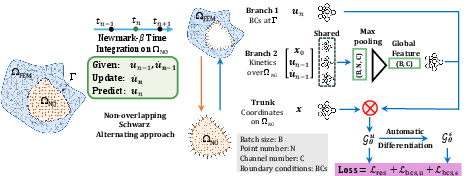
Figure 1: Schematic overview of the non-overlapping Schwarz hybrid FE–Neural Operator framework built on the time-marching Point-DeepONet, partitioning the domain into ΩFEM and ΩNO and enabling unstructured and irregular geometry handling for the NO subdomain.
Methodological Advances
Non-Overlapping Schwarz Coupling
A central methodological shift is the move from Dirichlet–Dirichlet overlapping Schwarz to a non-overlapping Neumann–Dirichlet coupling. Interface tractions—rather than displacements—are exchanged, yielding several technical advantages:
- Reduced Inner Iterations: The non-overlapping approach decreases the inner Schwarz iterations required for convergence, demonstrated to drop from 9–10 to 2–3 per time step in elastodynamics.
- No Redundant Overlap Layer: The absence of overlap eliminates redundant inter-domain solves, directly impacting computational cost and wall-clock time.
- Bounded Error and Spatiotemporal Stability: The approach demonstrates error stability across extensive time horizons under dynamic, auto-regressive integration.
Point-DeepONet and Physical Consistency
The NO architecture is extended by integrating PointNet as the branch network, resulting in a Point-DeepONet capable of operating on unstructured point clouds. This innovation enables direct, interpolation-free feature extraction from arbitrary FE point samples, thus supporting highly irregular and non-convex geometries—unattainable with prior CNN-based variants.
Another notable contribution is the analytical derivation of strain and stress operators from displacement via kinematics, as opposed to training separate DeepONets for each tensor component. This eliminates redundant trainable parameter sets, resulting in both accelerated training and hard-wired mechanical consistency.
The PI-DeepONet is posed as a physics-constrained operator regression, with composite loss terms encoding PDE residuals and Dirichlet/Neumann boundary compatibility. For the dynamic regime, Newmark-β time-stepping is embedded into the operator, tightly coupling physics-based integration with learned operator inference and stabilizing long-horizon autoregression.
Numerical Results
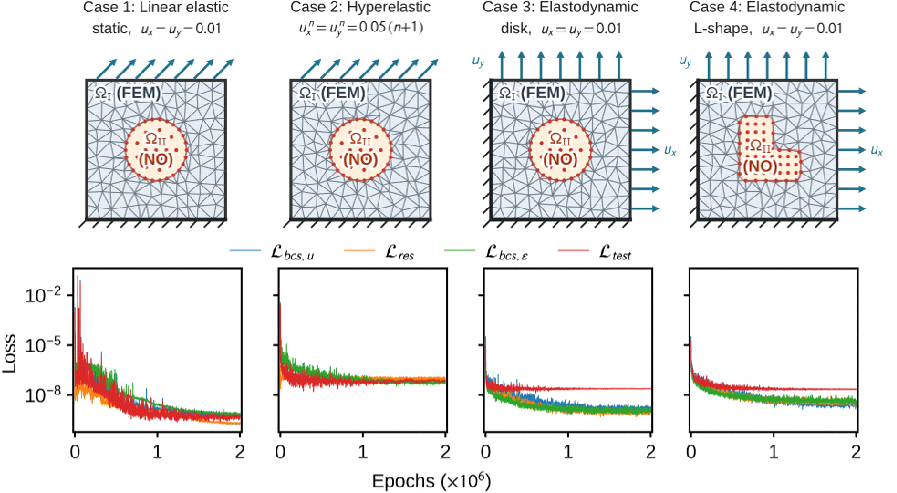
Figure 2: Schematics and training loss convergence for four validation cases, illustrating robustness on both regular (disk) and irregular (L-shaped) subdomains across static, quasi-static, and dynamic loading regimes.
The framework's efficacy is demonstrated on a suite of increasing complexity benchmarks:
- Case 1: Static Linear Elasticity. Convergence to below 0.2% relative error in 10 Schwarz iterations using FE–NO, outperforming FE–FE (28 iterations). Strain fields derived analytically from displacement operators achieve maximum errors ≤1.5%.
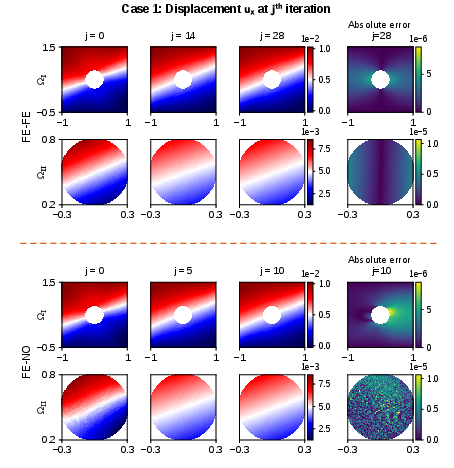
Figure 3: Schwarz iteration convergence of ux in static linear elasticity; FE–NO displays much more rapid convergence compared to FE–FE.
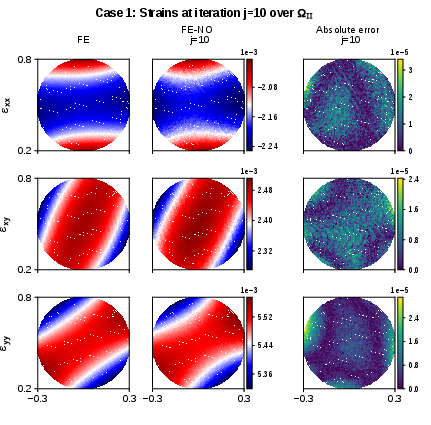
Figure 4: Converged strain fields from FE–NO at j=10 (static case), displaying physical consistency between FE reference and analytic differentiation.
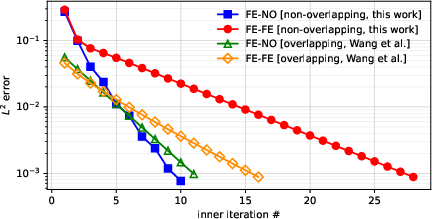
Figure 5: L2 error norm versus Schwarz iteration; FE-NO achieves rapid monotonic decay and superior wall-clock performance.
- Case 2: Quasi-Static Hyperelasticity. Under strong nonlinearity, the FE–NO approach consistently achieves bounded error with wall-clock speed-up (1.75x compared to FE–FE), and stable convergence in ∼16 iterations (compared to 23 for FE–FE). The method is robust to high deformations and interface normal evolution.
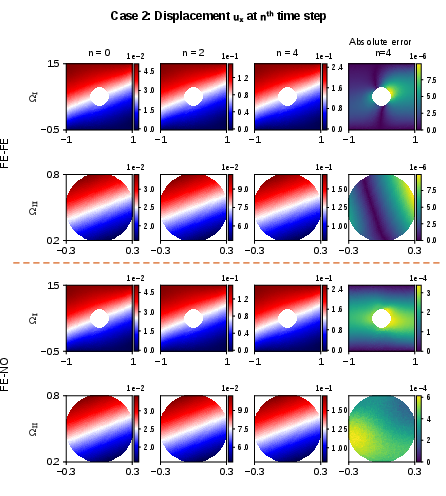
Figure 6: Quasi-static hyperelastic coupling for ux; accurate interface matching and rapid convergence are maintained under large strain.
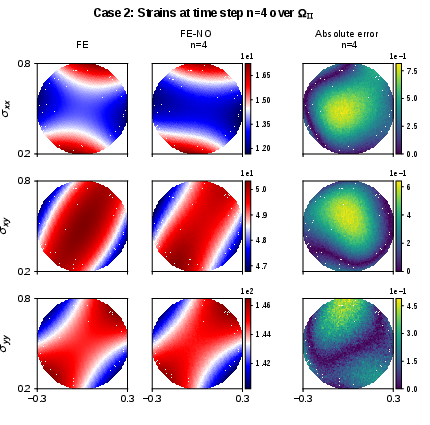
Figure 7: Converged Cauchy stress fields in the hyperelastic case; maximum errors remain negligible relative to stress magnitudes.
- Cases 3 and 4: Elastodynamics on Regular and Irregular Domains. The auto-regressive roll-out over up to 80 time steps showcases the stability of the NO-in-the-loop framework. For the disk case, the FE–NO error remains bounded below 0.1% (displacement) and 5% (strain) despite model switching events at NO window boundaries. The irregular L-shaped domain—unattainable with CNN-based NOs—demonstrates the PointNet's capacity for arbitrary geometries, with only a transient strain error inflation that self-corrects due to the stabilizing inter-domain feedback.
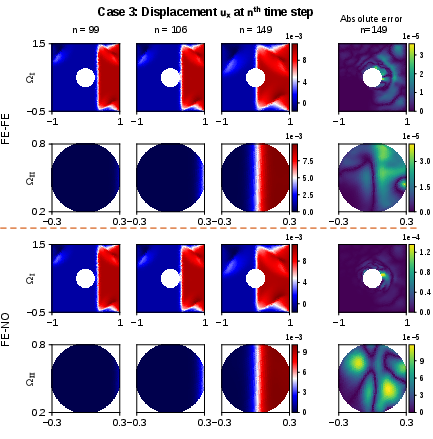
Figure 8: Dynamic coupling—ux wave propagation in elastodynamics, regular disk case; interface errors remain negligible.
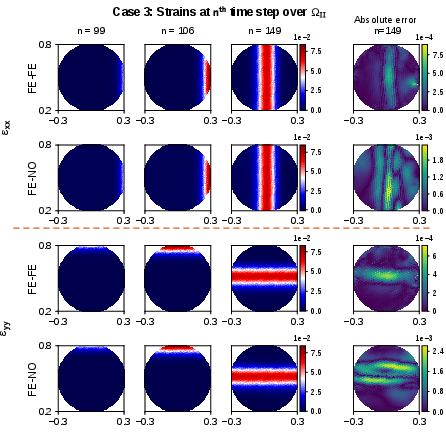
Figure 9: Strain evolution in ΩII (disk), illustrating bounded error propagation during auto-regressive roll-out.
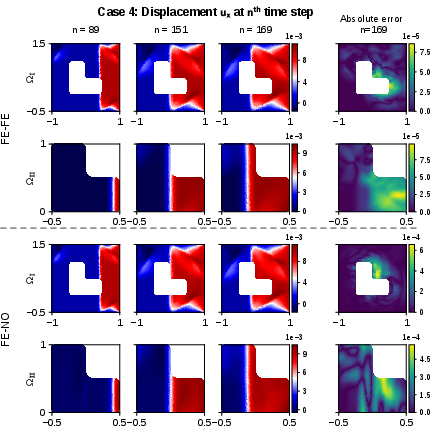
Figure 10: ux in the L-shaped example at several time points, demonstrating geometric flexibility.
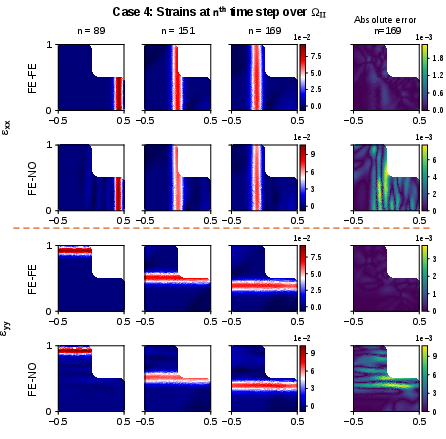
Figure 11: Strain evolution in the L-shaped domain, highlighting the initial difficulty of sharp curvature but self-correcting error dynamics.
The strong claim is that error accumulation remains bounded and iteration count is reduced by a factor of three compared to overlapping DIR-DIR coupling, even for unstructured and non-convex NO subdomains.
Implications and Future Directions
This work provides a systematic advance in hybrid physics–machine learning PDE solvers, particularly in solid mechanics, where the local assignment of FE and operator-learning regions is desirable for computational efficiency, geometric flexibility, and interface accuracy. The practical implications are direct: accelerated simulation of large, multiscale, or highly nonlinear mechanical systems for engineering and scientific applications. By achieving convergence stability and error control in auto-regressive roll-outs, the presented method is positioned as a candidate for real-time or on-the-fly analysis in design and digital twin settings.
Theoretically, the compact trainable parameterization and hard-encoded physics paves the way for transferability to other PDE regimes, domains in higher dimension, and general operator learning settings that interface with physics solvers.
Future directions outlined include:
- Extension to adaptive, error-indicator-driven subdomain selection,
- Transfer learning or online adaptation for NOs on highly variable geometric/topological regimes,
- Full 3D generalization leveraging PointNet-based architectures.
Conclusion
The proposed non-overlapping Schwarz FE–Neural Operator framework achieves geometry-invariant, parameter-efficient, and error-bounded hybrid simulation for solid mechanics. Through analytic operator construction, interface traction exchange, Point-DeepONet for unstructured domains, and stable auto-regressive time integration, it surpasses prior hybrid variational solvers both in computational efficiency and solution quality. The method sets a template for robust AI-accelerated physics computation in computational mechanics and related fields.
(2606.08796)