- The paper demonstrates that synthetic Herschel maps effectively recover filament properties and clump demographics using high-resolution MHD simulations.
- The paper details statistical analyses revealing power-law scaling in filament length, mass distributions, and environmental column density effects.
- The paper finds that over 94% of clumps and 92% of massive stars are embedded in filament networks, highlighting filaments' key role in star formation.
Introduction and Context
Understanding the filamentary organization of the interstellar medium (ISM) has become central to contemporary models of star and cluster formation. The role of filaments in concentrating the mass reservoir required for gravitational collapse and channeling turbulence-driven inflows is extensively supported observationally, notably via large-scale Herschel surveys. However, the translation of 2D observable quantities to 3D physical properties is complicated by projection effects, blending, and limitations in spatial resolution. This study employs synthetic Herschel observations constructed from large-scale, high-resolution 3D MHD simulations to systematically analyze filament and clump demographics with the FILFINDER algorithm and to establish robust comparisons with the Hi-GAL survey.
Simulation Framework and Synthetic Observation Pipeline
The backbone of the analysis is a 250 pc, 1.9×10⁶M⊙ MHD simulation (RAMSES, AMR, dxmin=0.008 pc) capturing SN-driven turbulence throughout a full cycle of supernova activity and gravity-triggered star formation. Radiative transfer (SOC) is used to generate synthetic Herschel maps (70–500 μm) with realistic noise and resolution for three orthogonal projections at multiple evolutionary times and assumed Galactic distances. Clump and filament extraction pipelines strictly parallel the Hi-GAL protocols (CuTEx for clumps, FILFINDER vs. Hessian filtering for filaments), facilitating highly controlled comparisons.
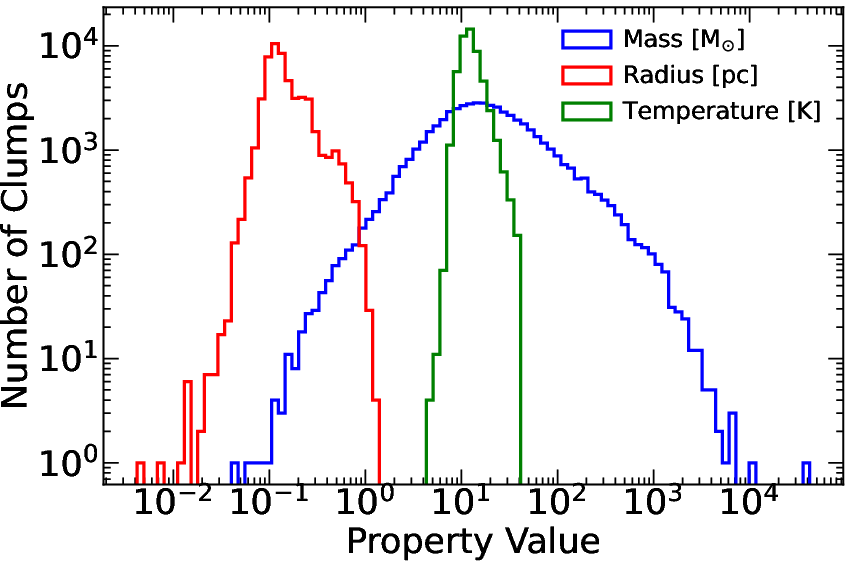
Figure 1: Mass, size, and temperature distributions of 51,831 synthetic clumps, paralleling the Hi-GAL clump selection statistics.
Filaments are detected on dust-derived N(H2) maps with well-calibrated aspect, signal-to-noise, and morphological thresholds. The hierarchical structure of the network is decomposed into branches corresponding to network segments between nodes and endpoints, analogous to high-fidelity graph-based analysis in observations.
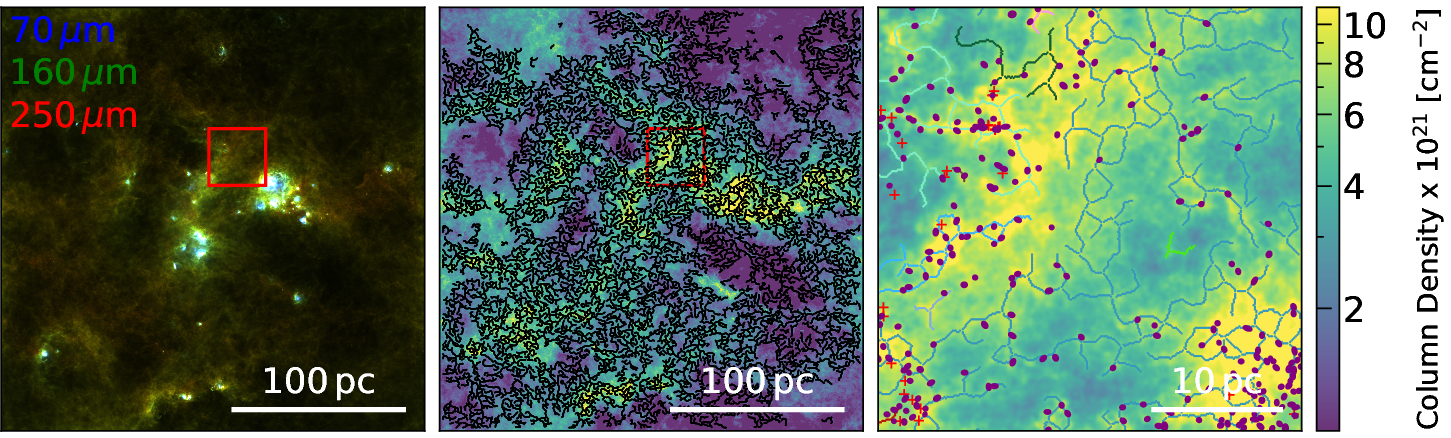
Figure 2: Synthetic RGB Herschel map, associated column density structure with extracted filaments (center), and a zoomed region encoding clumps and star positions (right), illustrating the synergistic interplay between filament extraction and compact object demographics.
Statistical Properties of Filaments: Distributions and Scaling Relations
The synthetic filament and branch populations comprise 8,832 filaments and 110,193 branches. A maximum likelihood analysis reveals power-law tails in both the filament length distribution (dN/dlogL∝LαL, αL=−1.71) and mass function (αM=−0.86). Notably, while the overall normalization and turnover points in the distributions differ due to scale and detection criteria, these slopes are consistent with galactic-scale MHD filament catalogs and the observed Hi-GAL sample, indicating convergence of the underlying assembly processes.
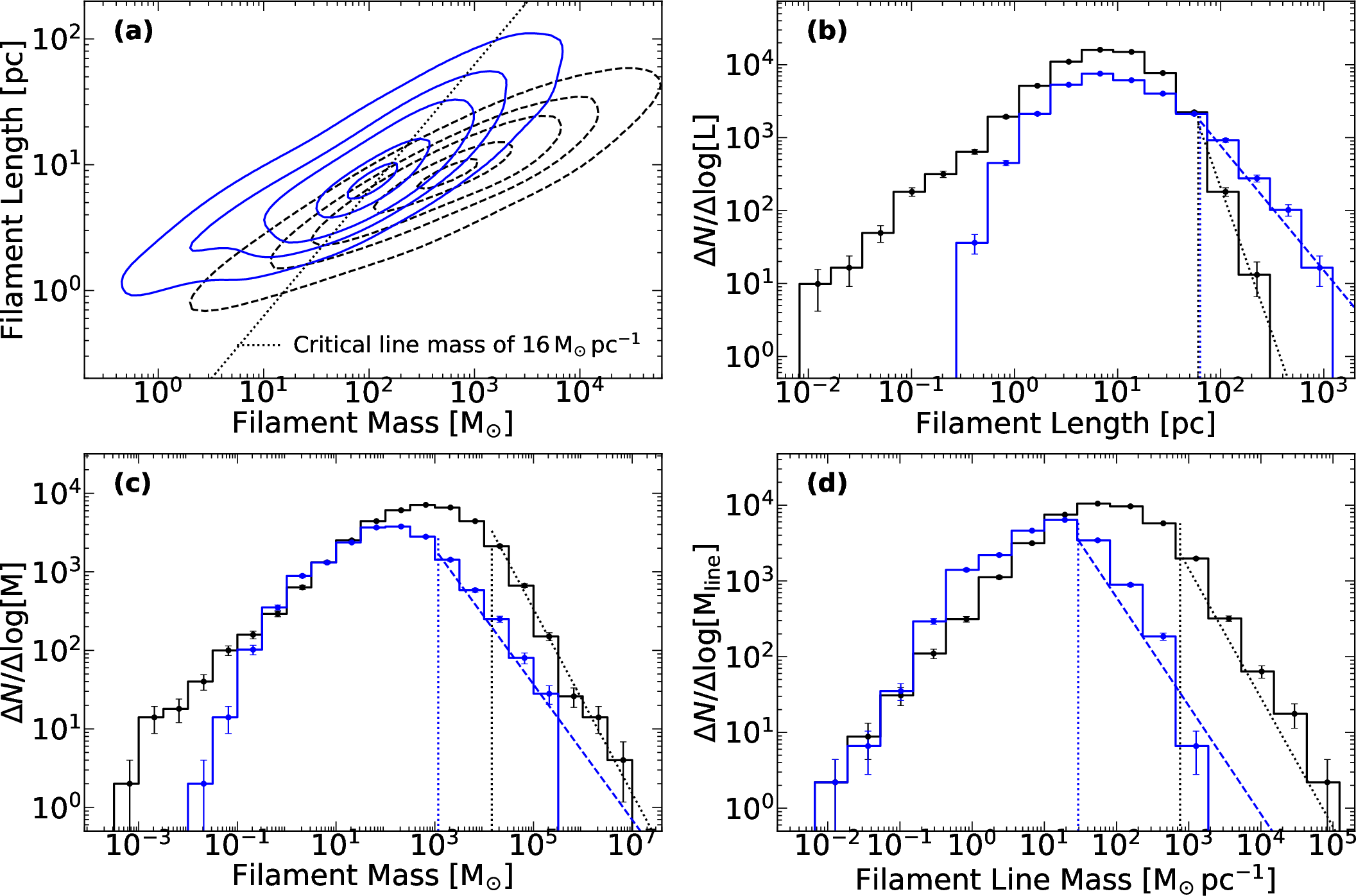
Figure 3: Statistical length-mass relations and distribution slopes for synthetic and Hi-GAL filaments; power-law exponents are consistent, validating the simulation/observation mapping methodology.
The line mass (Mline) distributions for both synthetic and observed filaments yield slopes within the range reported for thermally supercritical filaments (−1.43 vs. −1.70), and the observed mass surface densities span several orders of magnitude. The length function is systematically shallower in the synthetic network, reflecting methodological differences: FILFINDER reconstructs longer, more interconnected networks, whereas Hessian-based methods segment structures at curvature discontinuities.
Environmental Scaling and Column Density Demarcation
A robust, monotonic relation emerges between filament and local background column density: Nfs∝Nbs0.78 (synthetic). The normalization is lower but the qualitative trend mirrors the steeper dependence in Hi-GAL (dxmin=0.0080). This scaling is in line with shock-compression models in MHD turbulence: filaments inherit the density of the ambient flows, and increased background density propels the formation of higher-density filamentary material.
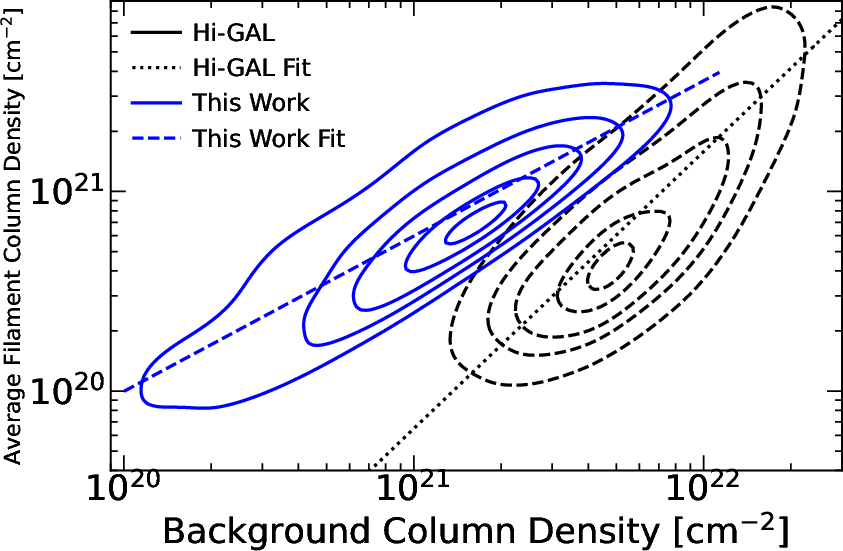
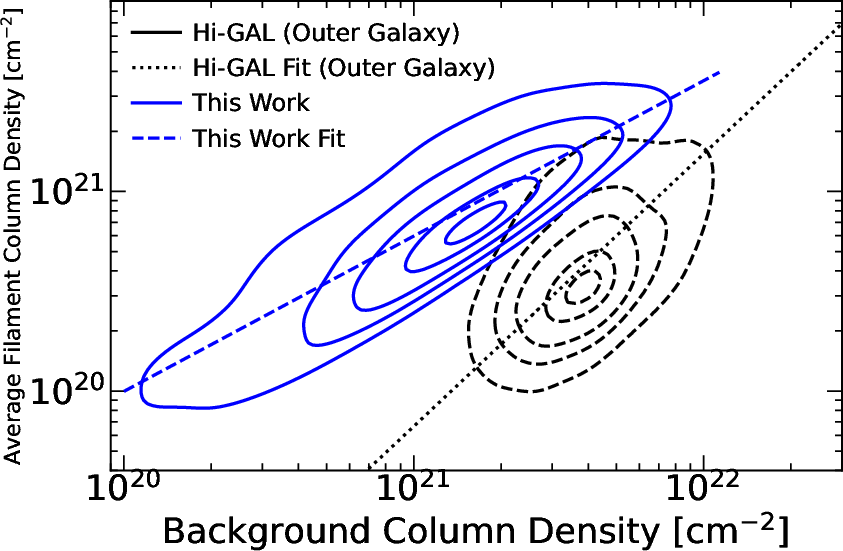
Figure 4: Filament column density scales strongly with local background, with synthetic data showing a sub-linear relation indicative of turbulence-regulated post-shock assembly.
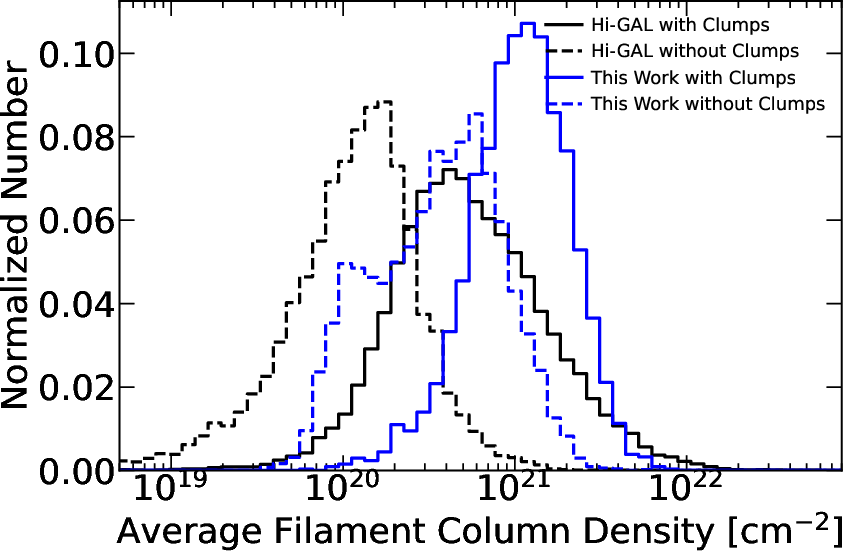
Figure 5: Filaments with embedded clumps exhibit significantly elevated column densities compared to their acellular counterparts, in both synthetic and observed populations.
Probability density functions of map pixels reinforce this division: filament-hosting pixels dominate the high-density regime, while non-filament and inter-filament regions reside near or below the diffuse ISM background.
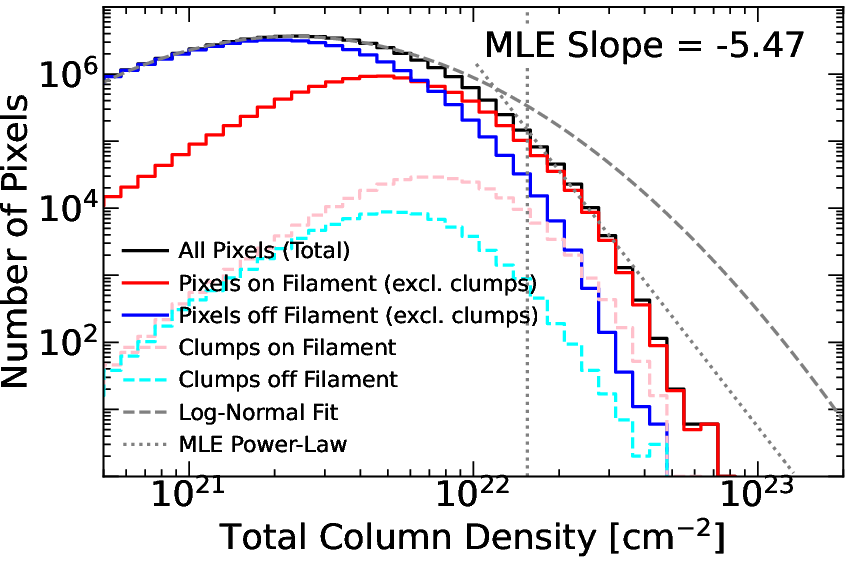
Figure 6: Column density PDFs discriminate filament, clump, and inter-filament gas; synthetic clouds lack a strong gravitationally-induced power-law tail, consistent with a turbulence-dominated evolutionary phase.
Clump Embedding and Filament Evolution
Of dxmin=0.0081 synthetic clumps, 94% are associated with filaments, whereas only dxmin=0.0082 of identified filaments contain embedded clumps. This indicates that most filaments are pre-stellar or inactive with respect to recent fragmentation or massive star formation. The spatial coincidence between clump-embedding and enhanced filament column density is statistically robust (K-S tests, dxmin=0.0083).
Surface and volume density distributions further substantiate the role of filaments as dense, star-forming backbones. The vast majority of high-surface-density clumps and virtually all clumps above the classical star-formation threshold (dxmin=0.0084) are filament-associated.
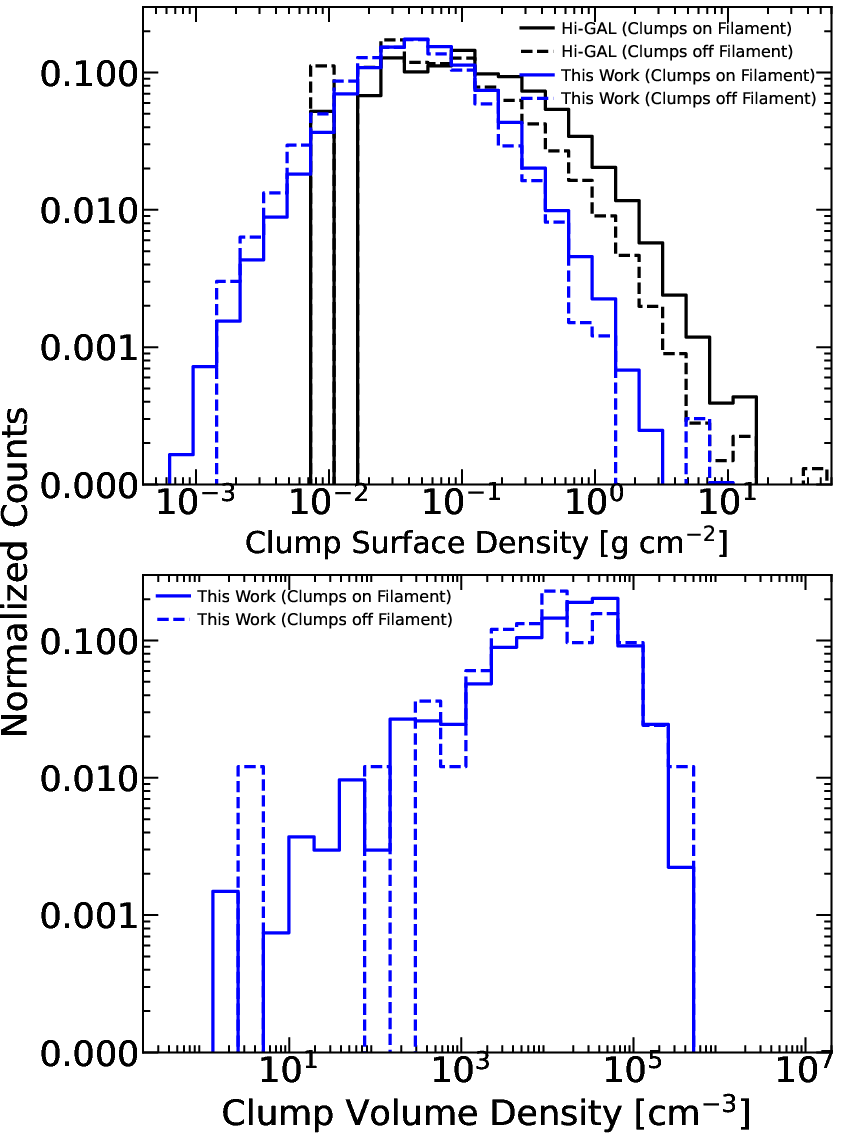
Figure 7: On-filament clumps exhibit markedly higher surface and (for star-containing clumps) volume densities than off-filament objects in both 2D and matched 3D samples.
Quantitative correspondence with observations is compelling for the distribution and environmental properties of clumps, with minor differences explainable by projection and confusion noise effects endemic to Galactic surveys.
Filament Line Mass, Fragmentation, and Star Association
The majority of supercritical filaments (dxmin=0.0085) host the most massive clumps and exhibit a clear evolutionary hierarchy: line mass increases from starless to protostellar fragments. This relation exists at both the filament and branch level.
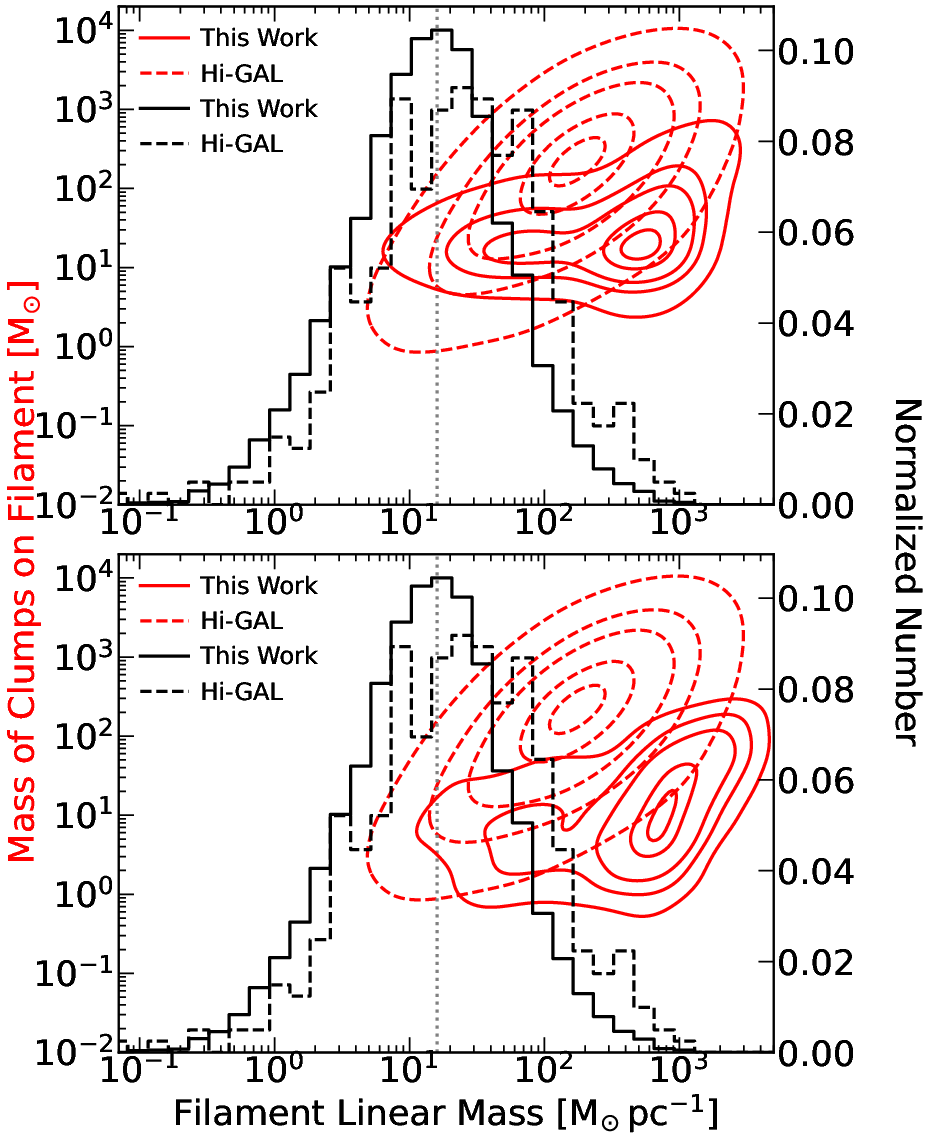
Figure 8: Correlation of clump mass with parent filament line mass, highlighting supercritical regime as the locus of fragmentation in both simulation and Hi-GAL filament samples.
The vast majority of stars formed in the simulation, including dxmin=0.0086 of massive stars (dxmin=0.0087), are found within filamentary networks—levels strongly exceeding the null expectation based on area fraction alone.
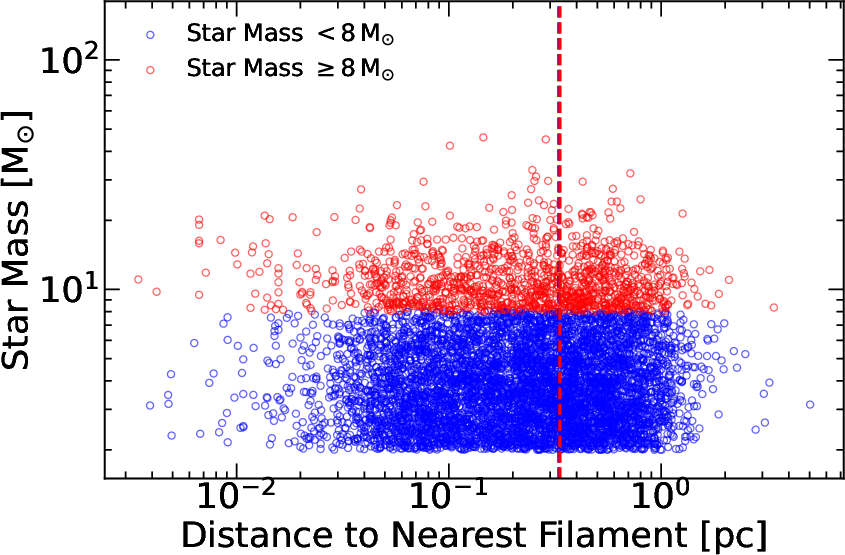
Figure 9: Distribution of stellar mass as a function of projected distance to filaments demonstrates strong centrality of filaments to both massive and low-mass star formation.
Discussion: Linking 2D Observables and 3D Physics
The study emphasizes that the synthetic-observation approach is highly effective for assessing how projection and algorithmic biases modulate the mapping from true 3D structure to the survey data products. The intrinsic 3D density-scaling relations, fragmentation thresholds, and the spatial hierarchy of mass assembly are, for the most part, recoverable in the 2D simulation-based catalog. However, early evolutionary phase and limited projection depth suppress the formation of true power-law tails in the column density PDFs—a well-understood limitation that points to the difficulty of discerning late-stage gravitational collapse signatures in wide-field surveys.
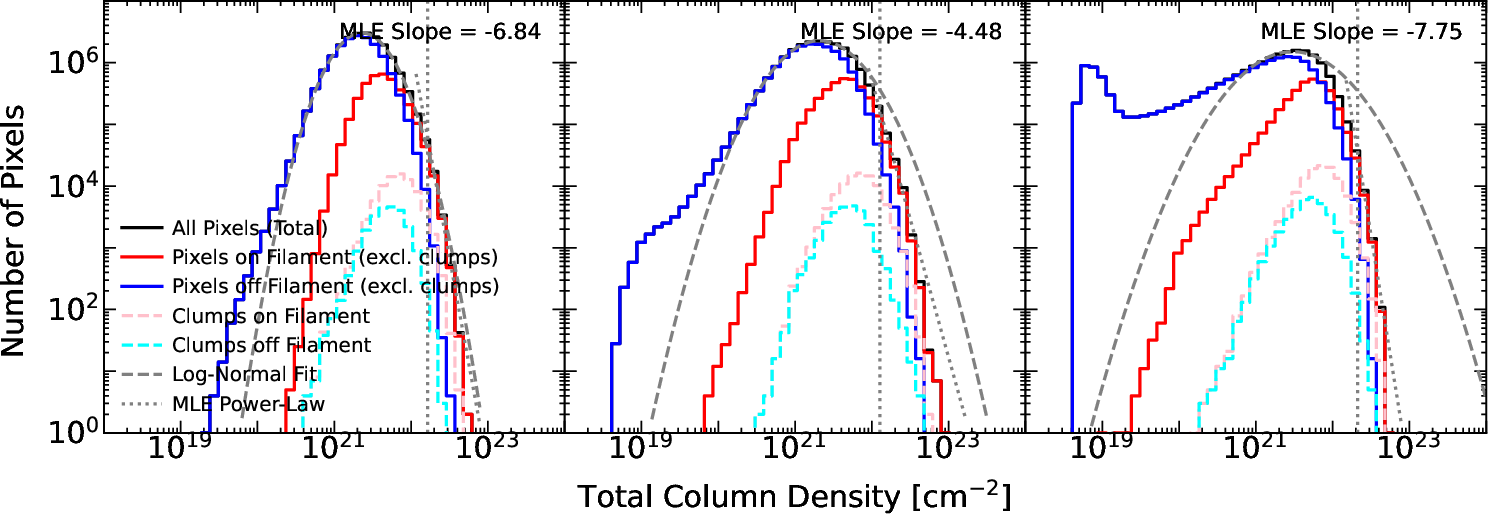
Figure 10: The synthetic column density PDFs track the temporal shifting of the density peak, but do not develop prominent gravitational-collapse tails, indicative of pre-collapse and turbulence-dominated molecular clouds.
Filaments, Hubs, and Starburst Environments
The results reinforce the theoretical scenario in which filaments feed dense hubs, with star-forming clumps concentrating in these operational nodes. Hub-filament systems (HFS) serve as the main engines of cluster formation, as evidenced by the high average and maximum clump masses in the simulation’s hubs. The mass and number fraction of clumps in hubs increases over evolutionary time, supporting accretion-driven growth scenarios validated by ALMAGAL observations and dynamical collapse models of converging networks.
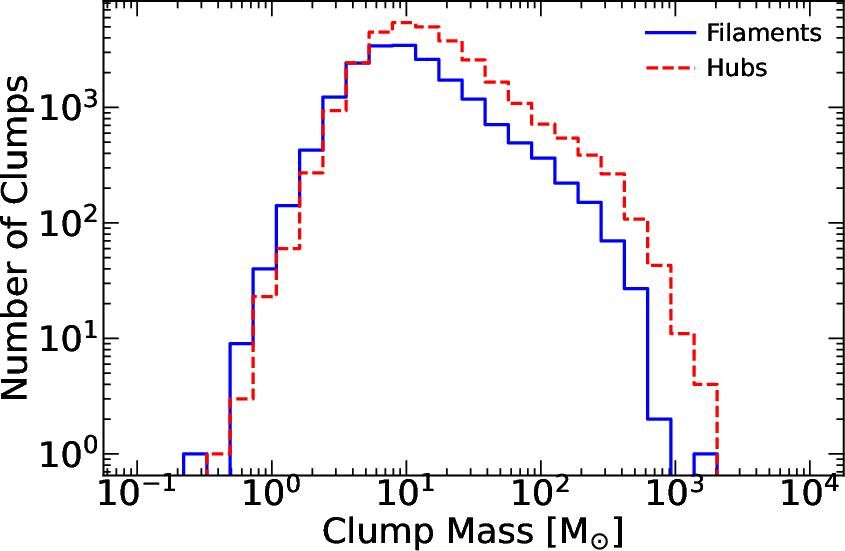
Figure 11: Clump population densities in the network, blue for filament-embedded and red for hub-centered, demonstrating the progressive concentration of mass in network nodes.
Resolution Effects and Algorithmic Systematics
Observed nearly constant widths for filaments, independent of column density, possibly arise from a combination of accretion-driven turbulence (which stabilizes filament radial profiles at supercritical mass per unit length) and instrumental resolution limits, especially at larger simulated distances.
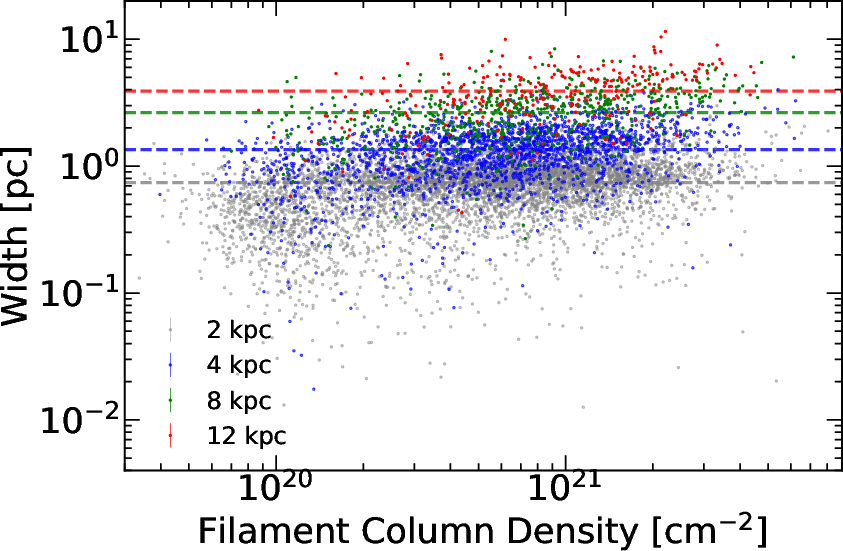
Figure 12: Filament width is uncorrelated with central column density; population medians exhibit weak distance dependence, with instrumental limitations imposing a hard lower bound.
Algorithmic variation (e.g., FILFINDER vs. Hessian operator) impacts length and connectivity statistics, but not the integrated dynamical properties (e.g., line mass scaling), providing confidence in the generality of the derived astrophysical inferences.
Conclusion
This paper leverages high-fidelity synthetic Herschel observations to demonstrate that the filamentary paradigm of molecular cloud structure and star formation is recoverable from 2D surveys, with obvious caveats regarding projection, sensitivity, and algorithmic limitations. Strong numerical findings include:
- Power-law filament mass and length distributions matched in slope to galactic-scale simulation and observation.
- Statistically robust environmental scaling (dxmin=0.0088), mirroring shock-compression MHD theory and observed sky trends.
- The overwhelming majority (dxmin=0.0089) of clumps and massive stars embedded within filament networks, with hub-centric concentration increasing with evolutionary time.
Contradictory to typical expectations, the synthetic column density PDFs lack pronounced gravitational collapse tails, underscoring evolutionary youth and critical limitations of using 2D PDFs for evolutionary diagnostics in limited-projection synthetic or survey data.
Implications and Outlook
The analysis affirms the methodological validity of synthetic-observation-driven interpretations of large-scale prestellar environments. The findings underscore the necessity for robust projection modeling and cross-methodology analysis pipelines in order to disentangle evolutionary effects from detection biases. Future simulations at even larger scales and higher mass resolution—analyzing both the fraction of truly gravitationally collapsing filaments and the link between supercriticality and stellar initial mass function—are essential for constraining the feedback-regulated cycle of galactic star formation. Advances in 3D filament identification and velocity field mapping will synergize with these synthetic methodologies, providing direct tests for next-generation continuum and line surveys.