- The paper develops a rigorous algebraic formulation that connects finite nonzero common polynomial roots to the logical qubit dimension in BBS codes.
- It establishes explicit criteria for boundary generator modifications, enabling systematic edge corrections without ad hoc fixes.
- An algorithmic approach is introduced that achieves competitive (n, k, d) tradeoffs for scalable, hardware-efficient quantum code design.
Algebraic Framework for Bivariate-Bicycle Surface Codes
Introduction
The paper "Algebra of Bivariate-Bicycle Surface Codes" (2606.08771) develops a rigorous algebraic formulation for constructing and understanding bivariate-bicycle-surface (BBS) quantum codes. These codes are built from pairs of bivariate polynomials over finite fields, and the work systematically elucidates how their structural properties—particularly the roots of these polynomials—determine essential code features such as code dimension, boundary structure, and practical implementation constraints. The analysis is set within the context of topological surface codes and quantum LDPC codes, with attention to code locality, encoding rates, and practical hardware concerns.
Algebraic Structure and Chain Complexes
The core formalism relies on interpreting BBS codes as chain complexes associated with Laurent polynomial rings over abelian groups, mapping physical qubits and stabilizer generators to algebraically tractable operations. The paper details the construction of such complexes for the infinite lattice and for finite-width strips, encoding the X and Z stabilizer generators in terms of polynomials a(x,y) and b(x,y).
A key algebraic result is that the code dimension—equivalently, the number of encoded logical qubits—is given by the number of simultaneous nonzero, finite roots of a(x,y) and b(x,y), counted with algebraic multiplicity. This dimension is invariant under monomial automorphisms, such as variable rescaling or unimodular substitutions, preserving the sublattice symmetries.
Boundary Conditions and Edge Modifications
One of the principal contributions is the derivation of explicit algebraic criteria relating the roots of a and b at zero or infinity to the necessity for boundary generator modifications. Roots of a and b where Z0 or Z1 vanishes (or is infinite) signal that standard truncation of bulk generators fails to guarantee the absence of low-weight boundary codewords, necessitating tailored edge corrections.
The work develops an explicit prescription: boundary rows in the generator matrices must be divided by the greatest common divisors of corresponding polynomial coefficients, effectively tailoring the code boundary to the algebraic multiplicity and location of these roots. Under these modifications, the boundary does not require ad hoc corner corrections, provided the polynomials satisfy orientation-specific edge conditions.
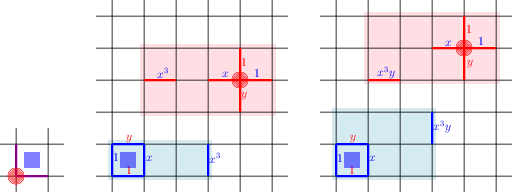
Figure 1: Planar layout of BB codes, with stabilizers and qubits mapped to vertices, edges, and plaquettes according to polynomial support.
Topological Invariance and Automorphisms
The invariance of the logical dimension under monomial automorphisms is established: finite, nonzero common roots are unaffected, whereas roots at zero or infinity—driving boundary effects—may appear or disappear under transformations. This observation provides a framework for predicting when boundaries in arbitrary lattice directions (including tilted or diagonal cuts) require explicit correction or are resolved automatically via truncation.
Practical Construction Algorithms
The authors formulate an explicit, algebraically grounded algorithm for constructing BBS codes with arbitrary boundaries (rectangular, diagonal, or generally tilted). The algorithm proceeds by defining strips in appropriate lattice directions, balancing code boundaries by selectively trimming qubits, and adapting boundary generators as dictated by the roots of the defining polynomials. The algorithmic formulation ensures code families with fixed dimension and distance scaling at least as fast as Z2, with all local stabilizers—enabling fault-tolerant operation.
Significantly, the construction generalizes existing tile code frameworks, offering both a strict formal foundation and broader design latitude via unrestricted polynomials and arbitrary boundary orientation. The equivalence conditions for tile code polynomials are made explicit, and cases where boundary/corner corrections are necessary are fully characterized.
An extensive computational survey explores the attainable Z3 tradeoffs for BBS codes generated via the proposed algebraic algorithm. Using weight-3 bivariate polynomials, the search identifies quantum codes that in many cases exceed or match the efficiency of previously optimized or lattice-grafted codes, particularly when diagonal boundaries are permitted.
Notably, for several code parameter pairs, the automated algebraic algorithm produces codes with shorter block length than even highly optimized handcrafted constructions. These findings are synthesized in tabular form, directly supporting claims about the algorithm's efficacy for practical quantum hardware deployment.
Implications and Future Research
The algebraic formalism developed in this work exposes a previously underappreciated connection between code properties and polynomial roots, deepening the theoretical foundation for modern topological quantum coding. Its invariant characterization of code dimension under automorphisms provides a powerful tool for code optimization and understanding of code dualities.
By revealing when and why boundary corrections are necessary, and by systematizing their implementation, the paper removes a substantial ambiguity in the design of high-rate, high-distance planar quantum codes. This provides a basis for further investigation into hardware-efficient fault-tolerant architectures, as the discussed symmetries and translation invariance can be directly exploited in circuit layout.
Moreover, the formalism suggests new avenues for exploring more general two-block group-algebra codes, lifted-product codes, and extensions to non-abelian group settings. It also points toward the systematic use of algebraic geometry for dimension and distance calculations, leveraging Gröbner basis techniques for code analysis and optimization.
Conclusion
This work provides a mathematically rigorous and practically actionable framework for constructing and analyzing bivariate-bicycle surface codes. Its main contributions consist of:
- Demonstrating that the logical dimension is given by the number of finite, nonzero common roots of the defining polynomials.
- Establishing explicit algebraic criteria for when boundary modifications are necessary, along with a systematic method for generating them.
- Generalizing existing construction techniques (such as tile codes) and enabling the efficient search for optimal codes across a vastly expanded space of polynomial pairs and boundary geometries.
- Providing concrete numerical results to substantiate gains in code size and overhead.
The algebraic methods introduced here not only clarify the essential structure of BBS codes but also lay the groundwork for their further theoretical development and scalable implementation in fault-tolerant quantum computing.

