- The paper introduces a framework for regularised arbitrary-gauge non-relativistic QED to address UV divergences and gauge-dependent light-matter interaction partitioning.
- It demonstrates that Lorentzian cut-offs significantly affect single-atom self-energies and inter-atomic couplings, with deviations over 30% at key atomic scales.
- It establishes conditions for the validity of the electric dipole approximation and multipolar Hamiltonians in regimes relevant to superradiant quantum phase transitions.
Introduction and Theoretical Framework
The paper develops a general, regularised, arbitrary-gauge non-relativistic quantum electrodynamics (nrQED) framework, addressing shortcomings in traditional paradigms where high-frequency (UV) pathologies and gauge-dependent partitioning of light-matter interaction have critical consequences for both single- and multi-atom systems. By systematically introducing Lorentzian cut-offs and rigorously quantifying their impact across distinct gauge choices—chiefly Coulomb and multipolar (Poincaré/Power-Zienau-Woolley)—the authors delineate the operational and conceptual boundaries of established approximations such as the electric dipole approximation (EDA), providing physical clarity on gauge invariance, regularisation-induced delocalisation, and the structure of effective interactions at short ranges.
A key assertion is that the partitioning of the total nrQED Hamiltonian into "free" and "interaction" segments is inherently gauge-relative, thus deeply entwined with the regulator applied to photonic modes. The analysis focuses on two primary model systems: the single hydrogen atom and the direct interaction between two atoms, moving beyond the typical reliance on EDA and the strict point-charge limit. The study also contextualizes the impact of these choices for phase transitions, such as the Dicke-model superradiant QPT, under high-density regimes where atomic overlap and direct interactions become significant.
Arbitrary-Gauge Regularisation and Hamiltonian Construction
Regularisation is introduced through a Lorentzian form factor φ(k)=kF2/(k2+kF2), with kF as a variable cut-off. This suppression of high momenta explicitly appears in the smearing of charge and current densities, thereby removing conventional UV divergences but at the expense of perfect spatial localisation. The gauge is specified by a Green function gT, interpolating between Coulomb (gT=0) and multipolar constructions—a methodology general enough to cover all frequently reconstructed field-matter decompositions.
The regularised Hamiltonian, derived via Dirac's constrained quantisation algorithm, enforces Gauss's law with the smeared charge density and maintains the canonical commutator algebra for matter and photonic operators. The resultant energy operator, Hg, incorporates explicit regulator dependence in both kinetic and interaction terms. The physical (observable) implications of gauge-relativity are highlighted in the nonlocality, with respect to the matter-photon tensor factorisation, of unitary maps connecting distinct gauge-fixings. This foundational structure allows the authors to systematically compare theoretical and practical effects of the regulator across gauge choices.
Single-Atom Energetics and the Role of Regularisation
The study analyzes self-electrostatic energies and Hamiltonian definitions for a single atom under arbitrary gauge and regularisation schemes. While the traditional (Coulomb gauge, unregularised) spectrum relies on a −1/r potential, the Lorentzian-regularised (finite kφ) Coulomb potential smooths the singularity at the origin, producing spectrum deviations for kφ near atomic inverse length scales (∼a0−1), but restoring the standard values as kφ approaches the inverse Compton wavelength (a natural relativistic UV cut-off).
In multipolar gauges, where additional "PZW" self-energy (kF0) terms emerge, it is shown that the inclusion of these can produce qualitatively different effective potentials—e.g., linear confinement at large kF1, severe for cut-offs exceeding atomic length scales. To prevent drastic deviations in physical spectra, the criterion is established that kF2 must remain a weak perturbation relative to the Coulomb part (condition I), achievable only for cut-offs not exceeding about kF3. For higher cut-offs, kF4 is necessarily strong, undermining the standard low-order perturbative treatment based on Coulombic bound states.
The strong numerical result presented is that even moderate cut-offs (e.g., kF5) can already yield observable deviations (over 30% at the dipole level for transition rates) from the unperturbed spectrum, as demonstrated for the kF6 spontaneous emission (see Figure 1).
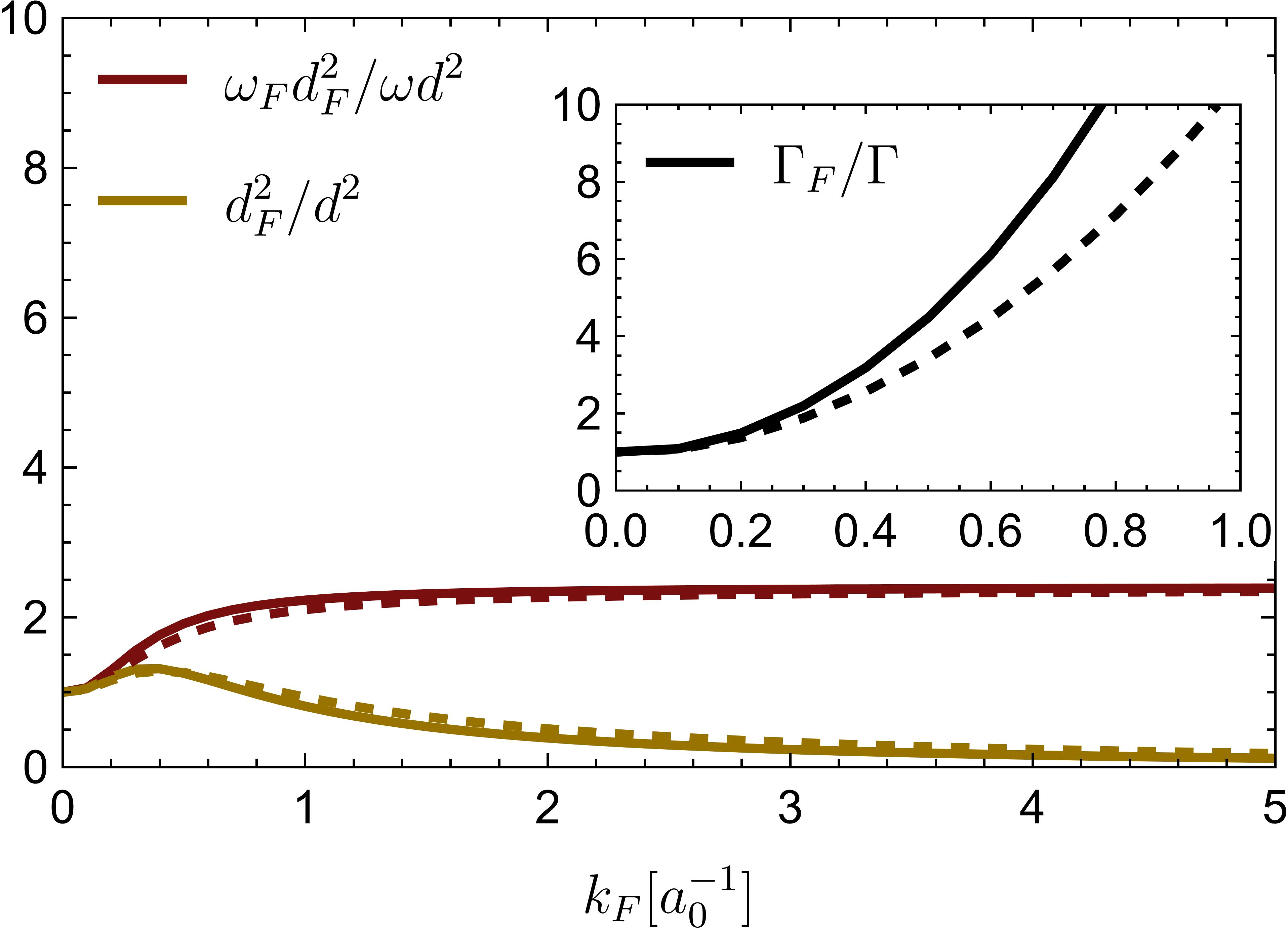
Figure 1: kF7 (dark yellow), kF8 (dark red), vs kF9, showing rapid departure from unity for gT0.
The analysis unambiguously indicates that the standard approach of including only Coulomb self-energy in gT1 is justified and robust only for large cut-offs, while alternative partitions or the inclusion of multipolar gT2-type terms must be justified on the grounds of their perturbative weakness.
Inter-Atomic Interactions: Regularisation, Localisation, and Direct Couplings
Moving to two-atom systems, the effect of regularisation on the pointwise spatial overlap and localisation of material subsystems is assessed. In the Coulomb gauge, the inter-atomic electrostatic energy reduces to the overlap of regularised longitudinal electric fields, which remains negligible for separations larger than a few Bohr radii for large cut-offs. Under multipolar regularisation, the spatial delocalisation caused by lowering the cut-off increases the overlap between atomic polarisations, meaning the direct static interaction—suppressed in the unregularised, point-charge multipolar gauge—re-emerges for smaller separations as the cut-off is reduced.
The key claim demonstrated quantitatively is that there is a pronounced, cut-off-dependent trade-off: increasing cut-off sharpens localisation and suppresses direct inter-atomic interactions, but necessitates the acceptance of a non-weak perturbation if the gT3 term is included in gT4. Conversely, lowering the cut-off ensures perturbative weakness but at the cost of nonlocality.
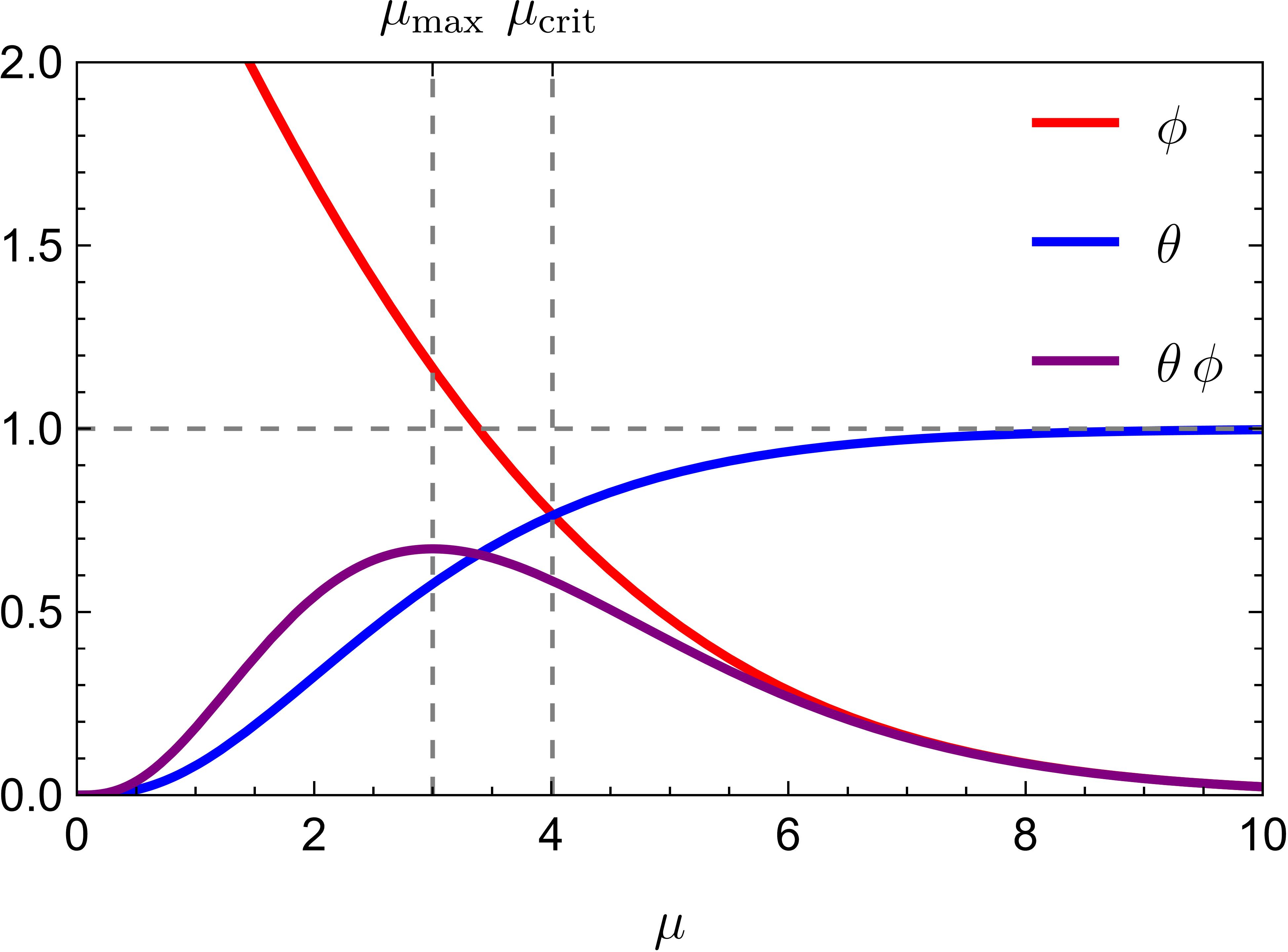
Figure 2: Ratios comparing multipolar and Coulomb-gauge direct interaction strengths gT5 and gT6 as functions of scaled separation gT7, highlighting loss of suppression in the multipolar gauge as gT8 is decreased.
This manifests most acutely in the short-range regime relevant for phenomena such as Dicke-model criticality or collective emission/absorption phenomena, where the distinction between local and retarded field-mediated interactions is crucial for both the theoretical consistency of the multipolar formalism and for the suppression of spurious, non-retarded direct couplings.
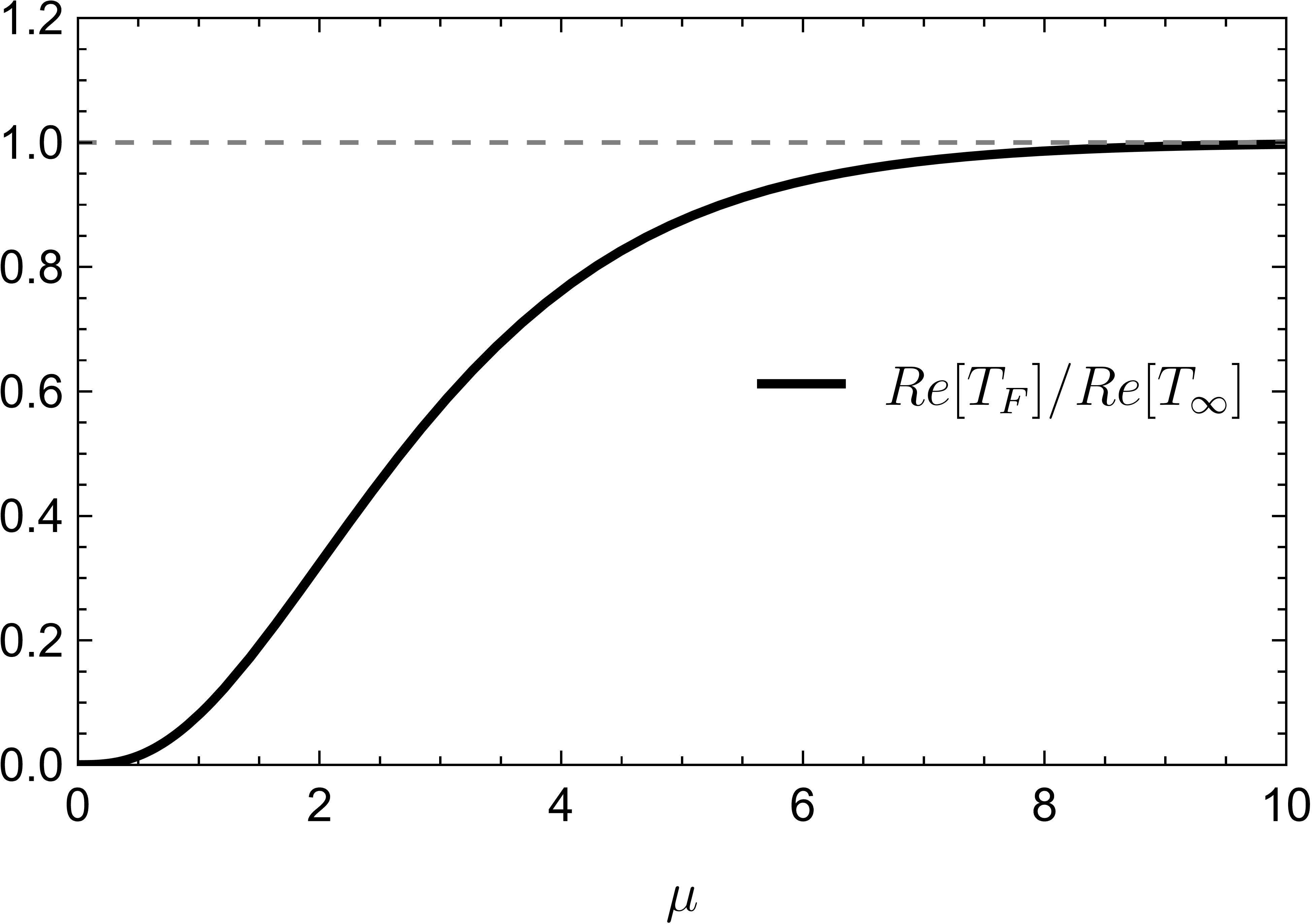
Figure 3: The ratio of the regularised transition element to the point-charge case versus gT9, elucidating the impact of regularisation on energy transfer rates as a function of cut-off.
Perturbative Calculations and the Electric Dipole Approximation
The authors provide comprehensive discussions on the consistency of the electric dipole approximation under various regularisation schemes. The breakdown point is associated with the parameter gT=00; when gT=01, neglected high-frequency virtual processes and atomic structure become increasingly important—coinciding with the scales at which direct interaction terms re-emerge in the multipolar gauge. Importantly, it is shown that Lamb shift and spontaneous emission corrections require a sufficiently high cut-off (gT=02 at least at the relativistic scale) for quantitative agreement with empirical values.
Thus, while cut-off lowering provides a calculational regime where all interaction terms are formally weak (satisfying condition I), it reduces the spatial sharpness of the multipolar partition and can lead to physically incorrect predictions for level shifts and radiative corrections if not properly justified.
Implications for Critical Phenomena and Future Directions
A central implication is the identification of precise consistency conditions for the application of multipolar (and more generally, arbitrary-gauge) nrQED to dense, short-range-interacting systems—such as those encountered in superradiant QPT or high-density microcavity QED. The findings clarify that the critical densities for such phase transitions, when formulated in terms of the dimensionless coupling gT=03, nearly coincide with the regime where EDA and simple field-matter partition become invalid due to overlap and strong inter-atomic static couplings.
The analysis calls for caution in the interpretation of multipolar Hamiltonian-based predictions for collective phenomena near such regimes, and suggests that engineered systems—e.g., dilute Rydberg gases with control over dipole moments and spacing—may be required to realize the theoretically predicted transitions without leaving the self-consistency domain of the EDA or incurring significant overlap effects.
Further, this work points towards the necessity of explicitly handling non-perturbative, possibly numerical treatments for systems operating near or within the overlap regime, going beyond standard partition-based analytical expansions. This also motivates generalisations to include relativistic corrections, multi-mode photons coupled to extended objects, and alternative regularisation schemes.
Conclusion
This paper systematically develops and analyzes a general, regularised, arbitrary-gauge formulation of non-relativistic QED. The main contributions include a rigorous framework for investigating the interplay between regularisation and gauge choice, a thorough quantification of the impact of regularisation on both single- and multi-atom systems, and a careful assessment of the regimes where the electric dipole approximation and traditional Hamiltonian partitions remain valid. Notably, the work demonstrates that commonly used multipolar Hamiltonians lose their signature suppression of direct interactions as cut-offs are lowered to maintain perturbative weakness, and that accurate predictions for radiative shifts require relativistically large cut-offs. These findings have broad implications for high-density quantum optics and future theoretical and experimental explorations of critical phenomena in engineered quantum light-matter systems.

