- The paper demonstrates a Lorentzian reformulation of the Gribov no-pole condition by recasting it as a boundary-value problem under Feynman conditions.
- It reveals that finite-frequency horizon crossings occur in chromoelectric backgrounds, contrasting sharply with traditional Euclidean results.
- The study emphasizes that a determinant-based horizon functional is essential for accurately capturing real-time dynamics in non-Abelian gauge theories.
Introduction and Motivation
The Gribov ambiguity, manifesting as non-uniqueness in local gauge fixing for non-Abelian gauge theories, has traditionally been framed via the Euclidean Faddeev–Popov (FP) operator's spectral properties. In the Euclidean Landau gauge, the first Gribov region is the domain of strict positivity for an elliptic, Hermitian FP operator. The Gribov horizon is reached when a zero mode appears, corresponding to a pole in the ghost propagator and enabling the construction of the Gribov–Zwanziger restriction through a local, renormalizable action.
However, in physical Minkowski (Lorentzian) spacetime, the FP operator transitions to a hyperbolic wave operator, and the notion of spectral positivity collapses as its spectrum becomes unbounded and continuous. The paper "A Lorentzian Gribov no-pole condition for Yang–Mills theory" (2606.08697) introduces a rigorously formulated Lorentzian analogue to the no-pole condition pertinent for real-time quantum field theory. The new principle is reframed as a boundary-value problem subject to the Feynman boundary conditions, rather than a spectral criterion.
Real-Time No-Pole Condition: Boundary Value Characterization
The Lorentzian reformulation posits that a background gauge configuration remains within the (now Lorentzian) first Gribov region if the solution space to the FP wave equation—with the Feynman boundary prescription—is trivial. Specifically, for any Aμ in Lorenz gauge,
M(1)={Aμ:∂μAμ=0,KerFΔA=0}0,
where ΔA is the hyperbolic FP operator. Here, the subscript F prescribes that solutions obey the Feynman boundary conditions, and 0 identifies the component connected to the vacuum. This approach replaces the conventional spectral positivity with an explicit dynamical question: can the FP wave equation admit a nontrivial source-free solution with the correct boundary behavior?
If the background is localized in time, the no-pole condition takes the form of the injectivity of the negative-frequency block, α−−, in the ghost scattering matrix. For stationary backgrounds, Fourier transformation separates frequency, reducing the condition to a spatial bound-state or resonance problem.
The condition is recast in operatorial language as the absence of −1 in the spectrum of GF0VA, where GF0 is the free FP Feynman propagator and VA is the color interaction potential:
M(1)={Aμ:∂μAμ=0,KerFΔA=0}0,0
In finite volumes, the vanishing of M(1)={Aμ:∂μAμ=0,KerFΔA=0}0,1 marks the Gribov horizon; in infinite volume, a Fredholm determinant regulates the obstruction. This structure is critical, as naive Feynman extensions of the Green’s function bilinear in the Zwanziger functional fail to reproduce the exact determinant, both near and away from the horizon.
Analytical Results: Wronskian Protection and Explicit Example Classes
A key technical result is the demonstration that mere frequency mixing induced by real-time gauge field fluctuations does not suffice to produce copy modes—protected by a conservation law, the Wronskian. In stable, self-adjoint temporal channels (e.g., time-dependent but spatially homogeneous color pulses), conservation of the auxiliary ghost flux ensures that M(1)={Aμ:∂μAμ=0,KerFΔA=0}0,2 remains injective. Thus, ordinary real-time temporal dynamics cannot drive the system to the horizon; a more intricate structure is required.
Two paradigmatic cases are examined: static chromomagnetic backgrounds and static chromoelectric wells.
Chromomagnetic Case: For smooth stationary color-magnetic backgrounds (e.g., Pöschl–Teller sheets), the horizon is crossed at zero frequency, reproducing familiar Euclidean Gribov phenomena as a spatial zero mode in the FP operator.
Chromoelectric Case: In contrast, for static chromoelectric wells, the horizon crossing occurs at a strictly nonzero frequency M(1)={Aμ:∂μAμ=0,KerFΔA=0}0,3, a phenomenon with no Euclidean counterpart due to the frequency-dependent potential depth induced by M(1)={Aμ:∂μAμ=0,KerFΔA=0}0,4 coupling directly to the time derivative in the wave operator. The corresponding finite-frequency bound state is a genuinely Lorentzian effect.
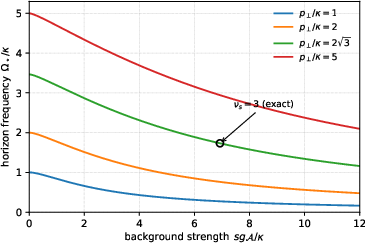
Figure 1: Frequency M(1)={Aμ:∂μAμ=0,KerFΔA=0}0,5 where the Gribov horizon is crossed in a static chromoelectric well, as a function of background strength and momentum; every nonzero coupling yields a positive M(1)={Aμ:∂μAμ=0,KerFΔA=0}0,6.
Explicit analytical solutions are constructed for these settings, with the chromoelectric well displaying an exact bound state at M(1)={Aμ:∂μAμ=0,KerFΔA=0}0,7 for suitable parameter choices, indicating a finite-frequency crossing of the Lorentzian horizon.
Horizon Functionals and Distinctions from Zwanziger’s Approach
Two functional forms are inspected to measure horizon crossing in real time:
- The "flow functional" M(1)={Aμ:∂μAμ=0,KerFΔA=0}0,8, constructed from M(1)={Aμ:∂μAμ=0,KerFΔA=0}0,9, diverges logarithmically as the lowest singular value of ΔA0 vanishes—thereby tracking the no-pole condition accurately.
- The Feynman-continued Zwanziger horizon functional ΔA1, a resolvent bilinear, diverges with a simple pole if and only if the background overlaps with the emergent copy mode. For symmetric backgrounds, this overlap can vanish, causing ΔA2 to miss the horizon crossing entirely.
These outcomes have pivotal implications: any genuine Lorentzian Gribov–Zwanziger action must encode a ΔA3—that is, determinant—structure, rather than a naive quadratic functional.
Theoretical and Practical Implications
This real-time reformulation aligns the non-perturbative gauge-fixing obstruction with the physical Feynman boundary prescription underpinning the Yang–Mills path integral, providing a direct Minkowski-space analogue to Gribov’s original proposal.
Importantly, this work corrects misconceptions about the effect of frequency mixing and specifies the sharp conditions under which genuine obstructions (copy modes) can occur, clarifying the interplay between dynamical gauge backgrounds and the mathematical structure of the gauge-fixed theory.
In practical terms, any attempt to study non-perturbative Yang–Mills dynamics in real time, such as for gluon confinement or spectral dynamics in Minkowski QCD, must account for this Lorentzian Gribov region, and cannot rely on direct Euclidean–to–Minkowski analytic continuation for nontrivial background fields.
Future Directions and Open Problems
A major unresolved question is the construction of a local, renormalizable Lorentzian Gribov–Zwanziger action reproducing the precise determinant structure found by this boundary-value analysis. Also of notable interest are backgrounds with simultaneous spatial and temporal structure, which may challenge or extend the scope of Wronskian protection and further elucidate the full boundary of the real-time Gribov region.
Conclusion
This work rigorously reforms the Gribov no-pole condition for Yang–Mills theory in Lorentzian signature, introducing a robust real-time boundary-value problem sensitive to the Feynman boundary prescription. Distinctly Lorentzian phenomena—such as finite-frequency horizon crossings in chromoelectric backgrounds—are analytically derived and shown to possess no Euclidean analogue. The functional–analytic structure demands a determinant-based horizon functional, invalidating naive extensions of the Zwanziger approach. These insights inform both formal quantum field theory and any future program in real-time non-Abelian gauge dynamics.