- The paper establishes sharp L² restriction estimates for toral Laplacian eigenfunctions, resolving the Huang-Zhang conjecture for high codimensions.
- It introduces a novel geometric slicing and packing method combined with multiplier approximations to reduce the problem to precise lattice point counting in spherical regions.
- The improved bounds for curves and totally geodesic submanifolds set new benchmarks, linking harmonic analysis, spectral theory, and arithmetic geometry.
Restriction Estimates for Toral Eigenfunctions and Lattice Points in Spherical Regions
Overview and Motivation
The paper "Restriction estimates for toral eigenfunctions and lattice points in spherical regions" (2606.08650) develops new, sharp L2 restriction estimates for eigenfunctions of the Laplacian on flat tori Td, with a focus on their restriction to submanifolds of arbitrary codimension. The restriction problem, central in spectral geometry and harmonic analysis, seeks to quantify how the L2 mass of an eigenfunction can concentrate or distribute when restricted to a given submanifold Σ⊂Td. These estimates are deeply connected with the arithmetic and geometric properties of the lattice points lying on the associated frequency spheres, and have implications for unresolved conjectures in the field, notably those of Bourgain-Rudnick and Huang-Zhang.
The authors resolve the Huang-Zhang conjecture for smooth submanifolds of sufficiently large codimension (m≥(d+3)/2 with d≥5), sharpen existing estimates for totally geodesic submanifolds, and produce improved restriction bounds for curves in T3. The approach fuses geometric slicing and packing arguments with discrete spherical multiplier approximations, notably those of Magyar-Stein-Wainger, leveraging both analytic and arithmetic tools.
Technical Foundations
Classical Restriction Estimates
Prior results ([BGT2006], [Hu2009]) establish that for an eigenfunction eλ on a compact Riemannian manifold of dimension d, restricted to a k-dimensional submanifold Td0 (codimension Td1), the Td2 norm obeys:
Td3
with Td4 scaling as Td5 for Td6, Td7 for Td8, and Td9 for L20. These bounds are optimal on spheres except for a logarithmic loss at codimension two.
Toral Setting and Bourgain-Rudnick Conjecture
The eigenfunctions on L21 are trigonometric polynomials corresponding to frequency vectors in L22. Restriction estimates thus depend on the lattice point distribution in spherical regions, an arithmetic aspect that often enables refining geometric bounds.
Bourgain-Rudnick formulated conjectures positing that restrictions to hypersurfaces (and more generally, to submanifolds of higher codimension) should display L23 norms uniformly bounded by global L24 norms, provided the submanifold is sufficiently regular (real-analytic, with curvature). Huang-Zhang extended this to codimension L25, predicting:
L26
for any L27.
Geometric and Arithmetic Decomposition
A central innovation is the reduction of restriction estimates to band-counting problems--quantifying the maximal number of lattice points in intersections of L28 transverse bands with the sphere. This band-counting quantity L29 characterizes regions near Σ⊂Td0-dimensional affine planes, making restriction problems equivalent to sharp lattice point counting in spherical slices.
Slicing and Packing Method
The slicing method decomposes spherical regions by affine planes, covering them by standard bricks whose projections have controlled diameter. Subsequently, packing arguments and recurrence relations (see Proposition \ref{prop:local}) establish upper bounds for the lattice points in these regions.
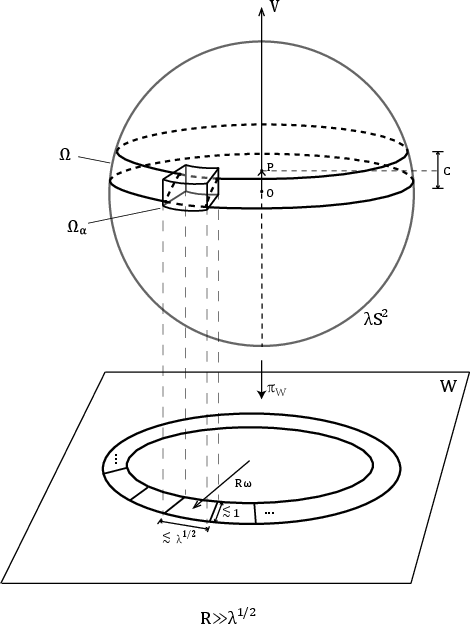
Figure 1: Lemma \ref{lem:shell} illustrates the decomposition of large spherical regions into standard bricks using geometric slicing and packing, crucial for bounding Σ⊂Td1.
The figure visually explicates the shell decomposition (Lemma \ref{lem:shell}), separating spherical regions into manageable smaller components whose structure is exploited for counting and restriction estimates.
Multiplier Approximation
For arbitrary smooth submanifolds, analytic methods (via discrete spherical multipliers) are necessary. Magyar-Stein-Wainger's spherical multiplier approximation expresses the counting function for lattice points as a main term plus an error, involving delicate estimates via Kloosterman sums. For eigenfunction restrictions, this yields bounds of the form
Σ⊂Td2
when Σ⊂Td3, improving classical results in this regime.
Main Results
Sharp Σ⊂Td4 Restriction Bounds
The core theorems assert:
- Sharp bounds for totally geodesic submanifolds: For Σ⊂Td5 and codimension Σ⊂Td6:
Σ⊂Td7
with explicit formulas for Σ⊂Td8 covering all codimensions and dimensions, refining classical bounds. For example, Σ⊂Td9 and for m≥(d+3)/20, m≥(d+3)/21.
- Resolution of Huang-Zhang for large codimension: For m≥(d+3)/22 and m≥(d+3)/23,
m≥(d+3)/24
thereby proving the conjecture in this parameter range.
- Improved bounds for curves on m≥(d+3)/25: For geodesic segments or curves with nonvanishing torsion/curvature,
m≥(d+3)/26
and for planar curves with nonzero geodesic curvature,
m≥(d+3)/27
These are consistent with the endpoint Discrete Restriction Conjecture ([BD]), further connecting restriction estimates and global m≥(d+3)/28 bounds.
Band Counting and Lattice Point Estimates
The reduction of restriction estimates to band-counting problems is made precise; estimates for m≥(d+3)/29 are sharp up to logarithmic losses and match conjectural exponents in specific geometric regimes. For instance,
d≥50
for d≥51, directly implying the sharp restriction bounds above.
Implications and Theoretical Discussion
These results represent a substantial refinement of prior restriction estimates in the toral case, particularly in the high-codimension regime and for special geometric configurations such as totally geodesic submanifolds and curves. The slicing and packing technique, combined with multiplier approximations, offers a powerful framework for handling the arithmetic-geometric interplay inherent in restriction phenomena on flat tori.
The resolution of the Huang-Zhang conjecture for large codimension and the improvement of bounds for curves provide new benchmarks for further investigation. The explicit connection between restriction estimates and band-counting/packing arguments anchors restriction theory within the lattice point distribution framework, deepening the interaction between harmonic analysis, number theory, and spectral geometry.
Further, the discussion situates restriction estimates within the broader context of global d≥52 bounds, showing that optimal restriction exponents follow from endpoint Discrete Restriction conjectures. This avenue suggests potential future research directions: leveraging decoupling theory, improved exponential sum estimates, or adaptive analytic multipliers to sharpen bounds in the remaining unresolved codimension and geometric cases.
Conclusion
The paper establishes sharp d≥53 restriction estimates for toral Laplace eigenfunctions, resolving long-standing conjectures for submanifolds of large codimension and improving quantitative bounds for curves and totally geodesic submanifolds. The geometric slicing and packing approach, together with discrete multiplier approximations, enables a reduction of restriction phenomena to lattice point counting problems, achieving exponents validated through lower bound constructions. These advances illuminate the profound connections between harmonic analysis, spectral theory, and arithmetic geometry on flat tori and signal promising avenues for further theoretical investigation concerning restriction estimates and lattice point distributions.