- The paper establishes exact approximation ratios for the coordinate-wise median: √2 for 1 ≤ p ≤ 2 and 2^(1-1/p) for p ≥ 2.
- It demonstrates that randomization via URCM and CRD improves worst-case performance, offering better ratios for specific p-regimes.
- The study employs geometric, probabilistic, and norm interpolation techniques to resolve open conjectures in strategyproof mechanism design.
Strategyproof Mechanisms for Euclidean Facility Location under Lp-norm Social Cost
Problem Formulation and Context
The paper investigates optimal strategyproof mechanisms for minimizing the aggregated Euclidean cost in two-dimensional facility location problems under Lp social cost objectives with p≥1. Each agent i declares a location xi∈R2, and the facility must be placed at a single output point. The goal is to design strategyproof mechanisms—deterministic or randomized—that produce facility locations minimizing
SCp(x,y)=(i∑∥xi−y∥p)1/p
where x is the profile of reported agents' locations. The mechanisms must be robust to manipulation: no agent should have incentive to misreport.
While the p=1 (total cost) and p=∞ (maximum cost) objectives have been comprehensively studied, the regime for general p presented unresolved issues—particularly regarding tight approximation guarantees for strategyproof mechanisms. Previous work established the coordinate-wise median (CM) as optimal among deterministic anonymous mechanisms for all Lp0, but the tightness of its guarantees was only conjectured for Lp1 and unknown for randomization.
Main Results: Tight Characterization of Deterministic Mechanisms
The first major contribution resolves a key open conjecture by Goel and Hann-Caruthers by establishing the exact approximation ratio of the coordinate-wise median (CM) mechanism for every Lp2:
- For Lp3, the tight ratio is Lp4.
- For Lp5, the tight ratio is Lp6.
This settles both upper and lower bounds, completing the landscape for deterministic, anonymous, and strategyproof mechanisms in two dimensions.
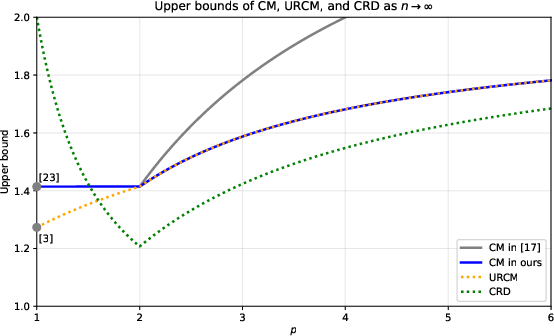
Figure 1: Upper bounds of Lp7, Lp8, and Lp9 as a function of p≥10 for large p≥11, capturing exact regime transitions and improvement under randomization.
These values are realized by explicit worst-case constructions, demonstrating that the factors are the best possible for any deterministic mechanism with the stated properties. The proof employs one-dimensional median inequalities, norm relation arguments, and geometric pairing techniques.
Improving Approximation Guarantees via Randomization
The paper further investigates two randomized mechanisms and establishes that randomization can strictly improve worst-case approximation in salient p≥12-regimes:
URCM operates by picking a uniformly random rotation of the 2D axes, applying the coordinate-wise median mechanism in the rotated basis, and then mapping the result back.
- For p≥13, the expected approximation ratio improves strictly over p≥14—e.g., for p≥15, the bound is exactly p≥16.
- The formula for the ratio is p≥17.
- As p≥18, the advantage of URCM vanishes, and for p≥19 the ratio coincides with the deterministic bound i0.
The improvement arises because, for i1, the expected i2-norm of the projected coordinates is strictly sub-additive; randomization allows the mechanism to escape axis-aligned worst cases.
Centroid Random Dictatorship (CRD)
CRD selects the centroid (mean of agent positions) with probability i3 and, with remaining probability, selects a uniformly random agent's position. This mechanism is shown to be strategyproof and to outperform both CM and URCM for all i4 above a specific threshold (i5).
- For i6, the ratio matches the best known deterministic and randomized lower bounds.
- For i7, the ratio is i8.
- For i9, the ratio approaches xi∈R20, strictly improving maximal cost compared to deterministic schemes.
URCM provides the best randomized guarantee close to xi∈R21, while CRD asymptotically dominates for larger xi∈R22.
Technical Insights
The methods employ sharp norm interpolation (e.g., Riesz-Thorin theorem for operator bounds), moment analysis of xi∈R23-projected lengths under random rotation, and careful decompositions of expected social cost contributions under randomization. The analysis of CRD utilizes operator norms for centering and pairwise-difference mappings, leveraging combinatorial symmetry and convexity.
The comparison in Figure 1 highlights regime transitions: for xi∈R24, URCM is optimal among these mechanisms; for xi∈R25, CRD is preferable.
Theoretical Implications and Open Directions
This work completes the classification of tight deterministic guarantees for 2D Euclidean facility location under xi∈R26-norm objectives and provides new benchmarks for the power of randomization. The identification of precise crossover points between randomized mechanisms sharpens the design space for practical applications.
On the theoretical side, it raises several challenges:
- The absence of general lower bounds for randomized mechanisms under the xi∈R27-norm social cost remains.
- The upper bounds for the two randomized schemes are not always tight for intermediate values; further analysis or construction of tight instances may close these gaps.
- The extension of results beyond xi∈R28 to higher dimensions, and to non-Euclidean (for instance, xi∈R29) norms, is left as future work; initial findings indicate dimension- and norm-dependent complexities.
Conclusion
The paper provides a comprehensive analysis of deterministic and randomized strategyproof mechanisms for Euclidean facility location under SCp(x,y)=(i∑∥xi−y∥p)1/p0-norm social costs, resolving long-standing open questions regarding the tightness of guarantees for coordinate-wise median and demonstrating that randomization enables provable improvements in key parameter regimes. These results directly inform the design of robust, non-manipulable facility location protocols under general norm objectives, with meaningful insights for multi-agent system design, voting, and economic resource allocation. They also lay the foundation for further exploration of tight bounds and the role of randomization in high-dimensional and alternative metric spaces.
(2606.08621)