- The paper introduces the Aco2 framework that leverages contrastive meta-RL to enable robust quadrotor payload manipulation in dynamic environments.
- It employs a GRU-based context encoder and supervised contrastive loss to infer latent task variables for rapid online adaptation.
- Zero-shot sim-to-real transfer and rigorous simulation tests demonstrate up to 46.2% gains in success rate for challenging out-of-distribution payloads.
This work addresses the challenge of autonomous payload manipulation for aerial robotic systems, specifically quadrotors equipped with passive hooks that must engage, transport, and deliver diverse handle-equipped payloads without human intervention. Real-world applicability is hampered by the extreme variability in payload properties—mass, geometry, inertial parameters—that substantially and unpredictably alter vehicle dynamics. Existing methods either limit autonomy (pre-attached payloads), impose restrictive requirements on end-effectors (specialized grippers), or lack generalization, especially on physically plausible, challenging payloads. The authors formulate the manipulation problem as a context-driven POMDP, where latent task variables encapsulate all unobserved variation induced by the payload and system.
The Aco2 Framework
The core contribution is the Aco2 (Autonomous aerial manipulation via Contextual Contrastive meta ReinfOrcement learning) framework. The system adopts a history-conditioned control policy: a context encoder (GRU-based) infers latent dynamics and environmental context on-the-fly from recent observations and previous actions. Instantaneous observations are fused with learned latent context for action selection and value prediction, enabling rapid online adaptation to new or perturbed payloads.
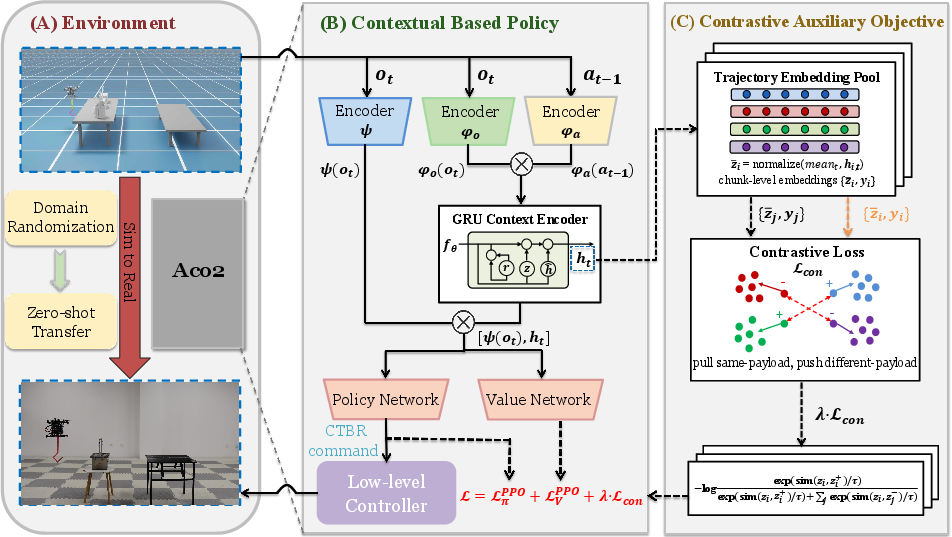
Figure 1: The Aco2 system integrating contextual encoding, contrastive regularization, and curriculum RL for adaptive aerial manipulation.
A contrastive auxiliary loss is imposed on the context embeddings: trajectory chunks from episodes with identical latent task variables are encouraged to cluster, while those from distinct contexts are repelled. Supervised contrastive loss [khosla2020supervised] stabilizes representation learning, directly addressing representation collapse that plagues multi-task RL.
Curriculum learning decomposes the difficult end-to-end hooking-transport-detachment task into tractable stages. The reward structure combines exponential and thresholded penalties to effectively balance aggressive task pursuit against safe, hardware-realistic control—specifically, regularizations penalize excessive action changes, velocity, and unsafe tilt, but only beyond specified operational thresholds.
Simulation and Real-World Evaluation
Aco2 is trained entirely in simulation (NVIDIA Isaac Sim), heavily leveraging domain randomization—masses, geometry, delays, observation noise, initial conditions, and external disturbances—to span a broad range of plausible real-world dynamics. The trained policy is then transferred zero-shot to a physical quadrotor without any additional fine-tuning.
Extensive simulation results across in-distribution (train-set payloads and spatial setups) and multiple OOD regimes (payloads of novel mass and goal locations) demonstrate substantial absolute gains in success rate with contrastive context learning, up to +46.2% in the hardest out-of-distribution settings. The contrastive policy not only improves average performance but significantly reduces variance, indicating robust generalization and avoidance of overfitting to individual payloads.
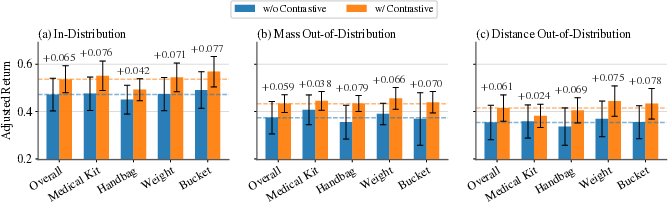
Figure 2: Adjusted simulation return in in-distribution and two OOD settings, with and without contrastive learning.
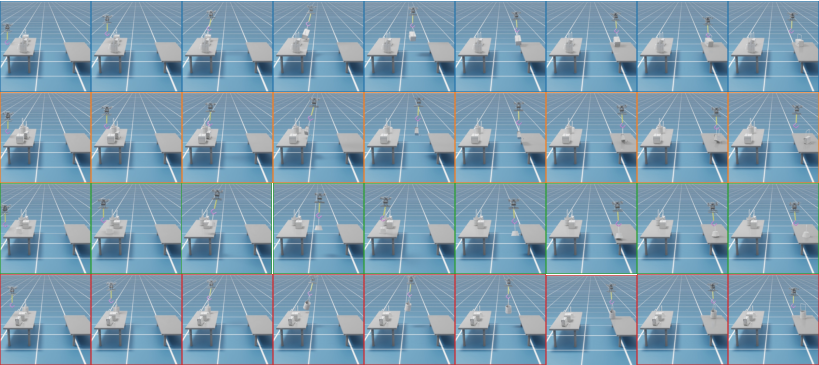
Figure 3: Simulation rollouts for four distinct payload categories, illustrating adaptation to variations in physical dynamics and geometry.
Notably, contrastive context learning yields context embeddings with high inter-task discriminability, as substantiated by t-SNE visualization: payload-specific representations are clearly separated only with the contrastive loss.
In real-world deployment, the Aco2-trained quadrotor autonomously completes full pickup-to-delivery sequences on objects with both familiar and entirely unseen physical properties. Importantly, the system performs robustly under payloads introducing entirely new aerodynamic disturbances and shifting centers-of-mass never encountered during simulation, without degradation or need for system identification.
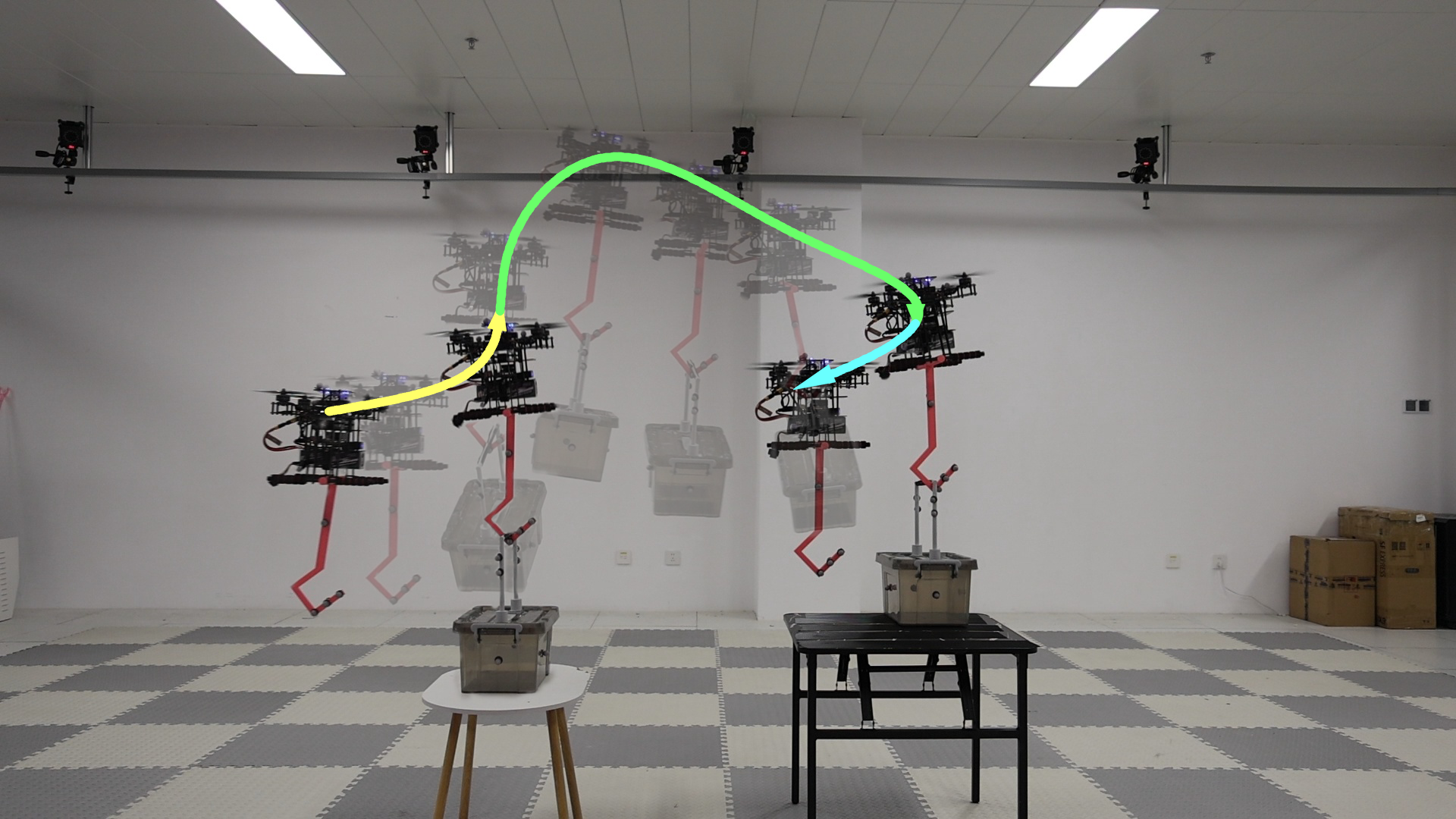
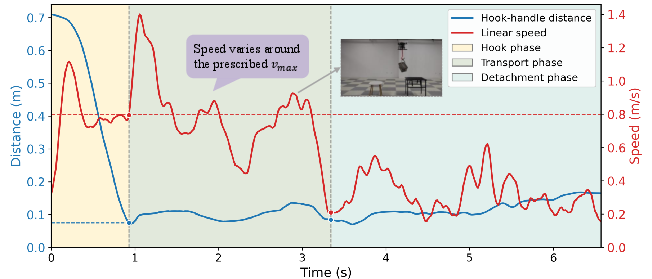
Figure 4: Real-world delivery: trajectory and physical analysis confirm accurate, repeatable behaviors and safe velocity/engagement profiles.
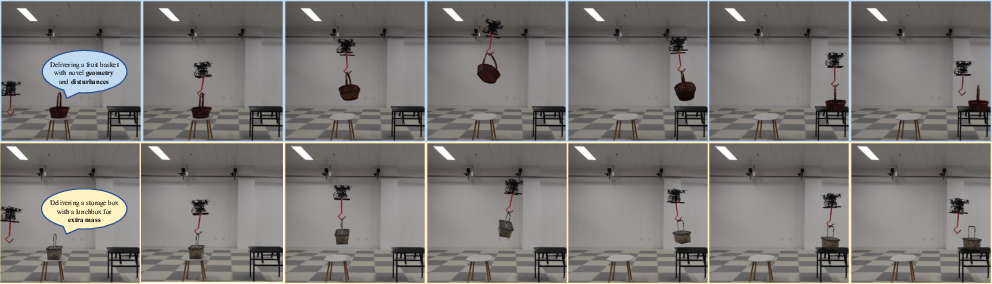
Figure 5: Successful deployment on unseen payloads—top, a geometrically novel basket; bottom, a mass-shifting container loaded with a meal.
Ablations confirm the necessity of regularization terms (thrust smoothness, velocity bounding, tilt, and angular velocity penalties) for safe and stable flight in hardware, and simulation analyses demonstrate that the overall reward structure with threshold-based penalties confers both stability and insensitivity to hyperparameter variations.
Theoretical and Practical Implications
By successfully deploying contrastive meta-RL in the high-dimensional, highly nonstationary aerial manipulation regime, this work illustrates the practical power of context-conditioned agents for adaptivity in real robotics scenarios. The explicit structuring of the context space using contrastive learning addresses generalization and task-interference issues that bedevil classical multi-task RL and vanilla meta-RL. Furthermore, training in pure simulation via domain randomization, then transferring zero-shot even to highly challenging mass/geometry cases, suggests a robust avenue for scalable deployment of autonomous aerial manipulation systems in logistics, supply delivery, and industrial transport.
The demonstration of a hook-based end-effector, rather than a specialized gripper or cable, underscores the generality of the approach: adaptation is achieved on the basis of recent physical interaction data, not handcrafted dynamics models or hardware-specific tuning.
Limitations and Future Directions
The current Aco2 realization remains dependent on external motion capture for state estimation, restricting application to instrumented environments. Onboard, vision-based state and payload estimation is required for broader practicality. The single-vehicle paradigm limits maximum payload, motivating extension to collaborative multi-UAV transport with decentralized, context-sharing policies, which will require further advances in multi-agent meta-RL and robust cooperative adaptation.
Conclusion
Aco2 provides a compelling framework for adaptive aerial manipulation: history-driven latent context inference, sharpened by contrastive representation learning and instantiated in recurring RL, yields a single policy capable of controlling a quadrotor hook-based manipulator across wide payload and environment variation. Theoretical advancements in contrastive meta-RL here translate into tangible robustness and sim-to-real transfer, opening new possibilities for autonomous aerial logistics and manipulation.

