- The paper demonstrates that curvature-induced scalarization in charged AdS black holes leads to a single, fundamental branch due to BF bound constraints.
- It uses analytical and numerical methods to examine effective potentials and delineate GB+ and GB– instability regimes triggering scalarization.
- Thermodynamic analysis shows that scalarized black holes are energetically favored over RNAdS solutions, undergoing a continuous second-order phase transition.
Curvature-induced Scalarization of Charged AdS Black Holes: Summary and Analysis
Introduction and Theoretical Context
The paper "Curvature-induced scalarization of charged AdS black holes" (2606.08507) conducts a comprehensive analysis of spontaneous scalarization in the Einstein-Maxwell-scalar-Gauss-Bonnet (EMsGB) framework with a negative cosmological constant. The investigation is focused on charged (Reissner-Nordström) AdS black holes, where scalarization is triggered by a quadratic coupling between a scalar field and the Gauss-Bonnet (GB) curvature invariant.
Scalarization phenomena, previously studied in asymptotically flat spacetimes, encounter unique features in the AdS context due to the confining geometry and the Breitenlohner-Freedman (BF) bound on effective masses for scalar fields. The paper demonstrates that the onset and structure of scalarized branches are sharply constrained in AdS, contradicting the generic presence of infinite branches observed in the flat-space case.
Instability Mechanism and Onset Analysis
Probe Limit and Effective Mass Structure
Scalarization occurs when the effective scalar mass term,
μeff2(r)=−4ηG,
becomes sufficiently negative to induce a tachyonic instability. Here, η is the GB coupling, and G is the Gauss-Bonnet invariant.
In AdS, instability is only relevant when μeff2 falls below the BF bound, making the instability region highly parameter-sensitive. The authors derive analytic and numerical constraints for parameter ranges corresponding to two distinct scalarization regimes:
- GB+ Scalarization (0<η<2.25 for Λ=−0.5): Supported when G>0, i.e., in certain regions of the black hole parameter space and for positive coupling.
- GB− Scalarization (η<0): Supported when η0, allowing scalarization for negative coupling but prohibiting it in domains where the sign condition is not met.
The profiles of the GB term and phase boundaries are mapped explicitly for various mass, charge, and cosmological constant values.
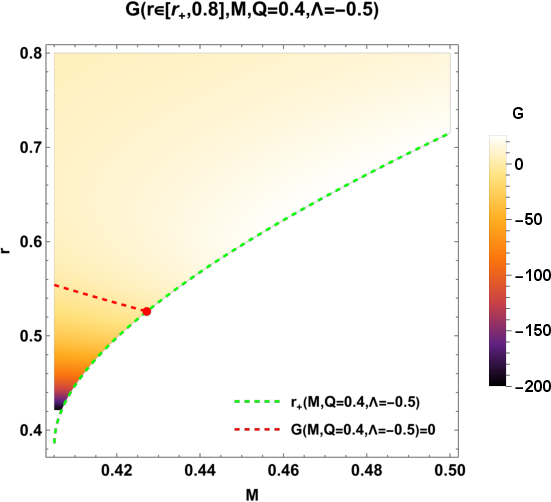
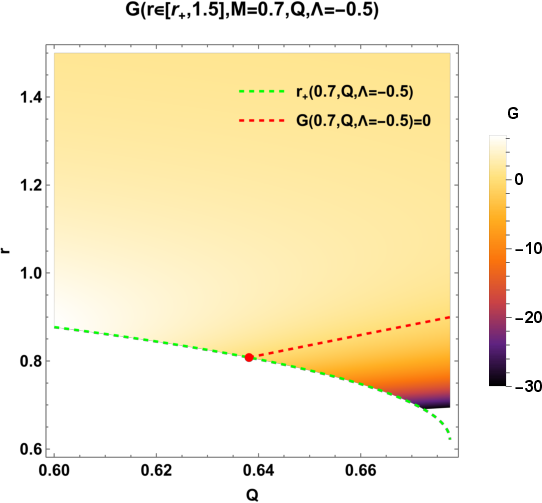
Figure 1: Profiles of the GB term η1 and outer horizon η2 near the horizon under varying parameters, illustrating the sign reversal essential for scalarization.
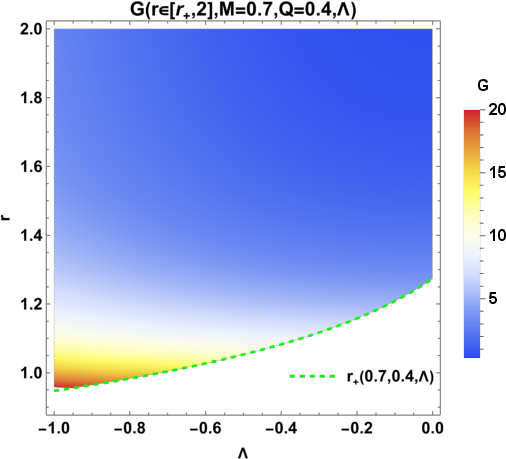
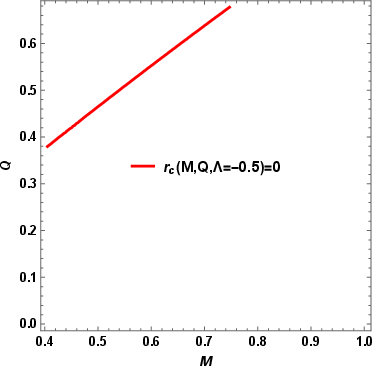
Figure 2: Near-horizon behavior of η3 as a function of η4 and the critical onset curve in the η5-η6 plane, distinguishing domains of GBη7 and GBη8 instability.
Potential Structure and Effective Schrödinger Analysis
The scalar perturbations are cast into a Schrödinger-like equation; detailed analysis of the effective potential η9 reveals the presence or absence of potential wells capable of supporting scalar bound states, depending on the GB coupling and black hole parameters. The asymptotic behavior and its dependence on G0 are illustrated, showing the transition to AdS-tachyonic instability at the BF bound.
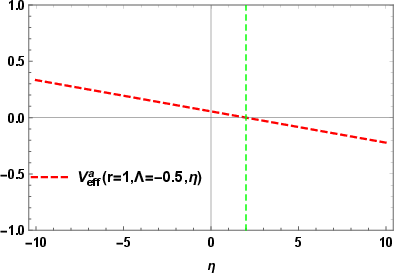
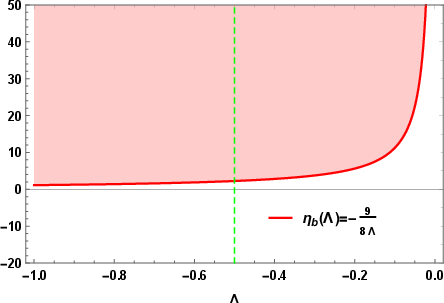
Figure 3: Coefficient of the asymptotic potential G1 and the BF bound for scalar perturbations, indicating the instability window for G2.
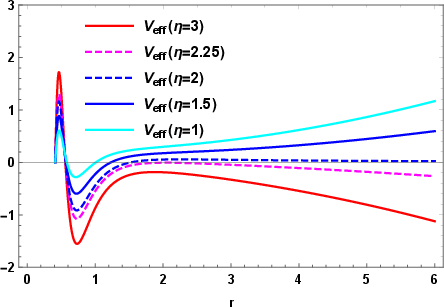
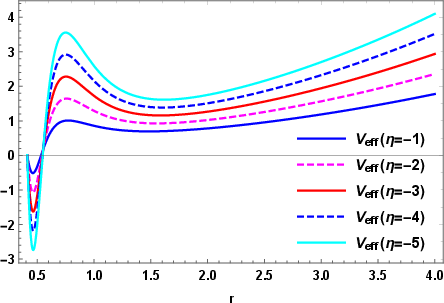
Figure 4: Effective potentials G3 for various G4 values, highlighting the development of tachyonic zones crucial for scalarization onset.
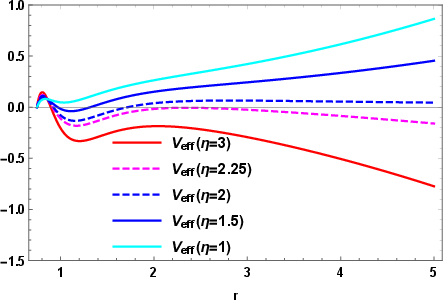
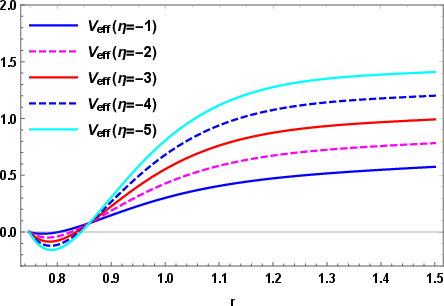
Figure 5: Effective potentials for the G5 branch, indicating negative near-horizon regions for GBG6 scalarization.
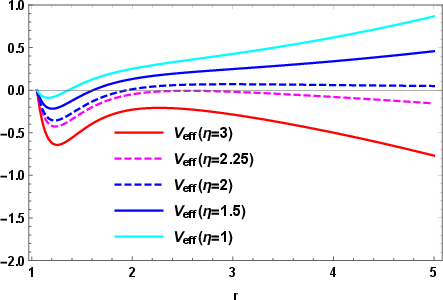
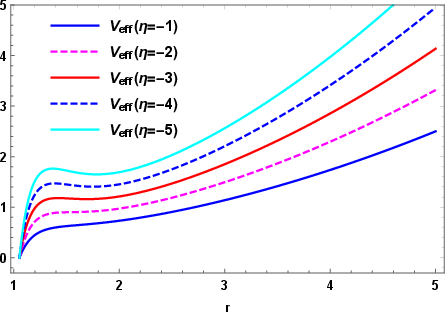
Figure 6: Effective potentials for the G7 branch, showing regions prohibitive to GBG8 scalarization.
Branch Structure and Numerical Construction
Branch Counting and Scalar Cloud Analysis
A critical focus is the number of scalarized branches allowed. Unlike asymptotically flat scenarios—where infinite scalarized branches are found—the combination of the BF bound and absence of deep enough potential wells in AdS restricts the scalarized solutions to a single fundamental branch (G9):
- For μeff20, numerics show only the μeff21 branch appears, with the μeff22 branch arising only outside the BF-stable interval.
- For μeff23, a single branch is supported by the negative near-horizon GB term.
This claim is substantiated by the detailed study of scalar cloud properties and their nodal structure.
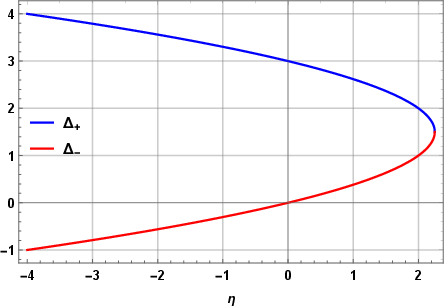
Figure 7: Characteristic exponents μeff24 as functions of μeff25, demarcating BF-stable and unstable regimes.
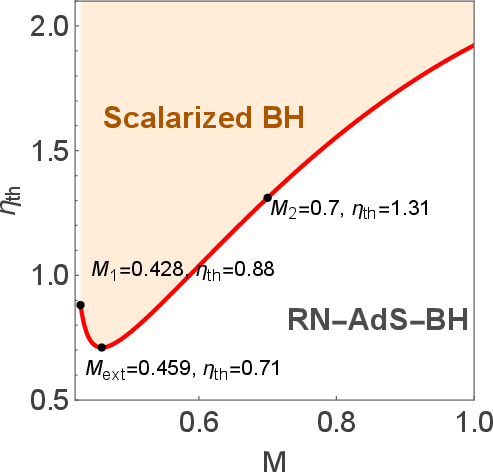
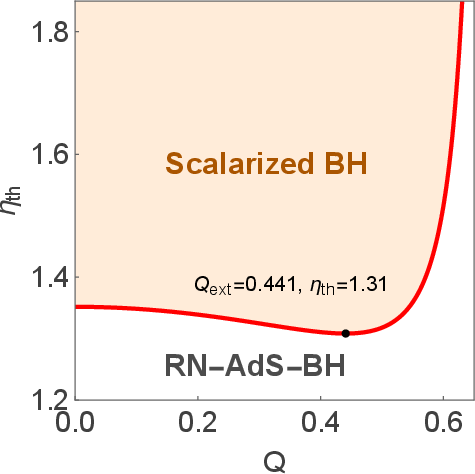
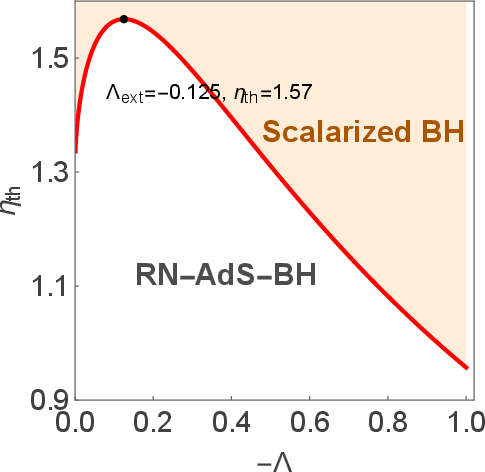
Figure 8: Threshold coupling constant μeff26 from scalar cloud analysis for spontaneous scalarization, marking the onset boundaries for different parameters.
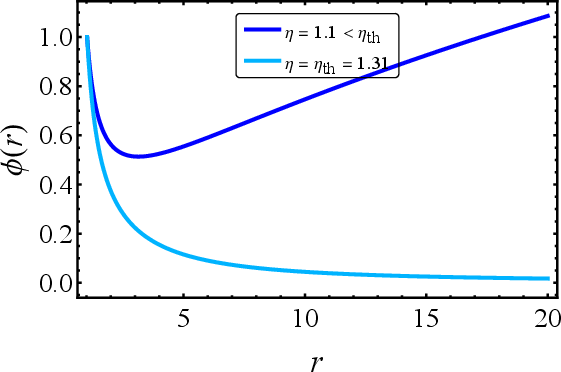
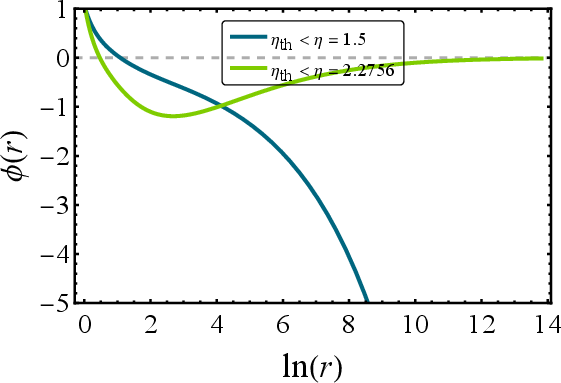
Figure 9: Radial profiles of the scalar field μeff27 demonstrating convergence/divergence behavior and node counting relevant for branch classification.
Fully Backreacted Black Hole Solutions
The coupled Einstein-Maxwell-scalar-GB field equations are solved numerically, imposing regularity at the event horizon and normalizability at infinity. The resulting solutions are:
- GBμeff28 Scalarized AdS black holes in the single, fundamental branch, with backreaction significantly altering the near-horizon geometry but preserving correct AdS asymptotics.
- GBμeff29 Scalarized AdS black holes found for +0, supporting highly compact scalar hair near the horizon.
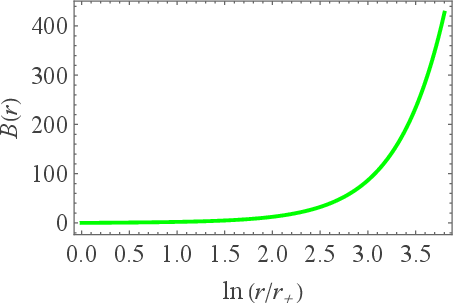
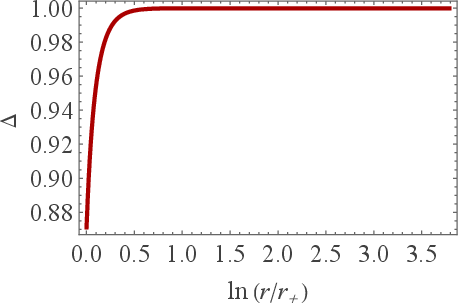
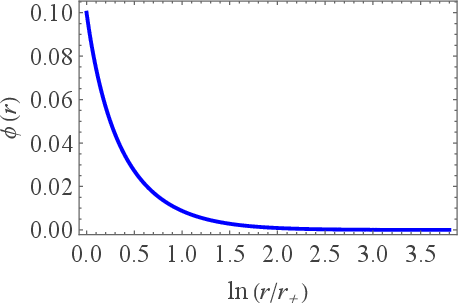
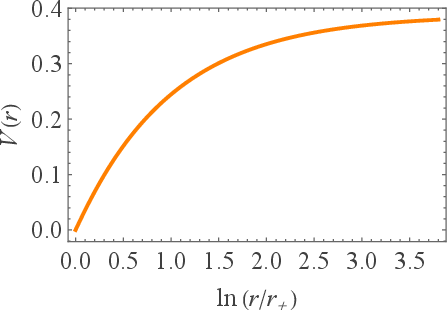
Figure 10: Radial profiles of the GB+1 scalarized AdS black hole, including metric functions, the scalar hair, and the electromagnetic potential under typical parameters in the allowed regime.
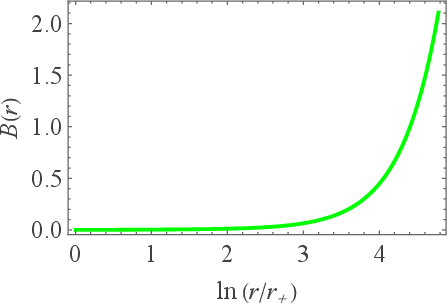
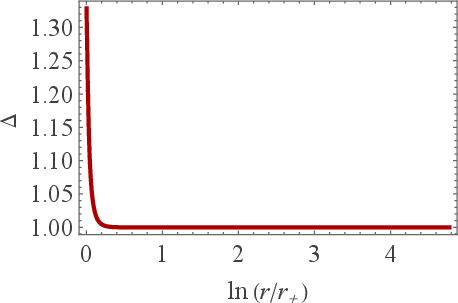
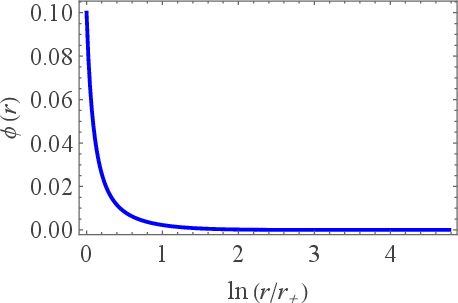
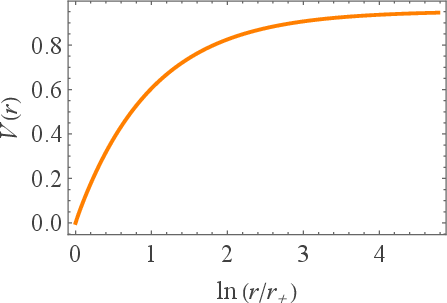
Figure 11: Radial profiles for GB+2 scalarized AdS black holes, showing distinct features in the metric ratio and scalar field compactness compared to the GB+3 case.
Thermodynamics and Phase Transitions
The thermodynamic investigation employs the canonical ensemble with fixed charge. The Gibbs free energy is calculated using the Wald entropy, incorporating GB corrections. The authors demonstrate:
- Scalarized AdS black holes in both GB+4 and GB+5 regimes universally possess lower Gibbs free energy than their bald (RNAdS) counterparts—implying their thermodynamic preference.
- The +6 curves show continuous, smooth transitions at the onset, with no swallowtail or discontinuous structure. The specific heat stability and continuity of entropy derivative confirm a second-order phase transition at the bifurcation point in both cases.
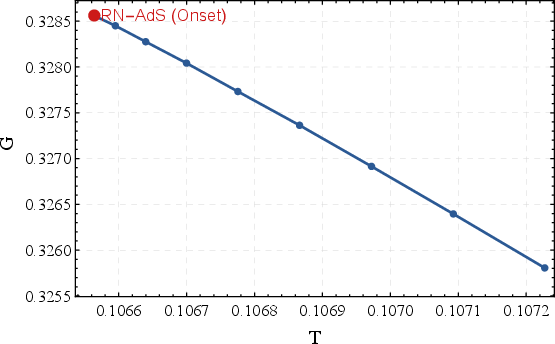
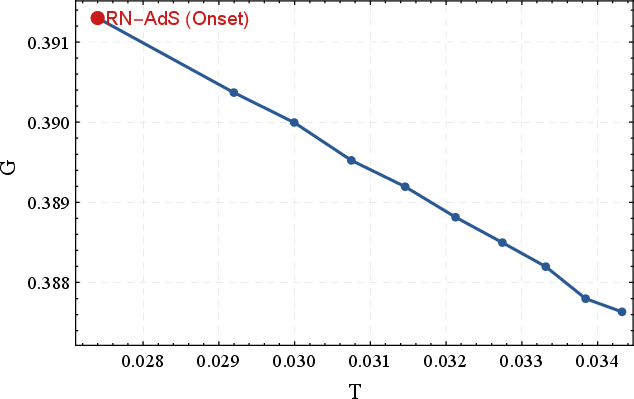
Figure 12: Gibbs free energy versus temperature for both GB+7 and GB+8 scalarized AdS black holes, with continuous transitions confirming the second-order nature of the scalarization phase change.
Implications and Future Perspectives
Theoretical Implications:
The results establish that the curvature-induced scalarization mechanism is qualitatively altered in the AdS context by the interplay of the confining geometry and the BF bound. The emergence of a single branch (and prohibition of higher branches in the stable region) represents a marked deviation from the flat-space scenario and sets strong restrictions on the landscape of possible hairy black holes in negative curvature backgrounds.
Practical Implications:
AdS black holes with non-trivial secondary scalar hair—arising spontaneously from curvature terms—may have relevance in gravitational wave signals and AdS/CFT-inspired holographic models, especially in contexts sensitive to scalar operator instabilities on the boundary.
Future Developments:
Further research could analyze the dynamical aspects of the spontaneous scalarization transition and extend the analysis to rotating black holes, higher dimensions, or more general couplings. The interface with holographic models and possible condensed matter analogues in the AdS/CFT correspondence, especially regarding critical exponents and phase structure, also remains a fertile avenue.
Conclusion
This work rigorously delineates the spontaneous scalarization of charged AdS black holes in the EMsGB model. The demonstration that only a single branch of scalarized black holes exists within the BF-stable interval, for both GB+9 and GB0<η<2.250 coupling ranges, contrasts with the asymptotically flat scenario. All scalarized solutions are globally thermodynamically favored and the transition from the RNAdS background is of second order. These results have significant consequences for the allowable hairy AdS black hole solutions and for the theoretical modeling of gravitational phase transitions in curved backgrounds.
(2606.08507)

