- The paper introduces a novel OctaOctree spatial-angular cache with a learned disparity shift that enables single-query radiance prediction for real-time glossy rendering.
- The method combines adaptive octree subdivision with octahedral parameterization to efficiently capture high-frequency, view-dependent reflections and reduce Monte Carlo noise.
- Experimental results show lower MAPE and LPIPS scores compared to prior methods, demonstrating superior reflection fidelity and reduced inference latency.
OctaOctree Neural Radiosity for Real-time Glossy Material Rendering
Introduction and Motivation
OctaOctree introduces a hybrid spatial-angular radiance cache for scene-specific neural radiosity, addressing the endemic difficulty in representing high-frequency, direction-dependent radiance distributions for glossy and specular BRDFs. Traditional neural global illumination techniques, particularly in the neural radiosity and neural radiance caching regimes, tend to rely on positional encodings and spatially-organized caches. While effective for diffuse interreflection, these approaches struggle to capture sharp view-dependent features without a commensurate increase in model complexity or sampling density.
Previous methods such as Neural Cone Radiosity (NCR) improved glossy transport fidelity via cone-based encoding but suffered from additional computational overhead due to reliance on multiple ray intersections per query. OctaOctree circumvents these bottlenecks by constructing an explicit spatial-angular cache, aligning the radiance representation with the physical structure of light transport, thus enabling efficient and accurate radiance prediction with a single network query at the primary intersection.
Methodology
Scene Representation: OctaOctree Spatial-Angular Cache
OctaOctree builds a multi-level, adaptive octree over 3D space, with each cell containing an octahedral directional map that discretizes the angular domain. This coupling of adaptive spatial partitioning with explicit angular storage provides complementary spatial-angular resolution: coarse spatial cells receive higher angular fidelity to resolve broad glossy or specular lobes, while fine spatial cells capture localized geometric or shading variations with reduced angular granularity.
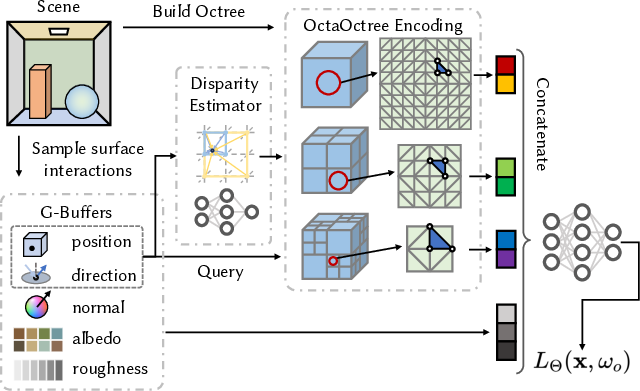
Figure 1: The OctaOctree pipeline combines spatial octree subdivision with octahedral directional maps, augmented by a disparity predictor for adaptive direction shifting at each query.
Octahedral parameterization maintains uniform coverage of the spherical domain and enables efficient interpolation across directions. For each surface query, the apparent outgoing direction is shifted according to a learned disparity (analogous to a soft, local reprojection guided by a compact hash-encoded predictor), aligning lookups with the dominant reflected content and yielding smoother, more accurate interpolation along reflection boundaries.
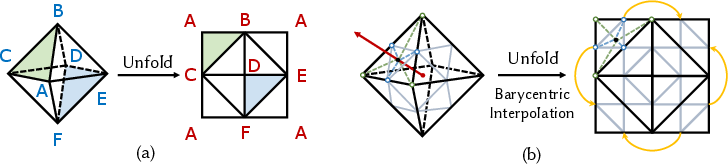
Figure 2: Octahedral mapping and continuous barycentric interpolation ensure smooth, cross-face directional queries throughout the sphere.
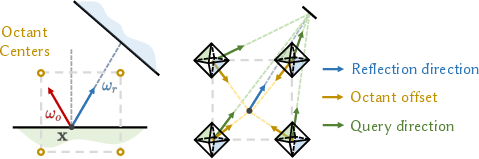
Figure 3: The disparity-based direction shift mechanism realigns angular lookups, improving radiance reconstruction near reflection discontinuities.
Network Architecture and Training Paradigm
The overall system comprises (i) the OctaOctree parameter buffers, (ii) an Instant-NGP-style disparity predictor to generate continuous direction shifts for each query, and (iii) a lightweight MLP decoder that maps concatenated multi-scale features and G-buffer attributes to outgoing radiance.
The entire model is optimized end-to-end using the self-supervised neural radiosity paradigm: the predicted primary-hit outgoing radiance is supervised by a Monte Carlo discretization of the rendering equation, where the right-hand side is computed via secondary ray sampling, but detached from the gradient path for stabilization. The loss is formulated as a relative L2 objective on radiance.
Experimental Results
Quantitative and Qualitative Comparisons
OctaOctree demonstrates improved performance across a series of challenging scenes encompassing both diffuse and sharply glossy materials. Compared with Neural Cone Radiosity, vanilla Neural Radiosity, image-space denoising (OIDN), and deferred NR/NRC (secondary-hit cache queries), OctaOctree produces lower MAPE and LPIPS scores on all scenes, while achieving lower or comparable inference latency.
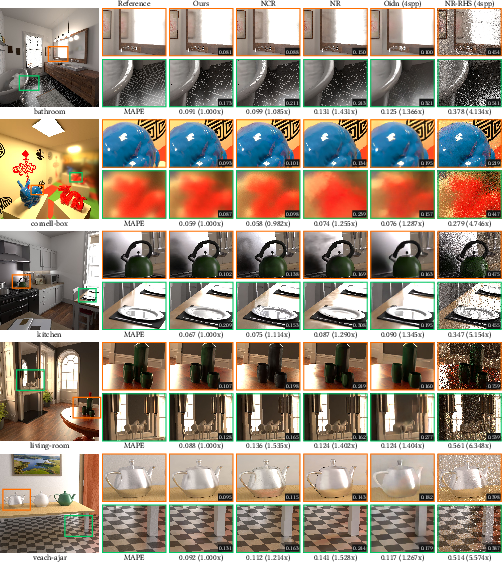
Figure 4: Rendered results show that OctaOctree yields cleaner and more accurate glossy reflections—minimizing both noise (relative to deferred NR/NRC and NCR) and over-blurring (relative to vanilla NR and OIDN).
OctaOctree achieves strong improvements in reflection stability and fidelity, particularly under spatial camera or lighting motion, obviating persistent artifacts such as flickering or high-frequency noise seen in baseline methods.
Representation and Feature Analysis
Visualizations of learned OctaOctree features at various hierarchy levels confirm the method's key design principle. Coarse spatial levels encode broad, spatially-smooth but angularly-detailed features, while fine levels capture high-frequency, local shading and visibility variations.
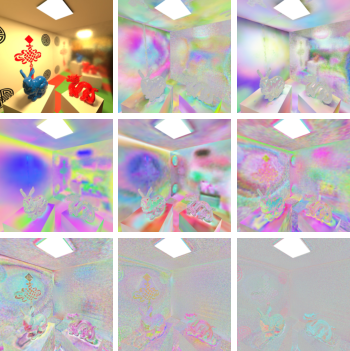
Figure 5: Coarse OctaOctree levels encode global reflected arrangements with sharp angular selectivity; finer levels resolve localized geometry and short-range illumination details.
Predicted disparity fields are shown to form smooth, medium-scale reprojection patterns that distribute neighboring angular queries adaptively, stabilizing radiance estimation near boundaries and avoiding hard geometric discontinuities.
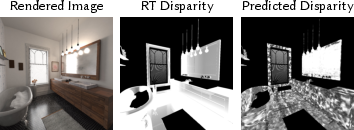
Figure 6: Predicted disparity fields operate as local reprojection maps, yielding smoother interpolation and reflection stabilization compared to hard ray-traced depths.
Ablation Studies
Ablating the direction shift mechanism or substituting it with raw outgoing/viewing directions results in visibly blurrier and less accurate reflections. Using the actual ray-traced depth for shifting provides marginal improvements in MAPE, but suffers from perceptual artifacts due to abrupt discontinuities at reflection occlusion boundaries—demonstrating the superiority of the learned, continuous disparity field.
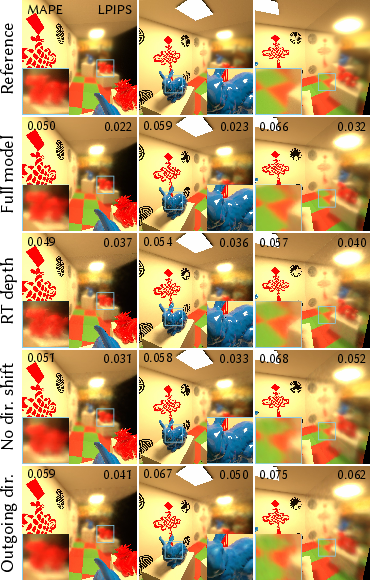
Figure 7: Removing direction shift or using the viewing direction blurs reflections; substituting learned disparity with ray-traced depth yields perceptual artifacts despite minor quantitative improvements.
Similarly, removing trilinear/barycentric spatial or angular interpolation leads to blocky, discontinuous artifacts and loss of fidelity, emphasizing the necessity of smooth interpolation in both spatial and directional domains.
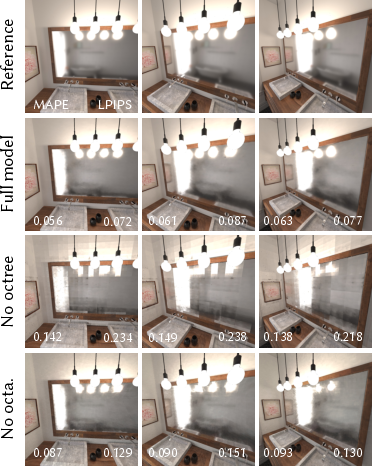
Figure 8: Ablating interpolation results in blockwise artifacts, clearly demonstrating the contribution of continuous, multi-cell and multi-direction blending for both spatial and angular cache queries.
Practical and Theoretical Implications
OctaOctree delivers a transport representation that enables real-time, path-tracing-quality global illumination for glossy and specular materials, with cache query cost largely decoupled from the complexity of directional radiance distributions. By transferring the encoding of transport structure from the network to the cache, it allows for significantly more compact decoders without sacrificing fidelity. The architecture is compatible with online or incremental optimization and can be naturally extended to dynamic scenes or other transport-driven learning paradigms such as neural path guiding or control variates.
The explicit, adaptive spatial-angular decomposition in OctaOctree provides a scaffolding for future research on transport-aware neural representations, and may inform new developments in neural rendering of complex light transport phenomena, especially those that are strongly non-local or directionally sparse.
Conclusion
OctaOctree Neural Radiosity bridges the performance-quality gap for real-time rendering of glossy and specular materials via an explicit spatial-angular cache. The key advances are the octree-organized, octahedrally-parameterized radiance storage and a learned disparity-driven direction shift that aligns interpolation with physical transport. This cache design enhances the fidelity and efficiency of scene-specific neural radiosity, enabling accurate single-query radiance prediction and significantly reducing Monte Carlo noise and artifacts inherent in previous approaches. The method's strong empirical results and flexible architecture mark a substantial step toward high-fidelity interactive global illumination for a broad spectrum of material and geometric complexity.
Reference: "OctaOctree Neural Radiosity for Real-time Glossy Material Rendering" (2606.08469)

