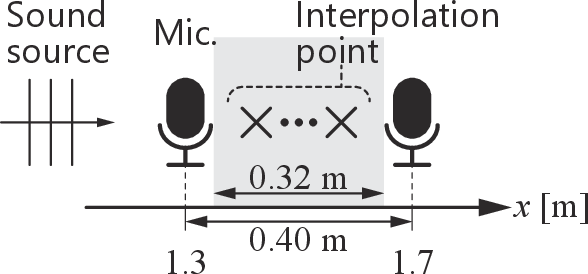
- The paper introduces a physics-informed extreme learning machine (PIELM) that leverages PINN-based pre-training to bolster hidden-layer stability for sound field interpolation.
- It achieves near iterative PINN accuracy with more than three orders of magnitude faster adaptation using a closed-form update under PDE constraints.
- The integration of explicit acoustic wave equation constraints with pre-trained hidden representations ensures robust performance from sparse microphone data.
Introduction and Motivation
High-fidelity sound field interpolation from sparse microphone measurements is critical for applications such as active noise control, virtual/augmented reality, and acoustic environment reconstruction. While traditional approaches—such as compressive sensing, kernel-based interpolation, and neural network-based models—have demonstrated progress, they often suffer from limited accuracy or high computational demands, particularly when physical constraints are not explicitly enforced. Physics-informed neural networks (PINNs) address this by embedding the governing partial differential equations (PDEs) into the loss function, yielding superior performance with fewer labeled data. However, the expensive iterative gradient-based training of standard PINNs hinders their applicability for low-latency or real-time scenarios.
This work proposes a hybrid approach that integrates PINN-based pre-training with a closed-form Physics-Informed Extreme Learning Machine (PIELM) adaptation, targeting efficient and accurate sound field interpolation in a one-dimensional free-field setting. The primary contributions are (1) a formalization of PIELM for acoustic sound field estimation under the wave equation constraint and (2) the introduction of hidden-layer weight pre-training via PINNs to stabilize and enhance closed-form adaptation.
Methodology
The framework consists of two stages: PINN-based pre-training for hidden-layer weights and closed-form PIELM-based sound field interpolation for each target audio environment.
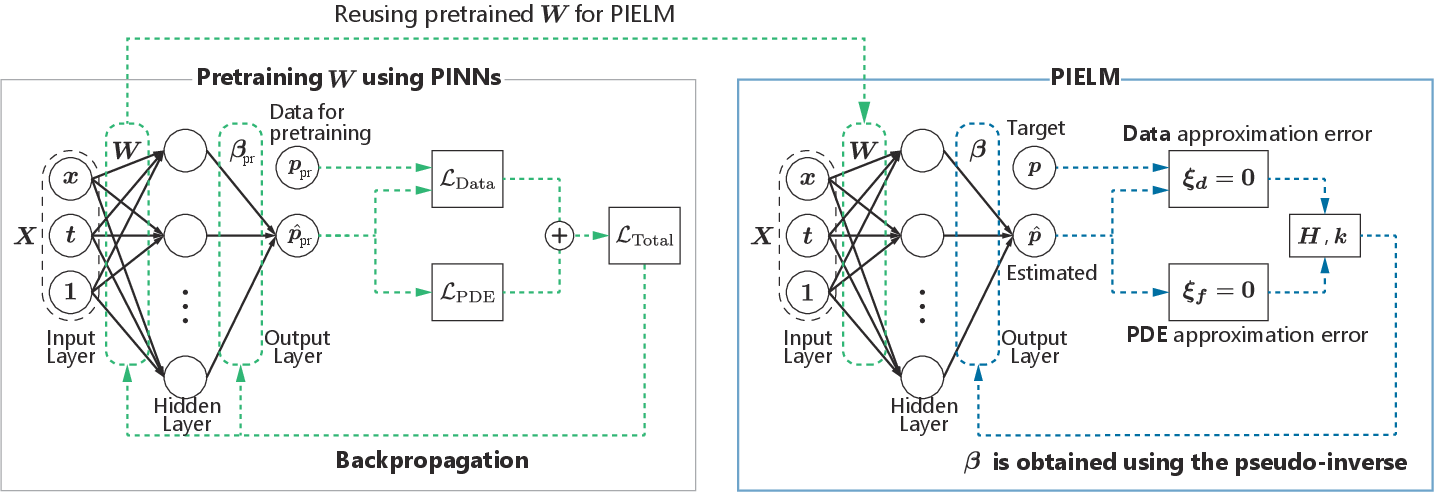
Figure 1: The proposed hybrid framework comprises PINN-based pre-training for universal hidden-layer weights (left) and physics-informed, closed-form PIELM sound field adaptation for new instances (right).
ELMs are single-hidden-layer feedforward networks where only the output-layer weights are learned in closed form via pseudoinverse computations, after random initialization of the hidden-layer. PIELM generalizes this by embedding physical constraints—here, the homogeneous one-dimensional acoustic wave equation:
∂t2∂2p=c2∂x2∂2p
as an additional requirement for the output function.
Given the measurement data and PDE evaluation domains, PIELM constructs a linear system by stacking both the data-matching and physics-constrained terms. The output-layer weights β are determined by:
Hβ=k
where H encodes both the neural network responses and the PDE residuals, providing enhanced extrapolation capability from minimal data.
PINN-Based Pre-Training
Random initialization in ELM/PIELM leads to instability and poor generalization, especially with sparse data and in physically constrained regimes. In the proposed framework, hidden weights are pre-trained using a PINN on source-domain sound field data, optimizing a composite loss:
LTotal=LData+λLPDE
PINN pre-training exploits both labeled sound pressure data and the PDE residual—imparting physically consistent representations to the hidden layer. After pre-training, only the output weights are adapted for each new interpolation task using the closed-form PIELM update—drastically reducing total adaptation time.
Experimental Design
Simulation experiments were conducted under a scenario emulating active noise control.
PINN pre-training used a single-hidden-layer network with 1008 neurons and hyperbolic tangent activation, following prior work. Measurement and PDE residual domains were matched throughout all compared pipelines.
Results
Interpolation Accuracy and Adaptation Speed
The pre-trained PIELM achieved a normalized mean squared error (NMSE) of −23.40 dB (at interpolation positions) with an average closed-form adaptation time of $0.42$ s, closely matching the accuracy of a fine-tuned PINN (−26.16 dB at $30,000$ iterations) yet reducing adaptation time by over three orders of magnitude (from $1060.27$ s to β0 s). This represents a significant leap in inference efficiency for physics-informed sound field interpolation.
Notably, omitting PINN-based pre-training degraded PIELM performance drastically (NMSE: β1 dB), underscoring the necessity of the pre-trained universal hidden representation. Ablation with standard ELM (without PDE constraint) yielded poor generalization (NMSE: β2 dB), further verifying the pivotal role of physics-informed modeling.
Robustness to Observation Noise
For high SNRs (20–30 dB), pre-trained PIELM maintained high interpolation accuracy (NMSE β3 to β4 dB). At 10 dB SNR, accuracy dropped to β5 dB, revealing sensitivity to noise due to the closed-form pseudoinverse construction, though PINN finetuning also exhibited notable degradation.
Implications and Future Work
The integration of physically consistent hidden-layer representations with closed-form output adaptation represents a promising paradigm for real-time sound field modeling with theoretical guarantees from the PDE constraint. This architecture can substantially lower the computational barrier for employing physics-informed learning in latency-critical acoustic applications, including spatial audio, low-latency active noise control, and sensor-limited environmental reconstruction.
Future directions include:
- Extending the methodology to two- and three-dimensional wavefields.
- Investigating noise-robust closed-form adaptation techniques.
- Applying similar frameworks for other PDE-dominated physical signals.
Conclusion
This work demonstrates that PINN-based pre-training combined with PIELM closed-form adaptation enables fast and physically consistent sound field interpolation from limited data, achieving accuracy comparable to iterative PINNs but at a fraction of the computational cost. The results delineate a clear path toward practical deployment of physics-informed ML in time-sensitive acoustic signal processing contexts.