- The paper introduces regime-switching models that overcome aggregation-induced information loss by leveraging disaggregated data.
- It employs scalable Bayesian estimation techniques, achieving up to 50–98% improvement in mean squared error for latent state inference.
- Empirical results on U.S. macroeconomic series show nearly binary recession detection that closely aligns with NBER dates.
Regime-Switching Models for Disaggregated Data: Analytical Foundations, Estimation, and Practical Implications
Motivation and Core Problem
The paper "Regime-Switching Models for Disaggregated Data" (2606.08398) addresses a fundamental limitation of regime-switching time-series analysis in macroeconomics: most extant methodologies model aggregate series, often leading to attenuated or ambiguous identification of latent regime shifts, such as business cycle phases. The authors rigorously demonstrate—both analytically and through simulation—that cross-sectional aggregation discards crucial information when signal-to-noise heterogeneity exists across underlying components. This loss manifests as diminished precision in assigning latent regimes and blurred recession probabilities, particularly when component series behave idiosyncratically.
To remedy this, the authors introduce generalized regime-switching models for collections of disaggregated time series, develop scalable Bayesian estimation techniques for high-dimensional settings, and empirically show that classification of business cycle states becomes sharper and more deterministic when leveraging disaggregated data.
Analytical Characterization: Aggregation Loss and Filtering Precision
A central analytical result establishes necessary and sufficient conditions under which aggregate models recover the same regime information as disaggregated models. The equivalence holds only if all component series share identical signal-to-noise ratios regarding regime shifts, an assumption rarely satisfied in empirical macroeconomic datasets. When this fails, aggregation forces likelihood weightings to average across components, thus downweighting informative series and upweighting noisy ones, resulting in substantial information loss.
Monte Carlo simulations further quantify this effect, showing that improvement ratios in mean squared error (MSE) for state inference can reach 50–98% as signal-to-noise heterogeneity rises (see empirical results in Section 4.1). As the number of series increases, the advantage of disaggregation escalates—even with fixed per-series signal-to-noise characteristics—resulting in nearly binary state classification when N>100.
Model Specification: Grouped Autoregressive Regime-Switching Systems
The authors formalize two high-dimensional models:
- Model A: Each time series features regime-dependent means and variances with grouped autoregressive coefficients, allowing heterogeneous dynamics but enforcing regime synchronization via a common latent Markov chain.
- Model B: Generalizes to settings with lagged-level effects, yielding distinct transition dynamics (immediate versus gradual regime shifts) and differing higher-order conditional moments.
Unlike classical factor models, these systems intentionally do not model cross-sectional error covariance, enabling tractable MCMC estimation via composite likelihood arguments.
Efficient MCMC Estimation and Forecasting
For estimation, the authors deploy a bespoke Gibbs sampler leveraging vectorized updates, minimax-tilting for truncated multivariate normals, and multi-move backward sampling for latent states. The estimator scales efficiently to hundreds of time series (N>100), outperforming conventional likelihood maximization—which often stalls in high-dimensional parameter spaces.
Key innovations include:
- Joint sampling of regime-dependent means under linear constraints, achieving computational tractability up to N=400.
- Exact backward smoothing for latent states conditional on observed sequences, ensuring robust posterior inference.
Simulation timing benchmarks confirm practical applicability: 50,000 draws in model sizes up to N=200 require less than an hour on modern CPUs, with further scalability for even larger cross-sections.
Empirical Application: Business Cycle Identification With U.S. Disaggregated Data
Applying their models to 94 U.S. macroeconomic series—including GDP components, industrial production, employment, capacity utilization, and hours worked—the authors demonstrate that regime probabilities become nearly deterministic, sharply delineating recessions and expansions in alignment with NBER chronology.
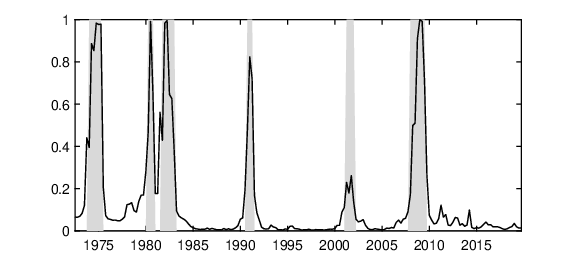
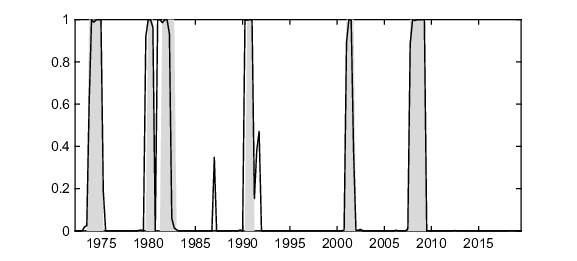
Figure 1: Inference on recessions using aggregate U.S. GDP (left) and its disaggregated components (right), revealing sharper identification with the latter.
Key empirical findings:
- The smoothed recession probabilities jump cleanly to zero or one, with minimal intermediate values.
- All NBER-defined recessions from 1972–2024 are detected. Onset lags relative to NBER dating are typically 1–2 quarters, while exits coincide precisely.
- Models with autoregressive structure (Model A and B) yield similar results, confirming that cross-sectional informational richness dominates model-dynamic choices.
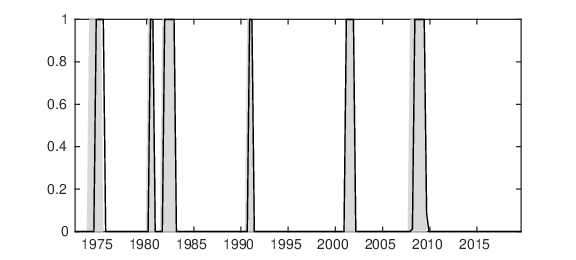
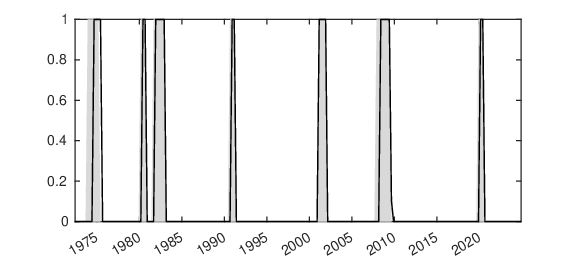
Figure 2: Smoothed recession probability estimates (without AR dynamics) show crisp alignment to NBER dates across multiple business cycles.
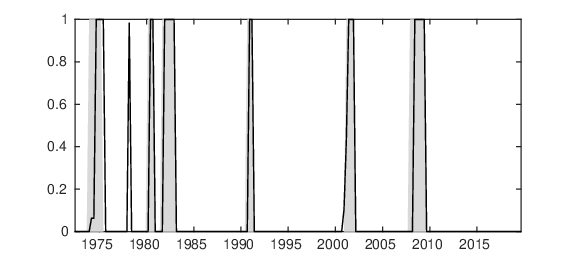
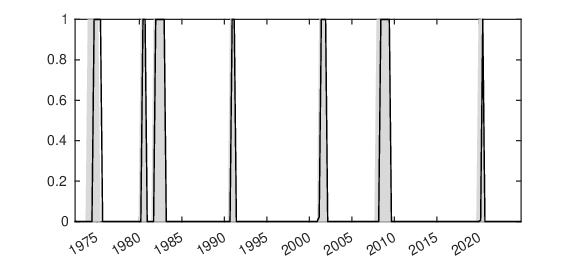
Figure 3: Regime inference with grouped AR dynamics (Model A), again showing nearly binary classification and close agreement with official recession dating.
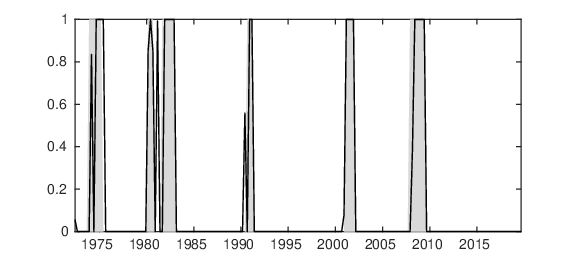
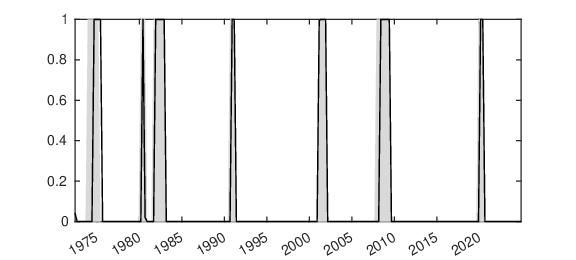
Figure 4: Estimates from Model B, reflecting responsive detection of recession onsets and exits through lagged-level propagation.
Comparison to conventional analyses (such as FRED's regime-switching factor model) underlines the sharper, more reliable regime detection achieved by exploiting disaggregated data.
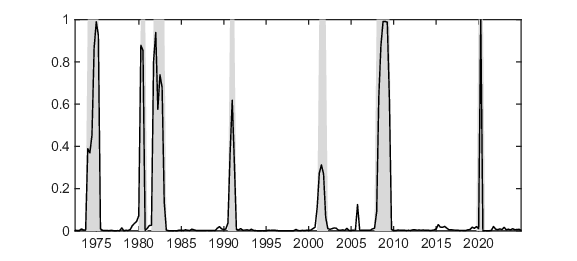
Figure 5: Benchmark recession probabilities from the FRED dynamic-factor model, which tend to dwell at intermediate values and often exhibit ambiguous regime transitions.
Structural Data Insights
Beyond the inferential gains, the modeling exercise also elucidates the structure of macroeconomic aggregates. Visualization of component distributions reveals pronounced cross-sectional comovement and increased dispersion during recessions, validating the theoretical necessity to allow for regime-dependent variance switching.
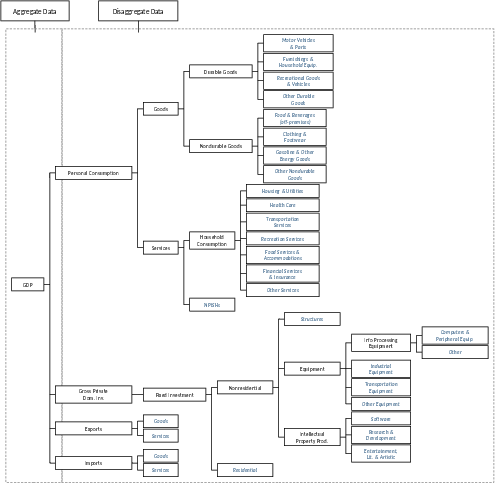
Figure 6: Hierarchical decomposition of real GDP into its constituent series, facilitating granular regime analysis.
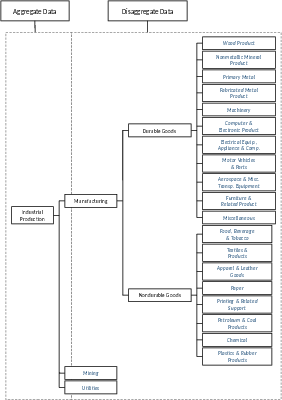
Figure 7: Expansion of industrial production into distinct sectoral time series for enhanced latent state tracking.
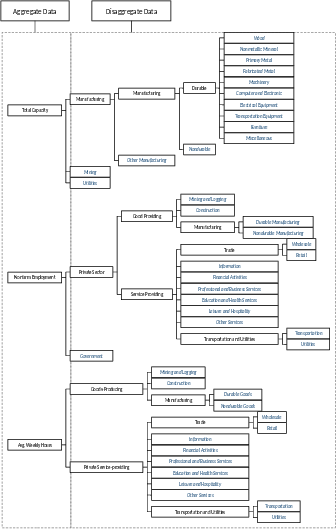
Figure 8: Disaggregation of core business cycle indicators, providing multiple series for regime-switching inference.
Practical and Theoretical Implications
Practically, the results advocate for routine use of disaggregated data in policy, forecasting, and research applications of regime-switching models, especially when high-frequency identification of business cycle phases is essential. The methodology supports scalable, robust state inference for large economic datasets and presents a viable path for expansion to other domains such as regional cycles, sectoral analyses, or volatility modelling.
Theoretically, the analysis generalizes prior aggregation debates (mainly focused on linear ARMA or factor models), showing that the aggregation loss is particularly acute for nonlinear latent regime processes. The findings may extend to models with nonlinear factors, stochastic volatility, or common structural breaks, suggesting broad applicability of disaggregate modeling strategies.
Conclusion
This work rigorously shows that regime-switching signals in macroeconomic time-series are substantially sharpened by modeling disaggregated components rather than aggregates, due to heterogeneous signal-to-noise characteristics across series. The developed estimation procedures enable efficient inference in high-dimensional regimes, and empirical results underline the practical superiority of disaggregated modeling for business cycle classification—achieving nearly binary state identification while matching NBER dates over decades of data. Extensions to other macroeconomic regions and latent regime models present clear avenues for further research and application in high-dimensional economics and time-series analysis.

