- The paper introduces a mechanistic framework that derives heavy-tailed, q-exponential decay from the spectral structure of a layered diffusion operator.
- It employs a Gamma rate distribution and modal weight scaling to connect operator eigenmodes with power-law decay exponents, matching observed tracer profiles.
- The analysis demonstrates that boundary geometry and dimensionality dictate the entropic index q, providing predictive insights for reactor and transport systems.
Spectral Mechanism for Power-Law Decay in Transport Systems
Introduction and Motivation
The paper "A spectral model of power-law decay in natural and engineered systems" (2606.08342) presents an operator-theoretic analysis of anomalous relaxation phenomena, which are frequently observed as power-law tails in tracer concentration profiles for both natural and engineered transport systems. Moving beyond phenomenological descriptions, the authors develop a mechanistic framework linking the emergence of q-exponential decay directly to the spectral structure of the underlying linear diffusion operator and the geometric configuration of boundary conditions. This work aims to clarify the origin and precise determination of the entropic index q responsible for heavy-tailed relaxation behaviors, which historically had been treated as ad hoc fitting parameters.
Phenomenological Framework and Spectral Representation
The paper establishes the relaxation dynamics through the nonlinear equation:
dtdC=−aCq
yielding macroscopic decay curves governed by the q-exponential:
C(t)=(2−q)λeq−λt
For q>1, this form captures the persistence of power-law tails. Within the Beck-Cohen superstatistical paradigm, such non-exponential relaxation can be represented as a Laplace transform over exponentially weighted processes with rates drawn from a Gamma distribution. The authors focus on deriving this emergent rate distribution from the eigenspectrum of the layered diffusion operator, eschewing phenomenological inputs.
Layered Diffusion Matrix and Modal Weight Scaling
The central model is a discretized layered system with homogeneous diffusivity and absorbing boundary layer, representative of incompletely mixed reactors or stratified media. The transport matrix possesses a tridiagonal structure, and spectral decomposition yields:
C1(t)∝∫0∞w(k)eω(k)tdk
where ω(k)∼−ατk2 is the low-wavenumber dispersion relation. Key to the analysis is the modal weight scaling: an asymmetric, volumetrically distributed initial concentration profile produces w(k)∝k2 at small k. The resulting long-time behavior for the boundary signal is:
q0
which directly corresponds to q1 in the q2-exponential law.
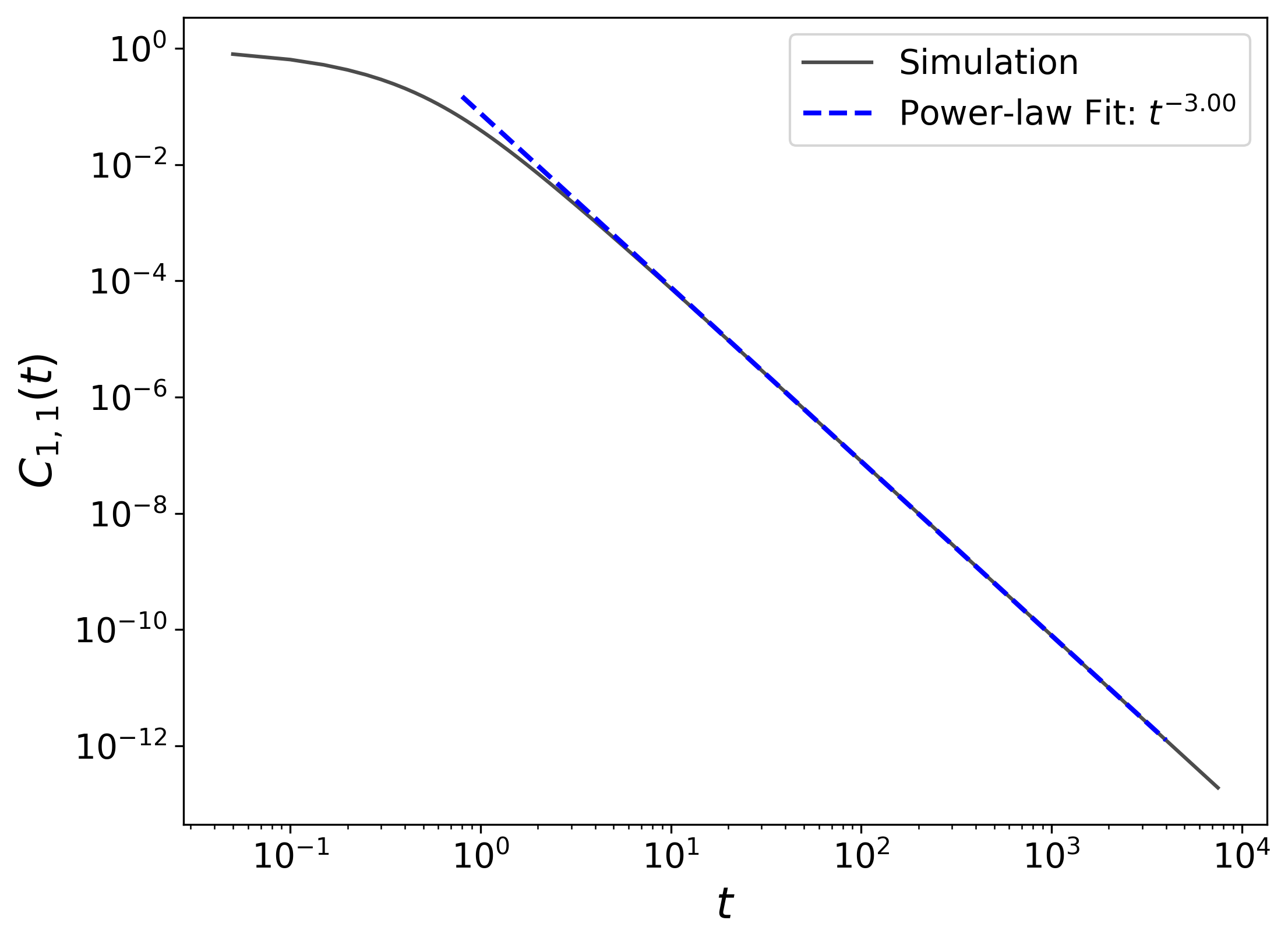
Figure 1: Boundary concentration q3 for a two-dimensional layered diffusion model, illustrating power-law decay and verifying numerical scaling.
Dimensionality and Boundary Geometry
Extending the spectral framework to q4-dimensional domains, the authors demonstrate that the scaling exponent and entropic index q5 are functions of spatial dimensionality and absorbing boundary configuration. For a singular initial profile at the boundary-adjacent corner, modal weights scale as q6 for each axis, yielding the general result:
q7
and
q8
Thus, q9 for dtdC=−aCq0, dtdC=−aCq1 for dtdC=−aCq2, converging to dtdC=−aCq3 in the mean-field limit (dtdC=−aCq4) with standard exponential relaxation. This dimensional connection robustly matches observed scaling in layered reactor and media systems.
Operator-Theoretic Origin of Gamma Rate Distribution
By transforming the spectral integral to relaxation-rate space, the paper shows that the emergent modal weight distribution is exactly a Gamma density, linking the operator structure to macroscopic superstatistical behavior. The mapping between the variance in wavenumber space and the entropic index dtdC=−aCq5 provides an explicit statistical interpretation; dtdC=−aCq6 quantifies spectral heterogeneity.
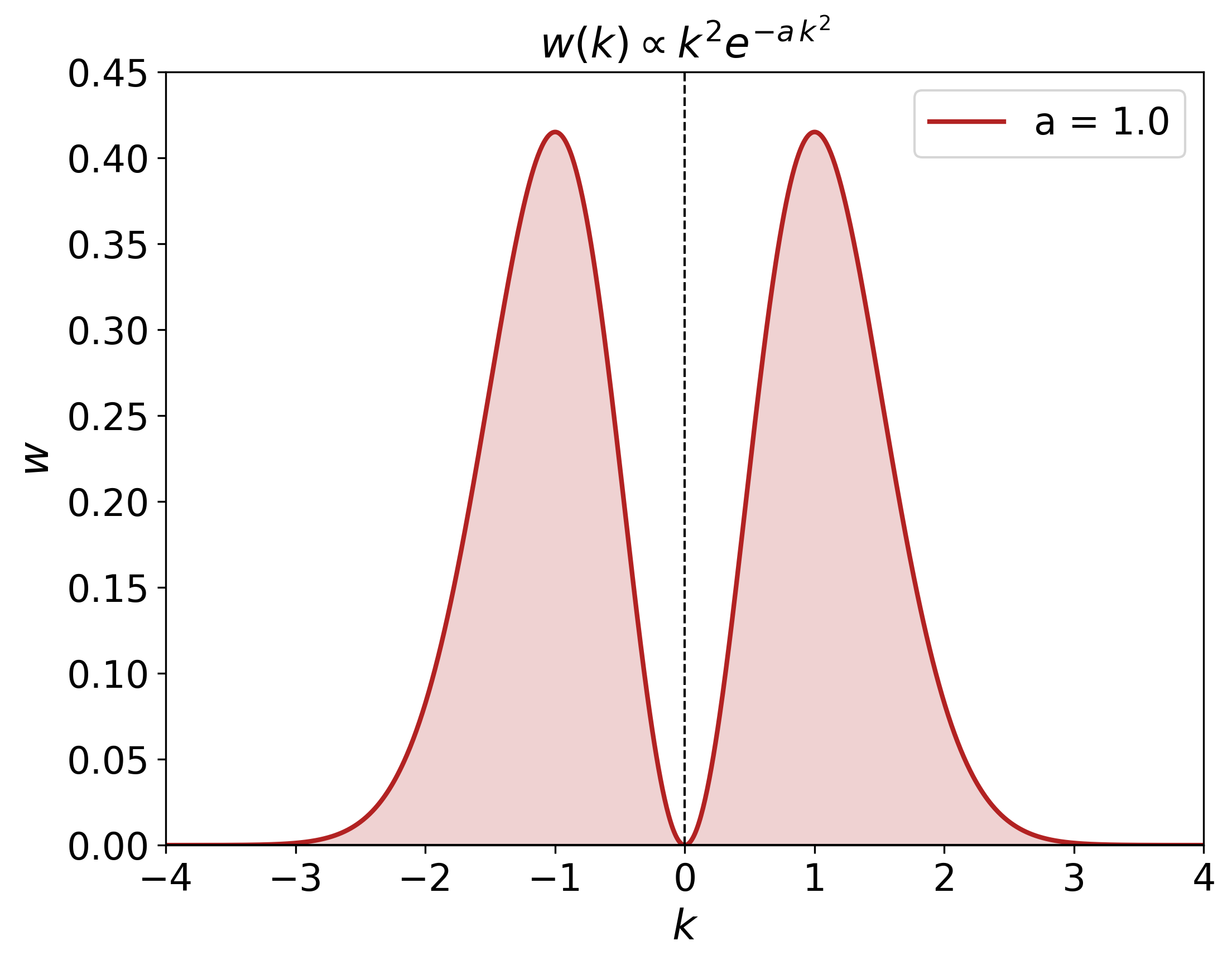
Figure 2: Modal weight distribution dtdC=−aCq7 derived analytically from the Gamma rate spectrum, confirming operator-driven superstatistics.
Initial State Regularization and Temporal Domain Accuracy
The authors clarify that conventional singular boundary initial conditions (delta impulses) produce high-frequency transients and fail to reproduce accurate dtdC=−aCq8-exponential behavior across all temporal scales. Instead, a regularized Gaussian-shifted initial profile, scaling linearly near the boundary and decaying exponentially, projects efficiently onto the low-dtdC=−aCq9 modes, producing exact agreement with the q0 exponential at all times in the q1 limit.
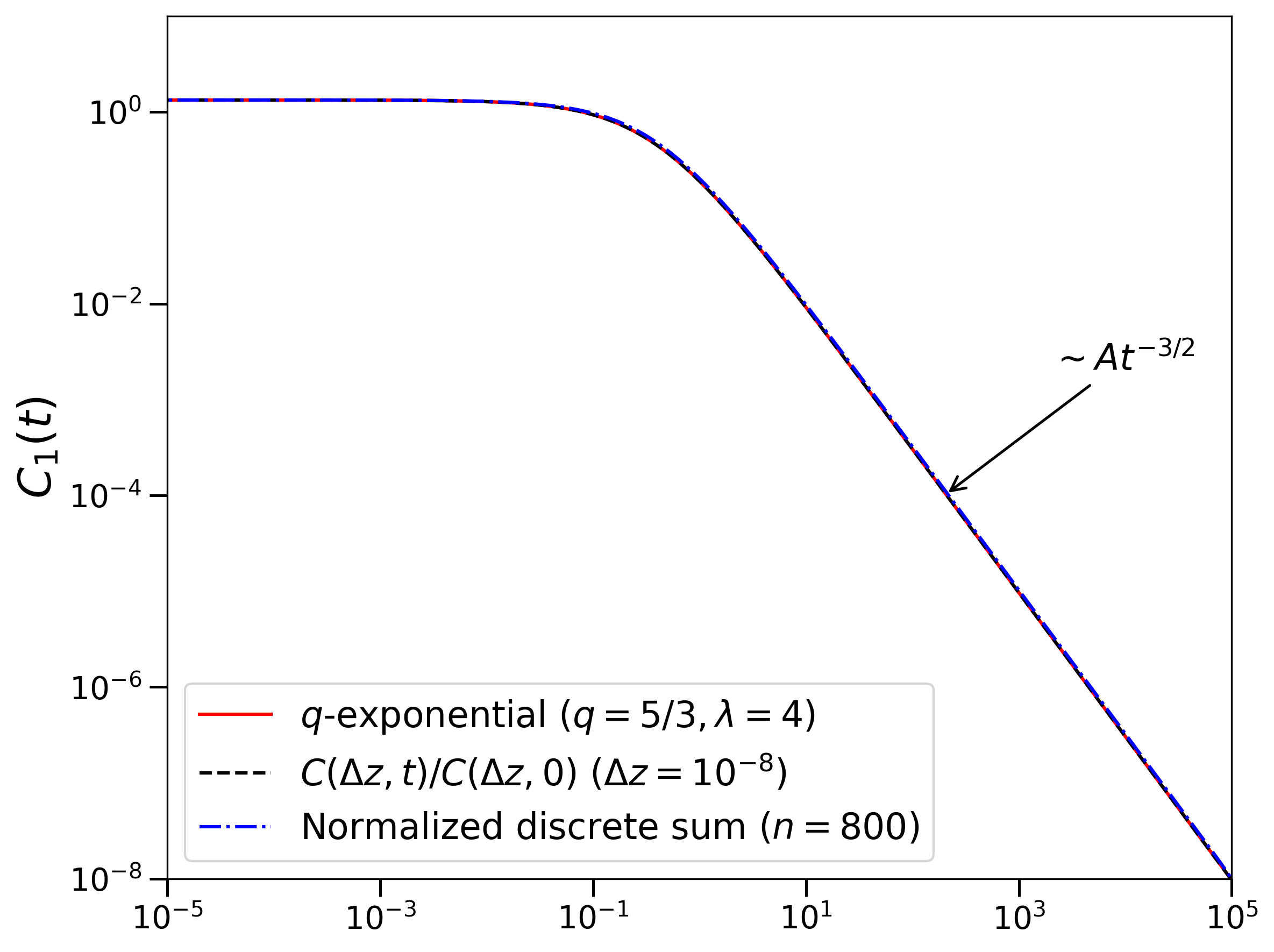
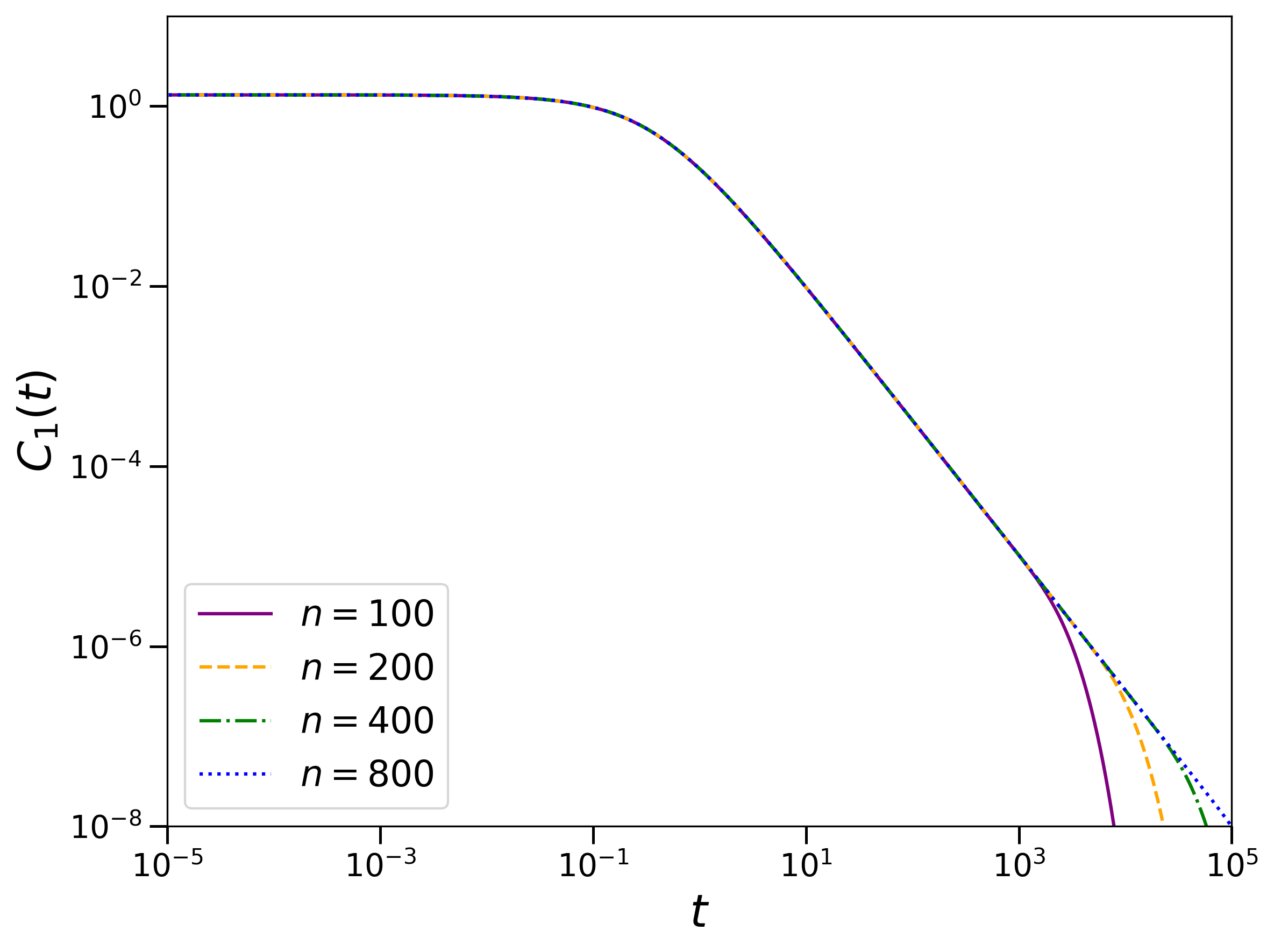
Figure 3: Comparison of boundary concentration q2 for normalized q3-exponential, continuous analytical solution, and discrete spectral sum.
Theoretical and Practical Implications
The explicit derivation of q4 from spectral weights and boundary geometry resolves the mechanistic ambiguity prevalent in nonextensive statistical mechanics. Practically, this informs design and analysis of reactors and transport systems where incomplete mixing and complex geometries produce heavy-tailed dilution. The theoretically robust mapping to q5-exponential functions enables predictive modeling of residence time distributions and enhances understanding of anomalous transport in heterogeneous domains.
The dimensional dependence of q6 provides a template for predicting relaxation regimes in engineered or natural media, accounting for configuration changes in boundary conditions (e.g., switching between absorbing and reflective walls). The geometric invariance of q7 in one dimension underlines the universality of this exponent for linear transport systems.
Future Directions
Opportunities exist to extend this framework to heterogeneous matrices, fractal geometries, and cascaded reactor networks, which will capture a broader class of anomalous relaxation phenomena. Examining non-integer effective dimensions and more complex structural configurations will bridge current theory with real-world irregular domains, including environmental transport and process engineering. Integrating empirical tracer breakthrough curves and alternative boundary constraints will further validate and refine the spectral scaling laws presented.
Conclusion
This paper provides a rigorous spectral foundation for anomalous power-law relaxation and q8-exponential dilution in linear transport systems, linking the emergence of heavy tails to boundary geometry and the initial eigenmode projection. The entropic index q9 is revealed as a structural parameter encoded in the spectral variance of the diffusion operator, not as a heuristic fit. This advances both theoretical and practical modeling of transport in complex, incompletely mixed domains and sets the stage for generalized descriptions across a wide range of natural and engineered systems.