Some Inverse Problems in Particle Physics
Abstract: Inverse problems play a central role in current areas of research in particle phenomenology. In these lectures we focus on two examples, the extraction of Parton Distribution Functions (PDFs) from experimental data (or, equivalently, from pseudo- and quasi-PDFs computed in lattice QCD), and the extraction of spectral functions from lattice Euclidean time correlators. We investigate in detail three different approaches, namely Backus-Gilbert, Gaussian Processes and fits based on Neural Network parametrizations.
- Bayesian Inference with Gaussian Processes for the Determination of Parton Distribution Functions (2024)
- Bayesian solution to the inverse problem and its relation to Backus-Gilbert methods (2024)
- Learning PDFs through Interpretable Latent Representations in Mellin Space (2023)
- Bayesian interpretation of Backus-Gilbert methods (2023)
- Bayesian inference of real-time dynamics from lattice QCD (2022)
- Neural-network analysis of Parton Distribution Functions from Ioffe-time pseudodistributions (2020)
- Reconstructing parton distribution functions from Ioffe time data: from Bayesian methods to Neural Networks (2019)
- A Unified Neural-Network Framework for Nucleon Imaging from Numerical Simulations of QCD (2025)
- Gaussian Processes for Inferring Parton Distributions (2025)
- Tackling inverse problems for PDFs from lattice QCD (2026)
Summary
- The paper develops and compares BG, GP, and NN approaches to address ill-posed inverse problems in particle physics with rigorous uncertainty quantification.
- It introduces a probabilistic framework that effectively incorporates regularization and uncertainty propagation for extracting PDFs and spectral densities.
- The analysis reveals how neural networks in the lazy training regime converge to kernel methods, offering clear insights into error decomposition and model stability.
Expert Essay: Some Inverse Problems in Particle Physics
Overview and Motivation
The paper "Some Inverse Problems in Particle Physics" (2606.08316) presents a rigorous, comparative analysis of inverse problems central to particle phenomenology, focusing on two archetypal cases: extraction of Parton Distribution Functions (PDFs) from experiment or lattice results, and reconstruction of spectral densities from Euclidean correlators computed on the lattice. The treatment emphasizes a stochastic/probabilistic framework that incorporates Backus-Gilbert (BG) methods, Gaussian Processes (GPs), and neural network (NN) parameterizations, enabling a precise control of statistical and systematic uncertainties—a crucial requirement for modern high-precision phenomenology.
The work highlights the intrinsic ill-posed nature of these inverse problems due to their infinite-dimensional functional spaces and the severe limitations imposed by finite noisy data. Regularization, either explicit or implicit, is therefore essential. The review prioritizes methods that provide clear uncertainty quantification and systematic error control, focusing on rigorous mathematical formulations over heuristic approaches.
Problem Definition: Inverse Problems in Particle Physics
Inverse problems in this context are typified by the need to estimate a function f(x) (e.g., a PDF or a spectral density) from noisy, finite, indirect data Y, where the data are related to f(x) via a known, typically linear, forward map F. For example, extracting PDFs reduces to an integral equation involving the convolution of f(x) with calculable coefficient functions; in the spectral density setting, the relevant map is a Laplace transform.
These problems are formally ill-posed due to the loss of information inherent in the forward maps (e.g., smoothing by convolution or Laplace transformation), leading to non-unique or unstable solutions without further assumptions. Regularization imposes preference on certain solutions over others, and the associated uncertainties and priors play a critical role in the physical interpretation and robustness of the extracted quantities.
Probabilistic Framework
By promoting the unknown function to a stochastic process, the solution to the inverse problem is encoded in the posterior probability distribution over possible functions, conditioned on the observed data. This Bayesian paradigm is superior for uncertainty quantification and explicit prior modeling. The paper distinguishes between the impact of the data (through likelihood) and of modeling assumptions (through the prior), offering a systematic mechanism for combining information sources and propagating uncertainties through to the final predictions.
Backus-Gilbert Method
The BG method offers a linear and non-parametric solution to inverse problems by constructing a smeared, regularized estimator of f(x) as a linear combination of observed data, with coefficients determined by minimizing the width of the corresponding "resolution" function under constraints. Specifically, the approach reduces the infinite-dimensional estimation to the optimization of smearing coefficients, balancing resolution and stability through a regularization parameter λ.
The BG estimator, both in the continuum and on grids, is formally equivalent to a Tikhonov regularized least-squares solution in a particular metric. Importantly, the BG method does not start with a prior for the solution function, but it can be embedded into a probabilistic framework by bootstrapping over data noise.
Gaussian Processes for Inverse Problems
GPs provide a principled mechanism for defining priors over spaces of functions, characterized by a mean and covariance (kernel) function. In the context of PDFs or spectral densities, the GP prior enables encoding of domain-specific information (such as smoothness or scaling behavior) via kernel choice and hyperparameters, which themselves can be inferred from the data.
Given linear response data with Gaussian noise, the GP posterior for the function is also Gaussian and admits closed-form expressions for the mean and covariance as functions of the data, the noise covariance, the forward map, and the prior kernel. Hyperparameter inference is performed through marginal likelihood maximization or full posterior sampling, integrating regularization into a Bayesian framework. The paper provides concrete application to extraction of isovector PDFs and explores the uncertainty propagation in regions extrapolated beyond data coverage, where uncertainty is dominated by the prior.
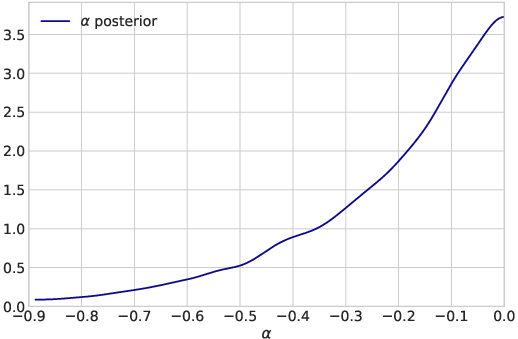
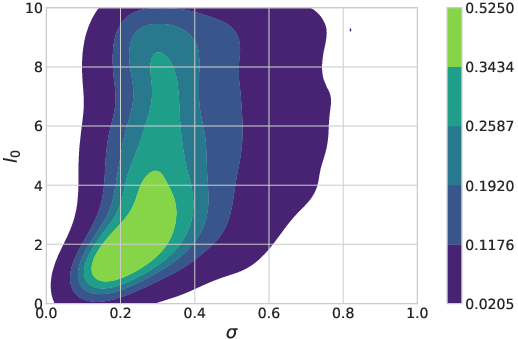
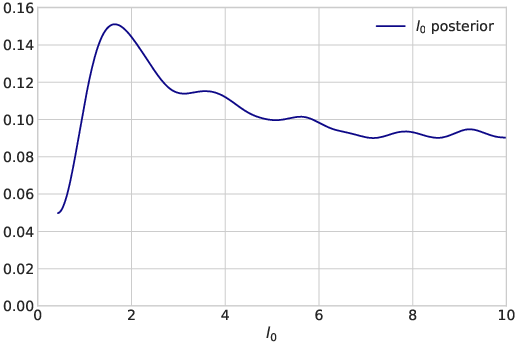
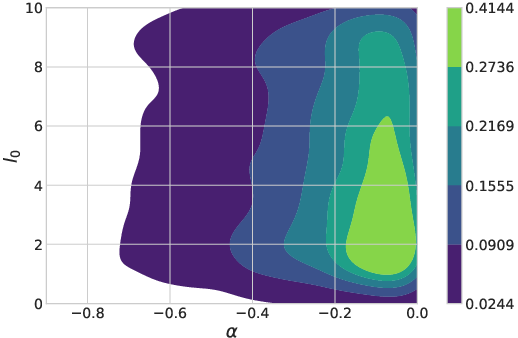
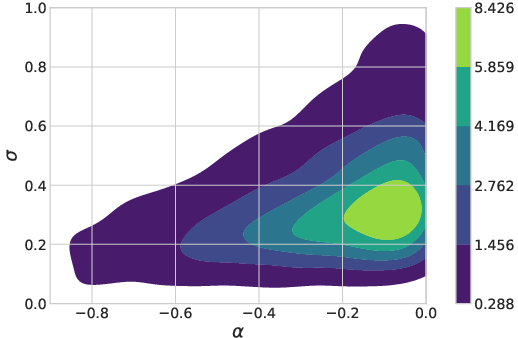
Figure 1: 1D and 2D posteriors of GP kernel hyperparameters for PDF extraction; sharp constraints are observed for σ, broader for α and l0.
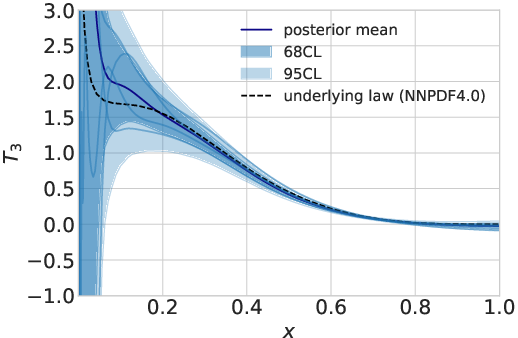
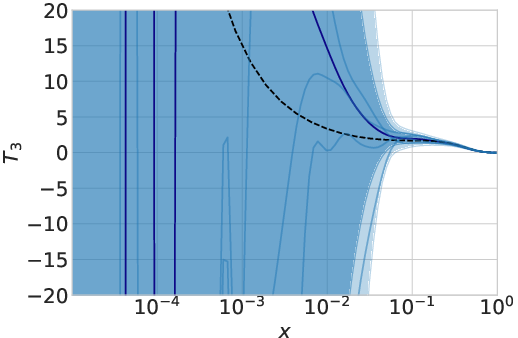
Figure 2: Posterior samples and confidence bands for extracted PDF Y0, demonstrating excellent pointwise uncertainty quantification and increased uncertainty in extrapolation regions.
The limiting case where the kernel reduces to an identity recovers Tikhonov regularization, showing BG as a limiting case of GP inference with a particular prior.
Neural Networks and the Neural Tangent Kernel
Neural networks provide a highly flexible, non-parametric representation of function spaces for inverse problem solutions, a paradigm adopted by NNPDF for unbiased PDF extraction. At initialization, random NNs induce a distribution over parameterizations analogous to a GP with a data-informed covariance structure.
The training dynamics of NNs are characterized via the Neural Tangent Kernel (NTK), which encodes the time-dependent sensitivity of the network output with respect to its parameters. In the infinite-width limit and under "lazy training" (where the NTK remains nearly constant), the training reduces to kernel regression, again formally analogous to GP inference.
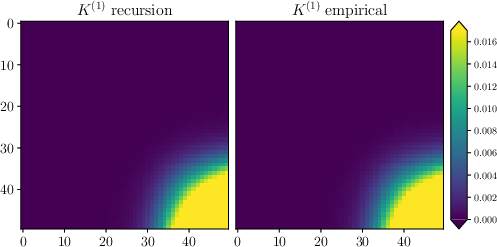
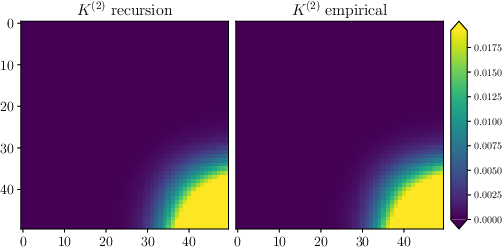
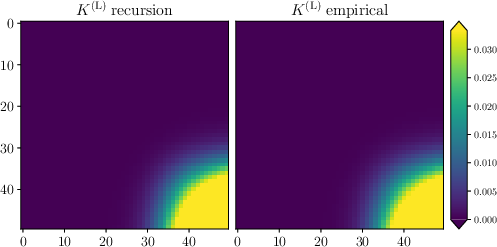
Figure 4: Empirical and analytical covariance matrices (kernels) for the NNPDF architecture, matching well with theoretical predictions from recursive formulas.
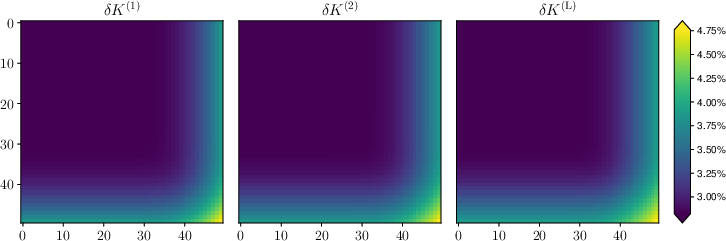
Figure 6: Relative difference between empirical network kernel and recursion-based prediction, substantiating the theoretical modeling of NN prior distributions.
Empirical studies reveal that during training, the NTK undergoes significant rearrangement, especially in early epochs, before reaching a "lazy" regime where its eigensystem stabilizes. The eigenvectors of the NTK align with the most "learnable" directions dictated by data, while components in its kernel remain unaffected by training and retain prior-induced fluctuations.
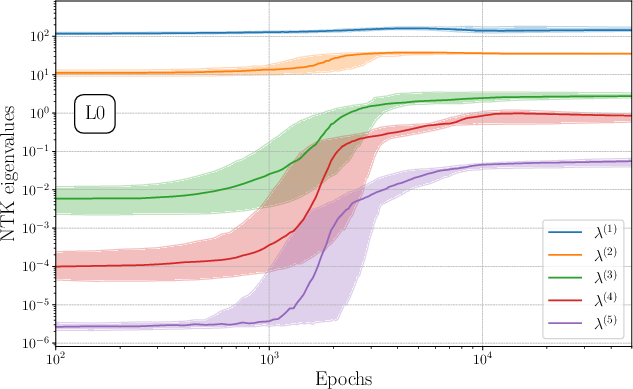
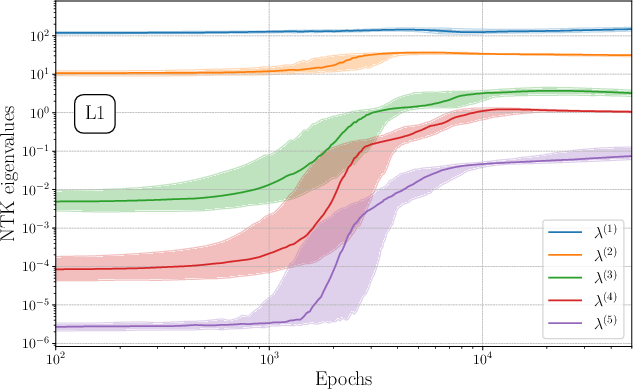
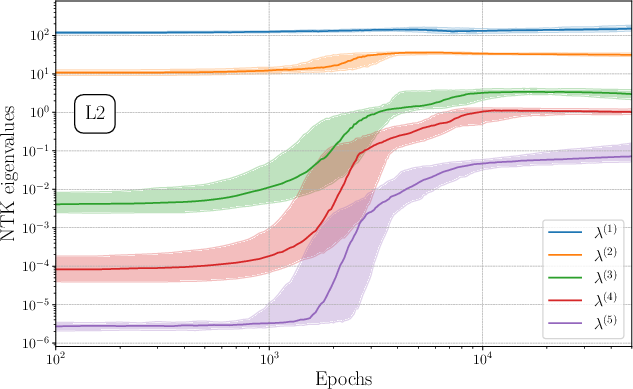
Figure 8: Evolution of first five eigenvalues of the NTK during NN training, illustrating a period of rapid reorganization followed by stabilization characteristic of lazy training.
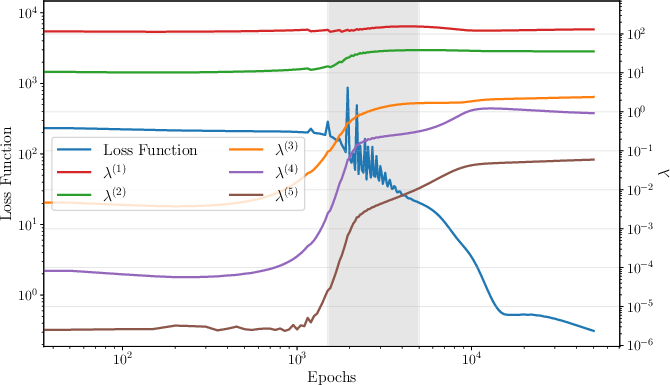
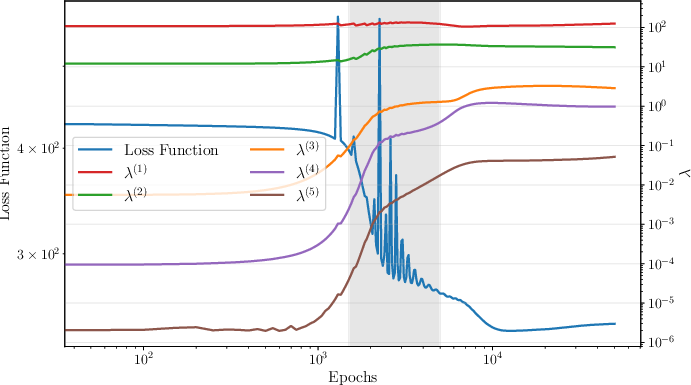
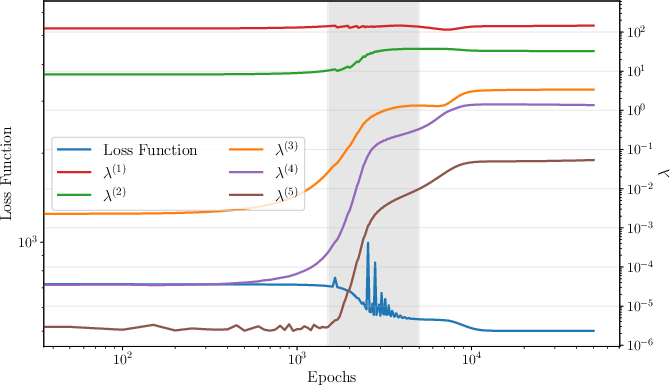
Figure 10: Loss function variation over training overlapped with leading NTK eigenvalues, demonstrating the interplay between feature learning (NTK eigenvalue dynamics) and error minimization.
Analytical Solution in the Lazy Training Regime
A key theoretical achievement is the explicit decomposition of the NN-trained solution in the lazy regime: the final output is a linear combination of the initial NN output (encoding prior assumptions) and a data-driven term determined by the NTK and the data. In the subspace orthogonal to the kernel of the NTK, the solution rapidly becomes data-dominated. In directions belonging to the NTK kernel, the solution cannot be updated and is fixed by prior initialization, explaining the residual uncertainty in unconstrained regions (e.g., PDF extrapolations).
Deviation from linear methods and persistent correlations in the learned solution can be quantified by explicit evaluation of covariances and their decomposition into data-driven and prior-induced terms.
Synthesis and Theoretical Implications
The comparative analysis underscores the strong formal connections between BG, GP, and NN approaches: all can be viewed as regularized linear function estimators under specific priors and regularization choices. GPs provide the most principled, probabilistic foundation; BG can be seen as a GP special case, and neural networks in lazy training converge to kernel methods controlled by the NTK, which itself evolves under training only outside its null space.
The explicit tracking of uncertainty decomposition clarifies the respective contributions of data, model, and architecture to the final prediction and error bars. This is critical both for precision phenomenology and for robust error propagation through lattice-to-experiment pipelines.
These results also highlight that the efficacy of NN-based inverse problem solutions is fundamentally connected to the information content of the NTK: architectural decisions, initialization choices, and training regimes can be viewed as means to control the NTK, hence the regularization and expressivity of the modeling procedure.
Practical and Future Directions
Practically, these findings point towards the utility of incorporating explicit prior modeling, Bayesian hyperparameter inference, and kernel analysis for improving the robustness of extracted physical quantities. The lazy training regime offers a tractable avenue for error interpretation and analytical control, but its realization in practical, finite-width networks warrants further study.
Theoretically, future developments might extend these analytical tools beyond quadratic losses, nonlinear forward maps, and simple priors. Importantly, understanding the relationship between stopping criteria in minimization-based approaches (such as NNs) and the implicit regularization in BG/GP schemes remains an outstanding problem, with direct implications for systematic error control in high-stakes applications like precision QCD.
Conclusion
"Some Inverse Problems in Particle Physics" (2606.08316) provides a comprehensive, mathematically rigorous treatment of inverse problems foundational in particle phenomenology. Through detailed analysis and explicit comparisons, it elucidates the formal and practical connections between Backus-Gilbert, Gaussian Process, and neural network approaches. The insights into uncertainty propagation, regularization, and model expressivity are of critical import for the ongoing development of robust, high-precision tools in QCD and beyond. The paper's framework and results lay the groundwork for a unified, principled approach to inverse problems across computational science and theoretical physics, while motivating further research into the interface between machine learning and foundational physics analysis.
Paper to Video (Beta)
No one has generated a video about this paper yet.
Whiteboard
No one has generated a whiteboard explanation for this paper yet.
Paper Prompts
Sign up for free to create and run prompts on this paper.
Top Community Prompts
Open Problems
We haven't generated a list of open problems mentioned in this paper yet.
Continue Learning
- How do the BG, GP, and NN methods compare in managing the ill-posed nature of particle physics inverse problems?
- What specific role does regularization play in stabilizing the solutions obtained through these methods?
- How does the probabilistic approach enhance uncertainty quantification in extracting PDFs and spectral densities?
- What are the implications of the Neural Tangent Kernel dynamics for feature learning in neural network parameterizations?
- Find recent papers about inverse problems in quantum chromodynamics.