- The paper introduces FXplorer, a map-based interface that employs ML embeddings to organize and explore hundreds of audio effect variants in a continuous 2D space.
- The paper demonstrates a hybrid architecture that combines perceptual (AFx-Rep) and semantic (CLAP) embeddings for intuitive navigation and real-time parameter editing.
- The paper shows that FXplorer facilitates both divergent and convergent exploration by enabling rapid auditioning and seamless interpolation between audio effect configurations.
FXplorer: Map-Based Navigation for Exploratory Audio Effect Design
Introduction
"FXplorer: A Map-Based Interface for Exploratory Audio Effect Design" (2606.08286) introduces FXplorer, a spatially organized interface for exploratory audio effects manipulation. The system leverages perceptual audio embeddings and machine learning–driven semantic search to organize hundreds of FX parameter configurations into a continuous 2D landscape. FXplorer is positioned as a workflow-agnostic interface, facilitating both divergent exploration and convergent refinement without sacrificing interpretability. It addresses the complexities arising from the multidimensionality and nonlinearity of FX parameter spaces, as well as the limitations of categorical, parameter-centric DAW interfaces.
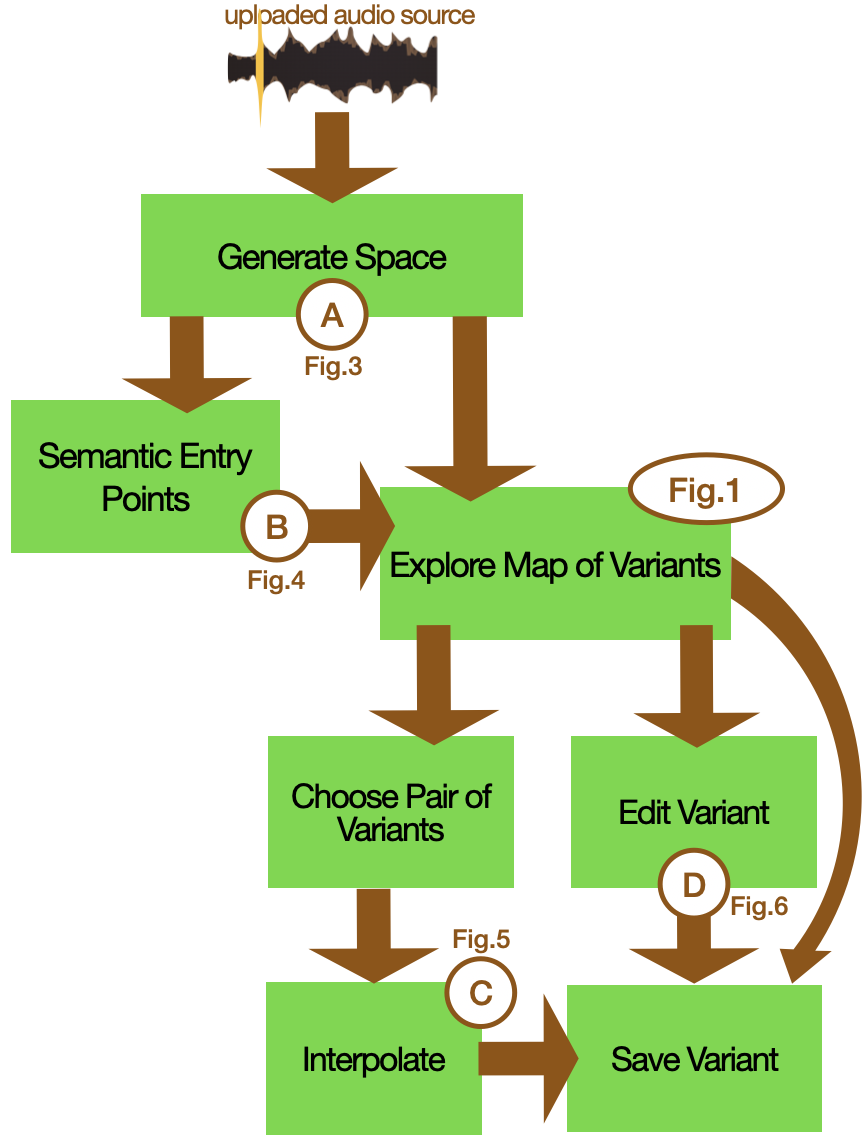
Figure 1: Overview of interaction workflows in FXplorer. Users navigate a space of effect variants, interpolate, refine, and save outcomes, supporting both divergent and convergent processes.
System Architecture
FXplorer operates through a hybrid computational architecture. Offline, the backend generates audio effect variants, encodes them using both audio-text (CLAP) and audio-only (AFx-Rep) embedding models, and projects high-dimensional embeddings to 2D via PCA or UMAP. The frontend, a Svelte web application using Tone.js, presents users with a fluid, interactive canvas of variants. Real-time FX processing applies selected parameters to a dry source signal without perceptual discontinuity.
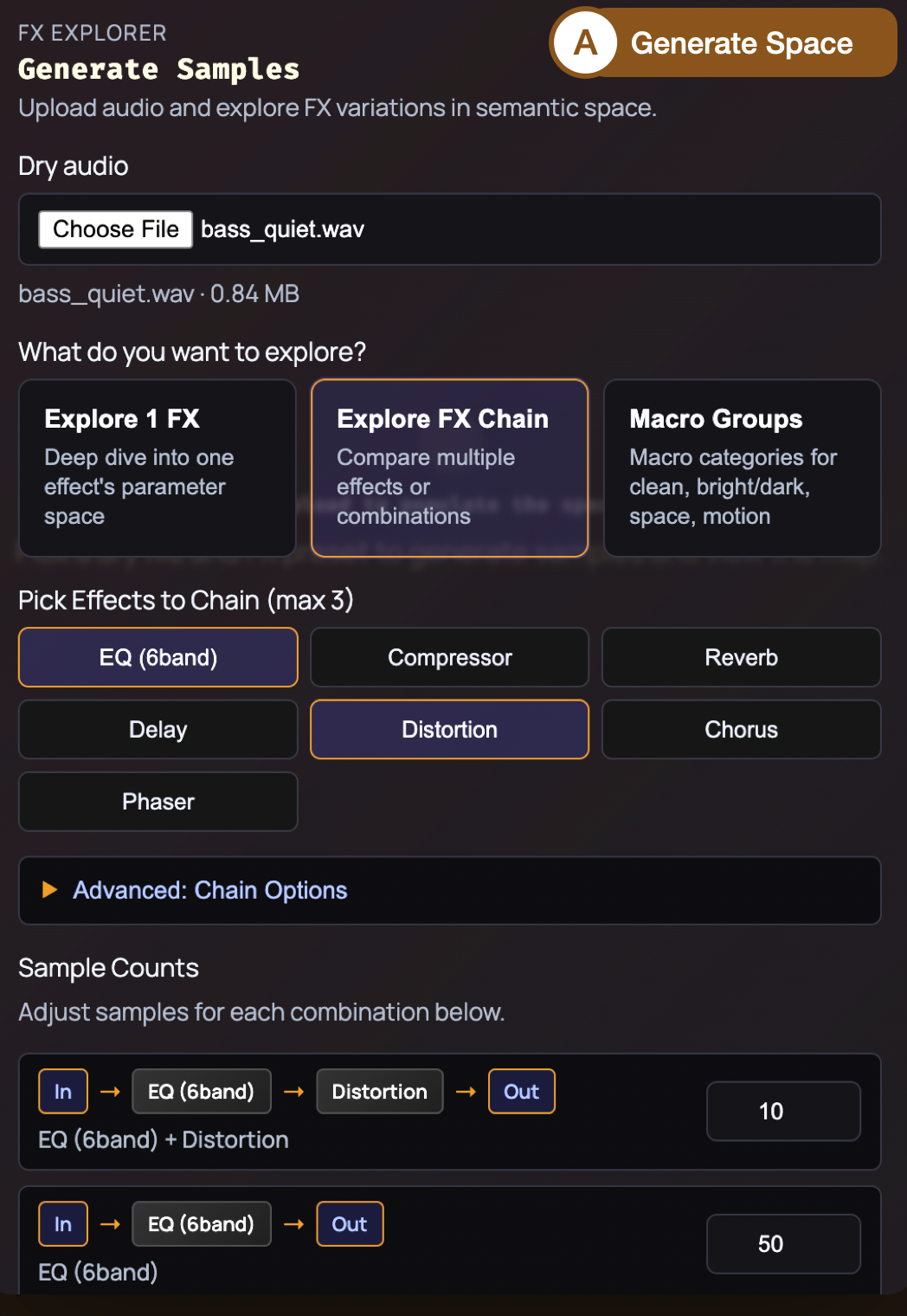
Figure 2: Sample generation in FXplorer, showing user input flow for uploading audio, selecting exploration modes, FX modules, and number of samples.
Perceptually-Organized Exploration Space
Variants are displayed as points in a 2D map where spatial proximity reflects timbral similarity. The dual embedding scheme allows toggling between perceptual (AFx-Rep) and semantic (CLAP) organization. The map exposes relationships between disparate FX chains, clustering perceptually similar outcomes regardless of underlying DSP or effect order. This 2D layout enables intuitive neighborhood browsing and resolves the discontinuities of preset-based systems.
Semantic Entry Points and Search
FXplorer integrates text and audio-driven semantic search, situating query results within the continuous variant space. CLAP embeds language descriptors (e.g., "warm", "metallic") alongside audio, while AFx-Rep focuses on spectral and timbral features. Users can locate "ballpark" regions matching their sonic goals and immediately explore adjacent variants for rapid auditioning.
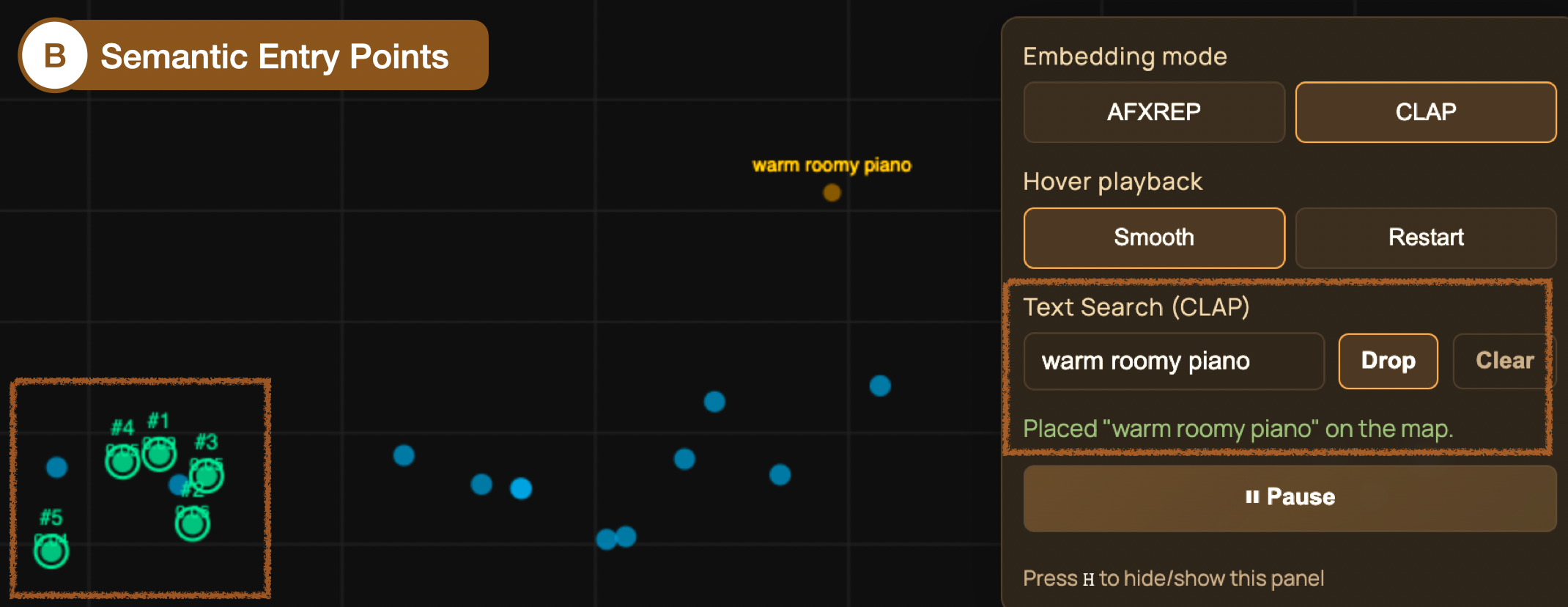
Figure 3: Semantic Entry Point Example. Top-5 results for "warm roomy piano" query embedded and highlighted in the map.
Interpolation and Auditioning
A core feature is parameter-space interpolation between user-selected endpoints. Unlike simple crossfading, FXplorer calculates perceptual blends of FX parameters, applying them to the dry input signal in real time. This facilitates rapid, low-commitment exploration of intermediate configurations, supported by synchronized visual and auditory feedback. Real-time scaling (logarithmic/exponential/linear) ensures perceptual continuity during transitions.
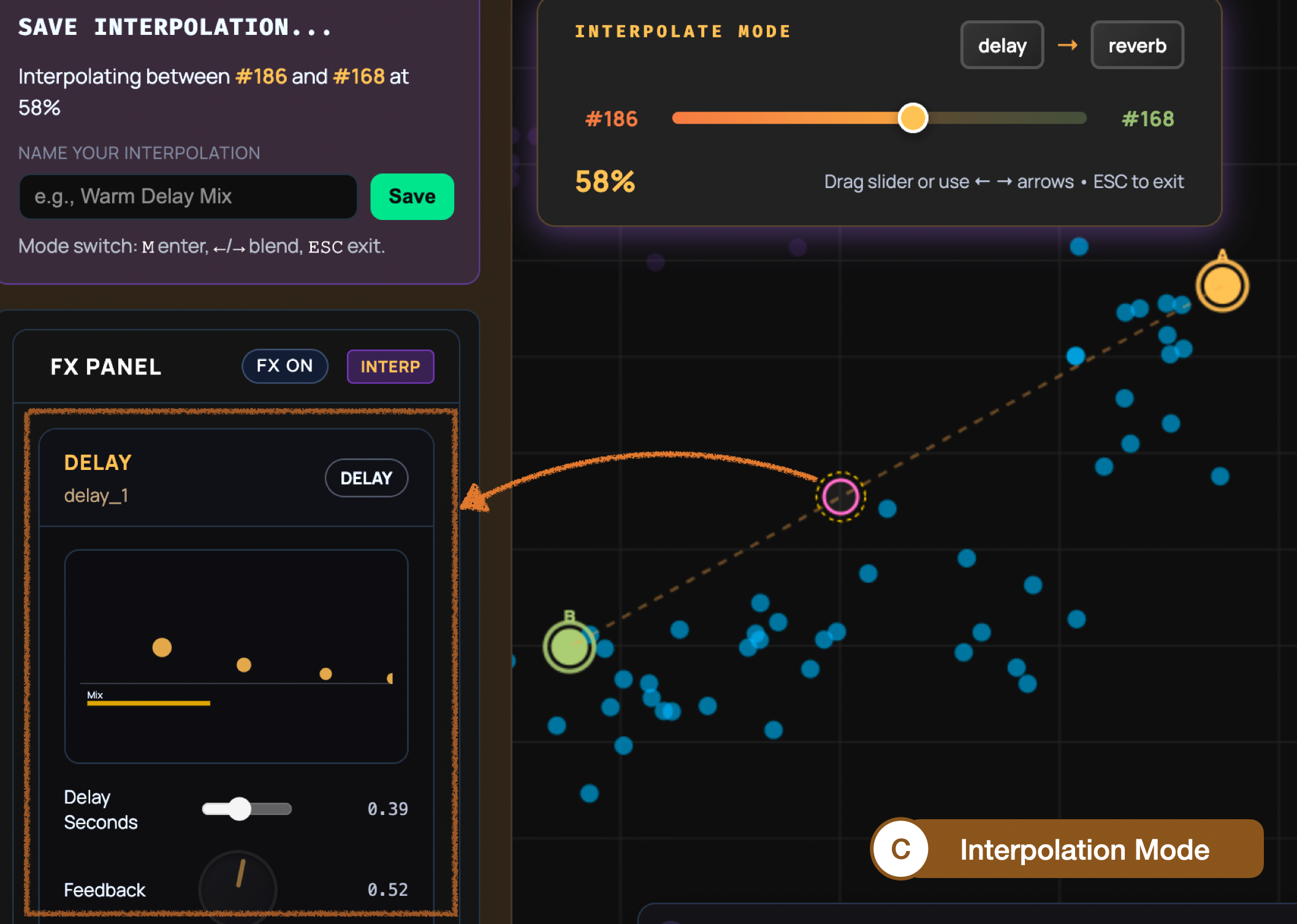
Figure 4: Interpolation Mode interface. Two variants set as endpoints; users continuously transition via parameter interpolation rather than audio crossfade.
Real-Time Editing and Spatial Feedback
Direct parameter editing is conducted in the Inspector panel. Edits are immediately re-embedded and projected back into the 2D space, visualized as "ghost" points indicating their new position. This closes the feedback loop, linking parameter manipulation to its perceptual context and helping users build intuition about sonic transformations. The spatial feedback is particularly salient — large map displacements signal significant timbral departure, while small shifts map to refined adjustments.
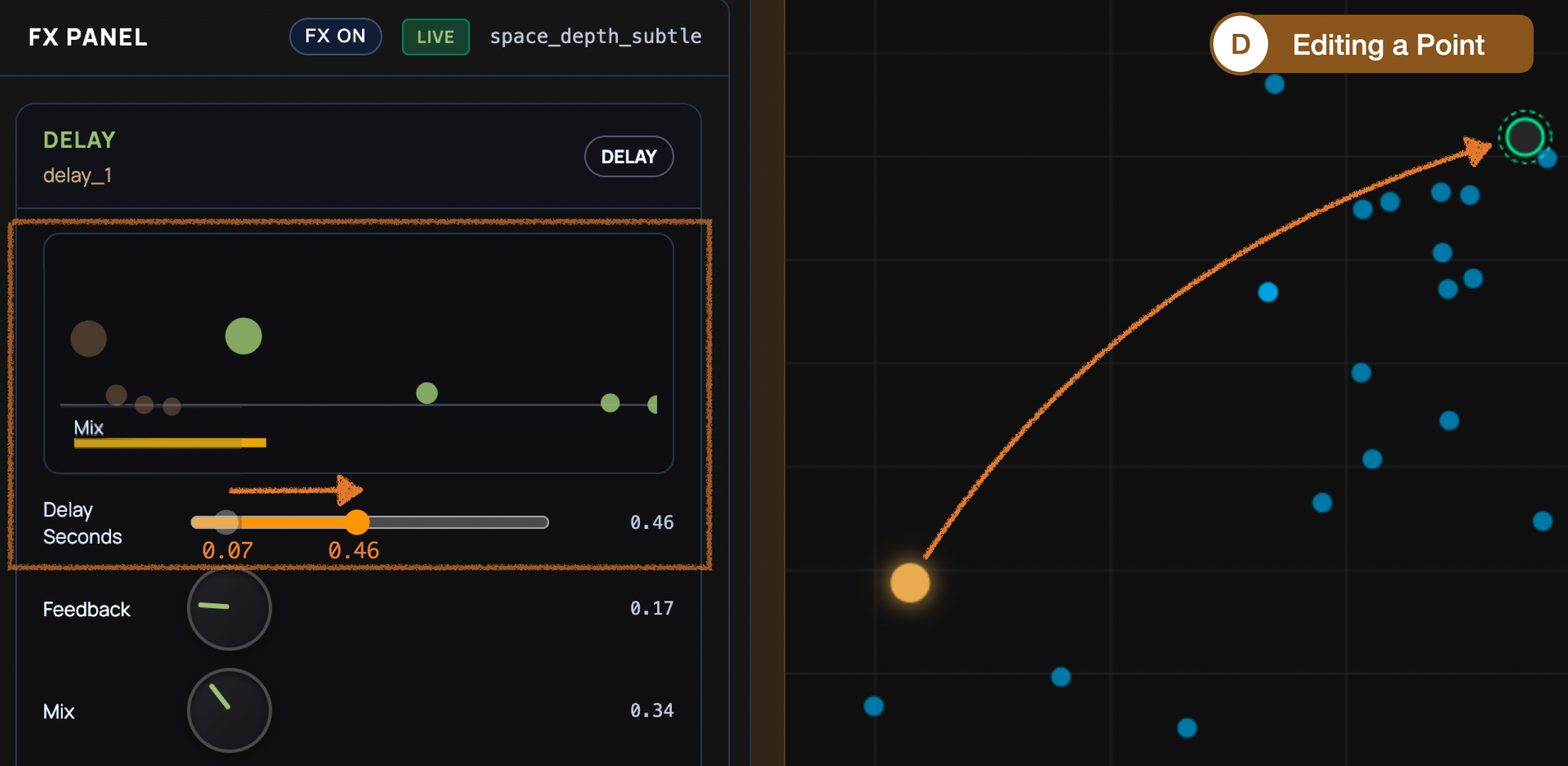
Figure 5: Variant editing. Selected map point opened in FX panel for direct manipulation; changes are tracked in spatial layout in real time.
Implications and Future Directions
FXplorer advances the state of audio FX interfaces within the NIME tradition by unifying perceptually motivated browsing, semantic search, parameter editing, and interpolation. It maintains DAW-compatibility for production, addresses workflow limitations found in categorical and parameter-centric systems, and leverages modern ML embeddings for search and organization. The interface supports rapid auditioning across configurations and encourages exploratory behavior, lowering the barrier for both novices and advanced practitioners.
Practical implications include accelerated sound design, faster ideation cycles, and enhanced intuitiveness for parameter exploration. Theoretical implications span the integration of perceptual embedding models and spatial interaction paradigms for musical expression. Potential future developments involve gestural spatial command, adaptive variant set expansion, alternative embedding schemes (including user-customized metrics), and empirical evaluation of creative strategies enabled by spatial interfaces.
Long-term, this approach could inform broader DAW workflows, generative sound tools, and adaptive mapping strategies for expressive musical interfaces. There is also relevance for algorithmic composition and ML-guided music production, where perceptual and semantic embeddings enable new forms of navigation and interaction.
Conclusion
FXplorer establishes a map-based interface for exploratory audio effect design, operationalizing the multidimensional FX parameter space in a continuous, perceptually organized landscape. By integrating machine learning embeddings, semantic search, interpolation, and real-time parameter feedback, FXplorer offers a unified workspace for sound designers and performers. The work demonstrates substantial advances in interface affordances for exploratory audio transformations, and sets the stage for further research in spatial, semantic, and gestural interaction paradigms for musical expression.