- The paper presents a quantum-corrected extension of the Oppenheimer-Snyder model to (d+1) dimensions, incorporating a nonzero cosmological constant and loop quantum cosmology corrections.
- The paper derives modified Friedmann dynamics, Hawking temperature, entropy, and heat capacity, highlighting new phase transitions and stable remnant behavior in black holes.
- The paper confirms universal critical exponents and emphasizes implications for black hole thermodynamics, holographic studies, and quantum gravity microphysics.
Higher-dimensional Quantum-corrected Oppenheimer-Snyder Model with a Cosmological Constant
Introduction and Theoretical Framework
The paper proposes an advanced extension of the quantum Oppenheimer-Snyder (qOS) model to (d+1)-dimensional spacetimes, incorporating a nonzero cosmological constant Λ, and develops the corresponding exterior metric solution by invoking higher-dimensional Loop Quantum Cosmology (LQC) corrections. The model addresses the gravitational collapse of spherically symmetric, homogeneous dust clouds within the quantum-corrected framework, enforcing metric and extrinsic curvature continuity at the collapse boundary via the Darmois-Israel conditions.
Critical LQC effects emerge through modifications to the Friedmann dynamics with a dimension-dependent quantum correction parameter α, associated with the Immirzi parameter and area gap. The quantum-corrected Friedmann equation dictates the interior's evolution, influencing the exterior vacuum metric, which now generalizes the Schwarzschild-AdS-Tangherlini solution with explicit quantum corrections. The formalism robustly accommodates both AdS (Λ<0) and dS (Λ>0) regimes. The resulting metric supports the study of higher-dimensional AdS black hole thermodynamics with quantum corrections.
Black Hole Thermodynamics in Higher Dimensions
Hawking Temperature
The Hawking temperature T is computed using the established surface gravity approach at the quantum-corrected event horizon. Unlike the classical Schwarzschild scenario, the quantum-corrected temperature remains finite and approaches zero as rh→0, in contrast with the standard divergence found in the Schwarzschild case. The extremal behavior is particularly pronounced for small black holes and is dimension-dependent; higher dimensions result in an increased peak Hawking temperature, with the associated remnant radius shifting accordingly.
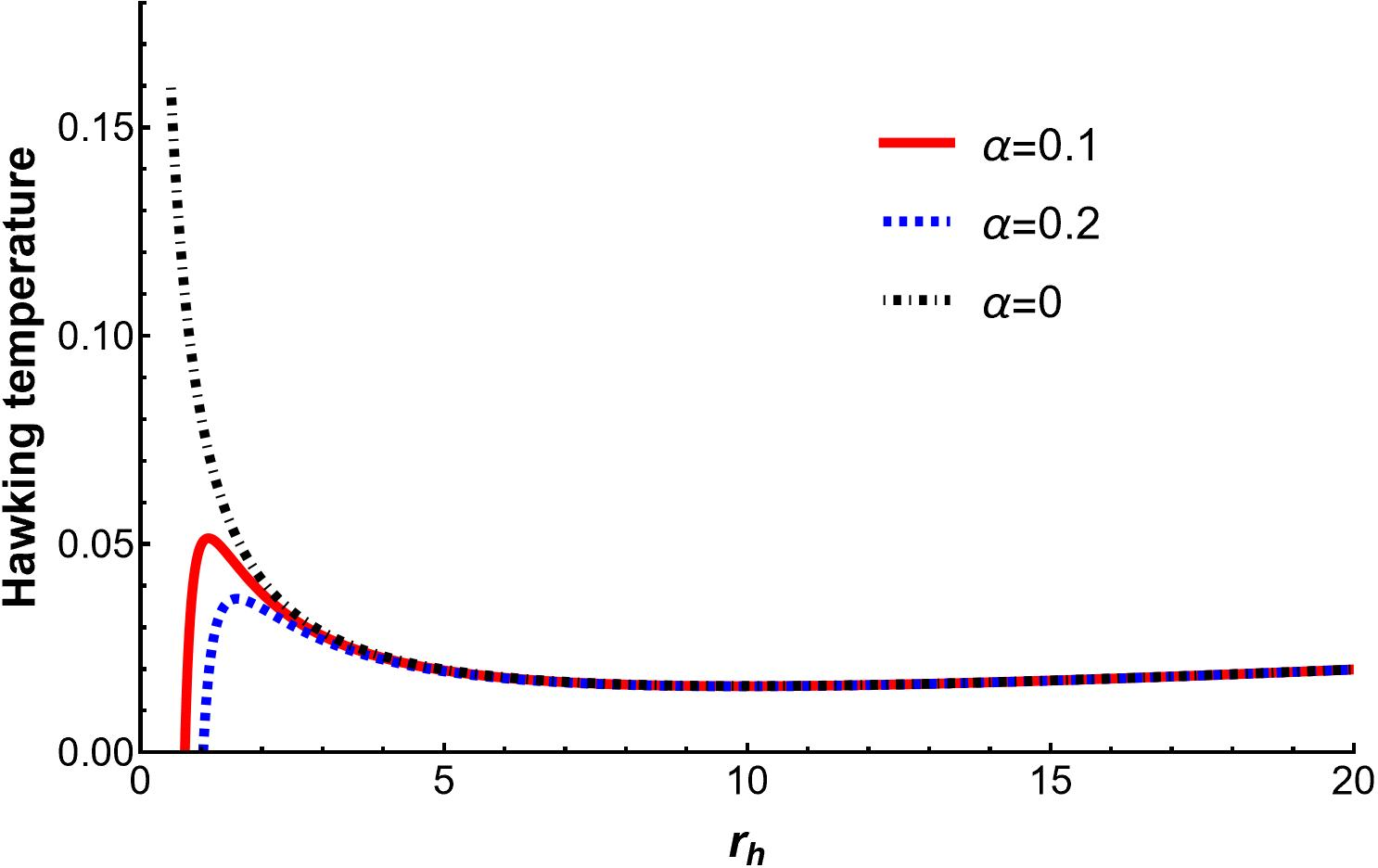
Figure 1: Hawking temperature for the quantum-corrected and Schwarzschild black hole in 5-dimensional spacetime with Λ=−0.01.
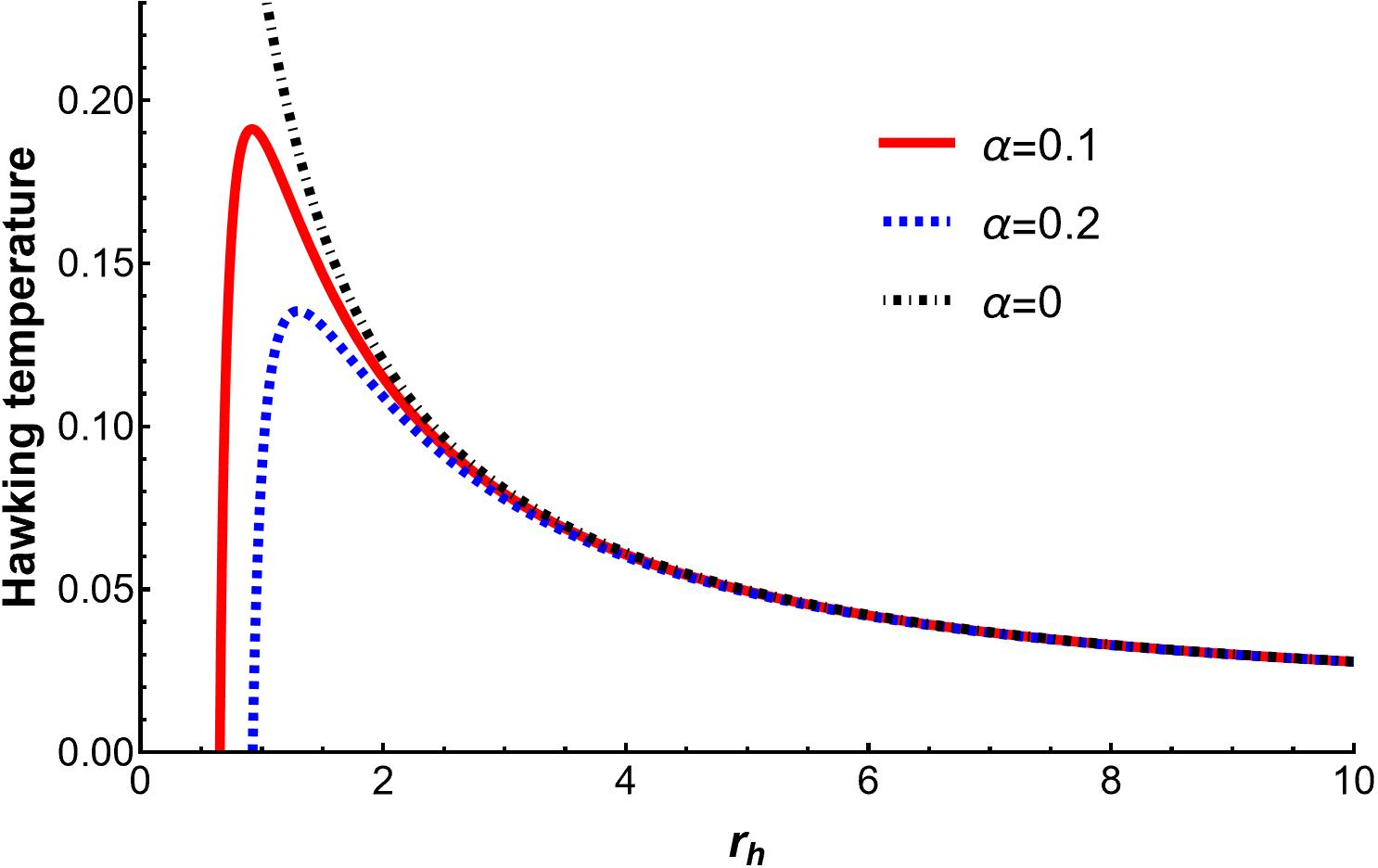
Figure 2: Hawking temperature for the quantum-corrected and Schwarzschild black hole in 6-dimensional spacetime with Λ=−0.01.
These results imply a robust suppression of Hawking radiation for small AdS black holes, signaling the possibility of stable black hole remnants. Quantum corrections manifest as an explicit cutoff in the evaporation process, directly linked to the magnitude of α.
Entropy and the Area Law
The entropy Λ0 is derived via the first law in the extended phase space, with the cosmological constant identified as a thermodynamic pressure. The analytic expressions demonstrate that the entropy corrections are independent of Λ1 and fully attributed to the quantum parameter Λ2. In higher dimensions, entropy converges to the Bekenstein-Hawking value for large event horizons, while subleading corrections dominate at small scale.
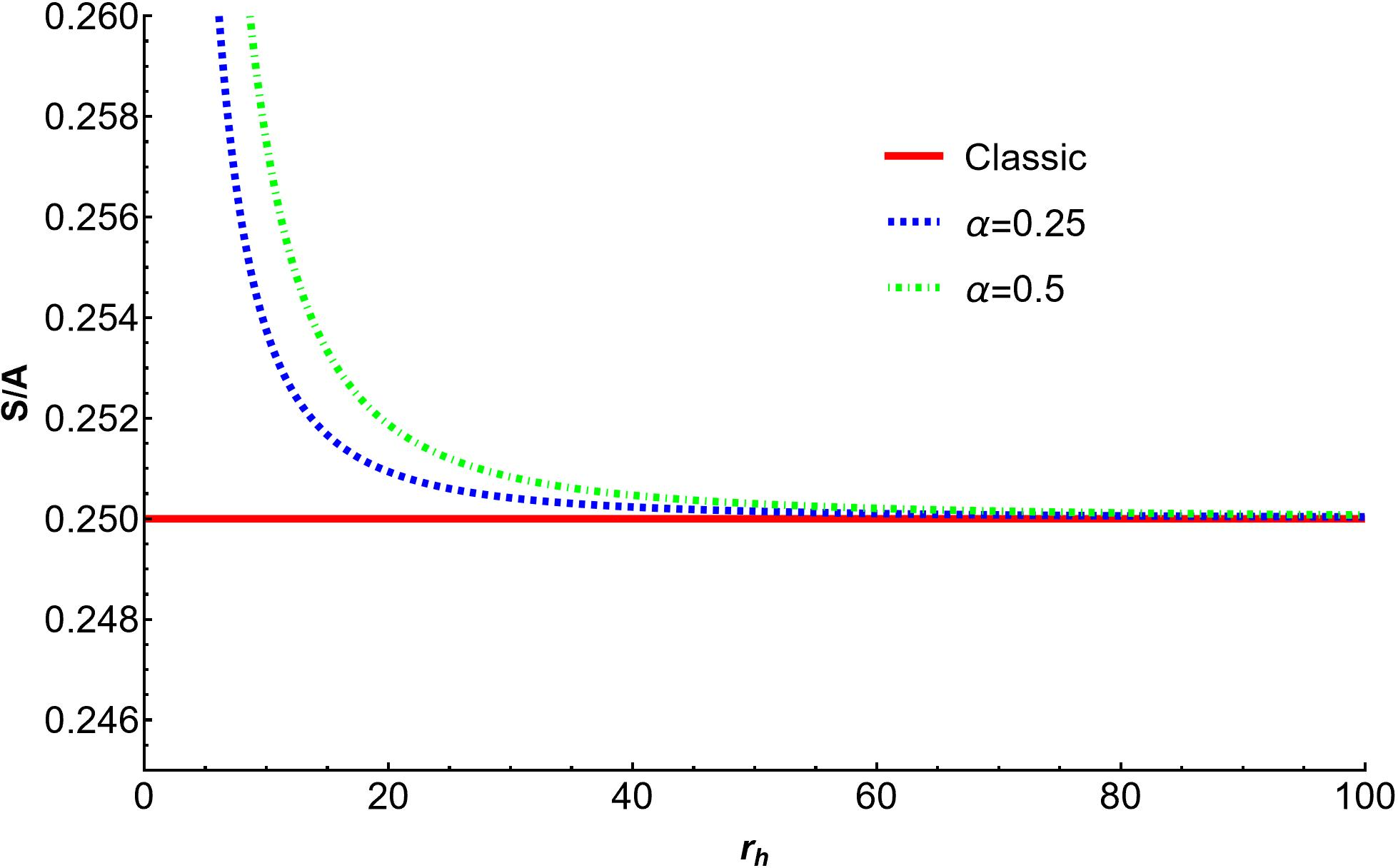
Figure 3: Entropy of quantum-corrected and Schwarzschild (classical) black hole in 5-dimensional space.
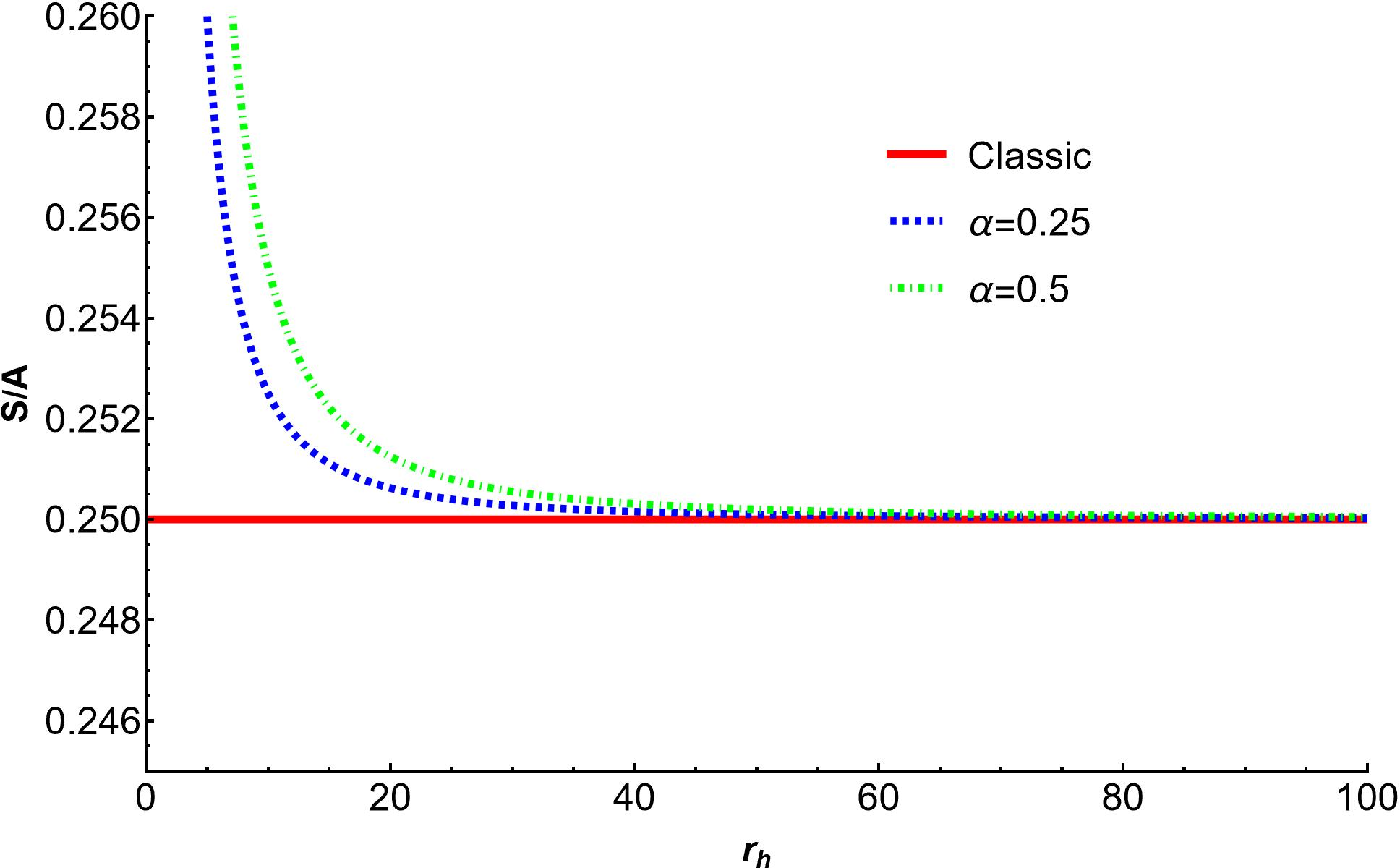
Figure 4: Entropy of quantum-corrected and Schwarzschild black hole in 6-dimensional space.
Plots of Λ3 as a function of Λ4 confirm that Λ5 for large Λ6, while quantum corrections are relevant only at sub-Planckian distances. As the dimensionality increases, quantum corrections become relatively suppressed.
Heat Capacity and Thermodynamic Stability
The heat capacity Λ7 exhibits nontrivial structure as a function of Λ8. Notably, quantum corrections introduce an additional phase transition absent in the classical Schwarzschild-AdS solution—manifested by another divergence in Λ9 at small radii, indicating a distinct shift from thermodynamic stability (positive α0) to instability (negative α1) for small quantum-corrected black holes.
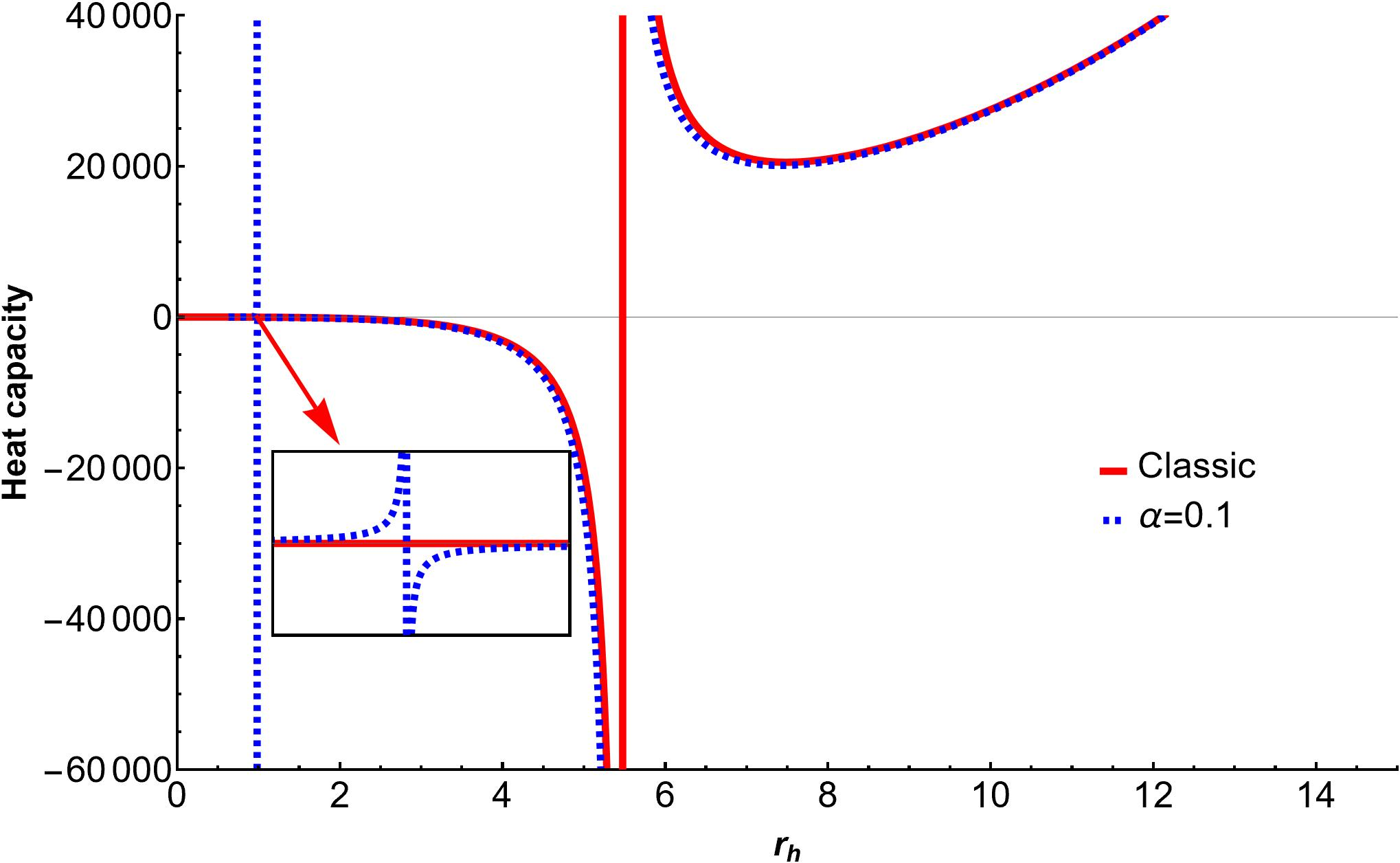
Figure 5: Heat capacity of the 5-dimensional quantum-corrected and Schwarzschild black hole.
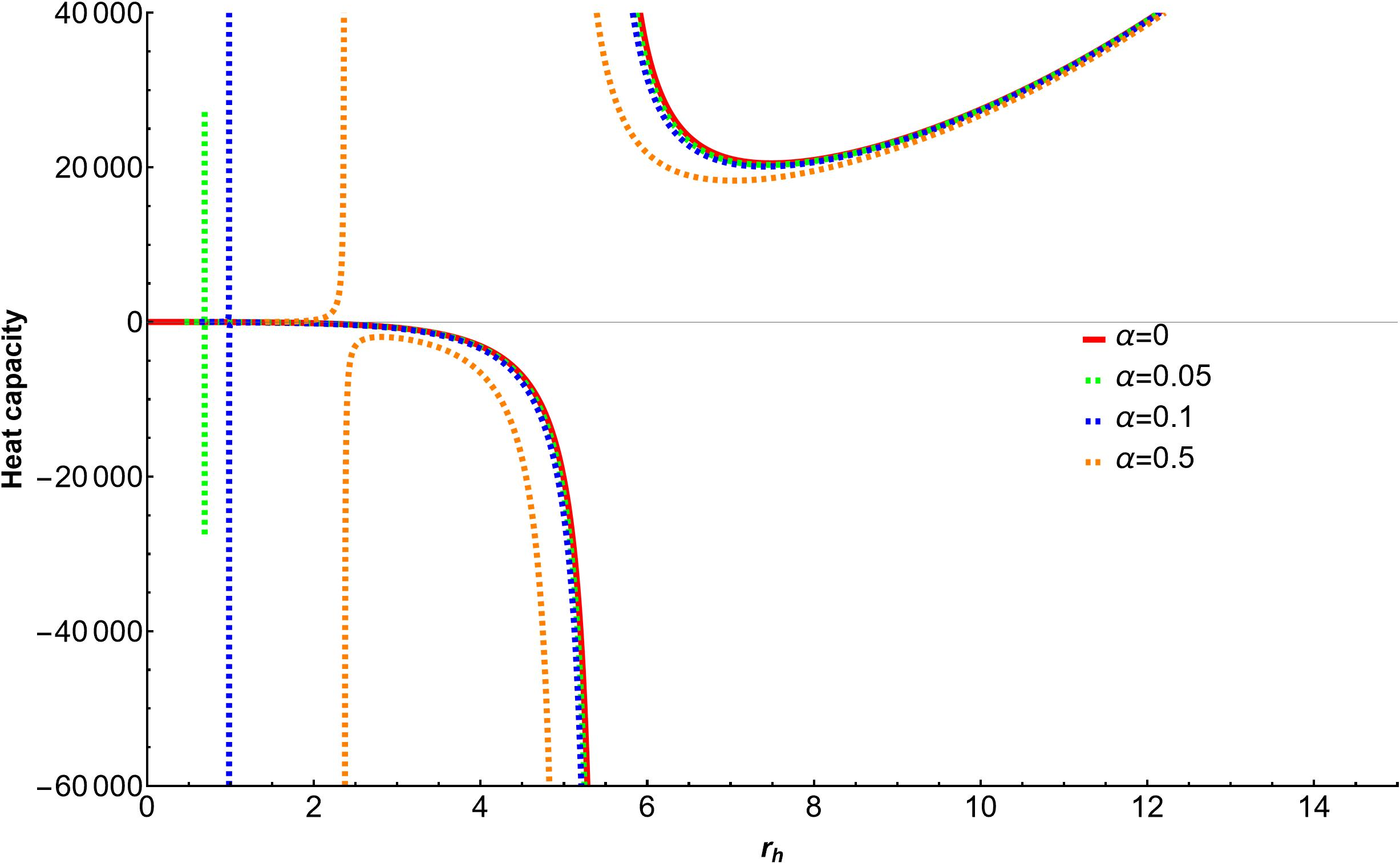
Figure 6: Heat capacity of the 5-dimensional quantum-corrected black hole with different values of α2 and Schwarzschild black hole.
Increasing α3 further accentuates the new phase structure by reducing the remnant radius at which the extra heat capacity divergence occurs. The location of the large-radius phase transition slowly approaches the classical value for increasing α4, and the discrepancy between quantum-corrected and classical heat capacities diminishes.
Gibbs Free Energy and Phase Transitions
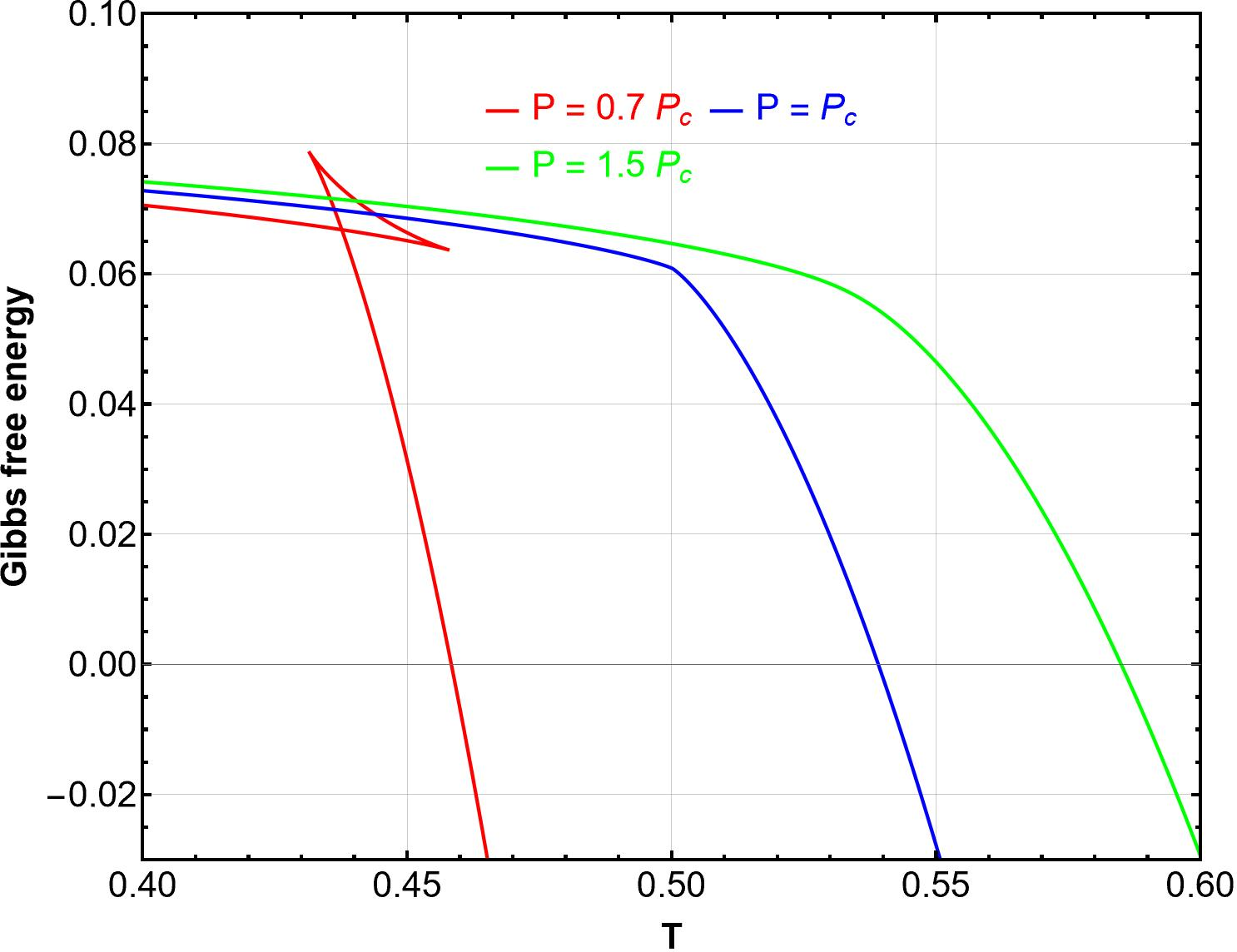
Figure 7: Gibbs free energy against temperature in 4-dimensional space.
Characteristic swallow-tail behavior in the Gibbs free energy diagram at subcritical pressures signals a first-order black hole phase transition. Quantum corrections preserve the qualitative structure; however, the underlying microphysical interpretation is now fundamentally modified due to the remnant scenario at small radii. At the critical pressure α5, the transition becomes second order, and for α6 only a single thermodynamic phase is present.
Critical Phenomena and Universality
The analysis of critical exponents and reduced thermodynamic variables (e.g., α7, α8, α9) establishes that the universal scaling laws are respected even in the presence of higher-dimensional LQC corrections. The critical exponents remain Λ<00 across all dimensions and parameter regimes, confirming mean-field type universality. The critical compressibility Λ<01 acquires explicit dependence on Λ<02, but otherwise the critical structure retains its classical universality class.
Implications and Future Directions
The quantum-corrected higher-dimensional AdS black holes developed in this model demonstrate profound modifications to both evaporation dynamics and phase structure—most notably, the elimination of temperature divergence, introduction of a thermodynamic remnant, and a new small-radius phase transition in heat capacity. The existence of remnants is consistent with recent LQG proposals for black hole singularity avoidance and quantum bounce phenomenology (2606.08182, Lewandowski et al., 2022, Belfaqih et al., 16 Apr 2025). The robust suppression of Hawking temperature at small scales sets the stage for the explicit investigation of information retention, remnant stability, and possible black-to-white hole transitions.
Practically, this construction can be leveraged to compute the Hawking radiation spectrum, greybody factors, and emission profiles for higher-dimensional quantum black holes, facilitating direct comparison with LQG-inspired signatures. Theoretical implications extend to holographic contexts via the AdS/CFT correspondence, suggesting that remnants and phase transitions influence the dual field theory thermodynamics. The universality of critical exponents in the presence of quantum corrections may have far-reaching implications for the structure of quantum gravity microstates.
Further research directions include dynamical studies of collapse, evaporation end-states, and information transfer in higher-dimensional quantum black holes. The interplay of quantum corrections, cosmic censorship, and the AdS/CFT dictionary warrants comprehensive analysis.
Conclusion
The quantum-corrected higher-dimensional Oppenheimer-Snyder model with a cosmological constant yields a rich thermodynamic phenomenology, distinct from classical solutions by virtue of LQC-motivated corrections. Temperature regularization, existence of remnants, novel phase transitions, and universal critical behavior provide a consistent and predictive framework for quantum gravity-controlled black hole dynamics in AdS backgrounds. The model paves the way for detailed spectroscopic and dynamical studies, fostering a deeper understanding of quantum black hole thermodynamics and their connections with quantum gravitational microphysics.

