- The paper presents a barrier-modulated control architecture that integrates HOCBFs and adaptive dynamic programming to ensure collision avoidance and robust affine formation tracking.
- It details two controllers—an analytical barrier-gradient and an ADP-based actor-critic—supported by rigorous stability proofs and validated through simulation.
- Simulations in a nine-agent 3D formation demonstrate absolute collision avoidance and uniform ultimate boundedness of tracking errors even under parametric uncertainties.
Introduction and Motivation
The paper addresses the challenge of guaranteeing safety in affine formation control for second-order multi-agent systems subjected to parametric uncertainties. While affine formation frameworks offer high geometric flexibility—encompassing translation, rotation, scaling, and shearing—prior research typically neglects formal collision avoidance guarantees. This gap is critical in practical applications, especially where distributed protocols must operate autonomously and safely under uncertainty.
The proposed solution integrates Higher-Order Control Barrier Functions (HOCBFs) with adaptive dynamic programming (ADP), resulting in a barrier-modulated control architecture. Two distinct safety controllers are formulated: a computationally efficient, mathematically rigorous analytical barrier-gradient controller and a data-driven actor-critic neural network controller. Theoretical analysis invokes Nagumo’s theorem and Lyapunov stability proofs to establish forward invariance of the safe set and Uniform Ultimate Boundedness (UUB) of tracking errors and parameter estimates. The approach is validated in simulation for dynamic obstacle avoidance and uncertain environments.
Affine formation control is characterized by a nominal geometric pattern, r, for a set of agents governed by a communication graph G. The permissible target formation is any affine transformation of r, defined as p∗(t)=(In⊗A(t))r+1n⊗b(t), wherein A(t) and b(t) dictate rotation, scaling, translation, and shearing. Rigorous affine localizability analysis ensures that followers can compute their positions from the leaders, provided necessary graph-theoretical conditions are satisfied.
Several works have already formalized affine control laws for single- and double-integrator dynamics, as well as non-holonomic constraints; however, collision avoidance for nonlinear uncertain agents remains an open problem, especially under distributed protocols.
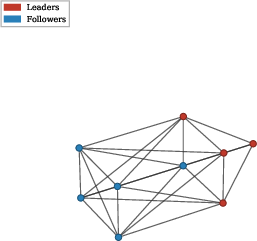
Figure 1: The nominal 3D affine dart formation consisting of 4 leaders (red) and 5 followers (blue); black lines denote the 25 active edges; r is the nominal configuration.
Barrier-Modulated Control Architecture
The proposed control input for a follower is given by ui=ρiunom,i+usafe,i, where ρi is a smooth function modulating the nominal controller as agents approach the safety boundary. This attenuation ensures that the formation tracking objective is subordinated to collision avoidance when required, thereby preventing conflicting control actions.
Safety is quantified using HOCBFs, allowing implementation for second-order (acceleration-controlled) systems. The constraint h0(xi,xj)=∥pi−pj∥2−Ds2≥0 ensures a minimum allowable inter-agent separation, and the augmented safety function G0 incorporates velocity terms for higher-order dynamics. The architecture supports both neighbor-based communication and local sensing, enabling distributed collision detection.
Analytical Barrier-Gradient Controller
The analytical controller adds a repulsive force proportional to the spatial barrier gradient across all agents detected by the local sensor. The magnitude of this force increases sharply as the safety constraint nears violation. Sufficient gain conditions are rigorously derived, ensuring forward invariance of the safe set via Nagumo’s theorem. Lyapunov stability analysis confirms that the formation tracking and adaptive estimation errors are UUB, even when the nominal objective is overridden by safety.
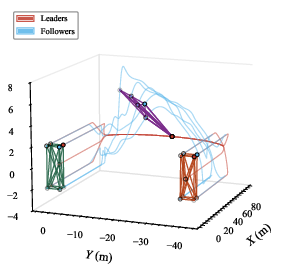
Figure 2: The 3D trajectory for the barrier-gradient based controller, demonstrating safe maneuvering under formation maneuvers.
ADP-Based Actor-Critic Controller
The second controller employs adaptive dynamic programming (ADP) via an actor-critic neural network to learn optimal safety policies online, solving the Hamilton-Jacobi-Bellman equation under uncertainty. The danger state G1 aggregates spatial and velocity information weighted by proximity to critical boundaries. When the safety boundary is approached, the controller modulates the adaptation gains and injects exploratory noise to satisfy persistent excitation, guaranteeing learning convergence.
The actor network learns the optimal repulsion policy, while the critic approximates the value function governing safety cost. Both weights are projected onto compact domains for numerical stability. Sufficient saturation bounds for the actor are mathematically derived to guarantee absolute collision avoidance, even with large disturbances or adversarial leader maneuvers.
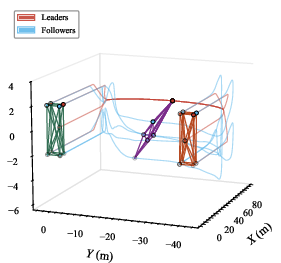
Figure 3: The 3D trajectory for the ADP-based controller, illustrating adaptive collision avoidance and robust tracking.
Simulation Results
The simulations feature a nine-agent 3D scenario with four leaders and five followers in a nominal dart formation. Parametric uncertainties (modeled via quadratic velocity drag) and intentional leader collapse are introduced. Both controllers maintain strict inter-agent separation, actively preventing collision by subordinating the nominal tracking objective when necessary.
Minimum pairwise separation trajectories corroborate absolute collision avoidance guarantees, with tracking errors and control inputs demonstrating UUB properties. Neural network weights for the actor and critic converge smoothly, satisfying persistent excitation requirements and validating the adaptive robustness of the ADP controller.
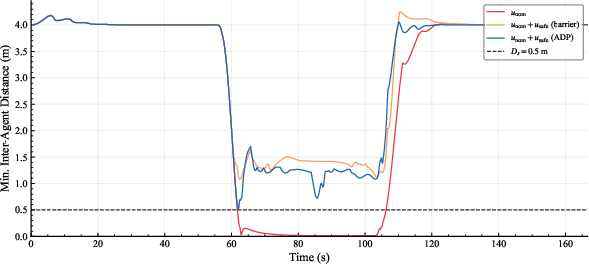
Figure 4: Comparison of minimum distance between follower-related pairs, confirming active maintenance of safe separation.
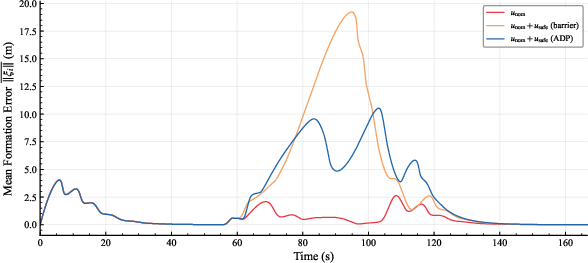
Figure 5: Comparison of tracking error for both safety controllers during acute maneuvers; errors are UUB.
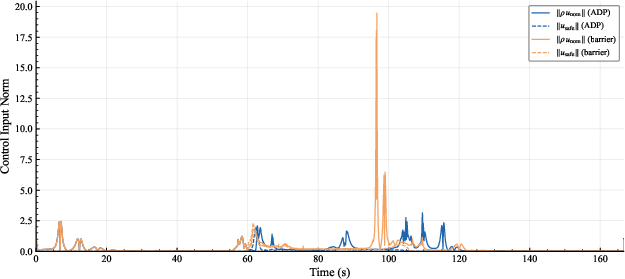
Figure 6: Comparison of control inputs, highlighting intervention magnitude and adherence to saturation limits.
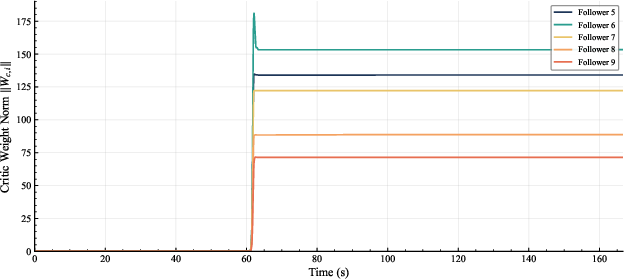
Figure 7: Critic weights convergence under persistent excitation, demonstrating learning stability.
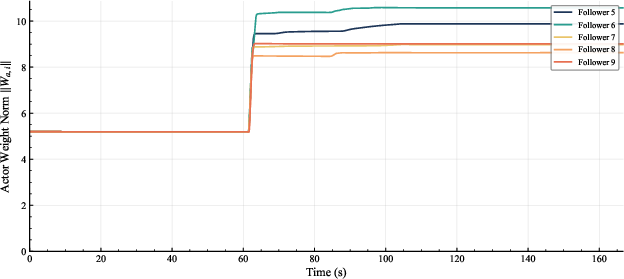
Figure 8: Actor weights convergence, validating the robustness of online safety policy adaptation.
Implications and Future Directions
Theoretical guarantees for absolute collision avoidance and UUB stability are established for both analytical and ADP-based controllers. The latter is especially relevant for large-scale swarms where distributed policies must robustly address uncertain dynamics and incomplete information. The modular architecture enables practical deployment on UAVs, autonomous vehicles, or marine systems, relying only on local communication and sensing.
Potential future directions include generalization to directed communication topologies, extension to nonlinear (control-affine) agents, hierarchical formation frameworks, and the incorporation of external dynamic obstacles or adversarial agent interactions. The synthesis of barrier modulation with distributed optimization and scalable reinforcement learning offers promising avenues for resilient multi-agent autonomy.
Conclusion
The paper presents a rigorous solution to safe affine formation control under uncertainty for second-order multi-agent systems (2606.08137). By integrating HOCBFs into a barrier-modulated architecture, the framework achieves simultaneous formation tracking and collision avoidance. Both the analytical barrier-gradient and the optimal ADP-based actor-critic controllers are proven to guarantee forward invariance of the safe set and UUB stability. Numerical and learning results validate robustness and adaptability in extreme dynamic scenarios. The research sets the foundation for scalable, resilient, and formally safe distributed formation control architectures applicable to complex autonomous swarms.