- The paper presents a detailed theoretical framework showing how the tilt parameter drives Fermi surface topology transitions and modulates DC conductivity.
- It applies the Kubo formalism with the first-order Born approximation to distinguish transport responses under short-range versus long-range impurity scattering.
- The study identifies anisotropic conductivity features near the Lifshitz critical point, offering clear signatures for experimental disorder characterization and Fermi surface engineering.
DC Conductivity of Tilted Dirac Fermions Across the Lifshitz Transition: Dependence on Short- and Long-Range Impurities
Introduction
This paper provides an extensive theoretical analysis of DC conductivity in two-dimensional tilted Dirac systems traversing subcritical (Type I), critical (Lifshitz), and overcritical (Type II) tilt regimes. Utilizing the Kubo formalism and the first-order Born approximation, the study systematically contrasts the impact of short-range and long-range (Coulomb) impurity scattering. The authors pay particular attention to the geometric evolution of the Fermi surface and its nontrivial consequences for macroscopic transport, with explicit analytic and numerical results that clarify the interplay between topology, disorder, and conductivity.
A two-dimensional tilted Dirac Hamiltonian captures the essential low-energy physics, with a tilt parameter t modulating the cone along qy. The topology of constant energy contours in momentum space evolves with t: closed ellipses for t<1, open hyperbolic branches for t>1, and a singular Lifshitz transition at t=1.
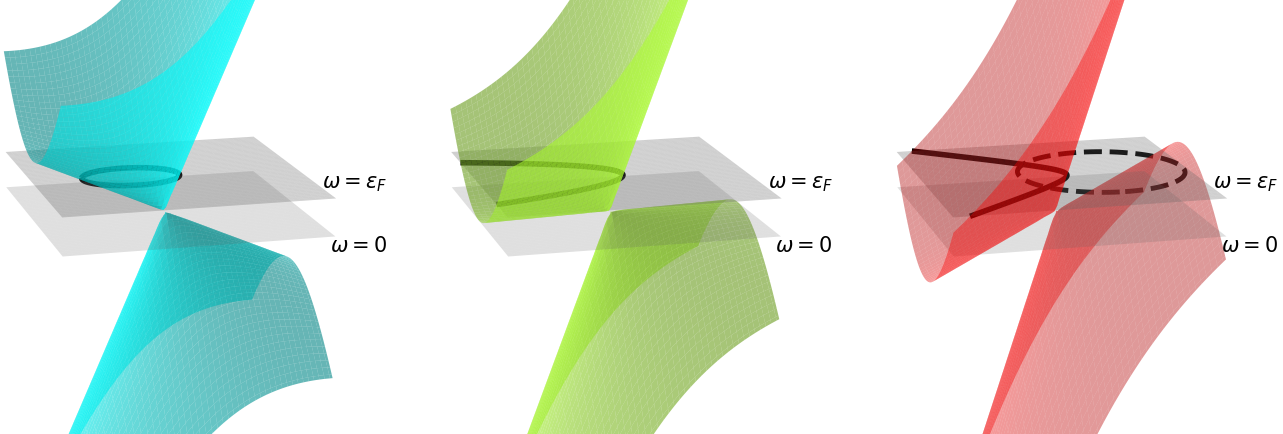
Figure 1: The evolution of the Fermi surface in a tilted Dirac semimetal, emphasizing the closed, critical, and open topologies and the necessity for a transverse momentum cutoff Λ in the overcritical regime.
The presence of tilt breaks Lorentz invariance and dramatically modifies the density of states (DOS), velocity operators, and regularization requirements for transport calculations, especially due to UV divergences in the Type II phase.
The DC conductivity tensor is computed using the Kubo formula, incorporating disorder via self-energy corrections in the Born approximation. The analysis explicitly treats vertex corrections through the Bethe-Salpeter equation and demonstrates their vanishing at the Lifshitz point (t=1) for both disorder classes.
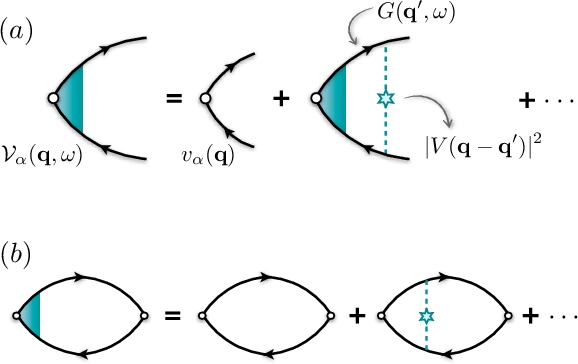
Figure 2: Diagrammatic form of the Bethe-Salpeter equation for the renormalized vertex, capturing essential multiple scattering corrections.
The conductivity integrals reveal sensitivity to both energy and tilt, mediated by the specific impurity potential.
Short-Range Impurities: Regime-Dependent Transport Signatures
Subcritical Regime (t<1)
For point-like (delta-function) impurity scatterers, the broadening Γ is linear in energy and enhances with increasing tilt due to a DOS increase. The resultant qy0 is energy-independent (excluding a trivial Drude tail at large energies) and decreases monotonically as qy1 rises, with a divergence as qy2 regularized by the introduction of a physical cutoff.
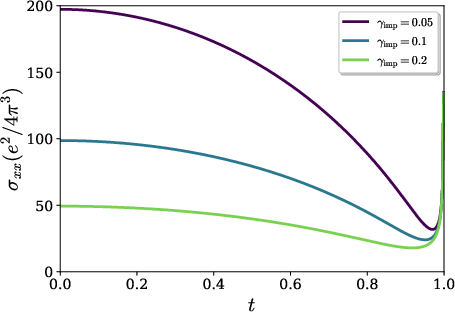
Figure 3: Subcritical qy3 for short-range impurities as a function of qy4, monotonically suppressed as the system approaches the Lifshitz transition.
Overcritical Regime (qy5)
In the Type II regime, the open Fermi surface causes both the scattering rates and conductivity to acquire explicit dependence on the cutoff qy6. Notably, qy7 (orthogonal to the tilt) exhibits non-monotonicity, peaking near qy8 before decaying due to phase space constriction; qy9 (along the tilt) grows unbounded, generating extreme anisotropy.
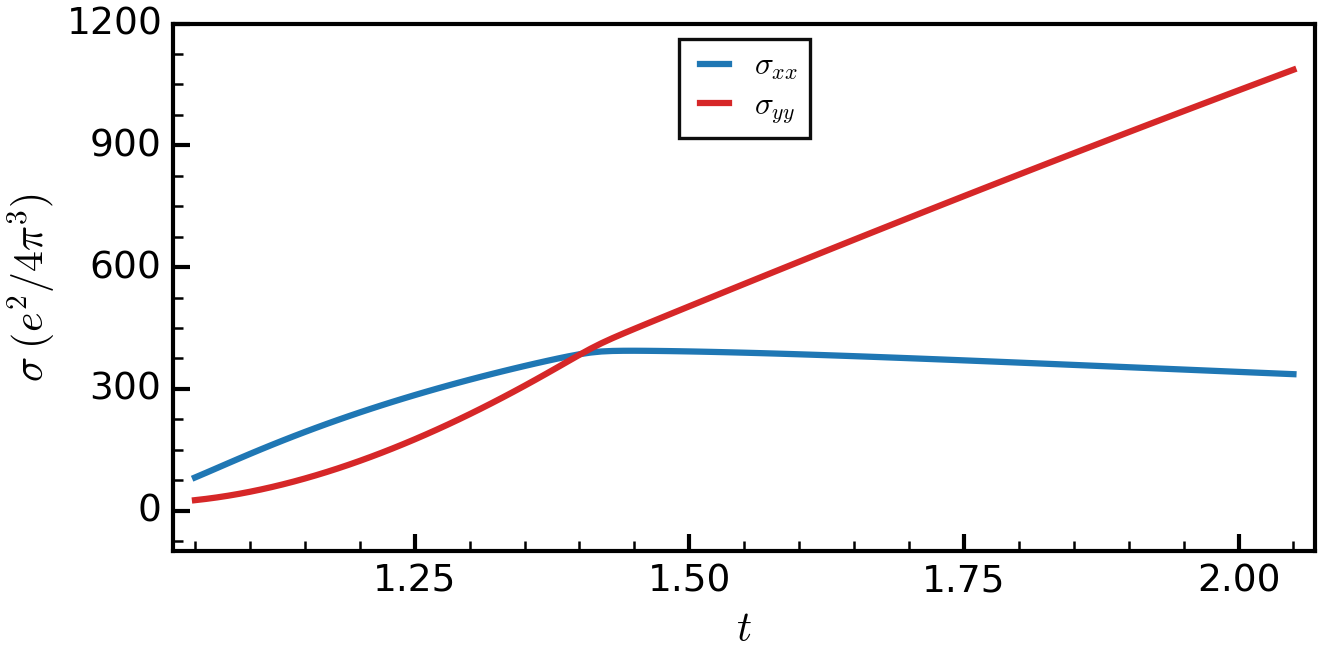
Figure 4: Conductivity anisotropy for t0, showing finite t1, a peak near t2, and diverging t3, signifying strong transport directionality.
Lifshitz Critical Point (t4)
A van Hove singularity emerges in the DOS, causing the self-energy to diverge as t5. The macroscopic transport signature is a sharply localized dip in conductivity at the Dirac point.
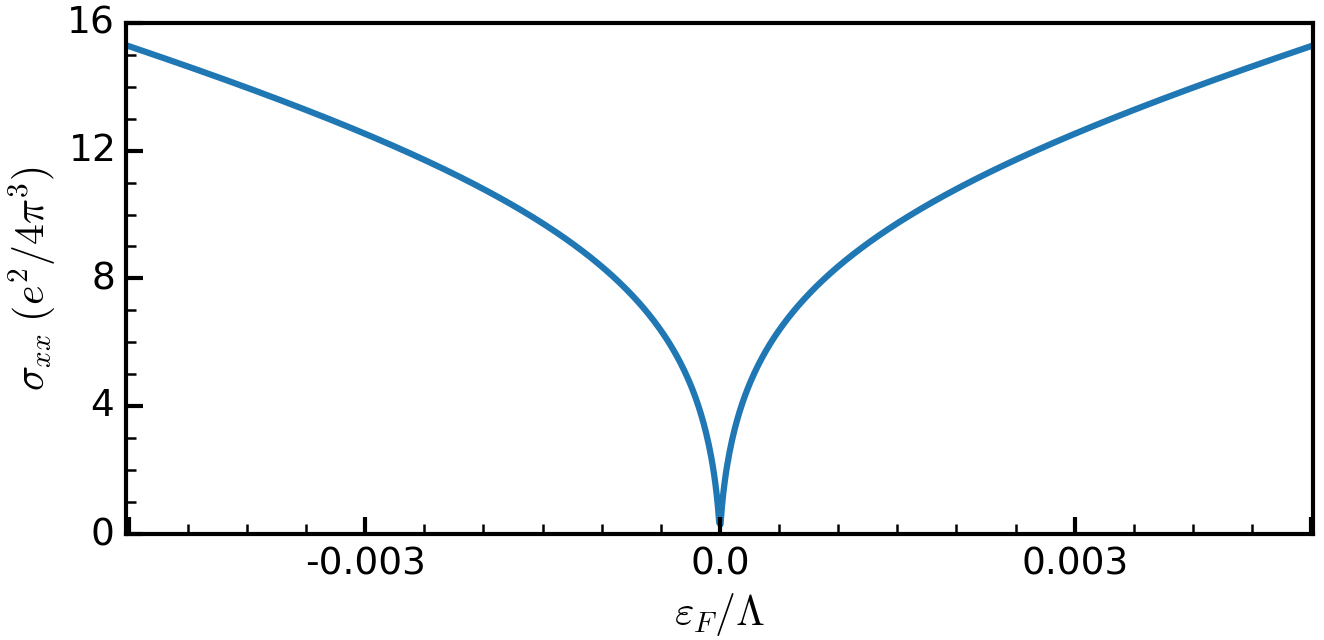
Figure 5: Conductivity dip at t6 for short-range disorder, caused by the divergent scattering self-energy.
Vertex Corrections
Vertex corrections are purely geometric: substantial for t7, zero at t8, and growing as t9 increases beyond unity, asymptoting to 2 for large tilt.
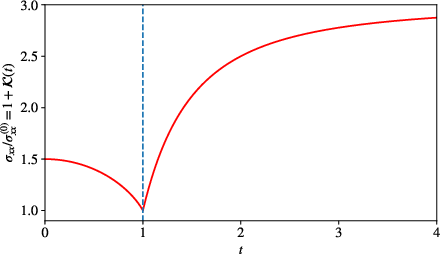
Figure 6: Geometric vertex correction factor to the conductivity across the tilt regimes, vanishing at the critical point.
Global Conductivity Evolution
The global trend of t<10 exhibits a frequency-independent plateau for small t<11, a marked dip at t<12, and a peak before subsequently decreasing at large t<13 due to the cutoff effect.
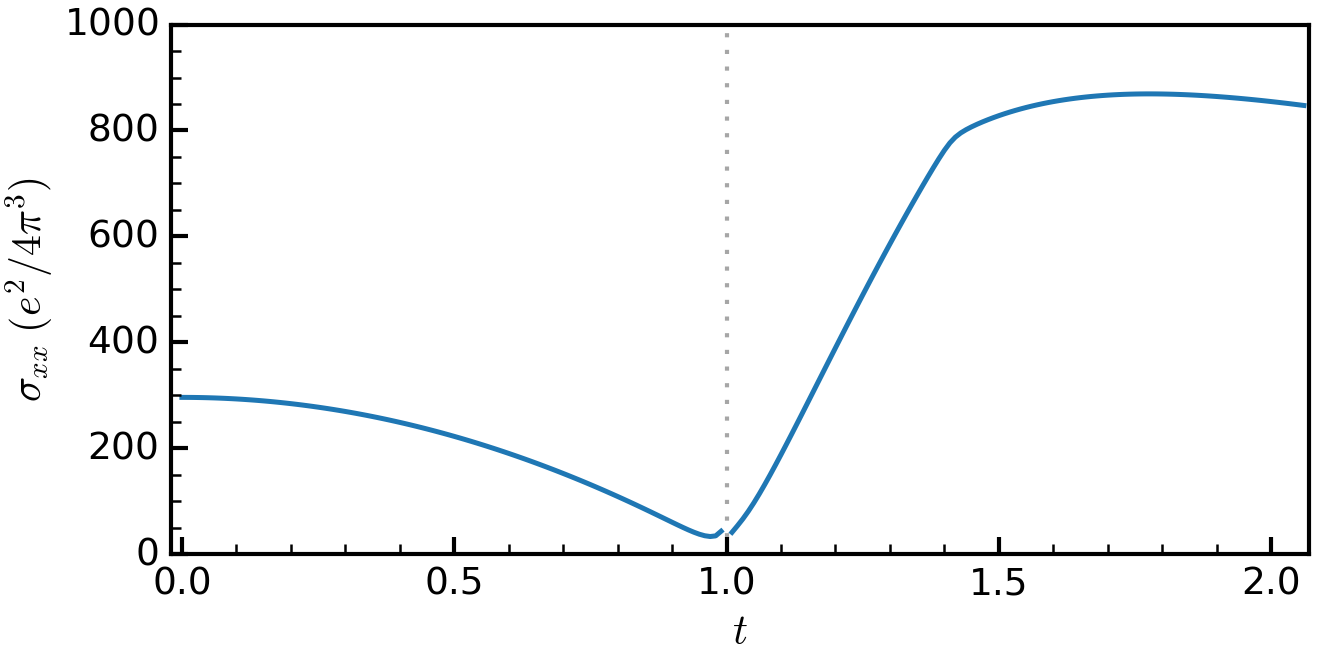
Figure 7: Unified view of t<14 across all tilt regimes for short-range impurities, illustrating plateau, dip, and non-monotonic overcritical behavior.
Long-Range (Coulomb) Impurities: Distinct Energy and Tilt Dependence
Subcritical Regime (t<15)
Coulomb scattering leads to a self-energy that scales inversely with energy, t<16, and is independent of tilt. This causes the conductivity to scale nearly quadratically with Fermi energy, with heavy suppression near t<17.
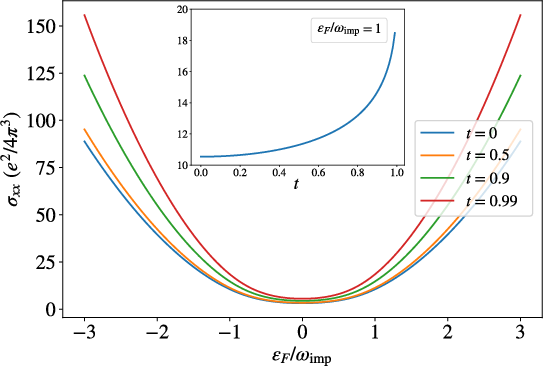
Figure 8: For Coulomb scattering, t<18 reveals a strong energy dependence, vanishing near the Dirac point for t<19.
Overcritical Regime (t>10)
Ultraviolet finiteness and open Fermi lines result in a conductivity that grows approximately linearly with Fermi energy. As the tilt increases beyond t>11, conductivity is monotonically reduced, distinctly contrasting the short-range case.
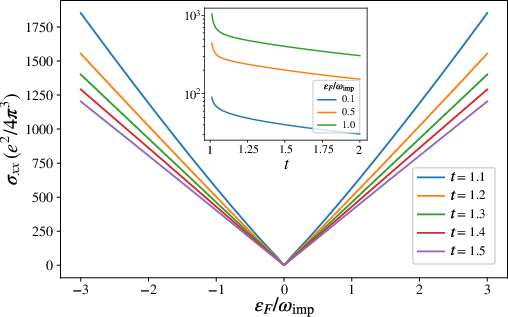
Figure 9: Overcritical conductivity for Coulomb scattering; note the linear energy trend and geometry-driven peak near t>12.
Lifshitz Transition (t>13)
At t>14, conductivity for long-range impurities displays a highly localized dip at the Dirac point, but, notably, the geometric enhancement near the Lifshitz transition manifests as a macroscopic conductivity peak for finite energy.
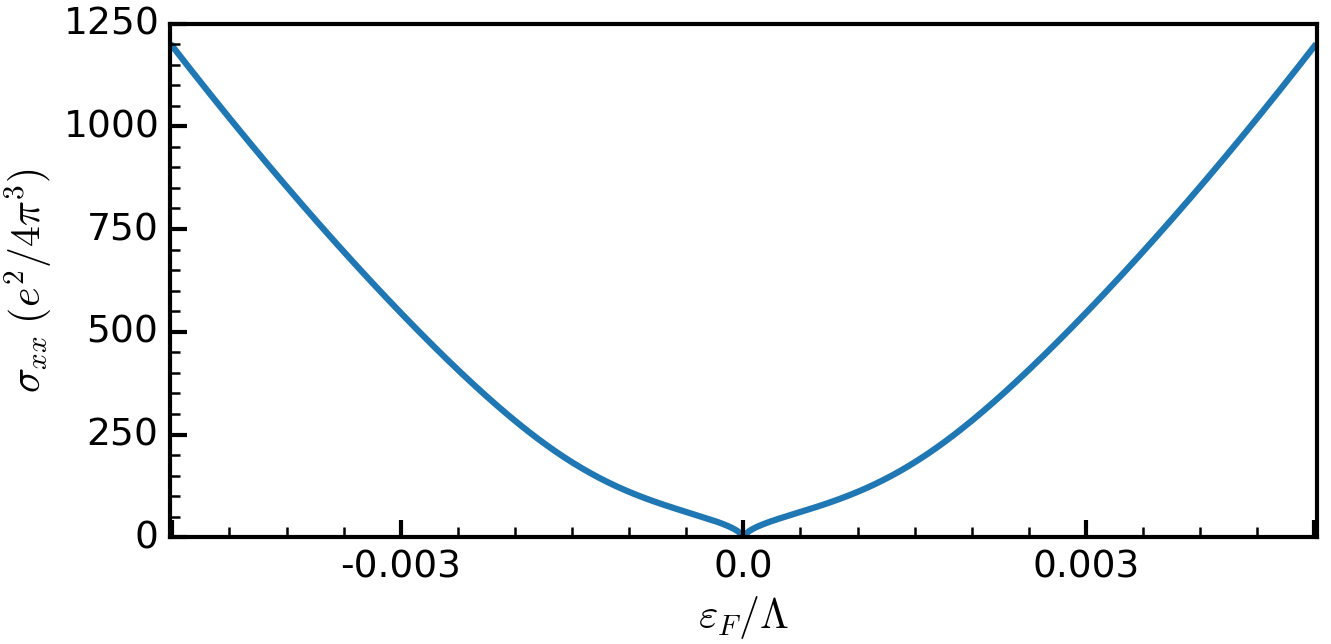
Figure 10: At the transition, the critical self-energy singularity leads again to a conductivity dip at the Dirac point even for Coulomb impurities.
Vertex Corrections and Global Conductivity
For long-range disorder, vertex corrections are weak except near t>15 where they vanish. Macroscopic conductivity is dominated by the bare-bubble contribution, with tilt-driven enhancement near t>16 that is robustly geometric.
Geometric Unification: Tilt as Effective Metric Curvature
The paper adopts a geometric interpretation wherein the tilt parameter t>17 redefines the momentum-space metric, modifying the integration measure, scattering rates, and physical observables. The DOS renormalization is shown to correspond to the determinant of the effective metric, connecting the curvature of the pseudo-Riemannian phase space to measurable transport coefficients.
Implications and Prospects
This study demonstrates that the tilt parameter enables precise control of both topological and transport phase transitions in Dirac/Weyl materials. From an experimental perspective, the sharply contrasting behaviors under short-range versus long-range scattering provide clear diagnostics for disorder-type identification and Fermi surface engineering. In particular, transport anisotropy in the Type II regime and the critical conductivity dip or peak at t>18 constitute robust signatures with potential applications in topological electronics.
Theoretically, the geometric formalism paves the way for future research on curved momentum-space quantum materials, providing an explicit link between effective metric structure and observable transport phenomena. Outstanding questions include the impact of interaction-driven self-energy corrections beyond the Born approximation, disorder-induced quantum criticality, and nonlinear response.
Conclusion
This work delivers a comprehensive, unified analysis of DC conductivity in 2D tilted Dirac fermion systems, elucidating the profound role of the tilt parameter as a geometric and topological knob. The study delineates a rich taxonomy of transport regimes controlled by both impurity character and Fermi surface topology, supplies explicit analytic and numerical formulas for conductivity behavior across the Lifshitz transition, and introduces an effective geometric viewpoint that may guide future explorations of emergent relativistic and gravitational analogs in quantum materials.

