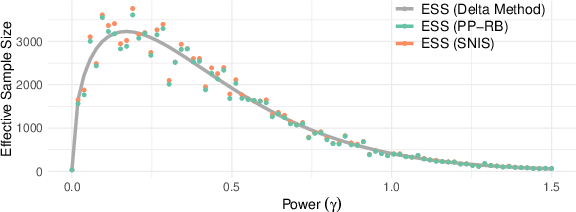
- The paper introduces the PPP-RB framework that robustifies recursive Bayesian inference by incorporating parallel tempering to address significant posterior shifts.
- It demonstrates substantial gains in effective sample size and computational throughput compared to standard PP-RB and full Metropolis–Hastings methods.
- The framework shows versatile applicability across complex models, evidenced by simulation studies and real-world applications like earthquake and spatial Gaussian process analyses.
Robustification of Recursive Bayesian Inference: PPP-RB Framework
Introduction
The paper "Making Recursive Bayesian Inference Robust" (2606.07981) introduces the Parallel-tempered Prior Proposal–Recursive Bayesian (PPP-RB) inference framework, an advancement over Prior Proposal–Recursive Bayesian (PP-RB) methods. While PP-RB offers scalable, parallelizable computation for Bayesian inference by sequentially updating the posterior with data partitions, its robustness is limited when posterior distributions shift significantly between stages. PPP-RB enhances robustness by integrating principles from Metropolis-coupled Markov chain Monte Carlo (MCMCMC), specifically parallel tempering, enabling efficient exploration of the parameter space and accurate inference even under substantial posterior shifts.
Background: PP-RB Limitations and Tempering
PP-RB operates by partitioning data and recursively updating posterior distributions, using samples from previous stages as proposals for the Metropolis–Hastings (MH) algorithm. While this facilitates scalability, it assumes close proximity between stage-specific posteriors and the final posterior. Substantial shifts in posteriors due to new or divergent partitions degrade inference quality and effective sample size (ESS). The degeneracy problem and posterior mismatch are distinct but related issues; the latter remains unresolved in conventional PP-RB.
To ameliorate posterior shift, power-tempered PP-RB tempers the posterior from previous stages, flattening the proposal distribution, and theoretically maximizing ESS through optimized temperature selection based on χ2-divergence. However, optimal temperature selection typically depends on knowledge of the final posterior, which is rarely accessible in practice.
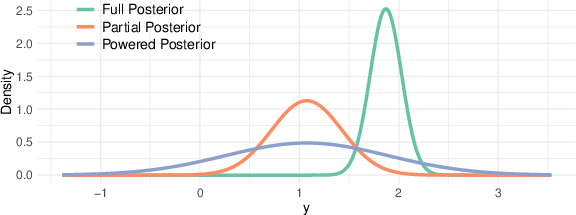
Figure 1: Comparison of densities for full, partial, and powered partial posterior distributions illustrating enhanced coverage achieved via tempering.
PPP-RB Framework and Algorithm
PPP-RB generalizes PP-RB by maintaining a set of parallel chains at different temperatures, akin to MCMCMC. Each chain recursively updates the tempered posterior across stages, and frequent swaps between cold (targeting the true posterior) and hot chains facilitate exploration of parameter regions poorly represented by previous-stage proposals. By satisfying the detailed balance condition, PPP-RB guarantees that the cold chain ultimately samples from the true posterior, unaffected by intermediate posterior shifts.
Implementation includes:
Theoretical Results
The stationary distribution of each chain at the first stage is the corresponding tempered posterior. The joint distribution across chains is invariant under the combined within-chain and swap transitions, and the marginal distribution of the cold chain converges to the true posterior after J−1 recursive updates. Detailed balance is proven for both within-chain MH updates and between-chain swaps.
Practical Implementation Considerations
Key tuning parameters include:
- Max Temperature (τmax): Should allow hot chains to adequately cover the space containing the true posterior's density; conservative selection can suffice due to computational parallelism.
- Number of Chains (L) and Temperature Schedule: More chains are recommended for higher τmax; geometric spacing is empirically effective. Swap acceptance rates between 0.2 and 0.4 are indicative of efficient mixing.
- Swap Frequency (m): Frequent swaps (ideally every iteration, m=1) are advised, especially in uncertain or highly multimodal settings.
- Hot Chain Selection: Random selection is simplest and effective; empirical acceptance rates may bias subsequent selection.
Simulation Studies
Two simulation scenarios highlight PPP-RB robustness:
- Normal Mixture Model: PPP-RB provides posterior summaries for mixture weights that are consistent with full MH sampling, whereas PP-RB fails when partitions yield substantial divergence.
- Linear Model Under Misspecification: PPP-RB recovers posterior estimates indistinguishable from the MH algorithm, outperforming PP-RB under posterior shift due to outliers.
Empirical Applications
Loma Prieta Earthquake (Hawkes Process)
PPP-RB is applied to earthquake count data via a Hawkes process. Posterior summaries agree closely with those from full MH inference and surpass PP-RB in robustness and ESS/ET efficiency. PPP-RB is notably more efficient in producing effective samples per unit time, substantiated with strong numerical results:
| Algorithm |
μ ESS/ET |
η ESS/ET |
β ESS/ET |
| Full MH |
0.9 |
1.5 |
0.3 |
| PP-RB |
0.6 |
0.7 |
0.7 |
| PPP-RB |
7.3 |
4.9 |
4.6 |
Sea Surface Salinity (Gaussian Process)
PPP-RB is tested on spatial SSS data using a GP model with partitioned, streaming data. Posterior diagnostics and predictive agreement with MH sampling confirm high accuracy and robustness. PPP-RB yields substantial improvement in ESS/ET:
| Algorithm |
log(J−10) ESS/ET |
log(J−11) ESS/ET |
log(J−12) ESS/ET |
| MH |
0.02 |
0.22 |
0.03 |
| PPP-RB |
4.13 |
3.89 |
3.56 |
Implications and Future Directions
PPP-RB facilitates robust, scalable Bayesian inference in streaming and large-scale contexts, particularly where posteriors shift between data partitions. By enabling efficient parallel tempering and targeted exploration, PPP-RB preserves exact posterior targeting while improving computational efficiency. Theoretical guarantees and strong empirical results imply PPP-RB's suitability for hierarchical models and multimodal target distributions.
Future developments may include:
- Formalized guidelines for temperature and chain scheduling, potentially adaptive.
- Optimization of data partitioning schemes for maximal efficiency.
- Integration with model streaming or online Bayesian learning platforms.
- Application to increasingly complex hierarchical, spatial, or deep latent models.
Conclusion
PPP-RB presents a theoretically sound and empirically validated advancement for scalable, robust recursive Bayesian inference. By combining PP-RB with MCMCMC strategies, PPP-RB resolves the major limitation of unrepresentative proposals under posterior shifts, offering substantial gains in accuracy, ESS, and computational throughput. This framework is readily extendable and adaptable to diverse Bayesian computational challenges, supporting both practical applications and future methodological innovation in scalable inference.