- The paper presents a complete classification of translationally covariant modulated symmetries and rigorously analyzes their spontaneous symmetry breaking and Goldstone phenomena.
- Using 1D examples, it identifies multipole, exponential, and harmonic components, each corresponding to distinct conserved charge structures.
- Applications to deformed Bose-Hubbard models reveal nonstandard Goldstone mode dispersions, including gapped and finite-momentum gapless excitations.
Translationally Covariant Modulated Symmetries: Structure, Classification, and Goldstone Phenomena
The study of symmetries with spatially modulated charge densities—so-called modulated symmetries—has led to remarkable generalizations of traditional symmetry-protected phases and their spontaneous symmetry breaking (SSB) patterns. This work establishes a comprehensive theoretical framework for translationally covariant modulated symmetries (TCMS), providing a concrete classification, explicit examples, and a rigorous analysis of their SSB and associated Goldstone spectra.
Definition and Classification of TCMS
A modulated symmetry is defined by a spatially dependent unit of charge F{x}, such as those emerging in models with dipole, multipole, or exponential charge conservation. Unlike conventional onsite symmetries, these do not trivially commute with spatial translations; thus, a fundamental constraint is compatibility with translation-invariant Hamiltonians. The authors derive necessary and sufficient algebraic conditions for a modulated symmetry to be translationally covariant, requiring that the set of symmetry generators closes under commutation with the translation operator, resulting in a real structure constant matrix Aμ per spatial direction.
For the class of Abelian TCMS, the analysis shows that the allowed spatial dependences for the unit-charge function F{x} are fully classified: they must consist of either multipole (polynomial), exponential, or harmonic (trigonometric) components. Notably, these three components are identified precisely with the real Jordan normal form blocks of Aμ, both at the algebraic and the differential equation level.
1D TCMS: Jordan Block Classification
In one spatial dimension, the problem reduces to the analysis of a single matrix A1, which by similarity transformation can be cast into block-diagonal real Jordan form. Each Jordan block corresponds to:
This classification is exhaustive: any 1D TCMS charge constraint must be reducible to a linear combination of these building blocks. Higher-dimensional generalizations are conjectured to follow from simultaneous triangularization constraints on commuting Aμ5 matrices.
Microscopic Models and Symmetry Realizations
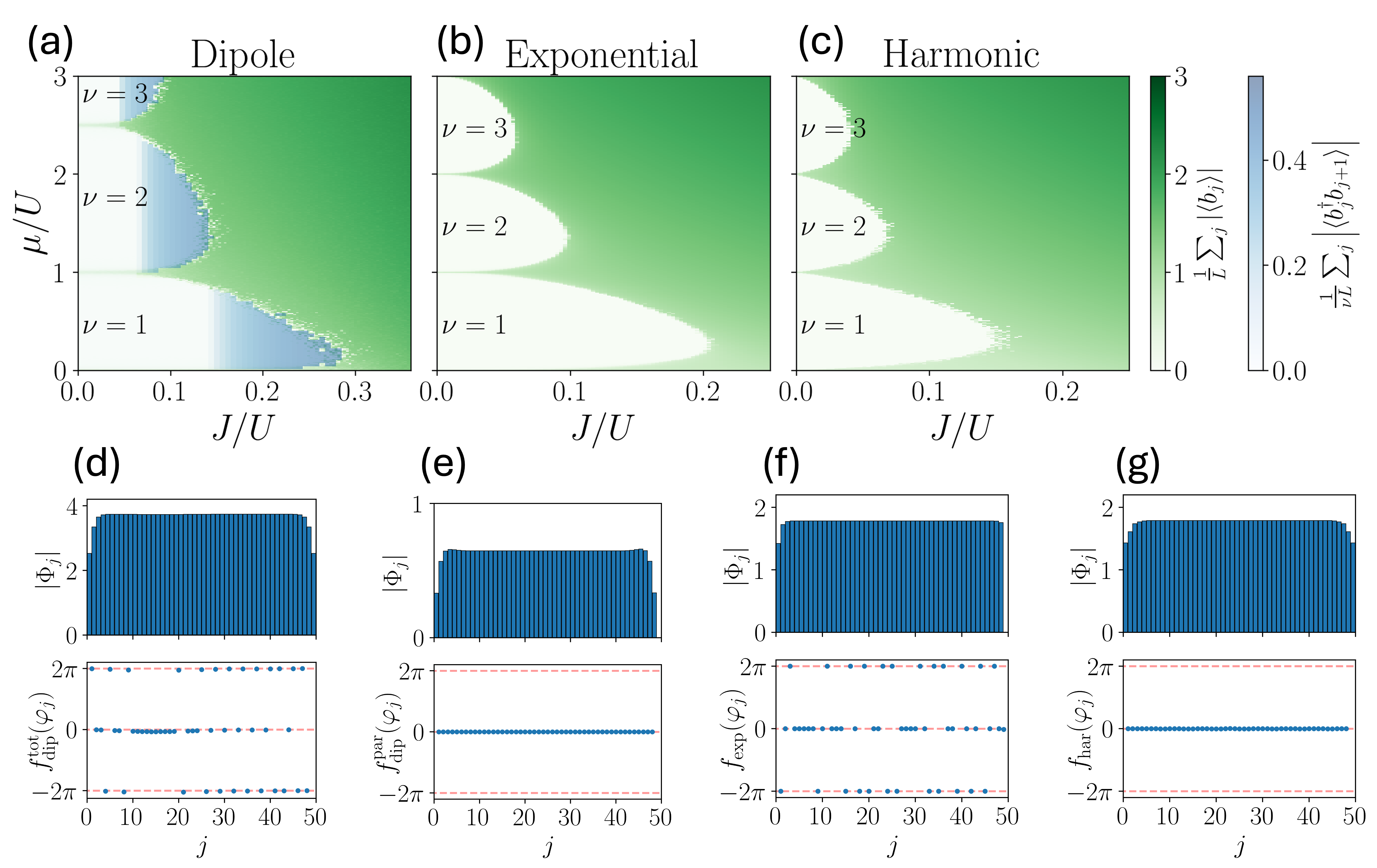
The framework is applied to deformed Bose-Hubbard models with diverse kinetic terms that enforce the desired modulated symmetries. Three explicit models are discussed in detail:
- Dipole model: Symmetry charges are monopole and dipole moments;
- Exponential model: Quantum breakdown Hamiltonian with exponentially-weighted charge;
- Harmonic model: Charges involve site-occupation modulated by sine and cosine functions.
These models exhibit SSB into phases in which the order parameter has spatially uniform magnitude yet nontrivial phase structure, indicating unbroken mixed symmetries of translation and modulated charge.
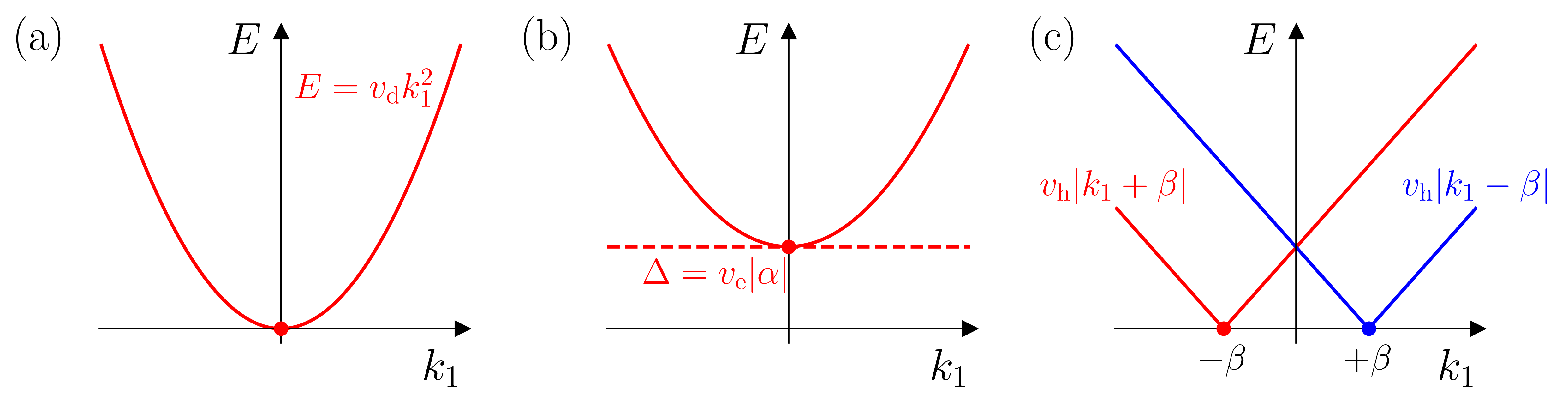
Figure 2: Schematic Nambu-Goldstone mode dispersions for broken dipole (quadratic, Aμ6), exponential (intrinsically gapped), and harmonic (linearly dispersing with minima at finite momentum) symmetries.
Generic Goldstone Action and Modified Goldstone Theorem
A central result is the derivation—using both effective field theory and coset construction—of the universal low-energy action for Goldstone modes in phases that spontaneously break continuous TCMS. The main quadratic Lagrangian has the structure:
Aμ7
where Aμ8 is the Goldstone field vector, and Aμ9, F{x}0 are model-dependent matrices. This form encodes the essential algebraic structure arising from the (possibly nontrivial) action of translations on the broken symmetry generators.
The Goldstone mode content for TCMS SSB is highly non-standard:
- Multipole broken phases: Higher-order gapless Goldstone modes appear, with quadratic (or higher) dispersion in the corresponding spatial direction (Figure 2a).
- Exponential broken phases: No gapless Goldstone modes exist; the spectrum is fully gapped (Figure 2b). This is in stark contrast to the standard Goldstone theorem for internal symmetries and implies robust SSB even in one dimension, as in the quantum breakdown model.
- Harmonic broken phases: Goldstone modes are gapless only at finite momenta F{x}1, with linear dispersion (Figure 2c). This is reminiscent of Luttinger-type modes rather than conventional zero-momentum Nambu-Goldstone bosons.
The work gives an explicit spectral derivation of these statements, revealing that the structure of the unit-charge function F{x}2 and its Fourier-space properties fundamentally modify the support of the commutator appearing in the Goldstone theorem, thereby shifting or even eliminating the locations of gapless modes in momentum space.
Implications, Open Problems, and Prospective Advances
This classification sharply constrains the possible forms of robust, translation-compatible modulated symmetries in quantum matter. Immediate theoretical implications include:
- Identification of allowed SSB patterns in higher-order or spatially modulated symmetry-protected phases.
- Prediction that certain SSB transitions can occur with robust gapped order-parameter modes (contradicting the usual assumption of emergent gapless excitations), enabled by exponential modulated symmetries.
- Construction of models with finite-momentum Goldstone modes as a generic possibility in lattice systems with harmonic TCMS.
Key open questions remain, such as the systematic extension to higher-dimensional and non-Abelian TCMS structures, the role of such modulated symmetries in topologically ordered or fractonic phases, and connections to gauge-theoretic or gravitational analogs (notably, the interpretation of F{x}3 as an "imaginary connection").
Conclusion
This work lays a rigorous and concrete foundation for the study of translationally covariant modulated symmetries and their physical realizations. The precise classification, model constructions, and analytic results concerning the Goldstone spectrum reshape the theoretical landscape regarding symmetry breaking and low-energy dynamics in spatially modulated systems. Future investigations into higher-dimensional and non-Abelian generalizations, and the exploration of emergent phenomena in novel quantum phases protected by TCMS, are promising avenues enabled by these results.