- The paper introduces the Fréchet Bayes rule to optimally predict metric-space responses by minimizing the posterior expected squared distance.
- It leverages reproducing kernel Hilbert space embeddings and weak conditional expectations to incorporate prior information without full likelihood specification.
- Applications in microbiome transfer learning demonstrate improved prediction accuracy through informed shrinkage and robust regularization in non-Euclidean settings.
Bayesian Global Fréchet Regression: Framework, Theory, and Applications
Introduction
The paper "Bayesian Global Fréchet Regression via Weak Conditional Expectations" (2606.07947) introduces a comprehensive Bayesian framework for Fréchet regression, which addresses the fundamental problem of regressing from Euclidean predictors to non-Euclidean responses modeled as random elements in general metric spaces. Classical regression models are not directly applicable to such settings because standard operations like addition or scalar multiplication are undefined for many metric-space-valued objects, such as probability distributions, manifolds, or compositional data. Existing literature on Fréchet regression has focused almost exclusively on frequentist methods, with limited capacity for incorporating prior information or external data sources. This work closes that gap, providing a principled Bayesian formulation along with robust inferential theory and scalable implementation.
The authors leverage operator-theoretic tools, notably reproducing kernel Hilbert space (RKHS) embeddings, to construct a Bayesian regression paradigm in which prior information is incorporated in a weak sense—via expectation and covariance structures—rather than requiring a full prior/likelihood specification in the metric space. The construction yields a new statistical object, the Fréchet Bayes rule, which generalizes the Bayes rule to responses in arbitrary metric spaces. This approach unlocks both theoretical and practical advances, including shrinkage to informed priors, robust inference under model misspecification, and applications with cross-study predictive portability.
Fréchet Bayes Rule and Bayesian Fréchet Regression
At the core of the methodology is the Fréchet Bayes rule, which defines optimal prediction for metric-space-valued responses by minimizing the posterior expected squared distance. Let Y be a random object in a metric space (ΩY,d), associated with predictor X∈Rp. For Euclidean responses, the Bayes rule minimizes the expected squared error between the response and the estimator. In the metric space setting, the paper proposes to instead minimize
y∈ΩYargminE[d2(Y,y) ∣ data],
where the expectation is with respect to the predictive (posterior) distribution given the observed sample. Since integrals or linear averages are usually undefined in ΩY, the problem is shifted to working with squared distance values, which are real-valued and amenable to standard Bayesian updating.
Crucially, instead of specifying priors and likelihoods directly over ΩY, the regression problem is recast as a collection of scalar regression tasks for the squared distances d2(Yi,y), reducing an intractable nonlinear object regression to a tractable sequence of scalar kernel/ridge regressions indexed by y. The regression function is modeled as an element of an RKHS, and a prior is placed on this function. This enables full Bayesian updating via standard Gaussian process conjugacy under mild assumptions or, more generally, via weak conditional expectations when Gaussianity is not tenable.
Theoretical Foundations and Robustness
Two theoretical regimes are developed: (1) an exact Bayesian updating with a working Gaussian model and conjugate priors in RKHS, and (2) a generalized construction based solely on first- and second-moment assumptions, replacing posterior means with weak conditional expectations [li_dimension_2022]. In both cases, explicit formulas for the posterior predictive mean are derived, and the minimizer over y yields the Bayesian Fréchet estimate.
The methodology achieves controlled shrinkage between the prior and the frequentist estimator, parameterized by variance ratios that modulate the influence of external information. As n→∞ or the prior variance becomes large, the method converges to the nonlinear global Fréchet regression estimator of [bhattacharjee_nonlinear_2025]. As the prior variance goes to zero, the estimator collapses to the prior mean structure.
The approach is robust to prior misspecification; only moment conditions are required for valid inference in the weak framework, as demonstrated both theoretically and numerically. Robustness to incorrect prior centering is directly evaluated (see Figure 1 below), revealing that moderate prior strength confers regularization benefits even under misspecification, while over-regularization can introduce bias—mirroring the classical bias-variance tradeoff in shrinkage estimation.
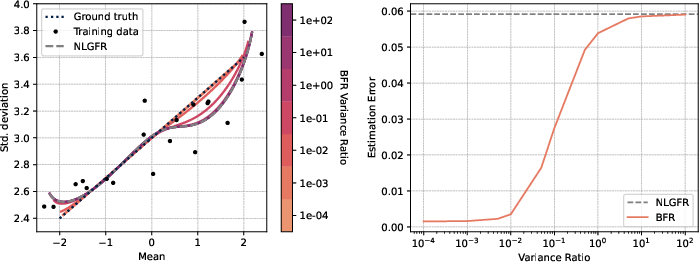
Figure 2: Bayesian global Fréchet regression for univariate Gaussian distributional responses, demonstrating interpolation between the prior and NLGFR estimator as prior strength varies; integrated estimation risk is plotted for varying prior-to-noise variance ratios.
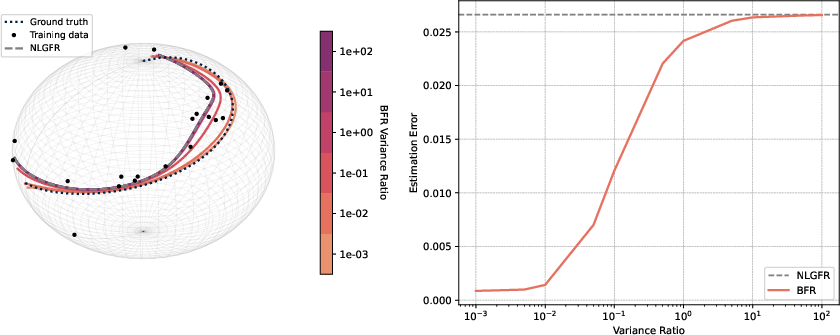
Figure 3: Bayesian global Fréchet regression for spherical responses on the unit sphere, illustrating the estimated Fréchet mean's trajectory along the manifold as controlled by prior adaptation and regularization path.
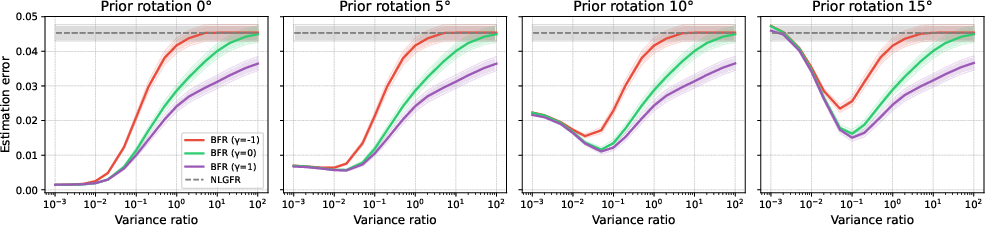
Figure 1: Prior misspecification and robustness analysis for spherical responses, showing how estimation risk evolves with increasing misalignment between prior and true mean function, across several prior covariance formulations.
Practical and Algorithmic Implementation
The Bayesian Fréchet regression is computationally tractable: eigen-decomposition of the RKHS Gram matrix is performed once, and subsequent evaluations of the objective for different (ΩY,d)0 reduce to efficient matrix-vector operations. The minimization over (ΩY,d)1 can be approached with gradient or Riemannian optimization when the geometry is smooth, or via discrete optimization for distributional responses. The prior is specified operationally via evaluations of a prior Fréchet regression function on the training predictors, allowing for flexible construction from external datasets or subject-matter information.
The shrinkage effect induced by the prior is easily interpretable and tunable; for example, functional analogs of Zellner's (ΩY,d)2-prior arise with appropriate spectral choices for the covariance structure [zellner_assessing_1986]. The effect of hyperparameter tuning and truncation of the kernel spectrum is analyzed both theoretically and empirically.
Applications: Synthetic Studies and Microbiome Transfer Learning
The paper presents extensive simulations and an applied study in human microbiome analysis, exemplifying the broad utility of the method. Simulations on Wasserstein spaces (probability distributions) and spheres demonstrate the method's geometric generality, interpolation behavior, and robustness to prior misspecification.
A key application is the transfer of auxiliary knowledge across microbiome studies, where data heterogeneity and sample size imbalance are critical practical issues. By constructing priors from a large, external cohort, the proposed Bayesian Fréchet regression achieves substantial improvements in predictive performance for compositional microbiome data in small target cohorts. The reduction in test-set Hellinger distance (Figure 4 below) attests to the practical benefit of regularization via informed shrinkage in non-Euclidean regression.
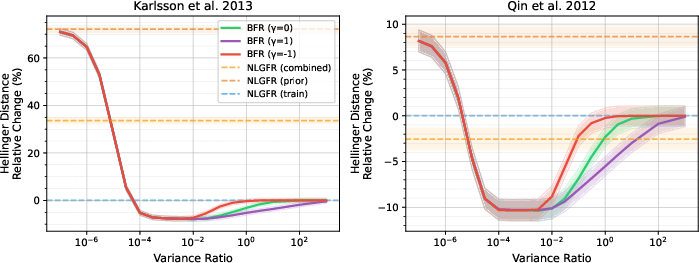
Figure 4: Cross-study predictive portability for microbiome compositional data; incorporating external priors from a large auxiliary cohort reduces test prediction error in two target cohorts, as measured by the Hellinger metric.
Implications and Future Directions
This paper establishes a paradigm for statistical inference and learning in non-Euclidean object spaces under the Bayesian framework. The ability to incorporate prior knowledge, perform valid shrinkage, and robustly regularize fractious regression surfaces is immediately relevant in many areas, including biomedical data science (e.g., compositional and network data), shape analysis, optimal transport, and other domains where responses are not vectors.
Future research directions include extensions to hierarchical or longitudinal models for repeated measures of random objects [bhattacharjee_geodesic_2025], Bayesian model selection and variable selection in object regression [yang2025variable], and unifying this framework with recent advances in generalized Bayesian inference, loss-based updating, and variational approximations in nonparametric settings. There is also potential for theoretical development of Bayesian uncertainty quantification in metric spaces [lugosi_uncertainty_2024], and connections with PAC-Bayesian theory for risk bounds in object-valued prediction.
Conclusion
The paper "Bayesian Global Fréchet Regression via Weak Conditional Expectations" (2606.07947) provides a foundational advance in regression with non-Euclidean responses by introducing a rigorous, scalable, and robust Bayesian formulation. The Fréchet Bayes rule and its weak version offer a principled mechanism for integrating prior knowledge and achieving regularized inference in arbitrary metric spaces. Theoretical analysis, algorithmic innovations, and empirical demonstrations validate the approach, establishing new pathways for statistical learning and predictive modeling in complex geometric data domains.