- The paper proposes an operational quantum PID using superdense coding to decompose classical capacity into unique, redundant, and synergistic components.
- It defines unique information through maximum differences in superdense coding capacities while respecting quantum constraints like entanglement monogamy and no-cloning.
- Applications on canonical states, quantum error correction codes, and decoherence models reveal that redundancy dominates, with synergy enhancing overall capacity.
Introduction
The quantification and decomposition of information in multipartite quantum systems is central to quantum information theory. While classical Partial Information Decomposition (PID) rigorously distinguishes between unique, redundant, and synergistic information among classical subsystems, its extension to the quantum domain has been ambiguous due to the lack of operationally meaningful definitions respecting quantum constraints such as entanglement monogamy and the no-cloning theorem. This work formulates an operational quantum PID (C-PID) grounded in superdense coding capacity, elucidating the structure of quantum information shared between subsystems, and applies this framework to quantum error correction codes and decoherence models.
Quantum PID Framework
The central objective is to decompose the classical information capacity CAB—here, defined via the operational superdense coding protocol—between a target system T and two parties A (Alice) and B (Bob), into components that are unique to A, unique to B, redundant (shared), and synergistic (emergent only jointly). For a tripartite quantum state ρTAB, the following decomposition holds: CAB=CunqA+CunqB+Cred+Csyn
where the individual capacities CA and CB decompose analogously. Crucially, the authors' definition for unique quantum information is rooted in superdense coding advantages, which are strictly limited by the exclusion principle: only one party can exceed classical capacity simultaneously.
The construction begins with definitions of one-bit (normally-dense) and two-bit (superdense) classical capacities in terms of the von Neumann entropy of outcome ensembles under Pauli or phase-randomized unitaries. Unique information is operationally determined using maximum differences in these capacities, corrected for consistency, thereby permitting the assignment of simultaneous nonzero unique capacities—a property unavailable in classical minimal mutual information (MMI) PID.
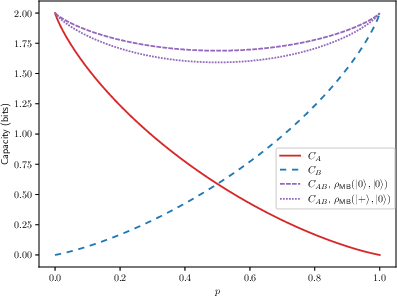
Figure 1: Collective and individual two-bit capacities for the states T0 as the mixture parameter T1 varies across entanglement partitions.
Demonstration on Canonical Quantum States
Analysis of the quantum PID on canonical states, such as the GHZ and W states, reveals that redundancy dominates: individual capacities are identical and entirely redundant, with synergy accounting for the remainder beyond redundancy. For mixed-Bell states interpolating between maximal bipartite entanglement with Alice vs. Bob, unique capacity is attributed to the party more entangled with the target, except in asymmetric “spectator” configurations where both parties can simultaneously possess nonzero unique capacity.
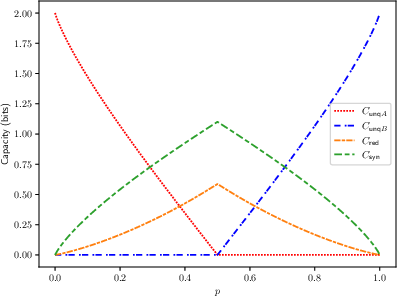
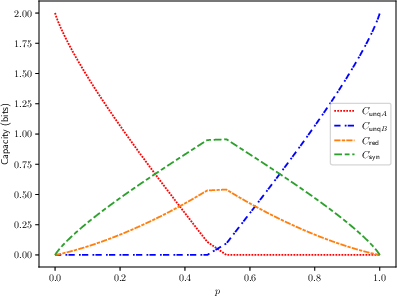
Figure 2: C-PID for two instances of the mixed-Bell state, highlighting regions with simultaneous nonzero unique capacities.
Application to Quantum Error Correction Codes
Within the stabilizer formalism, C-PID reveals that the possible subset capacities between target and encoding qubits are highly constrained: only T2, T3, or T4 are achievable, where T5 is the entropy of the target's reduced state. This trichotomy reflects whether a subset supports no, one, or both logical operators of the code. The results generalize: in any T6 code, correctable subsets always exhibit zero unique information, and only uncorrectable (large) subsets contain unique capacity, explicitly relating unique quantum information to code distance and correctability.
For the three-qubit bit-flip code, all strict subsets possess only one bit of redundant information, confirming their purely classical nature—the full quantum advantage is realized only collectively. In contrast, the five-qubit perfect code prohibits any subset from possessing merely one bit of classical capacity; only sufficiently large groupings recover the total information, directly reflecting the code's perfect nature and quantum secret sharing properties.
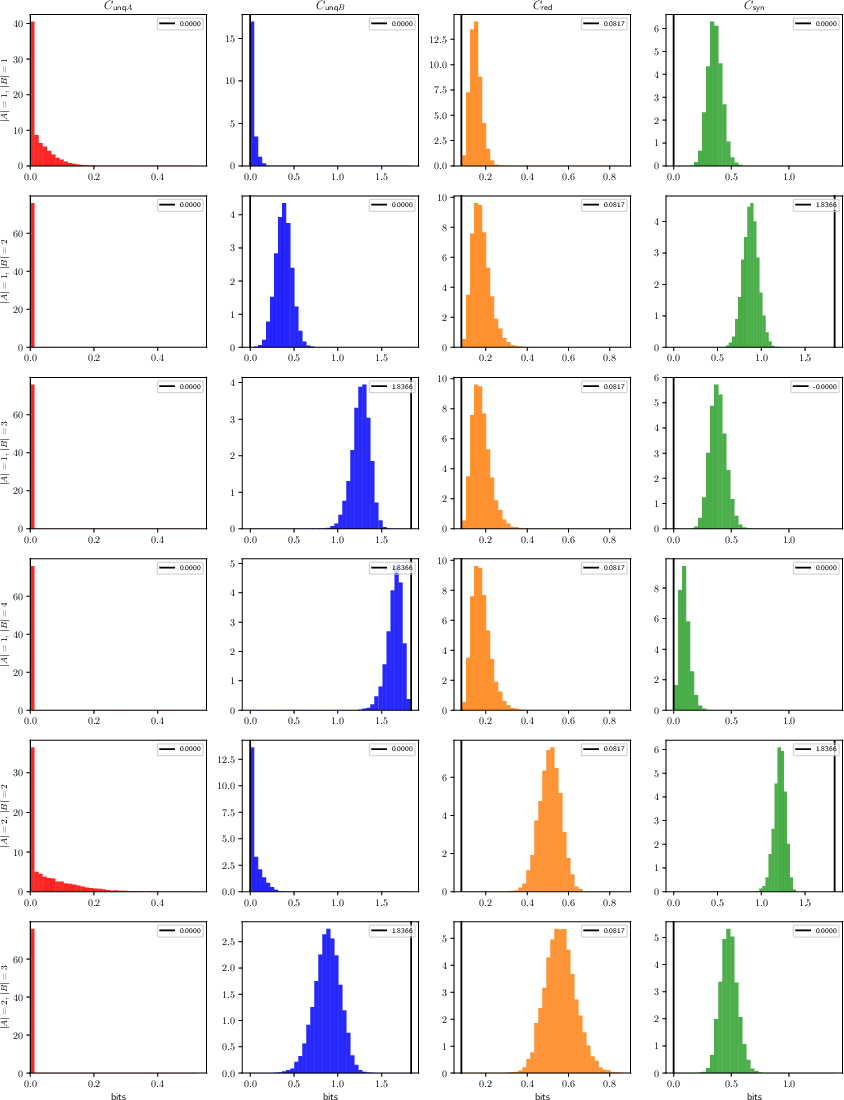
Figure 3: Distribution of unique, redundant, and synergistic capacities for random T7 encodings compared to the exact five-qubit code, showing extremal behavior for the latter.
Random vs. Exact Codes
Comparison with Haar-random codes demonstrates that while exact codes are extremal (minimizing redundancy, and never permitting simultaneous unique capacities in disjoint subsets), random codes exhibit distributed unique and synergistic components. As subset size approaches half of the encoded qubits, random codes grant nontrivial unique capacity, agreeing with recoverability phenomena from scrambling scenarios (e.g., Hayden-Preskill thought experiment).
Application to Decoherence and Quantum Darwinism
The PID framework is deployed on quantum decoherence models central to quantum Darwinism, where the emergence of a classical objectivity is said to arise from redundant encoding of information about a system into many fragments of the environment. In symmetric models—where all environmental fragments interact identically—PID demonstrates that individual capacities plateau at one bit (the classical entropy), composed almost entirely of redundancy. Synergy accounts for the capacity exceeding individual capacities, while uniqueness vanishes except in the limit where one party holds nearly all environment qubits.
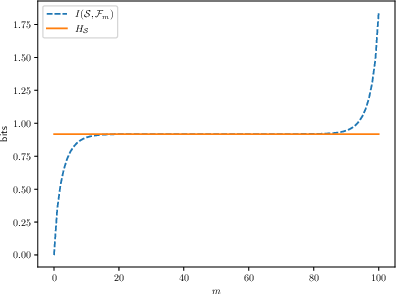
Figure 4: Mutual information between system and environment fragment as a function of fragment size, illustrating the classical plateau marking redundant encoding.
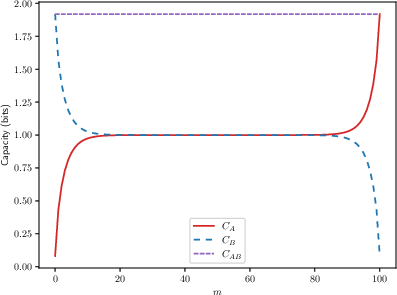
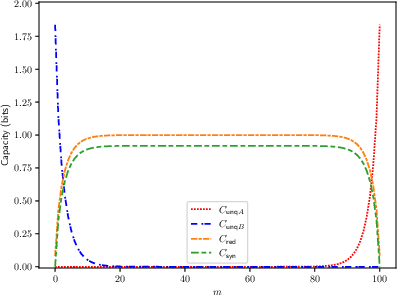
Figure 5: a) Collective and individual superdense capacities versus fragment size. b) C-PID decomposition, showing redundancy on the plateau and unique capacity near fragment extremes.
When the model is generalized to permit non-identical interactions (e.g., differing types of environmental particles with distinct coupling), the PID still finds redundancy to dominate, but now one party (corresponding to the more effective interaction) can retain unique information, reflecting residual quantum individuality.
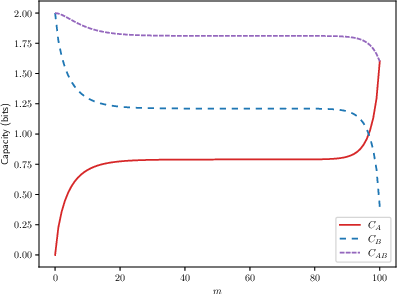
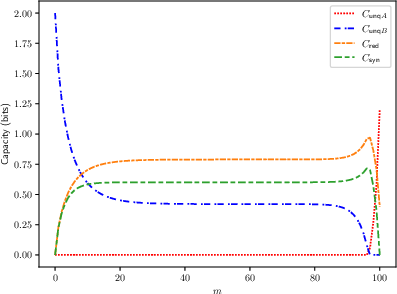
Figure 6: a) Superdense capacities in the generalized decoherence model with asymmetric interactions; b) corresponding PID showing persistent Bob-unique information on the plateau and dominant redundancy.
Theoretical and Practical Implications
This operational quantum PID tightly links the information-theoretic structure of quantum channels, error correction, and environment-induced decoherence with the resource-theoretic constraints of quantum theory. For QEC, the framework clarifies the role of unique and synergistic information for correctability, generalizing the “no-cloning” constraints into quantitative operational statements. In decoherence, it provides a rigorous basis for characterizing objectivity and redundancy, accommodating physically realistic, non-symmetric environments.
The framework suggests that random codes approximate “good” codes in the sense of increased redundancy, but the ideal codes remain structurally extremal, minimizing unnecessary duplication and synergistic non-locality in line with desired error correction properties.
Conclusion
The proposed quantum Partial Information Decomposition grounded in superdense coding gives a precise, operational approach to decomposing classical information capacity in multipartite quantum systems. It reconciles colloquial and formal notions of redundancy, uniqueness, and synergy, capturing their role in both quantum error correction and the emergence of classicality. Theoretical extensions to multi-level systems and further analysis of operational consequences in quantum networks and resource theories are immediate directions for ongoing research.