- The paper derives bipartite quantum correlations using qplex geometry, reproducing the Tsirelson bound for the CHSH inequality.
- It employs SIC-POVMs and centered C-vectors to map quantum states onto a probability simplex, setting inner-product bounds for joint expectation values.
- The study finds that while the qplex captures dichotomic quantum bounds, it permits superquantum correlations in multi-outcome CGLMP scenarios, signaling the need for additional constraints.
Geometric Constraints on Quantum Correlations in the QBist Qplex Framework
Introduction
The reconstruction of quantum theory from operational or information-theoretic principles is a central theme in the foundations of quantum mechanics, with reconstructions based on generalized probabilistic theories (GPTs) and geometric approaches generating significant interest. QBism—a subjective Bayesian interpretation of quantum mechanics—offers a distinctive perspective by recasting quantum theory as a framework for agents’ probability assignments, with the Born rule formulated as the Urgleichung. The qplex program generalizes this approach by characterizing a convex geometry within the probability simplex, delimited by constraints rooted in the Urgleichung, symmetry, and inner-product bounds.
While earlier work established the constraints and scope of single-system qplexes, their implications for bipartite correlations and the extent to which their geometry agrees with or deviates from quantum predictions remain unexplored. This paper addresses this gap, expressing bipartite joint expectation values via inner products of appropriately defined C-vectors in the qplex geometry and analyzing their impact on Bell-type inequalities, notably the CHSH and CGLMP scenarios.
QBism, SIC-POVMs, and Qplex Geometry
QBism represents quantum states as probability vectors associated with outcomes of an informationally complete measurement, most naturally symmetric informationally complete (SIC) POVMs. The mapping of states and effects to the probability simplex Δd2 via SICs leads to a subset Q characterized by:
- The Urgleichung, which rewrites the Born rule as
P(Dj)=i∑((d+1)P(Ri)−d1)P(Dj∣Ri).
- Geometric constraints on probability vectors, including pairwise inner product bounds
d(d+1)1≤i∑P(i)Q(i)≤d(d+1)2.
A qplex is defined as the maximal subset of Δd2 whose vectors satisfy these pairwise bounds. Quantum state spaces correspond to Hilbert qplexes, which additionally inherit symmetry under the unitary group, whereas general qplexes need not.
Bipartite Correlations in Qplexes
The paper introduces a geometric formalism for bipartite correlations, analyzing scenarios where two agents, Alice and Bob, perform local measurements and exchange outcomes. All probability assignments are those of Bob, consistent with the personalist Bayesian stance of QBism. Through repeated application of the Urgleichung and the duality properties of qplexes, the conditional probability for Bob's measurement after learning Alice's outcome is given as an inner product of vectors in the qplex:
P(Bbβ∣Aaα)=d2γbβ[(d+1)i∑P(Ri∣Aaα)P(Ri∣Bbβ)−d1],
where P(Ri∣X) are the SIC representation probability vectors for the relevant outcome. The joint expectation value for particular settings (α,β) is then
Eα,β=i∑C(Ri∣Aα)C(Ri∣Bβ),
with the centered C-vectors C(Ri∣X) encapsulating the geometric structure and normalization. This machinery reduces optimization over joint probabilities to geometric optimization in the probability simplex, with vector orientations, centers, and norms imposing substantive restrictions.
The CHSH Case: Saturation at the Tsirelson Bound
The CHSH inequality (Q0) is the archetypal test of quantum nonlocality. In classical theories, Q1; in quantum theory, the Tsirelson bound is Q2; in non-signaling GPTs, the algebraic maximum Q3 is possible.
Within the qplex framework, each correlator Q4 appears individually bounded by Q5 due to the norm constraints on C-vectors, suggesting the possibility of algebraic violations. However, taking into account the shared inner product structure among the C-vectors associated with Alice and Bob reveals that their orientations are not independent. The CHSH expression consolidates to an optimization over four C-vectors constrained to lie in a two-dimensional plane:
Q6
which achieves its maximum Q7 for orthogonal Bob vectors (Q8), precisely the quantum (Tsirelson) bound.
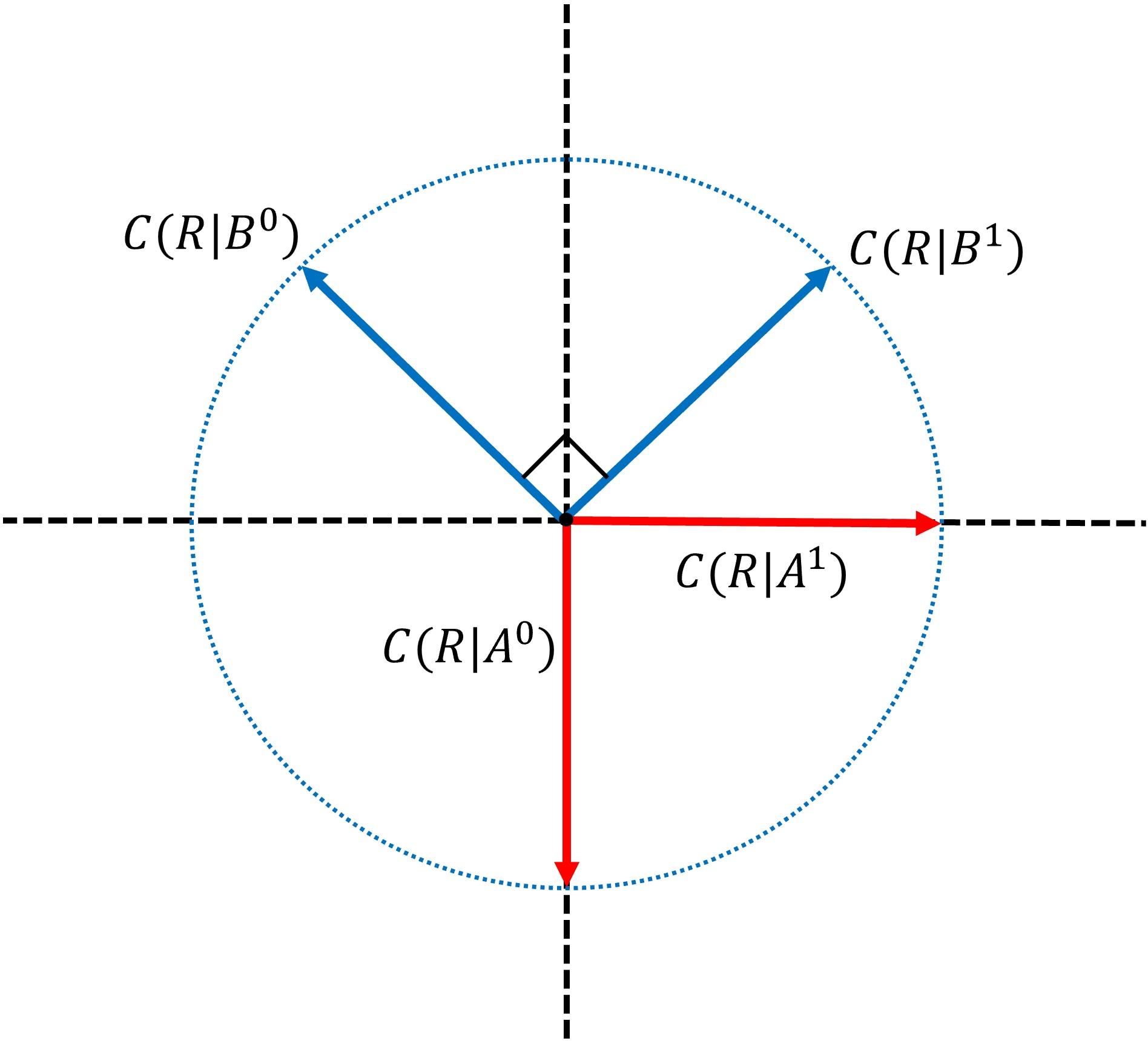
Figure 1: Geometric configuration maximizing the CHSH parameter; Alice's and Bob's orthogonal centered C-vectors lie on a unit circle with optimal alignments.
This result demonstrates that the core geometric constraints of the qplex—norms, unbiased marginals, and the inner-product-defined correlations—reproduce exactly the quantum Tsirelson bound for CHSH-type scenarios, independent of Hilbert space specifics.
CGLMP Inequality: Superquantum Correlations Persist
The situation changes for the CGLMP (Q9) inequality, testing correlations with three outcomes per measurement. The quantum bound is strictly lower than the algebraic maximum (P(Dj)=i∑((d+1)P(Ri)−d1)P(Dj∣Ri).0), with the maximal quantum violation being approximately 2.872. However, the qplex-based optimization, paralleling the CHSH analysis, leads to
P(Dj)=i∑((d+1)P(Ri)−d1)P(Dj∣Ri).1
which reaches the algebraic maximum of 4 for a particular geometric configuration (P(Dj)=i∑((d+1)P(Ri)−d1)P(Dj∣Ri).2 between Bob's C-vectors). The CBGLMP scenario thus admits superquantum correlations within general qplexes, not precluded by the constraints imposed by the basic qplex geometry or the Urgleichung.
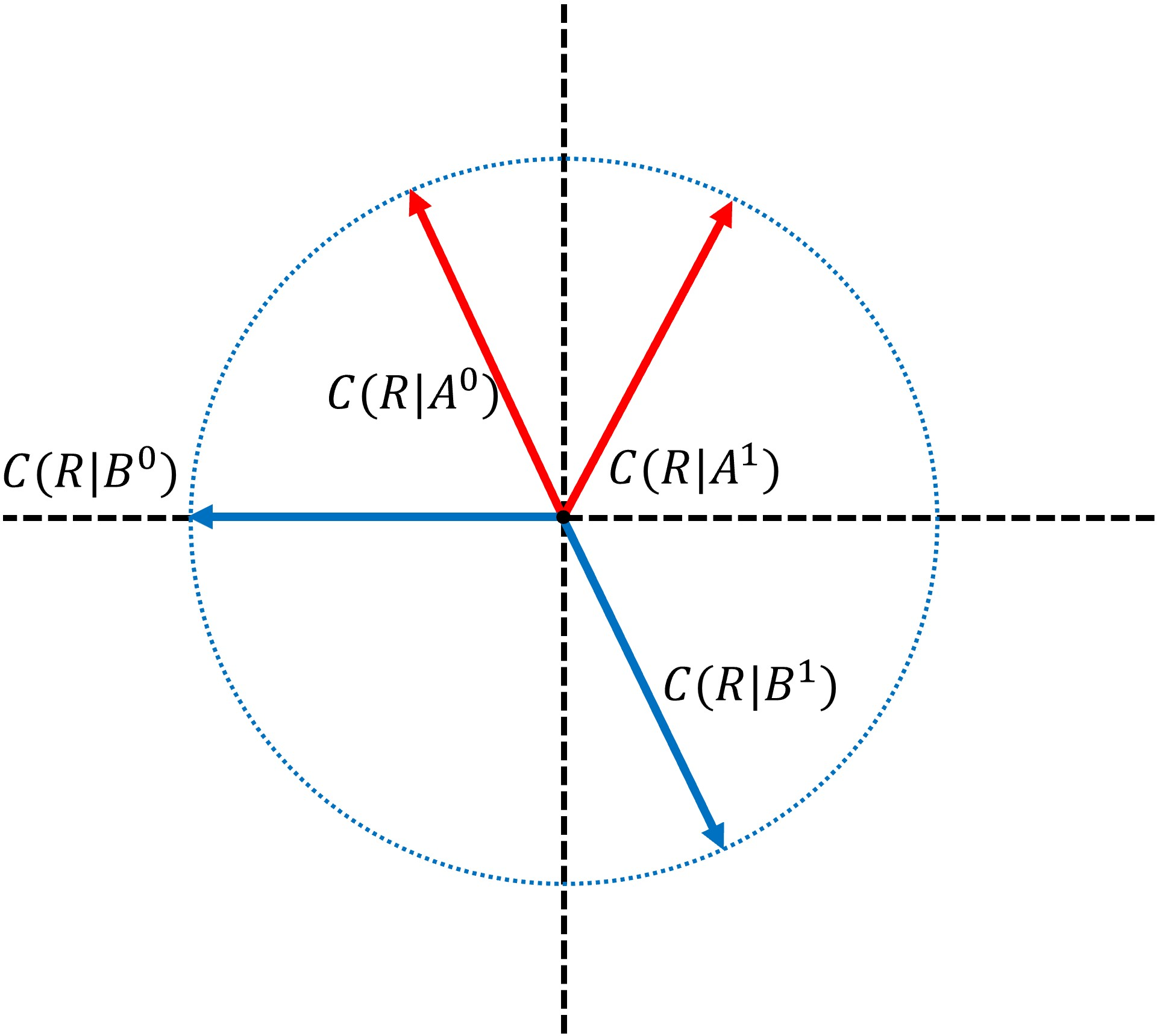
Figure 2: Geometric configuration of centered C-vectors achieving the algebraic maximum for P(Dj)=i∑((d+1)P(Ri)−d1)P(Dj∣Ri).3 in CGLMP; non-orthogonal vectors induce a distinct vector geometry unlike CHSH.
This dichotomy evidences that while the qplex structure suffices for recovering quantum bounds in dichotomic scenarios, it is insufficient in higher-outcome cases. The implication is clear: additional principles or constraints beyond those used to define the qplex, such as further symmetry or compositional rules, are required to recover the full quantum set of correlations across all Bell scenarios.
Implications and Future Directions
These results have significant implications. For the quantum foundations community, they establish that pairwise geometric (inner-product) constraints combined with unbiased marginals and maximal norms are sufficient—but not necessary—for simulating quantum bipartite correlations in simple Bell scenarios, a non-trivial accomplishment for geometric GPT approaches. The fact that these same constraints admit superquantum correlations in more complex scenarios such as CGLMP points to open structure in general qplexes and signals the necessity for further delimiting principles to single out Hilbert-space quantum theory.
The findings reveal that, although the qplex captures essential geometric features, its generality allows behaviors not present in quantum theory—paralleling developments for almost quantum correlations and other nearly quantum GPTs. The suggestion is that new principles—possibly involving compositional rules, multi-vector overlaps, or explicit constraints on higher-order structure—must be incorporated into QBism’s reconstruction program for convergence with quantum predictions in all scenarios.
Practically, the geometric re-expression of bipartite expectation values may influence numerical and analytic studies of GPTs, facilitate alternative simulation approaches, and suggest new geometric criteria for uniquely quantum (vs. superquantum) resource identification.
Conclusion
This work rigorously demonstrates that the geometric constraints intrinsic to the QBist qplex framework fully recover the Tsirelson bound for CHSH inequalities but allow maximal (superquantum) violations of the CGLMP inequality. The results indicate that the existing QBist-inspired geometric axioms are insufficient to recover the full quantum set of correlations, pointing to crucial missing principles in current reconstructions. Future progress will require the identification and incorporation of these additional constraints, likely inspired by the multi-outcome structure and compositional aspects of quantum measurements.