- The paper provides a rigorous analysis of evolved stellar populations in Sextans A using JWST’s multi-band photometry, distinguishing dust-free and dusty sequences.
- It employs color–magnitude diagrams and stellar evolution models to quantify progenitor masses, ages, and circumstellar dust production rates.
- The study reveals that dusty carbon stars dominate the galaxy’s dust budget, with observations indicating metallicities below [Fe/H] ~ -1.4 and limited SiC formation.
Introduction
This study presents a rigorous analysis of the evolved stellar population in the extremely metal-poor, star-forming dwarf galaxy Sextans A, utilizing the JWST's broad wavelength coverage (1–21 μm) obtained through both NIRCam and MIRI. By comparing observed color–magnitude diagram (CMD) distributions of Asymptotic Giant Branch (AGB) populations with contemporary stellar evolution and dust-formation models across a metallicity range of $1$–7% solar, the work delivers constraints on progenitor mass, age, metallicity, and circumstellar dust production. The analysis offers significant empirical data to inform theoretical models of dust formation in low-metallicity environments akin to those present in the early universe.
Observational Data and Modelling Framework
Observational data is sourced from the JWST-GO-1619 program, comprising deep imaging in a suite of near- and mid-infrared bands with both NIRCam and MIRI. The completeness and photometric precision extend to ∼25th magnitude for NIRCam and well below the luminosities of locally evolved AGB stars for MIRI, ensuring robust population sampling. The study adopts evolutionary models and synthetic photometry for $0.8$–7 M⊙ stars at Z=10−3, including sequence extensions to post-AGB phases. Dust-formation calculations leverage chemo-dynamical wind modelling to derive species-dependent DPRs and circumstellar envelope properties, synthesized into predicted spectral energy distributions (SEDs) via DUSTY radiative transfer.
NIRCMDiagram Morphologies and Population Demographics
The (F277W−F444W, F444W) CMD of Sextans A (Figure 1) exhibits a prominent vertical sequence at (F277W−F444W)≈0, containing >90% of the evolved star sample. This vertical dust-free sequence (DFS) aligns well with evolutionary tracks for AGB stars devoid of significant circumstellar dust, predominantly M-type. These objects span a wide range of ages and progenitor masses but exhibit negligible infrared excess, attesting to minimal ongoing dust production.
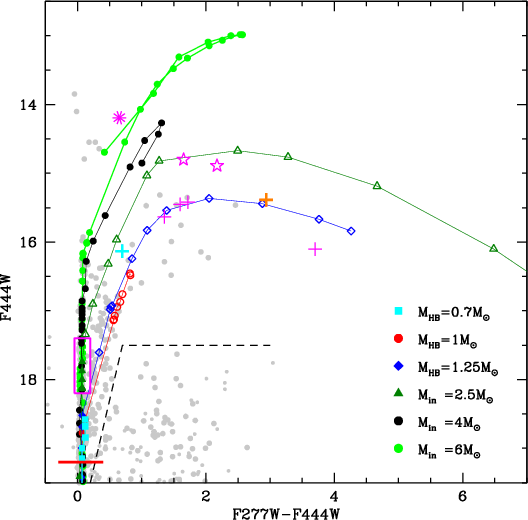
Figure 1: Distribution of the evolved stellar population of Sextans A in the (F277W−F444W,F444W) CMD. The red line marks the tip of the red giant branch.
The empirical correlation between the F444W flux and bolometric luminosity within the DFS yields the relation: 7%0
valid for DFS members. This renders F444W a robust luminosity diagnostic in metal-poor systems.
Superposed on the dust-free majority is a minority subset (7%120 stars) exhibiting substantial redward displacement, dominated by carbon stars with copious circumstellar dust. Evolutionary tracks demonstrate that stars at 7%2 mag correspond to later AGB phases with pronounced third dredge-up and carbon enrichment, tracing progenitors of 7%3–7%4, predominately formed 7%5–7%6 Gyr in the past.
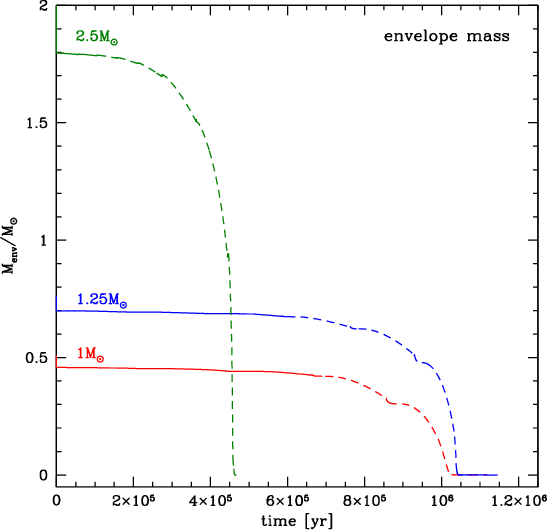
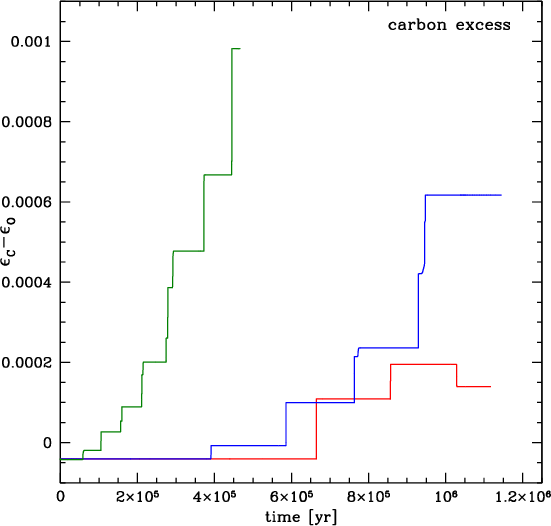
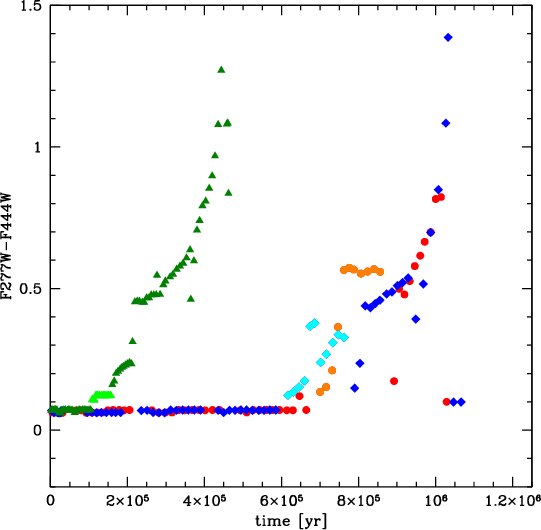
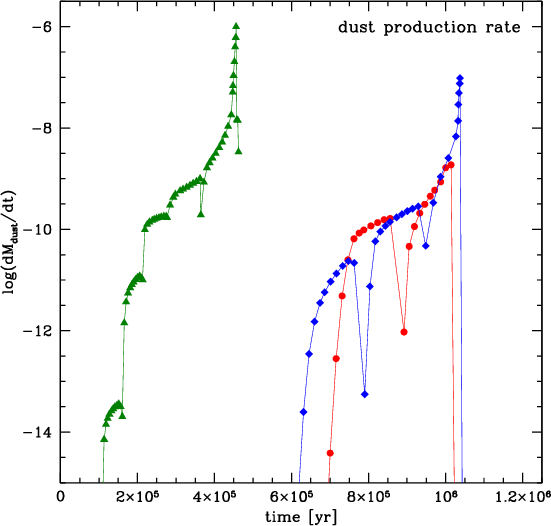
Figure 2: Evolution of envelope mass, carbon-to-oxygen excess, 7%7 color, and carbon DPR during the AGB phase for various initial masses.
Analysis of MIRI color–magnitude diagrams—7%8 and 7%9—corroborates the evolutionary model assignments for dusty carbon stars in advanced AGB stages (Figure 3). However, metallicity becomes a dominant uncertainty: the silicon carbide (SiC) dust feature's strength at ∼25th0m is overestimated by solar-scaled ∼25th1 models compared to observed MIRI colors and JWST/LRS spectra, suggesting the need for progenitor metallicities lower than ∼25th2. This conclusion is consistent with measurements from red giant branch morphology, favoring ∼25th3.
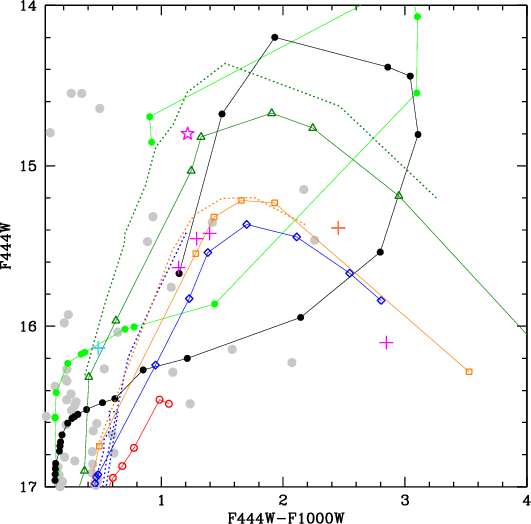
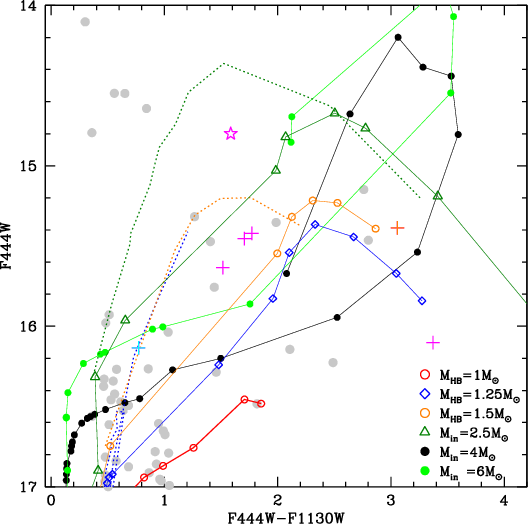
Figure 3: Distribution of Sextans A evolved stars in MIRI CMDs, highlighting discrepancies between model tracks and observations attributed to SiC formation efficiency and metallicity.
The study further demonstrates that the most IR-luminous sources are best described by progenitors in the ∼25th4–∼25th5 range, with SiC features empirically limited to ∼25th6 of the total DPR, and amorphous carbon as the dominant dust species.
Dust Production Rates and Diagnostics
The analysis demonstrates a tight correlation between NIRCam color and DPR for C-stars: ∼25th7
over ∼25th8 mag, providing an efficient photometric proxy for dust production (Figure 4). The maximum rates for individual AGB stars reach up to ∼25th9, in line with values observed in similar low-metallicity dwarf galaxies.
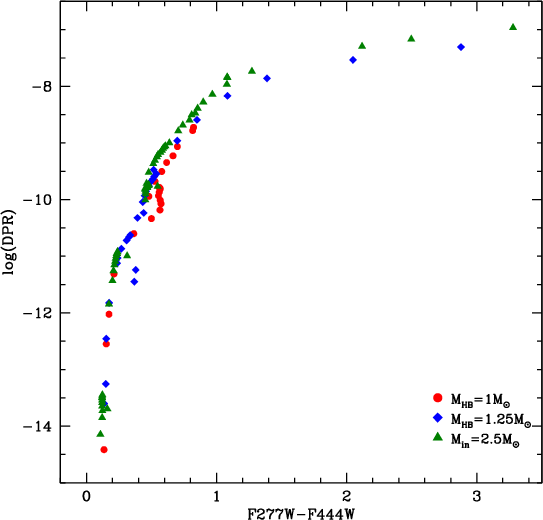
Figure 4: DPR evolution as a function of $0.8$0 color during the AGB phase.
Importantly, the global dust budget is almost exclusively generated by these dusty carbon stars, despite their numerical paucity. Contributions from low-mass or massive M-type AGBs, and from oxygen-rich dust species, are found to be negligible ($0.8$1).
Theoretical and Broader Implications
This study provides stringent empirical validation for the metallicity dependence of AGB dust formation physics. The observational support for minimal SiC production, even with comparable carbon excess, at $0.8$2 aligns with predictions of silicon-depleted nucleosynthesis and condensation chemistry. The robust coupling of JWST NIRCam/MIRI color diagnostics with stellar evolution and dust models offers a powerful toolkit for characterizing the late-stage mass loss and dust production across diverse metallicity regimes—paramount for interpreting dust content in high-redshift galaxies.
The results constrain the initial mass function and star-formation history of Sextans A from an AGB-centric perspective. Furthermore, the methodology and findings directly inform future studies of ISM enrichment and feedback, and provide a calibration baseline for early-universe analogs where direct measurement of dust sources is precluded.
Conclusion
By leveraging high-precision JWST NIRCam and MIRI photometry, this work delivers a cohesive and quantitative framework for the evolved and dusty stellar content of Sextans A. It demonstrates that:
- The evolved population is dominated by dust-free M-type AGBs forming a vertical color–magnitude sequence, with F444W as a reliable luminosity measure.
- All significant circumstellar dust production is confined to a minority of carbon stars descending from $0.8$3–$0.8$4 progenitors.
- The observed IR SEDs and CMD morphologies impose stringent limits on SiC formation and progenitor metallicity, compelling a revision to values below $0.8$5.
- The JWST NIRCam F277W–F444W color is an effective proxy for DPR, enabling efficient identification and quantification of dust-producing evolved stars in metal-poor environments.
The study delivers robust empirical constraints for stellar evolution and dust formation models, which have critical implications for ISM enrichment histories and the interpretation of unresolved stellar populations at cosmological distances. Future work can extend these diagnostics to other low-metallicity systems and incorporate binary interactions and time-series monitoring to refine progenitor/dust correlations.

