- The paper introduces an algebraic geometric framework that defines the minimal structured matrix factorization length and its border variant for various matrix classes.
- It establishes precise upper and lower bounds on factorization lengths for matrices like Toeplitz, Hankel, and tridiagonal using displacement rank and elimination theory.
- The study develops efficient alternating minimization algorithms that empirically achieve the theoretical minimal lengths, highlighting implications for computational stability.
Structured Matrix Factorization Length: An Algebraic Geometric Framework
Introduction and Problem Setting
This work introduces the concept of structured matrix factorization length in the context of algebraic geometry, providing a unified theory that extends beyond Toeplitz and Hankel matrices to a broad class of matrix structures represented as affine varieties. While prior results have shown that every complex n×n matrix can be factorized into a finite product of structured matrices (e.g., Toeplitz or Hankel), a minimal description of this “length” as an intrinsic invariant was lacking. This paper formalizes this length as the smallest integer r for which a matrix admits such a factorization, generalizes the question to arbitrary algebraic matrix structures, introduces border variants (analogous to tensor border rank), and explores foundational aspects: geometry, bounds, and computational techniques.
Let X⊆Cn×n be an affine algebraic variety encoding a matrix structure (e.g., Toeplitz, companion, tridiagonal, skew-symmetric). The X-factorization length of A, denoted FLX(A), is the smallest r such that A=M1⋯Mr for Mi∈X. The set of all such products (not necessarily Zariski closed) is denoted μr0(X); its Zariski closure, r0, is the so-called r1-th r2-factorization variety. The border r3-factorization length r4 is the minimal r5 with r6. This distinction is essential in cases where the image of the multiplication map is not closed, paralleling phenomena in algebraic complexity where border rank can differ from (tensor) rank.
This geometric lens allows access to powerful algebraic tools: computation of dimension/degree, limits and closures (border variants), dominance and irreducibility, and applications of displacement structure.
Main Theoretical Contributions
1. Unified Framework and Extension to Arbitrary Matrix Structures
The paper systematically applies the above formalism to classical spaces: Toeplitz (r7), Hankel (r8), (upper/lower) bidiagonal (r9, X⊆Cn×n0), tridiagonal (X⊆Cn×n1), companion (X⊆Cn×n2), and skew-symmetric (X⊆Cn×n3) matrices. For each, dimension and (when feasible) degree of the corresponding factorization varieties are analyzed, and (border) lengths are bounded both above and below.
Strong statements obtained include:
- Every X⊆Cn×n4 matrix is a product of X⊆Cn×n5 Toeplitz matrices; a generic X⊆Cn×n6 matrix requires exactly X⊆Cn×n7 Toeplitz factors, and this is shown to be tight.
- The same generic/maximal lengths hold for Hankel matrices due to an algebraic reduction via permutation conjugacy.
- For tridiagonal, the minimal generic length is X⊆Cn×n8, and every matrix is a product of at most X⊆Cn×n9 such matrices.
- For companion matrices, a generic matrix requires X0 factors, every matrix is a product of at most X1.
2. Border Lengths, Closure, and Irreducibility
The gap between X2 and X3 is demonstrated with explicit examples—e.g., some diagonal or upper X4-diagonal matrices do not admit X5 term factorizations but can be written as the limit of such products. It is established that if X6 is irreducible (which holds for most structures considered), X7 is irreducible and its Zariski and Euclidean closures coincide.
3. Algebraic Geometry of Factorization Varieties
A detailed analysis is provided for the dimension of the X8-factorization varieties:
- For Toeplitz and Hankel: X9, proved via careful analysis of the Jacobian of the multiplication map at certain “special points” and block diagonalization arguments.
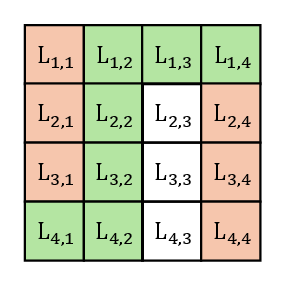
Figure 1: The set at (\ref{eq:picking Lij 1}) is the union of three groups of matrix entries selected for rank calculation in the A0, two-factor Toeplitz analysis.
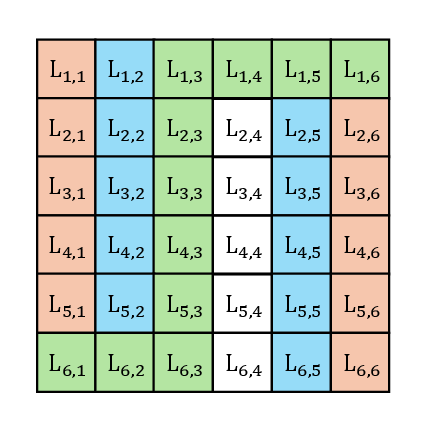
Figure 2: Entry selection for the A1, three-factor Toeplitz factorization case, illustrating combinatorial structure in the proof for lower dimension bounds.
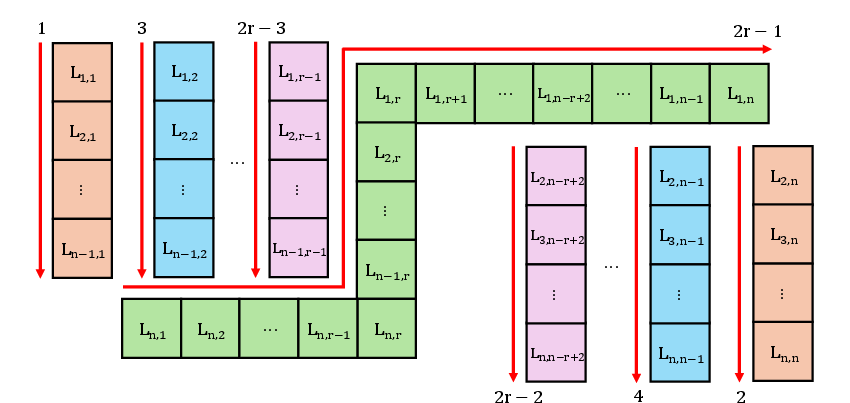
Figure 3: Illustration of ordered index selection A2 for dimensional analysis in higher-order Toeplitz factorization; identifying pivot entries for block diagonal dominance.
- For tridiagonal, bidiagonal, and companion matrices, the factorization varieties are shown to be linear, with dimension expressible in closed form, confirming that all defining equations are linear.
- For skew-symmetric varieties, detailed table-based enumeration for low A3 is included, with dimension calculations that exploit the algebraic properties of skew-symmetric orbits under conjugation.
4. Lower and Upper Bounds via Displacement Rank and Alternating Minimization
A general method leveraging displacement operators (Sylvester type) is developed to yield lower bounds on (border) factorization length:
- For Toeplitz: rank conditions on A4 and A5 supply concise determinantal equations that vanish on A6—tight for many but not all cases.
- Analogous results are outlined for other structures, e.g., Hankel.
Upper bounds and explicit constructions are studied via:
- Inductive block construction arguments for tridiagonal and bidiagonal matrices.
- A practical alternating minimization algorithm (ALS/ALS-like block Gauss-Seidel) for explicit computation of Toeplitz (or other structured) factorizations, with convergence proofs for the (nonnegative) residual (not the factor sequence).
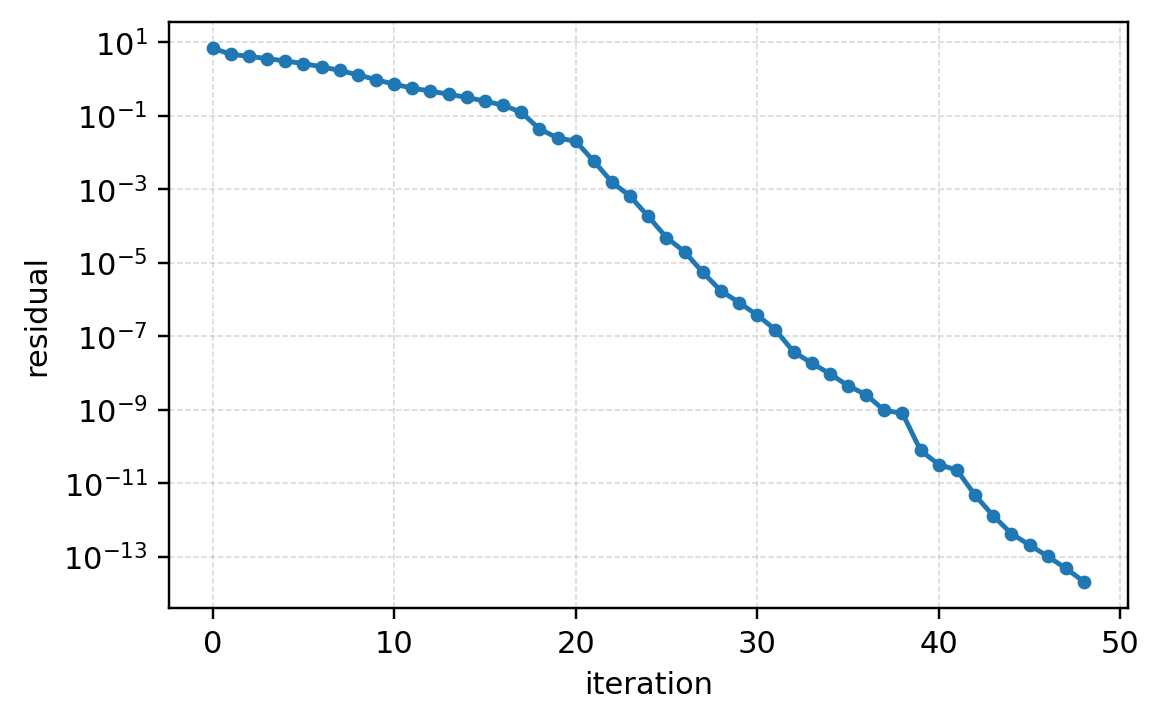
Figure 4: Residual decay (log-scale) for 3 × 3 Toeplitz alternating minimization illustrates monotonic convergence to exact factorization.
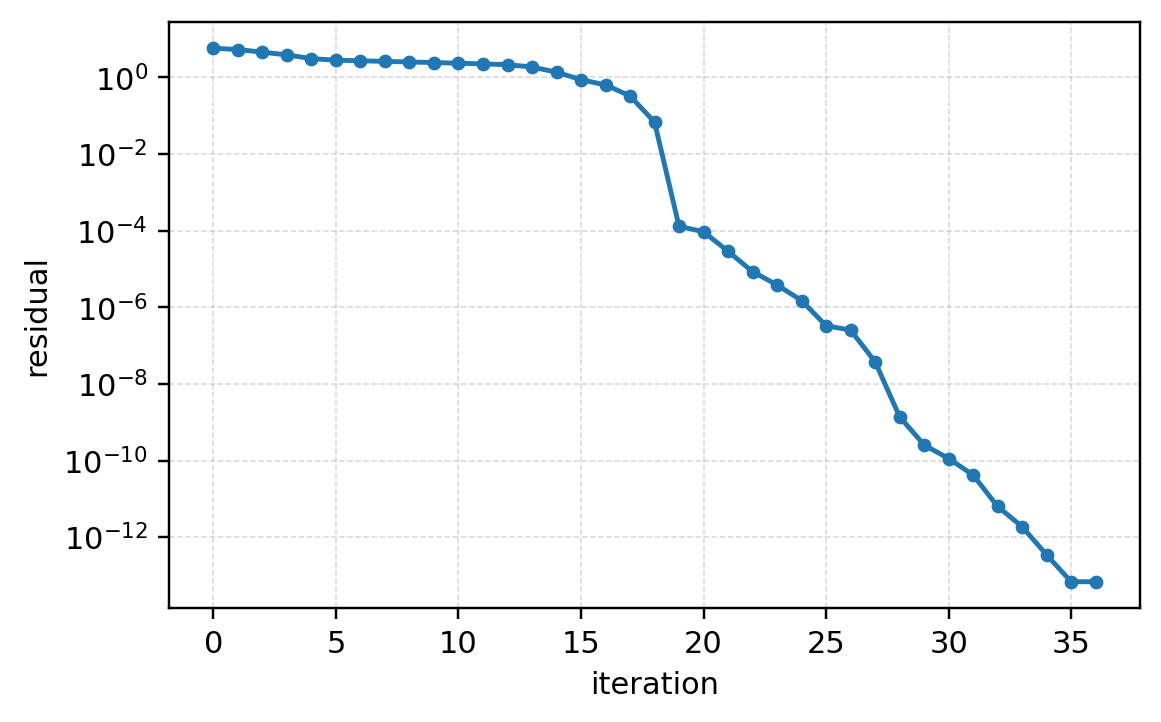
Figure 5: Residual convergence for A7 Toeplitz target with A8 factors, matching the theoretical generic upper bound.
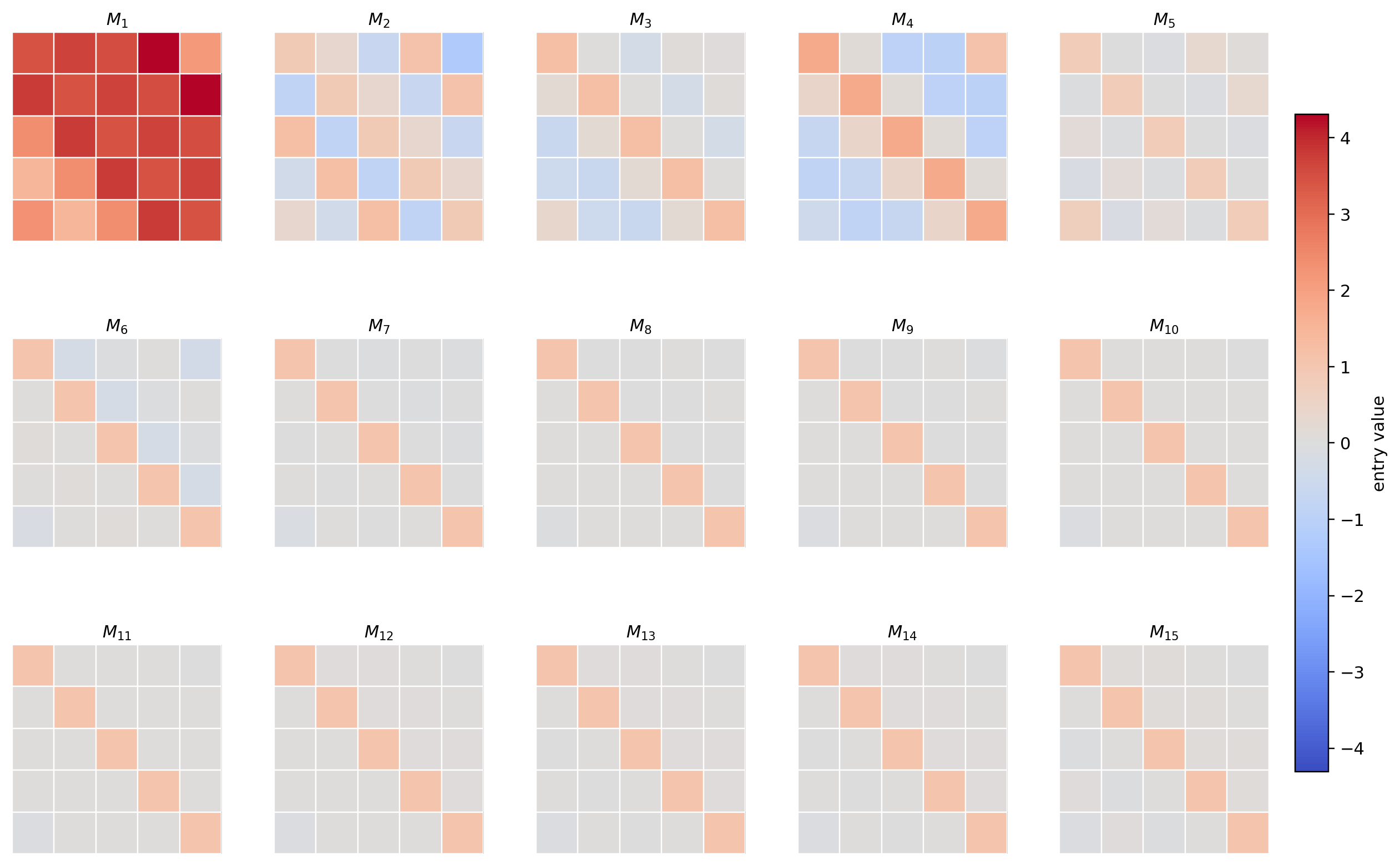
Figure 6: Visualization of the computed 15 Toeplitz factors for the A9 target; all factors displayed on identical color scale, illustrating factor diversity/structure.
5. Computational Investigation of Degrees and Defining Ideals
The degrees of factorization varieties, in particular for the Toeplitz case, are explored computationally using homotopy continuation and elimination theory. For instance, for FLX(A)0, degree 74 is numerically verified. The approach also details why, for non-linear varieties, complete algebraic computation of all defining equations is difficult, motivating this hybrid algebraic-numeric strategy.
6. Treatment of Orthogonally Invariant Structures
The paper extends analysis to matrix varieties invariant under orthogonal conjugation, notably the space of traceless symmetric matrices. For FLX(A)1, the maximal (generic) factorization length is shown to be 2, in contrast to FLX(A)2, where such factorizations cannot be surjective. Every matrix is a product of at most 10 traceless symmetric matrices, due to the ability to realize diagonal matrices as such products.
Implications
Practically, these results signify that for a wide class of matrix structures, minimal-length structured factorizations are both intrinsically algebraic and efficiently characterizable. In numerical computation, exploiting such structures yields not just computational efficiency (as in Toeplitz multiplication) but optimality guarantees tied to precise algebraic geometry invariants. The border variant distinguishes between representability and approximation (via algebraic closure), with ramifications for understanding stability under perturbation (“border rank” jump phenomena). The alternating least-squares approach provides a computational pipeline for approximate factorizations, with strong empirical performance at the theoretical minimal lengths identified.
Theoretically, this perspective unifies disparate structural results and situates structured matrix factorizations as algebraic secant/cactus varieties, inviting deeper investigation using tools from algebraic geometry, invariant theory, and complexity.
Open Problems and Future Directions
Key open questions include:
- Determination of the exact degree and complete ideal of FLX(A)3 (and analogous non-linear varieties).
- Stability and Euclidean distance degree (ED degree) under perturbations, linking algebraic geometry and numerical analysis.
- Computational complexity classification (e.g., NP-membership, hardness of factorization length).
- Extension to real algebraic varieties and to “multi-structure” settings (e.g., factorization into alternating types).
- Algorithmic development for efficient construction of minimal-length factorizations in large-scale numerical settings.
Conclusion
This work recasts structured matrix factorization length as an algebraic geometric invariant, providing sharp length bounds and analytic tools via dimension, degree, and displacement structure. It affirms that, for a diverse array of matrix structures, both the generic and worst-case minimal factorization lengths are now susceptible to systematic algebraic analysis. The introduction of border length parallels advances in tensor rank theory, while computational schemes like alternating minimization bridge the theory with practical matrix computations.
The mathematical code and tools developed herein constitute a foundation for future theoretical exploration and algorithmic development in structured matrix computations.
Reference:
"Structured matrix factorization length" (2606.07407)

