- The paper introduces an inverse symmetron framework where neutrino masses dynamically vary, mitigating instabilities found in conventional MaVaN models.
- It employs a modified scalar potential and an inverse exponential coupling to limit the fifth force duration, ensuring density contrasts align with ΛCDM post-symmetry restoration.
- The model provides a transient early dark energy injection that may help alleviate the Hubble tension while reconciling cosmological neutrino bounds with oscillation measurements.
Mass-Varying Neutrinos from an Inverse Symmetron: An Expert Analysis
Introduction
This paper develops a scenario for mass-varying neutrinos (MaVaNs) mediated by a symmetron-like scalar field, centering on an inverse phase transition framework. Motivated by tightened cosmological constraints on neutrino masses—often in tension with terrestrial oscillation measurements—this mechanism provides a route for significant neutrino mass variation in cosmic history while avoiding critical instabilities characteristic of conventional MaVaN models. The construction manipulates the scalar potential and the scalar-neutrino coupling structure to activate a strong fifth force only during a finite cosmological epoch, after which the force naturally decouples as the universe evolves.
Symmetron Mechanism and Instability Structure
The baseline for the analysis is the traditional symmetron model, wherein a scalar field’s vacuum expectation value (VEV) is controlled by the ambient energy density, and the scalar couples nonminimally to neutrinos, rendering their mass field-dependent. Specifically, the effective neutrino mass is parameterized as mν(ϕ)=m^νA(ϕ), with A(ϕ) Taylor-expanded near the symmetric point.
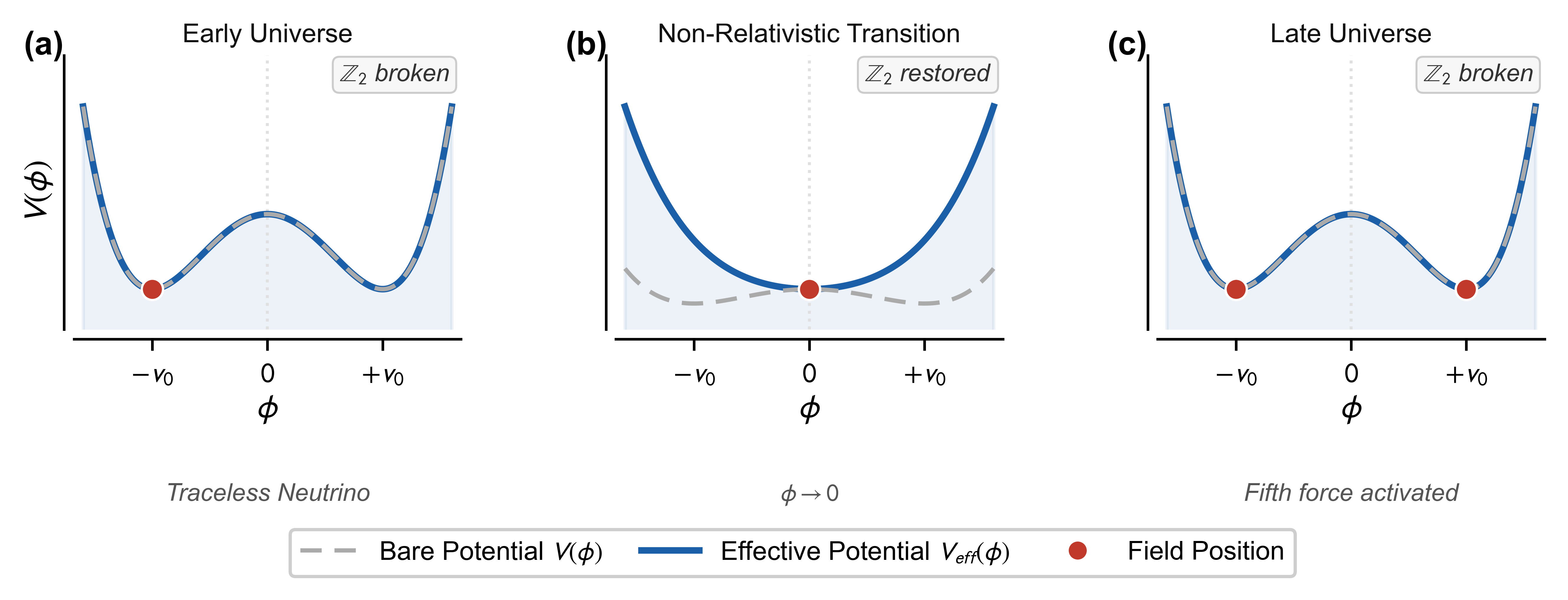
Figure 1: Typical configuration of the symmetron field and its couplings to neutrinos across different cosmological environments.
For a range of symmetry-breaking redshifts, both the evolution of the scalar field and mν(z) is computed, revealing that rapid field excursions yield only modest neutrino mass variation unless the coupling is substantially strengthened or nonpolynomial conformal factors are used.
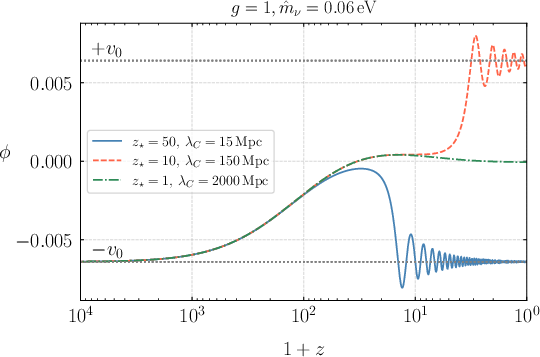
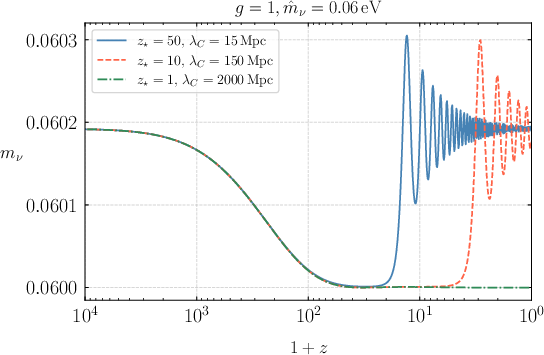
Figure 2: Left: Symmetron field evolution for different symmetry-breaking redshifts; Right: Associated neutrino mass evolution.
When the fifth force is activated via late-time symmetry breaking, the model generically suffers from the catastrophic growth of linear density perturbations. This is seen for both neutrino and cold dark matter (CDM) density contrasts post-symmetry breaking, where the additional attractive force causes a blow-up incompatible with observed structures.
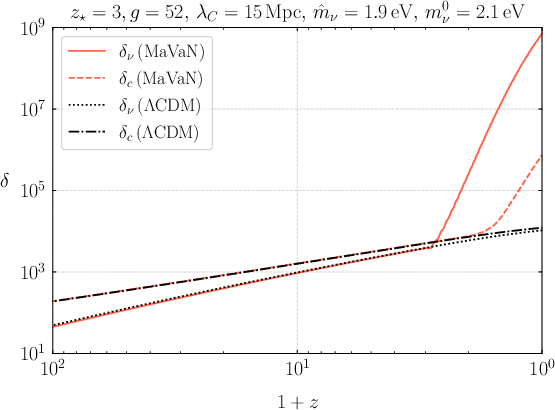
Figure 3: Evolution of neutrino and CDM density contrasts in the MaVaN symmetron versus ΛCDM baseline.
Increasing the nonlinearity in the conformal factor (e.g., exponential A(ϕ)) yields a larger amplitude of neutrino mass variation but fails to resolve the instability; the clustering still diverges at late times.
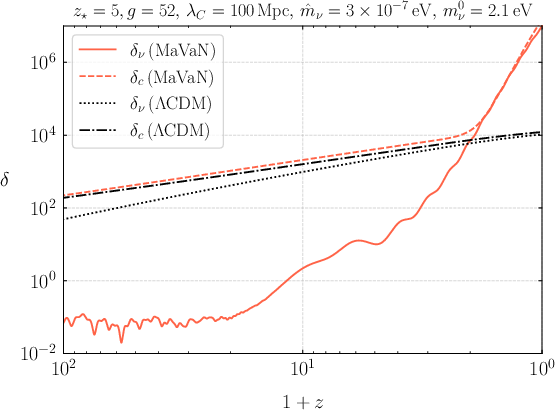
Figure 4: Even with an exponential conformal factor, late-time instability in density contrasts persists.
Inverse Phase Transition: Model Construction
To reconcile neutrino mass variation with structure formation constraints, the authors propose an “inverse” symmetron scenario. Here, the conformal coupling is an inverse exponential, and the potential minimum structure is engineered so that symmetry is restored at late times, dynamically switching off the fifth force. As a result, the problematic scalar-mediated clustering is shut down in the linear regime before significant instabilities develop.
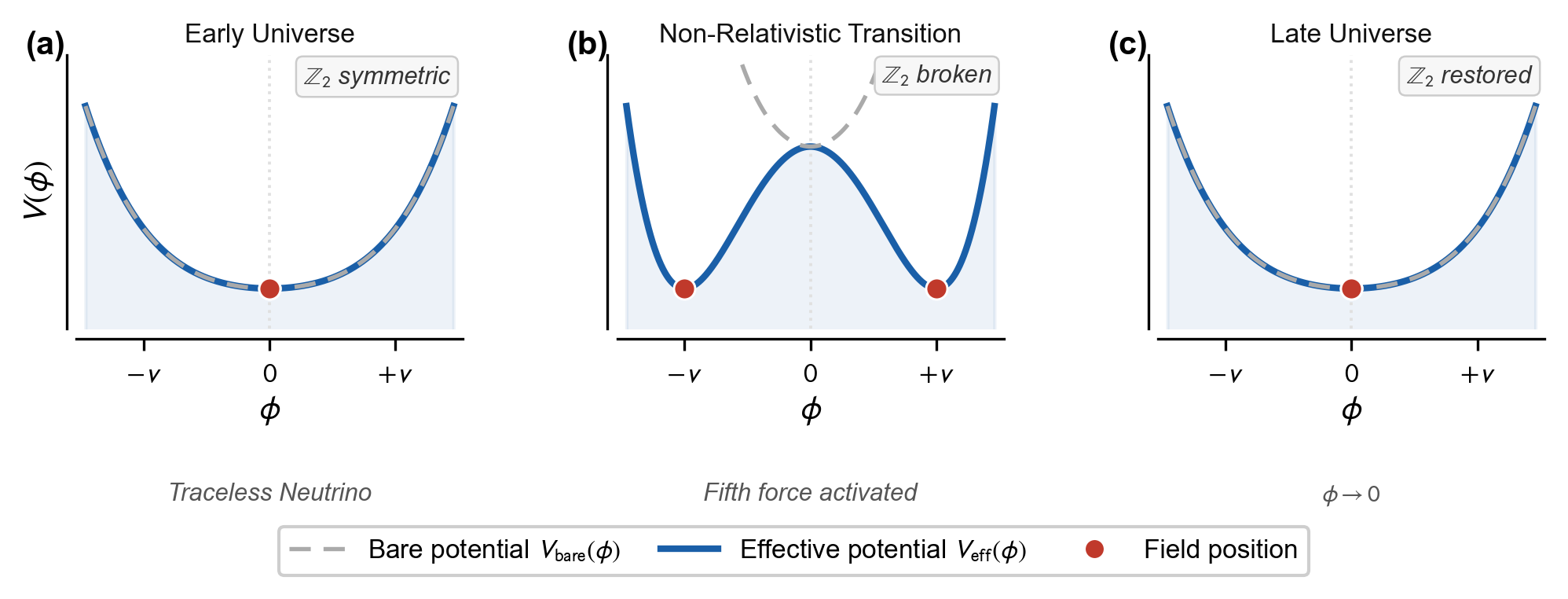
Figure 5: Schematic depiction of the scalar field evolution in the inverse phase transition scenario.
Numerically, in such a model, the scalar field is driven away from zero as neutrinos become nonrelativistic at intermediate redshift, decreasing mν below its terrestrial value. As the universe continues to dilute, symmetry is restored, the scalar returns to zero, and the coupling vanishes. The net effect is a transient mass variation, with the present-day neutrino mass matching the bare parameter in the Lagrangian.
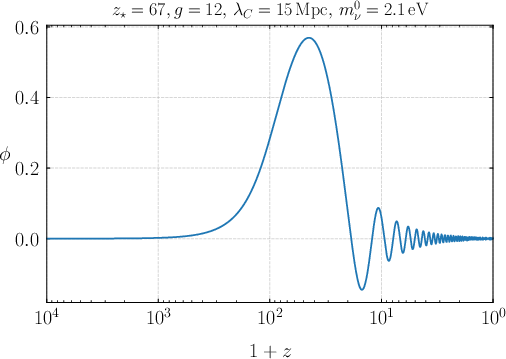
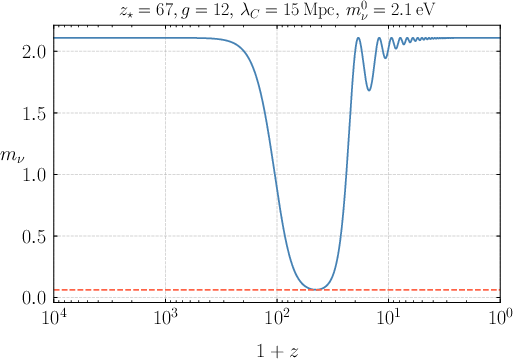
Figure 6: Left: Time evolution of the scalar field; Right: Corresponding neutrino mass evolution, with late-time restoration to the terrestrial value.
The energy density evolution reveals that at the epoch where the coupling is active, there is a localized injection of scalar field energy density, manifesting as early dark energy. This injection corresponds to an effective wϕ<−1 (phantom-like behavior), which is transient and bounded.
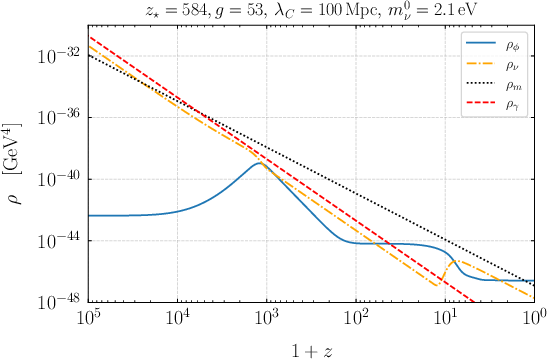
Figure 7: Energy density tracking for photons, matter, neutrinos, and the scalar field during the inverse phase transition.
The authors implement the full linearized Einstein-Boltzmann system with the modified interaction terms in the CLASS code. The inverse phase transition configuration ensures that when the fifth force is active, it is only for a limited time; as a result, density contrasts in both neutrino and CDM sectors grow only mildly and rejoin the ΛCDM behavior after symmetry restoration. This structure entirely suppresses the run-away clustering seen in standard MaVaN/symmetron scenarios.
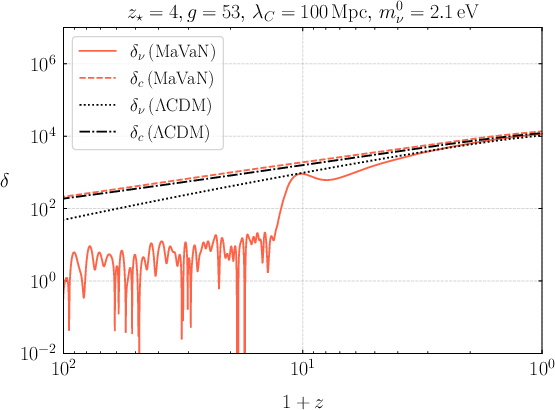
Figure 8: Density contrast evolution in the inverse phase transition setup, exhibiting no late-time instability.
Physical and Cosmological Implications
The practical implication of this model class is that strong, transient neutrino mass variation becomes possible in the early/mid-universe without violating large-scale structure limits or inducing nonlinear features inconsistent with data. The early dark energy injection created by the coupling can potentially relieve the Hubble tension, as it alters the sound horizon at recombination without modifications at late times. Unlike conventional symmetron or MaVaN models, the fifth force is naturally self-limiting and does not require ad hoc cutoffs or excessively fine-tuned screening mechanisms.
The theoretical implication is that phase transition topology and coupling structure in the dark sector can be exploited to reconcile model-dependent cosmological tensions, such as the Σmν lower bounds from oscillation data and the upper bounds from BAO and CMB measurements.
Outlook and Future Directions
The work opens several directions for subsequent studies:
- Nonlinear Structure Formation: The restriction of runaway growth at the linear level has been established, but investigation of the full nonlinear regime—where local high densities might transiently restore symmetry and locally re-activate the fifth force—remains to be explored.
- CMB Parameter Estimation: Detailed Bayesian inference using CMB and BAO data will be needed to quantitatively assess the model's viability in reducing the H0 tension and addressing joint constraints on A(ϕ)0 and early dark energy components.
- Topological Defects: The dynamics of domain walls or cosmic string formation during the inverse transition and their phenomenological consequences merit further scrutiny.
- Testing with Future Surveys: Precision tests with Euclid, CMB-S4, and LSS data could decisively probe the allowed parameter space for such scalar-neutrino interactions.
Conclusion
The inverse symmetron scenario provides a robust method for realizing significant cosmological neutrino mass variation while evading the endemic instabilities afflicting previous MaVaN models. This construction enables both transient early dark energy and fifth-force screening, aligning late-time cosmological and laboratory neutrino mass measurements and offering plausible alleviation of the Hubble tension. Extension to nonlinear structure, CMB anisotropies, and cosmic defect phenomenology will empirically test the predictions of this class of models.