- The paper introduces constructor theory to delineate possible versus impossible tasks, framing experimental tests for non-classicality across hybrid systems.
- It details experimental proposals like the BMV experiment, using entanglement-based protocols to witness non-classical behavior in gravity-mediated interactions.
- The research recasts thermodynamics and self-reproduction, demonstrating constructor-based irreversibility and the potential for universal constructors.
Authoritative Essay on "Tests of constructor theory" (2606.07352)
Introduction and Theoretical Framework
Constructor theory proposes a fundamentally new mode of explanation in physics, seeking to supplement—rather than supplant—dynamical laws with a framework based on possible and impossible tasks. Crucially, it abstracts from the details of dynamics or statistical descriptions, focusing instead on counterfactual properties—what can, and cannot, be made to happen by physical systems called "constructors." This approach has been developed to generalize theories of information, computation, thermodynamics, and even biological self-reproduction, enabling scale- and dynamics-independent statements about physical reality.
A central construct is the "universal constructor," a programmable machine that can, in principle, accomplish any task permitted by the laws of physics. The boundary between possible and impossible tasks is dictated by a set of constructor-theoretic "meta-laws," with the subsidiary dynamical theories constrained but not determined by them.
The constructor-theoretic approach to information provides a unification platform for classical, quantum, and hypothetical post-quantum theories. Information media are defined as physical substrates supporting variables that admit arbitrary permutations and can be copied via possible tasks. Distinguishability and measurement are formulated without the need for dynamical or probabilistic primitives.
Quantum systems, within this framework, are understood as a subclass of "superinformation media," characterized by possessing at least two observables that are not mutually sharp—i.e., incompatible in the quantum sense (Figure 1).
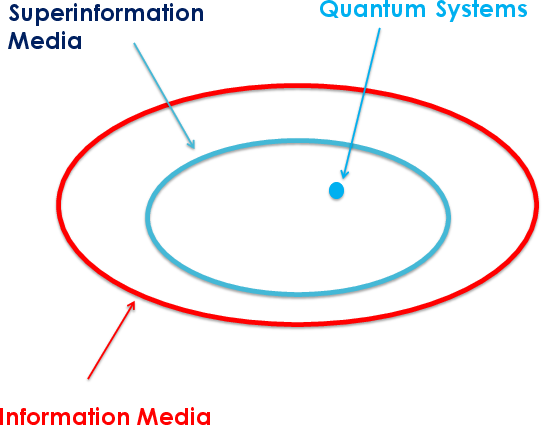
Figure 1: Information media and superinformation media; quantum systems are a special case of superinformation media.
The interoperability principle asserts that information should be transferable between any two media of matching capacity, fundamentally connecting and extending classical and quantum information in a single corpus.
Experimental Proposals: Non-Classicality Witnesses in Hybrid Systems
One of the major empirical frontiers in constructor theory is the characterization and testing of non-classicality in hybrid systems—systems comprising quantum and possibly non-quantum components (Figure 2). Classical-quantum hybrid scenarios are relevant in the interface between quantum information processing and foundational physics, such as quantum gravity or macroscopic quantum effects.
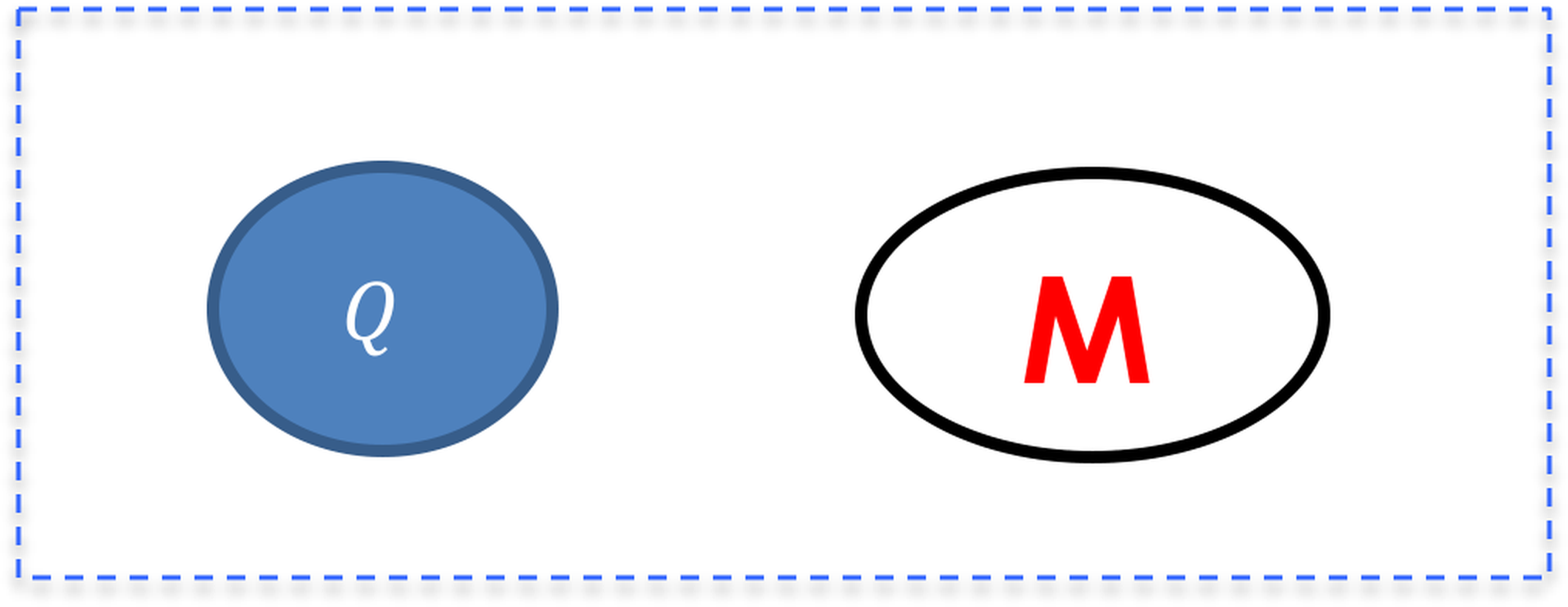
Figure 2: Hybrid systems consisting of a quantum probe Q and a 'mystery' system M with partially unknown, possibly non-quantum laws.
A pivotal theoretical result is the generalization of DeWitt’s "totalitarian property," showing—without assuming particular dynamics—that if a superinformation medium (e.g., a qubit) engages in certain types of interactions with a system M, then M must also exhibit non-classicality (i.e., possess incompatible observables). This forms the basis for experimental protocols which witness non-classicality by observing the entanglement between two quantum probes mediated only by local, indirect interaction via M.
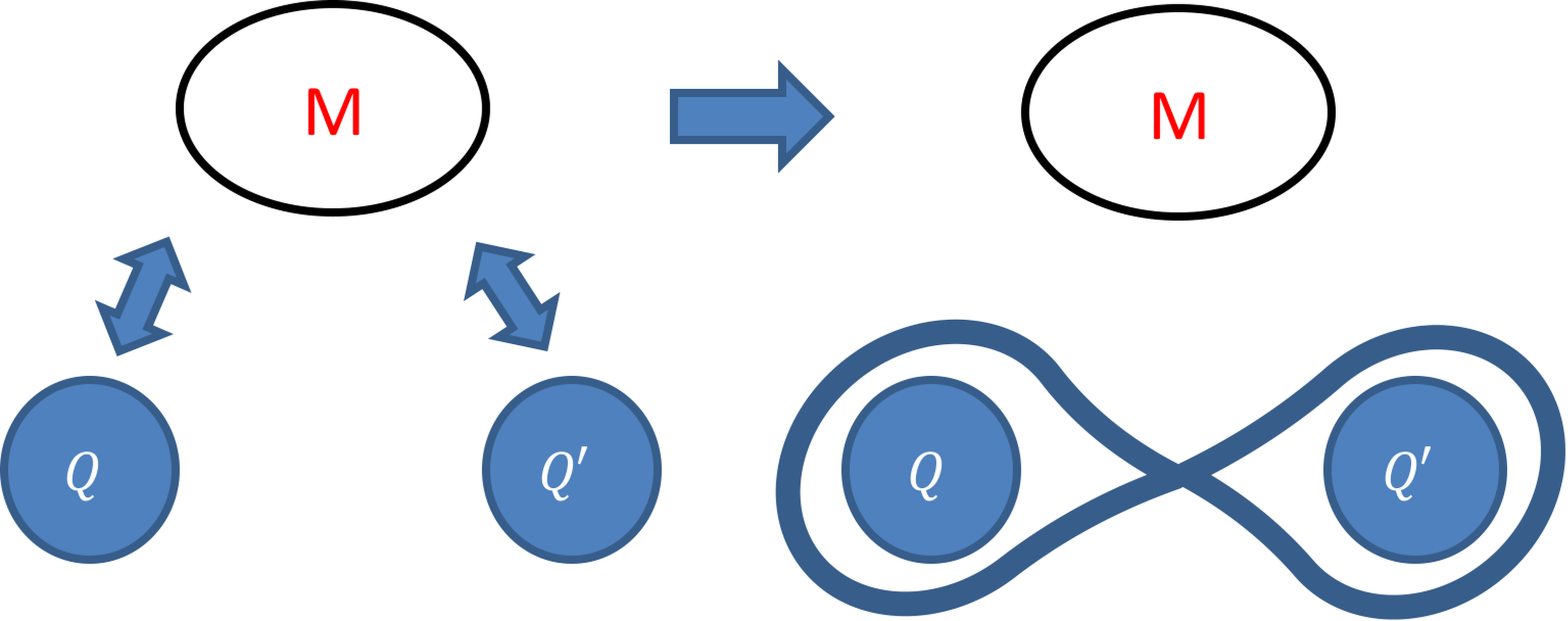
Figure 3: Entanglement-based witness of non-classicality: if M can generate entanglement between spatially-separated quantum probes Q and Q′, then M is necessarily non-classical.
The Bose-Marletto-Vedral (BMV) experiment is a concrete instantiation of these ideas for testing the non-classicality of gravity. If two masses (treated as quantum probes) become entangled through their mutual gravitational attraction, this would empirically rule out descriptions of gravity as a purely classical mediator, irrespective of the dynamical details involved.
Temporal witnesses of non-classicality extend this logic to scenarios where a "mystery" mediator M induces non-classical evolution on a single quantum probe M0, under the assumption of a conserved quantity. Measurement of coherent quantum evolution under these circumstances would provide evidence for the non-classicality of M1, even when M2 itself is not directly measurable within the quantum formalism.
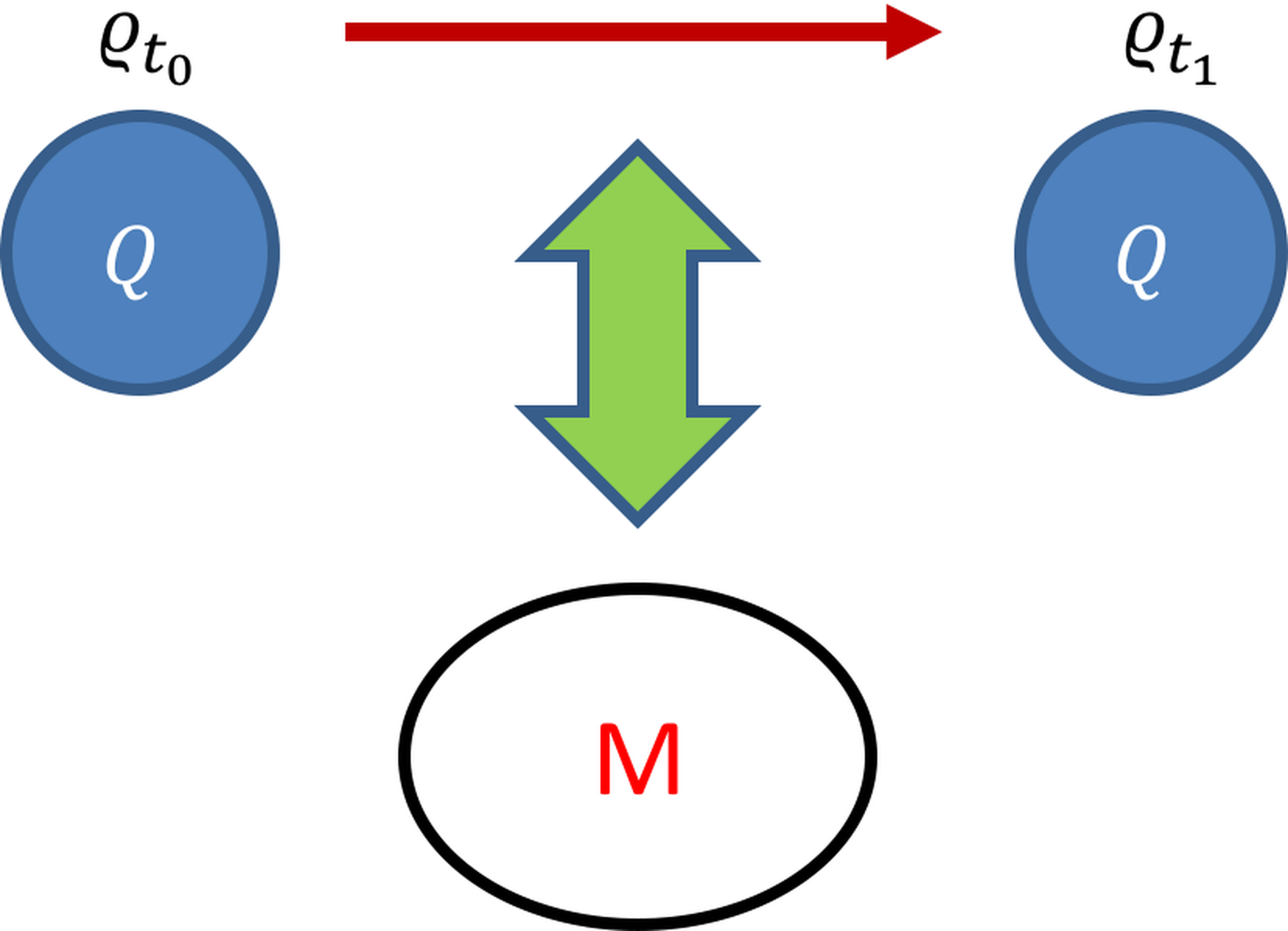
Figure 4: Temporal witness of non-classicality: if M3 induces a quantum evolution on probe M4 under a conservation law, M5 must be non-classical.
Constructor Theory of Thermodynamics and Irreversibility
Thermodynamics within constructor theory is reformulated in terms of work media and the possibility or impossibility of certain transformations, eschewing reliance on macroscopic coarse-graining or statistical assumptions. A key result is the identification of "constructor-based irreversibility": there can exist tasks M6 (such as mapping a pure state to a mixed state) that are possible, while their transposed tasks M7 (such as purification) are impossible, even under time-reversal symmetric (unitary) dynamics. This is distinguished from standard entropy-based or probabilistic formulations of the second law.
This constructor-theoretic irreversibility has been instantiated and experimentally simulated in quantum systems using a quantum homogenizer—an ensemble of qubits undergoing a sequence of partial swap operations, effecting a transition from a pure to a mixed state in the system qubit. The irreversibility is measured through "relative deterioration," quantifying both the error and operational robustness across multiple cycles.
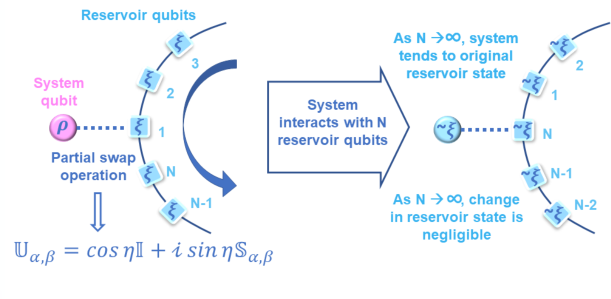
Figure 5: Quantum homogenizer—a model for constructor-based irreversibility where a system qubit sequentially interacts with M8 resource qubits via partial swaps.
Photonic qubit experiments have corroborated these theoretical predictions, demonstrating that irreversible task asymmetry can emerge from strictly reversible dynamics, in alignment with constructor-theoretic expectations.
Constructor Theory of Life and Universal Constructor
Constructor theory provides a rigorous extension of von Neumann's replicator–vehicle logic, establishing that high-fidelity self-reproduction under "no-design" laws necessarily requires an informational substrate (the replicator) and a machinery (the vehicle) that can construct the entire system, including itself, from generic resources (Figure 6).
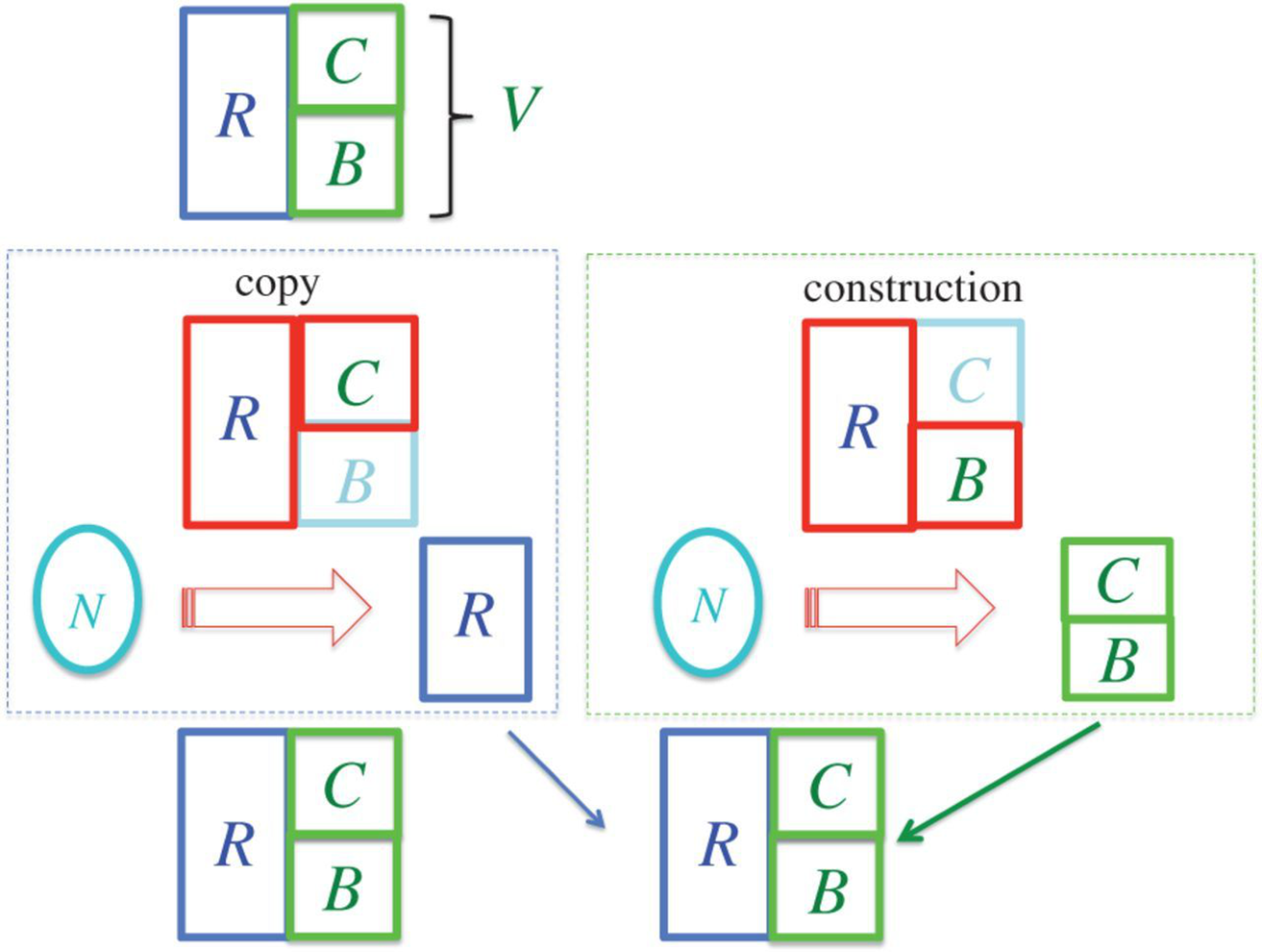
Figure 6: Self-reproduction logic with replicator (blue) and vehicle (green); the replicator is copied, and the vehicle constructed, yielding an offspring system with both components.
This result is not contingent on biological specifics but arises from the general constructor-theoretic analysis of possible tasks, and forms the theoretical basis for relating biological evolution, information, and fundamental physics. It also yields testable predictions about resilience to environmental deterioration as a function of constructor-theoretic knowledge.
The pursuit of a theory of the universal constructor—capable of performing any physically allowed transformation—is an open research avenue with sweeping implications. Progress in this domain may yield explanations for why physical laws are structured to permit, but not to guarantee, the construction of arbitrary objects, potentially illuminating the "fine-tuning" problems in physics.
Implications and Future Directions
Theoretical Implications
Constructor theory establishes a language and apparatus to discuss physical law independent of underlying dynamics, enabling unified statements about information, computation, thermodynamics, and life. It sharpens the identification of genuinely structural principles, informing efforts in quantum gravity and beyond-standard-model physics, where Hilbert-space structures and conventional time evolution may be emergent.
By generalizing probabilistic statements (e.g., the Born Rule) to constraints on tasks, it lays groundwork for post-quantum generalizations of current theories and prescribes operational tests in regimes where details of dynamics are ab initio unknown.
Experimental Implications
The formalism yields strong, operationally accessible tests in domains where quantum/classical distinctions and the nature of mediating interactions (e.g., gravity, biological macromolecules) would otherwise be inaccessible to conventional quantum-theoretic analysis. Constructor-based irreversibility predicts new, quantifiable asymmetries even in unitary quantum systems.
The framework also suggests that key signatures of genuinely universal constructors (as opposed to limited programmable machines) should be detectable in future experiments, with thresholds separating systems of differing levels of constructive universality.
Prospects and Open Problems
Immediate directions include:
- Experimental closure of "loopholes" in gravitationally induced entanglement (BMV-type tests)
- Development of scale- and dynamics-independent tests of fundamental thermodynamic asymmetries
- Empirical quantification of physical knowledge relevant to biological resilience and evolution
- Clarification of the ultimate constructor-theoretic selection principles for dynamical laws
The possibility of recasting foundational selection rules—such as the second law of thermodynamics, locality, and computational complexity—entirely in terms of possible and impossible tasks, independent of dynamical or probabilistic formalism, represents a far-reaching research trajectory.
Conclusion
Constructor theory provides a meta-framework in which physical theories can be judged not only by their dynamical predictions but also by the structure of the possible and impossible. Its influence on information theory, thermodynamics, foundational quantum mechanics, and the physics of life is both deep and broad. Current and proposed experimental avenues provide strong opportunities to corroborate these principles and potentially delineate the structure of future, more fundamental physical theories.