- The paper demonstrates that tuning high Fourier harmonics can arbitrarily enhance many-body gaps in FCIs, establishing a full excitation-spectrum correspondence with FQH states.
- Analytic mapping via the vortexable/ideal band construction and numerical exact diagonalization on triangular lattice clusters validate the spectral rescaling mechanism.
- Application to moiré materials like tMoTe₂ illustrates that lattice modulation can be engineered to optimize FCI stability, with implications for topological quantum computation.
Theoretical Foundations and Motivation
The work "How Similar Can Fractional Chern Insulators Be to Fractional Quantum Hall States? Moiré-Enhanced Gaps and Excitation-Spectrum Correspondence" (2606.07323) develops a comprehensive theoretical framework that elucidates the relationship between FCIs in lattice systems and the canonical FQH states in continuum Landau levels. Historically, the FCI-FQH correspondence has been justified only at the level of ground-state topology (adiabatic continuity and Chern number), with excited state spectra, charge-neutral gaps, and anyon energetics remaining far less understood, particularly in the presence of strong lattice-induced inhomogeneities. Prior approaches have largely regarded lattice-periodic modulations—quantified via reciprocal-lattice Fourier components wG—as detrimental, emphasizing their role in introducing Umklapp scattering and suppressing many-body energy gaps.
The core claim of this work is that the effect of these modulations is fundamentally non-uniform: low-∣G∣ ("small-wavevector") harmonics corresponding to large-scale modulations indeed disrupt the topological phase and suppress the gap, but high-∣G∣ ("large-wavevector") harmonics pronouncedly enhance the many-body gaps, even arbitrarily, within ideal flat-band projections. This challenges the prevailing understanding and establishes lattice modulation as a potent design parameter for engineering robust FCIs.
Main Results: Gap and Excitation Spectrum Enhancement
Analytic and Numerical Framework
The authors leverage the "vortexable/ideal band" construction, where the single-particle wavefunctions of Chern bands factorize into LLL wavefunctions and a periodic modulation h(r). The modulation induces density inhomogeneities characterized by wG and raw moments Mn=⟨∣h(r)∣2n⟩uc/⟨∣h(r)∣2⟩ucn (with M2 being a key control parameter for gap enhancement).
The analytic mapping is achieved by showing that, for ideal bands with suppressed first harmonics (∣w~1∣≪1), the two-body interaction projected into the band is renormalized by M2=1+G=0∑∣w~G∣2, leading to the spectrum:
ΔFCI=M2ΔFQH
This rescaling applies not only to the neutral excitation gap, but to the entire low-energy excitation spectrum.
Numerical Demonstration: Gap and Spectral Correspondence
Exact diagonalization on ∣G∣0-symmetric triangular lattice clusters confirms the analytic predictions. Increasing lattice modulation (controlled via higher harmonics) results in an approximately linear enhancement of the charge-neutral gap and the entire excitation spectrum, as shown at ∣G∣1 for ideal bands. Notably, after rescaling the FQH (LLL) spectra by the factor ∣G∣2, the FCI and FQH many-body spectra collapse, establishing the spectral correspondence.
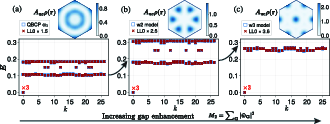
Figure 1: Charge-neutral gap enhancement of ∣G∣3 FCI in ideal bands over LLL in the ∣G∣4 limit; the FQH spectra rescaled by ∣G∣5 matches the FCI spectra across the excitation spectrum.
Density profiles for the ground states reveal pronounced spatial inhomogeneity as ∣G∣6 increases, marking a departure from the uniform FQH limit. Nevertheless, the topological phase and excitation structure persist, and degeneracies expected from magnetic translation symmetry are (approximately) preserved, as the detrimental low harmonics remain suppressed.
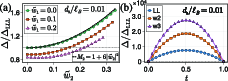
Figure 2: The gap enhancement factor ∣G∣7 as a function of second and first Fourier harmonic amplitudes, demonstrating that large higher-harmonic modulations produce strong enhancement provided first harmonics are small.
The mechanism is shown to generalize to non-Abelian FCIs (e.g., Moore–Read state at ∣G∣8) and to more general vortexable bands, including multi-Landau-level hybridization scenarios. For three-body interactions, an analogous enhancement factor ∣G∣9 applies.
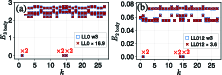
Figure 3: Gap enhancement and spectral rescaling in the Moore–Read state, demonstrating the robustness and universality of the enhancement mechanism in non-Abelian FCIs.
The effect of short-range versus long-range interactions is addressed: for sufficiently short screening length (∣G∣0), the enhancement is maximal, but it diminishes as the interaction range exceeds the lattice period, as the Umklapp scattering channels become ineffective.
Application to Moiré Materials
The framework is applied to twisted bilayer MoTe∣G∣1 (tMoTe∣G∣2) near ∣G∣3 twist, where experimental signatures of robust FCI phases at ∣G∣4 have been reported. The top valence band in this system is nearly ideal (measured by its quantum geometric parameters and the small value of ∣G∣5), and a small higher-harmonic content gives ∣G∣6.
Exact diagonalization of the continuum model, projected onto this nearly-ideal band, produces a many-body spectrum closely matching the FQH spectrum in the LLL when properly rescaled, confirming that FCI robustness in this system derives from the favorable structure of ∣G∣7.
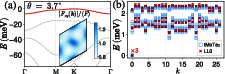
Figure 4: Comparison of excitation spectra for tMoTe∣G∣8 at ∣G∣9 and the corresponding LLL problem; the close spectral agreement supports the analytic framework for real materials.
This analytic correspondence suggests that reciprocal-lattice harmonic analysis provides a practical criterion for identifying or engineering moiré materials with maximized FCI stability and enhanced excitation gaps.
Implications and Outlook
The study exposes a general principle: the lattice specifics, previously viewed as perturbative complications, can be used as a design tool to favor or even optimize FCI energetics at no cost to the excitation structure. The possibility of arbitrarily large gap enhancement (unbounded h(r)0 in the ideal flat-band theory) implies that thermal stability and energetic control of anyonic excitations—critical for applications in topologically protected quantum computation or anyon condensation—can be systemically achieved by reciprocal-lattice engineering.
These findings have direct relevance for the interpretation of experiments in moiré materials (e.g., tMoTeh(r)1, twisted graphene systems), where observation of fragile FCI phases can be understood through the harmonic content of the underlying bands. Microscopically, the work also clarifies the relationship between band-geometry metrics (Berry curvature and quantum metrics) and higher-order Fourier modulations, positioning the latter as the primary determinant of stability distinct from geometric averages.
Future directions include exploring the interplay of lattice modulation with disorder, quasiparticle interactions, and thermal fluctuations; incorporating nonzero band width corrections; and systematic experimental realization of arbitrarily "engineered" h(r)2 distributions in artificial platforms such as cold atoms or photonic lattices.
Conclusion
This work rigorously establishes both theoretically and numerically that, by carefully controlling real-space periodic modulation in Chern bands—specifically enhancing higher harmonics while suppressing the first—a class of FCIs can be created that are essentially spectral twins of FQH states, but with tunably larger gaps. The central analytic correspondence, supported by exact diagonalization, is validated in both Abelian and non-Abelian settings, and further demonstrated in experimentally relevant moiré valence bands.
The results suggest a practical path for designing robust FCIs with predictable excitation structure in lattice materials, moving the FCI-FQH analogy from a ground-state correspondence toward a full excitation-spectral identity.
References:
(2606.07323) S. Sarkar, Y. Zhang, K. Sun, "How Similar Can Fractional Chern Insulators Be to Fractional Quantum Hall States? Moiré-Enhanced Gaps and Excitation-Spectrum Correspondence".