- The paper presents a Bayesian reformation of the cosmic chronometer method by adapting the D4000 approach from spectroscopy to photometric data.
- It calibrates the D4000 index against stellar age and metallicity using BC03 models and a Gaussian prior to control key biases in passive galaxy selection.
- The methodology yields a competitive H(z) constraint at z=0.65 that aligns with ΛCDM predictions, demonstrating its promise for future large photometric surveys.
Bayesian Photometric Cosmic Chronometers with VIPERS: Methodology and Results
Introduction
This work presents a rigorous Bayesian reformation of the cosmic chronometer (CC) method, enabling the extraction of the Hubble parameter H(z) from photometrically-selected samples—specifically, galaxies from the VIMOS Public Extragalactic Redshift Survey (VIPERS). Traditionally, the CC technique leverages differential aging of passively evolving galaxies at different redshifts to obtain direct, model-independent constraints on the expansion history. However, prior implementations require high-resolution spectroscopy to guarantee reliable passive galaxy selection and robust measurements of age-sensitive indices such as D4000, with explicit treatment of stellar population and metallicity systematics. This study systematically adapts the D4000 approach to the photometry domain through a probabilistic Bayesian framework, controlling for key sources of bias, and demonstrates competitive H(z) constraints at intermediate redshift.
Data and Passive Galaxy Sample Selection
VIPERS provides deep spectroscopy and multi-band photometry (0.5≤z≤0.8, iAB≤22.5) over two CFHTLS-Wide fields, optimized for high-completeness and minimal low-redshift contamination.
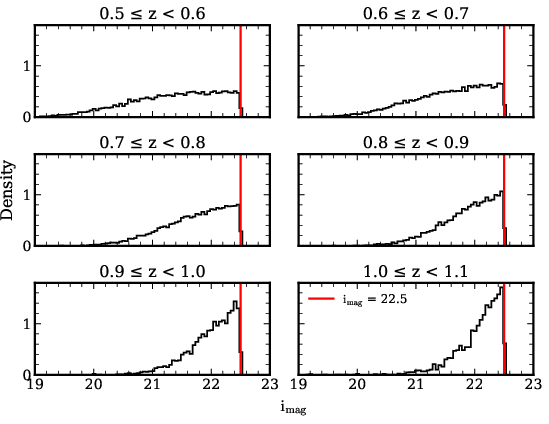
Figure 1: Distribution of VIPERS i-band magnitudes across narrow redshift bins illustrating the magnitude limit imag=22.5.
Passive galaxy selection follows a two-tier approach:
- Color selection: Rest-frame (NUV−r) and (r−K) are combined via a modified version of the NUVrK cut designed to exclude green valley galaxies, as motivated by the passive sequence in VIPERS and prior spectro-photometric studies.
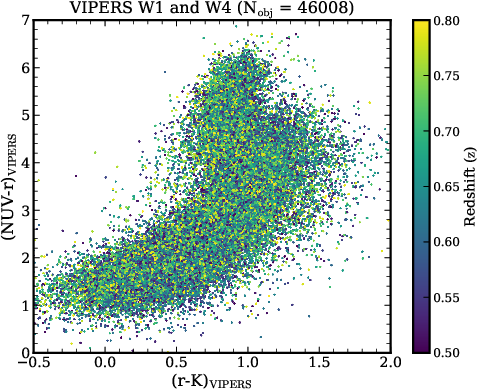
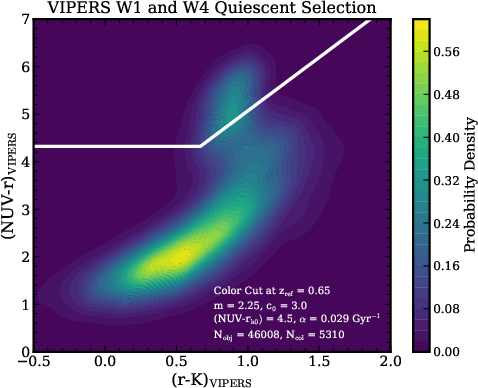
Figure 2: NUVrK color-color diagrams for the combined VIPERS fields, delineating photometric passive selection boundaries and redshift dependence.
- Stellar mass cut: Only galaxies with log(M/M⊙)≥11 are retained, suppressing contamination by younger objects and mitigating the effect of downsizing, which can bias age estimates if lower-mass galaxies with extended SFHs are included.
Purity is evaluated via passivity indicators and the distribution of D4000n (narrow definition), resulting in a sample consistent with the quiescent population required for CC analysis.
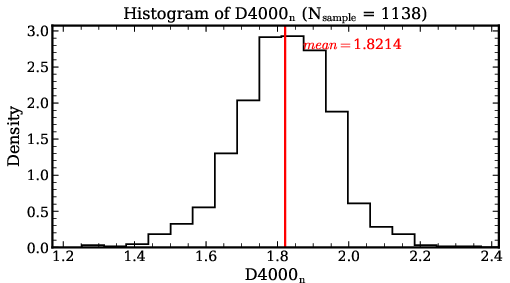
Figure 3: Histogram of D4000n for the color- and mass-selected VIPERS sample, showing the passivity of the selected population.
The inference pipeline requires a calibration linking observed D4000H(z)0 indices to stellar age and metallicity. Synthetic spectral grids are generated using the BC03 population synthesis models, under rapid post-burst star formation histories (H(z)1 Gyr) and a grid of metallicity values. The D4000H(z)2-age relation is strongly metallicity-sensitive, thus prior knowledge of metallicity is essential to lift the degeneracy in age estimation.
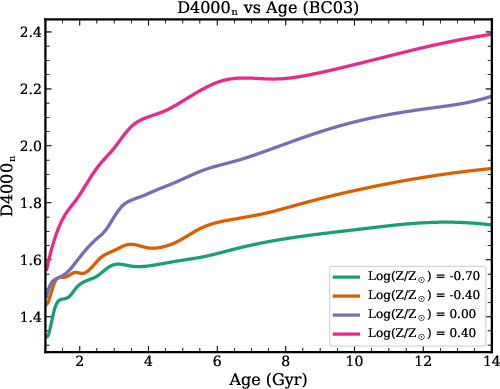
Figure 4: D4000H(z)3 as a function of age from BC03 models, shown for varying input metallicities, delineating the non-linear, metallicity-dependent mapping utilized for Bayesian age inference.
Bayesian Age Inference Framework
To propagate uncertainties and non-Gaussian error structure from data and theory, a fully Bayesian approach is employed:
- The observed D4000H(z)4 in each redshift bin is treated as a noisy realization from the forward-modelled grid, with likelihood H(z)5.
- The age prior is taken as broad and uninformative, while a Gaussian metallicity prior is imposed, based on independent spectroscopic studies of VIPERS passive galaxies (centered at H(z)6).
- The posterior H(z)7 is computed by likelihood evaluation and marginalization over metallicity.
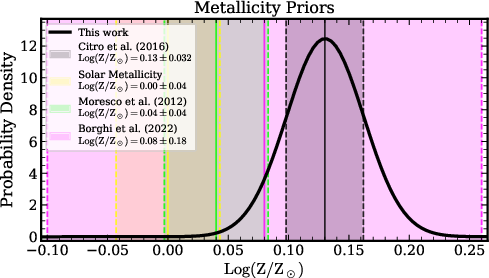
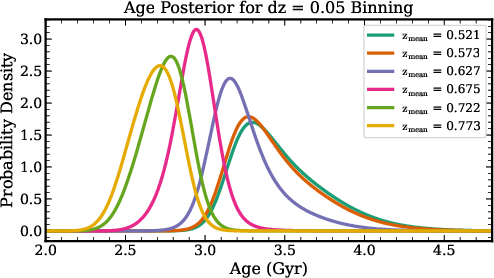
Figure 5: Top panel shows the adopted metallicity prior against measurements from the literature; bottom panel displays posterior age distributions for a representative redshift bin, illustrating non-Gaussian structure.
The median and 68\% credible interval of the posterior are used for downstream analysis; non-Gaussianity and possible multi-modality are preserved through all steps.
Binning and Differential Age Estimation
Redshift binning strategies are tested to optimize SNR and minimize scatter in D4000H(z)8 evolution, with bin widths (H(z)9) evaluated via reduced 0.5≤z≤0.80 metrics for linearity. Median D40000.5≤z≤0.81 values and errors are determined within each bin to mitigate outlier effects.
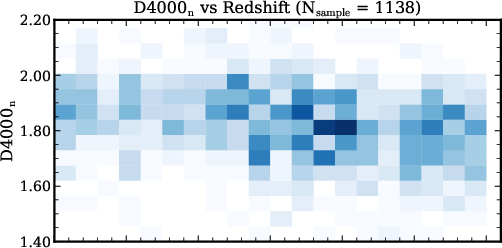
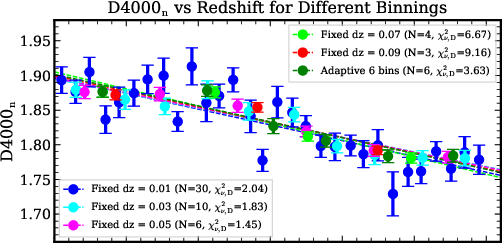
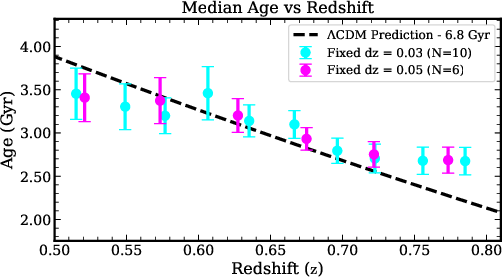
Figure 6: Top: D40000.5≤z≤0.82 histogram; Middle: D40000.5≤z≤0.83 vs. redshift for varied binnings; Bottom: Median age evolution with 0.5≤z≤0.84CDM prediction and inferred scatter.
The differential age 0.5≤z≤0.85 between bins at 0.5≤z≤0.86 and 0.5≤z≤0.87 is constructed via direct convolution of age posteriors, correctly propagating uncertainties and skewness, critical for valid statistical error estimates in 0.5≤z≤0.88.
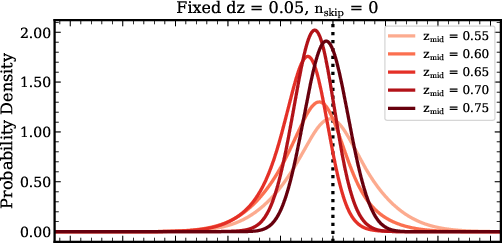
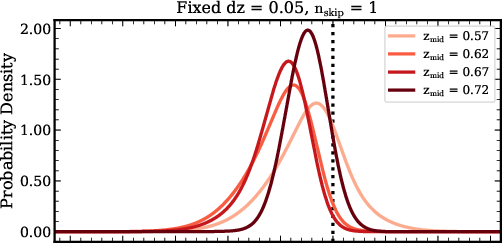
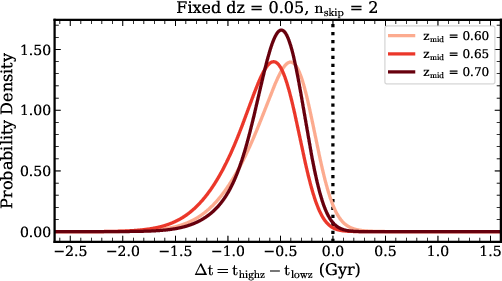
Figure 7: Age difference posteriors for the 0.5≤z≤0.89 binning, illustrating impact of bin skips (iAB≤22.50) on posterior shape and support for expected cosmic aging.
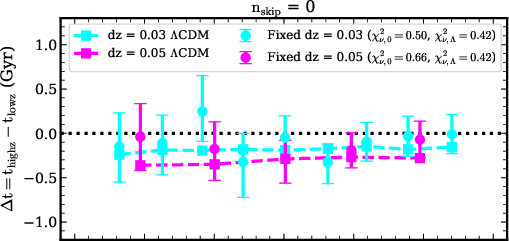
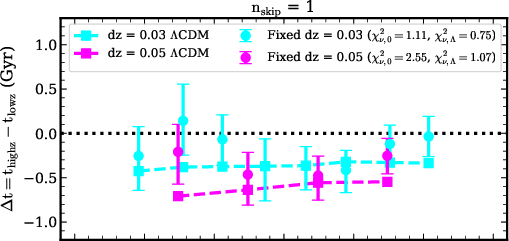
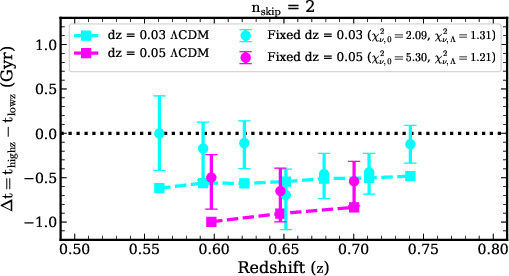
Figure 8: Mean age difference (iAB≤22.51) versus redshift for various bin skip strategies, compared against iAB≤22.52CDM expectation.
Derivation of the Expansion Rate iAB≤22.53
Differential ages yield iAB≤22.54 at effective redshifts via the CC relation iAB≤22.55, with full error propagation from statistical (posterior width) and systematic (SPS model, SFH, IMF, metallicity) sources, the latter adapted from the CC literature covariance approach. Inverse-variance weighted combinations of all bin pairs and bin-skip schemes yield the final constraint.
The primary result is
iAB≤22.56
with error dominated by statistical uncertainty. This is in statistical agreement with Planck iAB≤22.57CDM predictions (iAB≤22.58 km\,siAB≤22.59\,Mpcimag=22.50) and prior high-resolution spectroscopic CC studies.
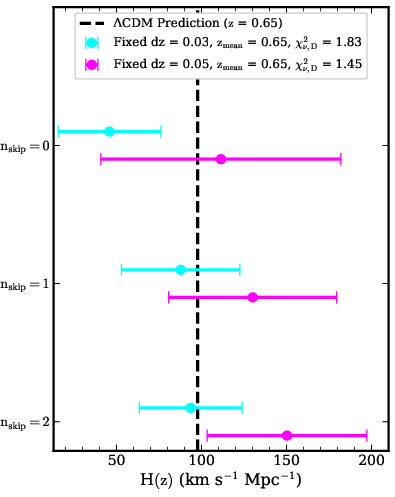
Figure 9: Weighted average imag=22.51 for the optimal binning schemes, demonstrating internal consistency and statistical agreement with cosmological predictions.
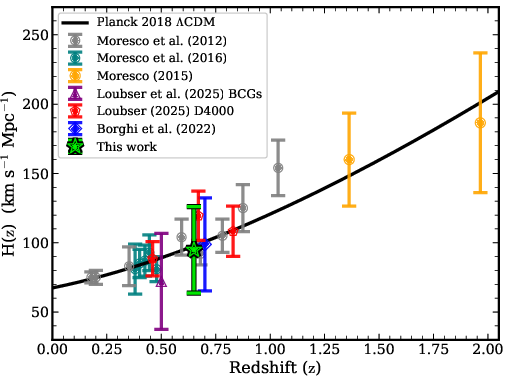
Figure 10: Comparison of imag=22.52 result from this work with prior CC and other cosmological determinations; the derived value is consistent within uncertainties.
Implications and Future Prospects
This analysis proves that, when properly controlling for sample purity and systematics, photometric-quality spectroscopy (as from VIPERS) can yield robust imag=22.53 constraints competitive with traditional spectroscopic CC measurement. The Bayesian pipeline enables straightforward generalization to future large-area photometric (PAUS, J-PAS) or intermediate-resolution spectro-photometric surveys, where massive gains in sample size may compensate for resolution—but only if stellar population systematics, progenitor bias, and metallicity control are sustained at sufficient accuracy.
The framework's modularity allows straightforward substitution of SPS grids or metallicity priors, inclusion of new stellar libraries, or enhanced treatment of bin correlations. This positions it as a scalable backbone for anticipated next-generation imag=22.54 inference from low-resolution but high-statistics photometric galaxy surveys.
Conclusion
By recasting the D4000-based CC methodology in a Bayesian formalism and applying it to a strictly photometrically-selected VIPERS sample, this work delivers a statistically competitive imag=22.55 determination at imag=22.56. The approach robustly propagates full error structure—including non-Gaussianities and population-level metallicity uncertainties—through to the cosmological parameter constraints. The result validates the applicability of chronometer methods to large photometric or intermediate-resolution datasets and establishes a generalizable template for future photometric CC analyses as next-generation surveys expand both depth and area.