- The paper introduces a two-phase simulated annealing approach that decouples preference satisfaction from fairness constraints to eliminate team formation complaints.
- It employs a preference-driven triad assignment followed by a constrained simulated annealing phase, ensuring balanced GPA distribution and no gender isolation.
- Empirical results on large cohorts showed zero complaints and near-zero GPA variance, outperforming traditional methods in efficiency and equity.
Introduction
Optimal team formation in large-scale engineering education settings remains a multifaceted combinatorial problem, requiring the reconciliation of competing priorities: social preference satisfaction, academic fairness (GPA balancing), demographic diversity, and the avoidance of problematic configurations such as isolated gender minorities. Conventional algorithmic approaches and manual assignment strategies show persistent limitations, failing to simultaneously achieve high satisfaction, equity, and complaint-free outcomes at scale. The paper "Two-Phase Simulated Annealing for Equitable Team Formation: Eliminating Complaints in Large Engineering Cohorts" (2606.07270) proposes a methodologically distinct solution: a two-phase architecture that decouples the underlying objectives, implementing a preference-driven triad formation phase followed by a rigorously constrained simulated annealing phase.
Most prior algorithms for team formation, such as CATME and Team-Anneal, trade off either student preferences or fairness constraints. Systems like CATME prioritize instructor-defined criteria (GPA, gender, schedule) but require manual post-processing for preference satisfaction. Team-Anneal employs simulated annealing for constraints but omits preference-driven formation, while hybrid lexicographic approaches, as exemplified in capstone project matching, seldom address teammate selection with both rigor and scale. The incorporation of student agency (e.g., via LIFT) improves satisfaction but often undermines demographic or academic diversity. Single-stage multi-objective optimization seldom yields non-compromised solutions, especially as cohort size grows and preference graph density fluctuates.
Methodology: Two-Phase Optimization Architecture
The core contribution is the construction of a two-phase pipeline:
Phase 1: Preference-Based Triad Assignment
Students submit up to two preferred teammates. A directed preference graph is constructed (vertices: students; edges: preferences, weighted by reciprocity). The algorithm hierarchically assigns triads by maximizing mutuality (up to complete triangles), prioritized matching of mutual pairs, and one-sided preferences, eventually assigning unconnected students to GPA-balanced triads. Clique detection in the preference graph ensures maximal preservation of social bonds.
Phase 2: Simulated Annealing for Macro-Team Formation
Triads are paired (typically forming teams of 6, ±1) through a simulated annealing metaheuristic. The cost function is a weighted sum of (i) between-team GPA variance, (ii) the count of gender-isolated individuals, and (iii) deviation from prescribed team size. Initial states are generated by a snake draft pairing of triads sorted by mean GPA, and neighbor states arise from random triad swaps. The acceptance of higher-cost swaps is adaptively controlled by an exponentially decreasing temperature schedule, ensuring robust escape from local minima and global convergence. Constraints render gender isolation impossible unless strictly demanded by cohort demographics; otherwise, the system prioritizes plural representation. Highly efficient implementation (Python + networkx/pandas/numpy) assures scalability, with total execution time <5 seconds for n ≈ 120.
Quantitative Outcomes and Analysis
Empirical validation across two large engineering cohorts (N=238) demonstrated that the two-phase algorithm not only outperformed all historical baselines, but did so with globally dominant results on every measured axis:
- Complaint Elimination: Zero formal complaints, whereas historical cohorts (82 instances over six years) suffered 30–35% complaint rates. Previous best-in-class algorithmic systems retain nonzero complaint rates (5–15%).
- GPA Fairness: Near-zero between-team GPA variance (0.005), orders of magnitude lower than the six-year institutional average (9.74 ± 14.32). All teams fell within a tightly clustered GPA range; outlier configurations were eliminated.
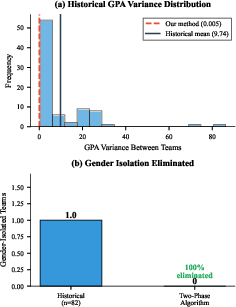
Figure 1: Distribution of historical (solid line) and algorithmic (dashed line) GPA variance and gender isolation. The algorithm's result for GPA variance (0.005) and gender isolation (0) are shown in comparison with the previous historical mean and typical incidence.
- Gender Isolation: Complete removal of gender-isolated teams. Given cohort composition (75–85% male), some all-male teams were demographically necessary, but the assignment scheme always grouped minority students in pairs or greater.
- Preference Satisfaction: Achieved 94.3% satisfaction rate among those expressing preferences, including >88% full matches in cohorts with dense preference graphs.
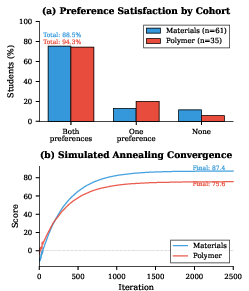
Figure 2: Left panel (a) shows the distribution of preference satisfaction by cohort and algorithm phase. Right panel (b) plots convergence of the cost function during simulated annealing, illustrating rapid improvement in fairness metrics.
- Computational Tractability: Average completion times (including all data parsing, graph operations, and annealing) were <5s for n=119 per cohort, with algorithmic complexity mediated by practical sparsity in real-world preference data.
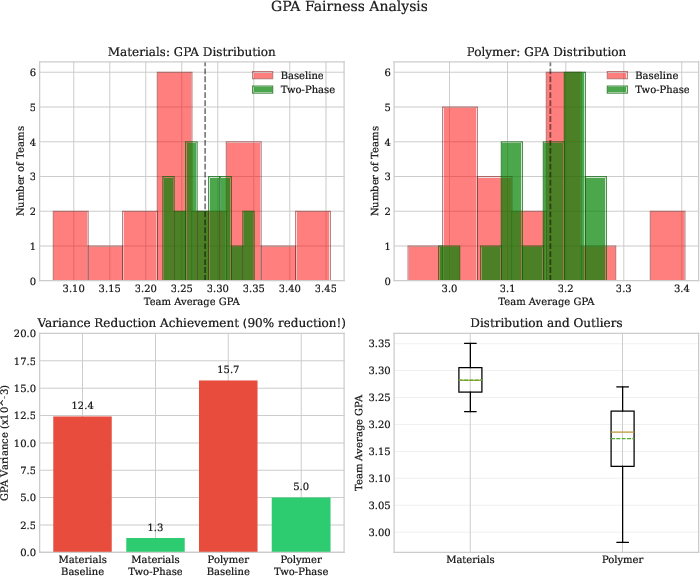
Figure 3: GPA distribution across teams: histograms and boxplots reveal minimized variance and suppression of outliers in algorithmic assignments compared to historical methods.
Practical, Pedagogical, and Theoretical Implications
The dual-phase method fundamentally alters the landscape of team assignment in several critical respects.
Pedagogical Integration: The use of simulated annealing—a topic in physical chemistry and materials science—for team optimization enables authentic curricular linkage, making administrative processes didactic rather than opaque.
Administrative Effort: Complete automation obviates the need for hours of faculty labor typically required for manual adjustment and complaint mitigation, offering a reproducible workflow aligned with institutional scaling pressures.
Team Functionality: Empirical elimination of isolation effects and enhanced initial satisfaction suppress common antecedents of dysfunctional team dynamics, though the authors note that sustained performance also requires assessment interventions for free-riding.
Theoretical Perspective: The separation of objective classes—social satisfaction then demographic/academic fairness—enables atomic optimization within each objective space, free of the usual trade-offs associated with high-dimensional single-stage cost functions. The analysis of preference graph topology highlights the potential for further sociometric study of cohort-specific network structures.
Limitations and Future Work
The method depends on nontrivial preference response rates (optimal operation with >60% preference submission). Extremely large cohorts (n>300) may challenge clique detection in phase one, although practical edge densities mitigate O(n3) worst-case complexity. Applicability across heterogeneous cultural or educational settings is an open empirical question. Future research directions include real-time reconfiguration based on peer evaluation, integration of multifaceted skill and personality data, and transfer learning of likely preference networks in low-response scenarios.
Conclusion
This work establishes a novel standard for algorithmic team formation in large educational settings, decisively resolving the longstanding tension between preference satisfaction and rigorous fairness constraints. The complete elimination of formal complaints, extreme reduction of GPA variance, and systematic removal of gender isolation materially outperform both legacy manual and state-of-the-art algorithmic benchmarks. By decomposing the problem structure and rooting the solution in well-understood optimization and network principles, the approach provides an extensible, transparent, and pedagogically valuable foundation for future innovations in educational group assignment.

