Transport functions for principal bundles and Morse homology with differential graded coefficients
Published 5 Jun 2026 in math.AT and math.GT | (2606.07260v1)
Abstract: We study transport functions as a Morse-theoretical way of describing principal bundles. Transport functions are maps from the spaces of broken gradient flow lines to a topological group and they encode the transition functions of the principal bundle. We describe and extend a construction by Voigt that yields such transport functions and show that one can recover the principal bundle from the transport function. Using transport functions with values in a topological group G and a differential graded module over the chains of G we define a chain complex in the style of Barraud-Damian-Humilière-Oancea's Morse homology with differential graded coefficients. We prove that in many cases the homology of this complex is the homology of an associated bundle. In the case of smooth bundles transport functions arise also from parallel transport with respect to a connection and the corresponding DG Morse complex turns out to be isomorphic to a complex defined in the style of Barraud-Damian-Humilière-Oancea. We eventually consider certain aspects of the functoriality of our constructions.
The paper introduces transport functions as a Morse-theoretic tool to characterize principal bundles via gradient flow lines and their transition data.
It establishes a Morse chain complex with DG coefficients, proving its homology is isomorphic to the singular homology of associated bundles.
The study provides functorial and spectral-sequence methods that bridge Morse theory, bundle classification, and homological algebra.
Transport Functions for Principal Bundles and Morse Homology with Differential Graded Coefficients
Introduction and Context
The paper develops a Morse-theoretic framework to describe principal bundles using transport functions, formalizing maps from spaces of (possibly broken) gradient flow lines to a topological group G that encode the bundle’s transition data. The work is motivated by extending the analytical and categorical perspective of Morse and Floer theory into the field of bundles and their associated topological (and homological) invariants, drawing on and refining constructions previously outlined by Voigt and later by Barraud, Damian, Humilière, and Oancea (2606.07260).
A significant byproduct is the definition and analysis of a Morse chain complex with differential graded (DG) coefficients arising from the transport function and a DG module over the chains of G. The resulting homology reflects associated bundle homology in broad settings—particularly for smooth bundles with connections—and provides new functorial and spectral-sequence tools.
Transport Functions and the Morse-Theoretical Description of Principal Bundles
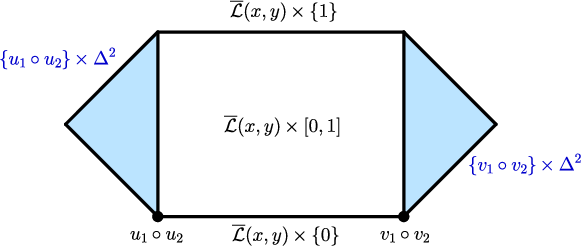
A transport function in this context is a continuous functor from the Morse flow category Mf (with objects the critical points of a Morse function f and morphisms given by compactified moduli spaces of flow lines between them) to the one-object topological category with morphism space G. Explicitly, this is a collection {Φx,y:L(x,y)→G} (for all pairs of critical points with ∣x∣≥∣y∣) satisfying
Φx,y(u1∘u2)=Φx,z(u1)⋅Φz,y(u2)
for any u1,u2 composable broken flow lines, expressing the concatenation's compatibility with the group structure.
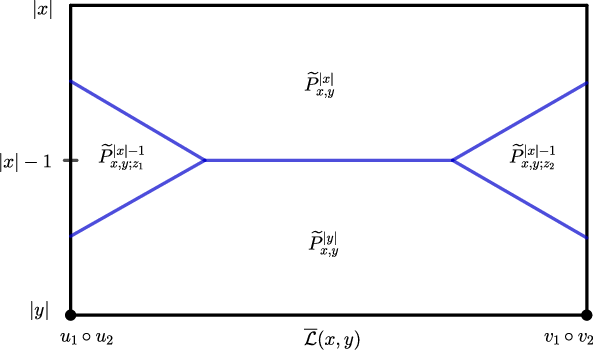
Figure 1: The sets Px,yi in the parametric space of gradient flow lines, indexed by critical points, which are central to constructing contractible neighborhoods for the definition of transport functions.
The author establishes a bijection between isotopy classes of such transport functions and isomorphism classes of G0-principal bundles (for G1 path-connected), via explicit Morse-theoretic constructions. Given a principal bundle G2, one can produce a Morse-theoretic transport function by selecting contractible neighborhoods around the critical points, choosing local trivializations, and encoding the transition functions as maps from flow lines to G3. Conversely, given a transport function, one constructs a G4-principal bundle by building the transition data directly out of the functorial image of flow compositions.
This theoretical structure significantly generalizes classical clutching functions and provides a Morse-theoretic mechanism for reconstructing principal bundle classes from flow data.
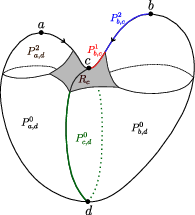
Figure 2: A Morse function on the G5-sphere G6 with four critical points; shown are the regions G7 and neighborhoods G8 critical in constructing local trivializations compatible with Morse theory.
Chain Complexes and Morse Homology with DG Group Coefficients
Given a G9-valued transport function Mf0 and a DG right Mf1-module Mf2, a Morse chain complex is defined: Mf3
with a differential incorporating both the module and Morse-theoretic flow structure. The twisting cocycle is constructed by pushing a chain Mf4 representing the fundamental class of moduli spaceMf5 forward via Mf6, resulting in Mf7.
This setup generalizes the Morse complex with loop space coefficients by Barraud, Damian, Humilière, and Oancea, with the action of Mf8 replaced by the action of an arbitrary Mf9. The main result is that, whenever compatible sections of the pullback bundles to compactified unstable manifolds exist (a property always valid for smooth bundles with connection and f0 a Lie group), the homology of this complex is isomorphic to the singular homology of the associated bundle f1.
The DG Morse complexes constructed are robust under isotopy and equivalence (c-equivalence) of transport functions; isotopic functions yield quasi-isomorphic complexes. For discrete groups, the complex reduces to a module over the group ringf2 tensored with Morse theory’s lifted complex.
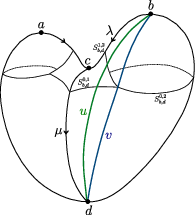
Figure 3: Sets f3 on f4, representing path spaces between critical-level sets, integral to encoding transition data and the twisting cocycle’s combinatorics.
Parallel Transport, Smooth Bundles, and DG Complex Comparison
In the smooth context, choosing a connection on a f5-principal bundle induces a transport function via parallel transport (holonomy) along Morse flow lines. The resulting function is canonically equivalent (up to isotopy) to any other transport function representing the same bundle. More precisely, the "parallel transport function" recovers the bundle through Morse data, and compatible sections always exist.
Moreover, the established Morse-theoretic complex is shown to be isomorphic to the complexes constructed via piecewise smooth path spaces (DG categories constructed on these path spaces), closely related to the classical Morse complex with loop space coefficients (Barraud-Damian-Humilière-Oancea). This is formalized by equating the Morse–theoretic and bundle–theoretic models via explicit homotopies and algebraic identifications.
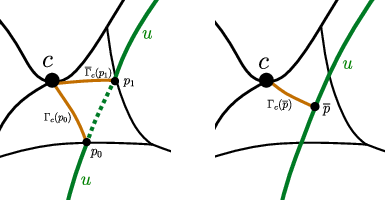
Figure 4: Sketch illustrating the isotopy construction between two transport functions—one derived from local trivializations, the other from parallel transport—by sliding the points of gluing in the moduli of flow lines, expressing the existence of a chain homotopy.
Functoriality and Shriek Maps in the Fiber
The paper further explores functoriality within this Morse–DG bundle framework, addressing both direct maps (e.g., f6-equivariant maps between fiber spaces) and fiberwise shriek maps (Gysin morphisms). In favorable situations (notably when the structure group is a finite or compact Lie group acting orientably), equivariant chain-level Thom cocycles can be constructed (via averaging), and a Morse-theoretic chain model for the shriek map is produced. The induced map on the spectral sequence descending from the Morse complex agrees with the classical Leray–Serre spectral sequence, concretely realizing fiberwise transfer in the Morse-theoretic setting.
Figure 5: Structure of f7 (for f8), the fundamental space for the isotopy construction at the chain level, highlighting the correspondence with the moduli spaces' faces and the combinatorial structure underlying higher-dimensional terms in the complex.
Conclusion and Perspectives
The paper establishes a tight correspondence between Morse-theoretic data and principal f9-bundle structure, mediated by the formalism of transport functions. The Morse-DG approach elegantly encodes both the classical topological classification and the bundle's associated (co)homology, provides functorial transition maps and shriek maps, and enables spectral sequence computations paralleling the fiberwise structure of associated bundles.
On the theoretical side, this analysis strengthens the bridge between Morse (and Floer) theory, bundle theory, and homological algebra, with implications for string topology, categorical field theories, and geometric representation theory. Practically, the results furnish new invariants and computational tools for principal bundles and their moduli, and suggest generalizations to Floer homotopy theory and gauge-theoretic settings. Future work may address explicit functorial behavior under smooth maps, refine chain-level constructions in the presence of torsion or non-orientable actions, and extend to more general (e.g., G0) structures.
Reference: "Transport functions for principal bundles and Morse homology with differential graded coefficients" (2606.07260)