- The paper demonstrates that trusted detector models enable secure key generation in free-space UD-CVQKD even under high electronic noise (1.4 SNU).
- It employs Gaussian-modulated, polarization-encoded coherent states to achieve stable interference and a strong correlation (R ≈ 0.98) between Alice and Bob.
- The study quantifies secure key rates and constrains channel loss (~0.7 dB cutoff), highlighting the practical trade-offs for short-range QKD implementations.
Experimental Free-space Unidimensional CV-QKD Under High Detector Noise
Introduction and Context
This paper presents an experimental study of Gaussian-modulated unidimensional continuous-variable quantum key distribution (UD-CVQKD) implemented over a free-space channel with explicitly high detector electronic noise, quantified at 1.4 shot-noise units (SNU). The protocol employs polarization-encoded coherent states with co-propagating signal and local oscillator (LO) in orthogonal polarizations, achieving stable interference and reducing the requirements for phase tracking prevalent in conventional fiber or free-space CV-QKD systems. Security is investigated under both untrusted (UTD) and trusted (TD) detector noise models, explicitly quantifying how detector trust assumptions critically influence achievable secret key rates in realistic high-noise scenarios.
Security Model and Theoretical Analysis
UD-CVQKD simplifies standard two-quadrature Gaussian-modulated protocols by encoding information in a single quadrature. While implementation and resource requirements are significantly reduced, analyzing security becomes subtle since some channel parameters for the unmodulated quadrature cannot be directly estimated. This necessitates worst-case maximization of Eve’s accessible information over all physically admissible correlations in the unmodulated quadrature.
Detection noise, specifically electronic noise from the balanced homodyne detector, is a critical limiting factor in CV-QKD and is treated under two paradigms:
- Trusted Detector (TD) Model: Electronic noise is excluded from Eve’s domain; Bob and Alice calibrate and characterize this noise as intrinsic.
- Untrusted Detector (UTD) Model: Electronic noise can be fully exploited by Eve and is ascribed to the channel.
Key rate analysis uses the asymptotic bound against collective Gaussian attacks with reverse reconciliation,
K=βIAB−χBE
where IAB is the mutual information, χBE is the Holevo bound, and β is the reconciliation efficiency. Security proofs adopt a worst-case assessment for the unknown Cp correlation in the unmodulated quadrature, maximizing the Holevo bound over all physical covariance matrices.
Security Regions Under High Electronic Noise
Theoretical security regions are constructed in the (VpB,Cp) parameter space to delineate physical, unsecure, and secure domains under both TD and UTD models.
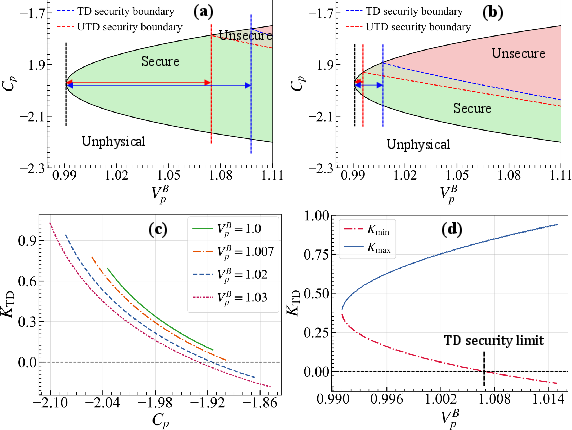
Figure 1: (VpB,Cp) parameter space with boundaries for the physicality of covariance matrices and positive secret key rates under TD and UTD noise models for low and high Vel.
For high detector noise (Vel=1.4 SNU), the UTD model’s Cp-independent secure region becomes physically unattainable since IAB0 must hold physically, but security requires IAB1. Conversely, the TD model, though constraining, retains a non-trivial secure region (IAB2), demonstrating that trust in detection devices is imperative for practical secure key generation in high electronic-noise environments.
Experimental Setup and System Characterization
The system leverages polarization-based state encoding, utilizing a high-extinction-ratio amplitude modulator and free-space optics for both Alice and Bob. An AWG generates Gaussian-distributed modulation applied to the amplitude modulator, controlling the weak horizontal polarization signal amid a strong vertical LO.
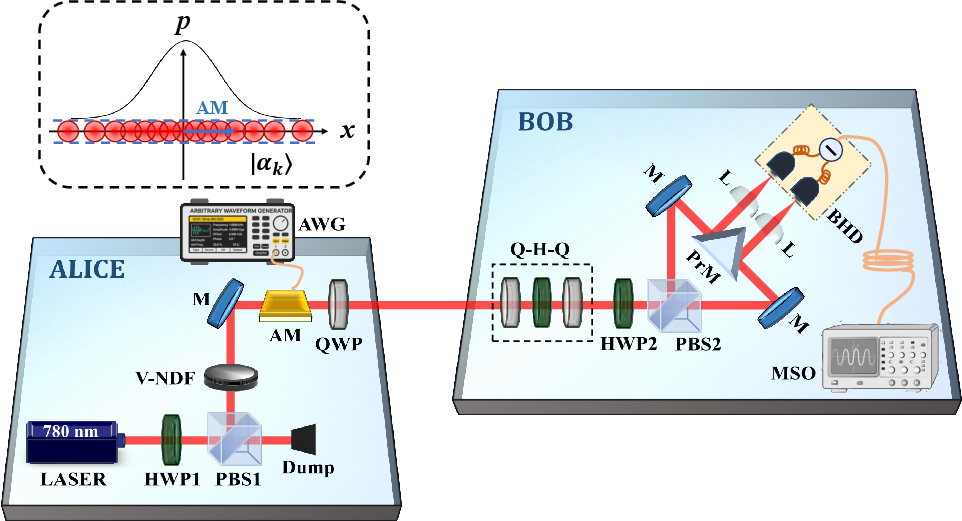
Figure 3: Experimental setup for the free-space Gaussian-modulated UD-CVQKD system employing polarization and Stokes-parameter detection.
Amplitude modulation and detection were confirmed to be linear and stable for small voltages, with measured variances and mean outputs in both quadratures closely tracking theoretical predictions.
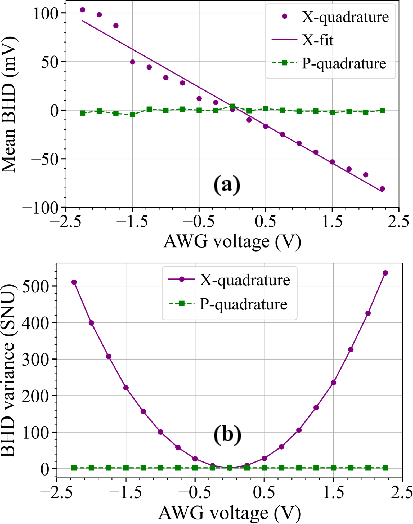
Figure 2: Calibration of modulation/detection shows linearity in IAB3-quadrature mean and quadratic variance scaling.
At the operational LO level, the shot-noise to electronic-noise clearance was determined to be only 2.4 dB, placing the experiment in a high absolute noise regime with IAB4.
Empirical Results and Key Rate Analysis
Experimental protocols scanned the modulation variance IAB5 from 4 to 97 SNU. For each IAB6, channel transmittance IAB7 and excess noise IAB8 were extracted via covariance analysis. The IAB9-quadrature at Bob was linearly dependent on Alice’s modulation, with strong correlation (χBE0), confirming noise-dominated but robust classical information transfer.
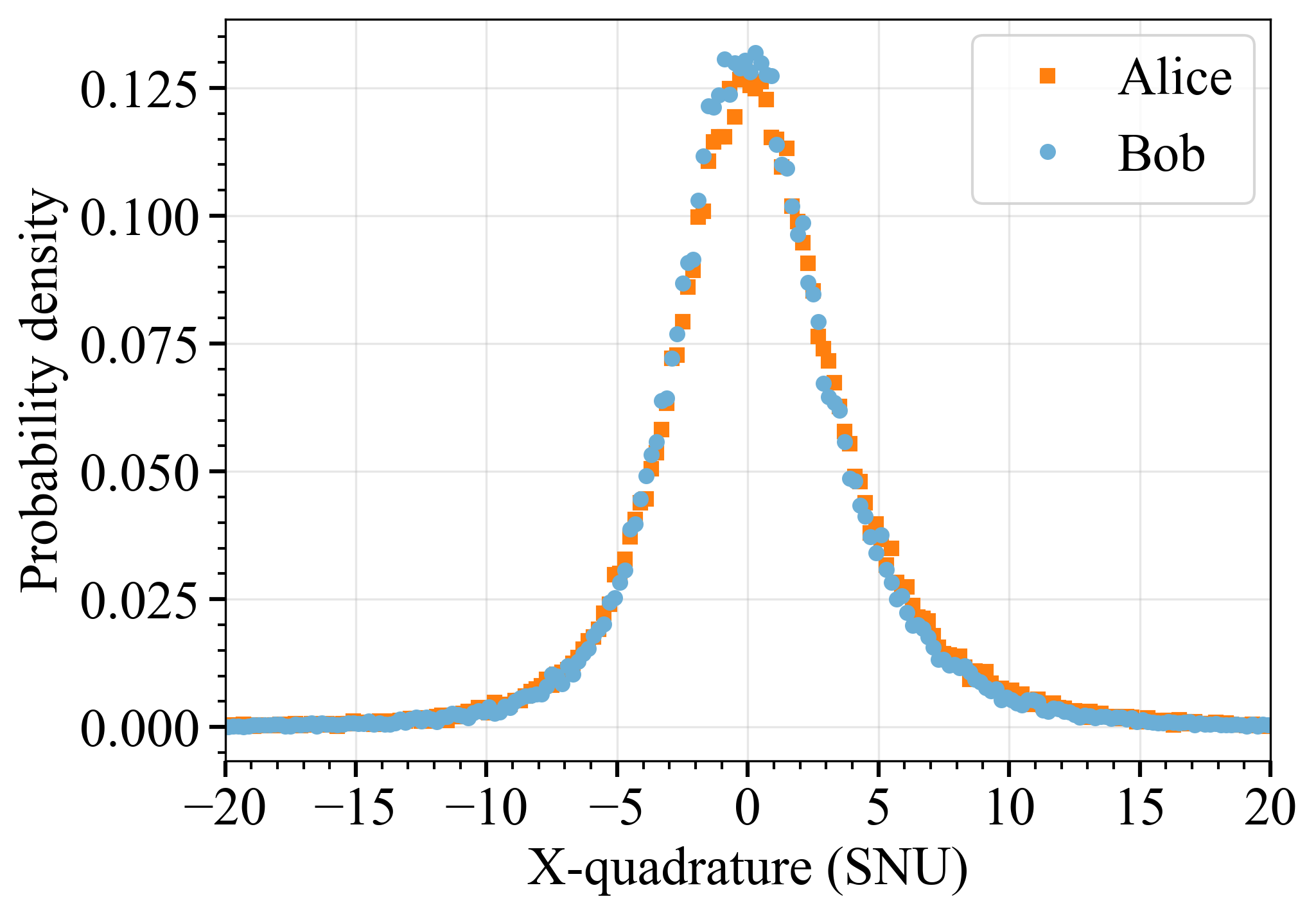
Figure 4: Strongly Gaussian distributions for Alice and Bob illustrate typical modulation transfer, with variance loss due to channel attenuation.
Bob's measured quadrature variance scaled linearly with χBE1, confirming stability and Gaussian character.
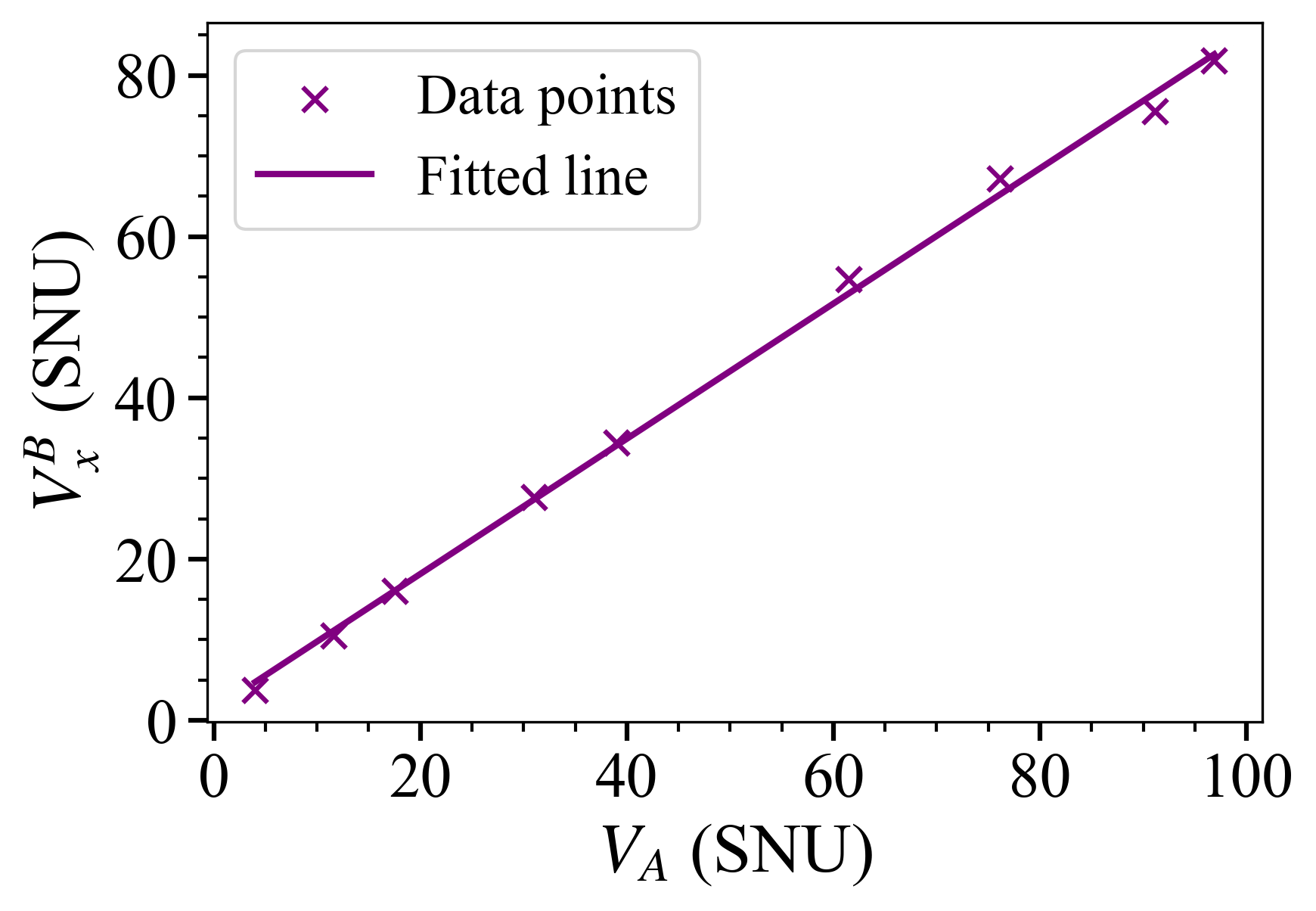
Figure 5: Measured χBE2-quadrature variance as a function of Alice's modulation variance, establishing overall channel gain.
The secret key rate under the TD model peaked at χBE3 bits/pulse (270 kbps) for an optimal χBE4 of 11.57 SNU. For higher χBE5, nonlinearity and noise accumulation in the detection system led to decreasing estimated χBE6 and a sharp drop in key rate, ultimately eliminating secure key generation for the experimentally achieved maximum values. No positive key rate was observed under the UTD model at any χBE7 due to the excessive effective noise attributed to Eve.
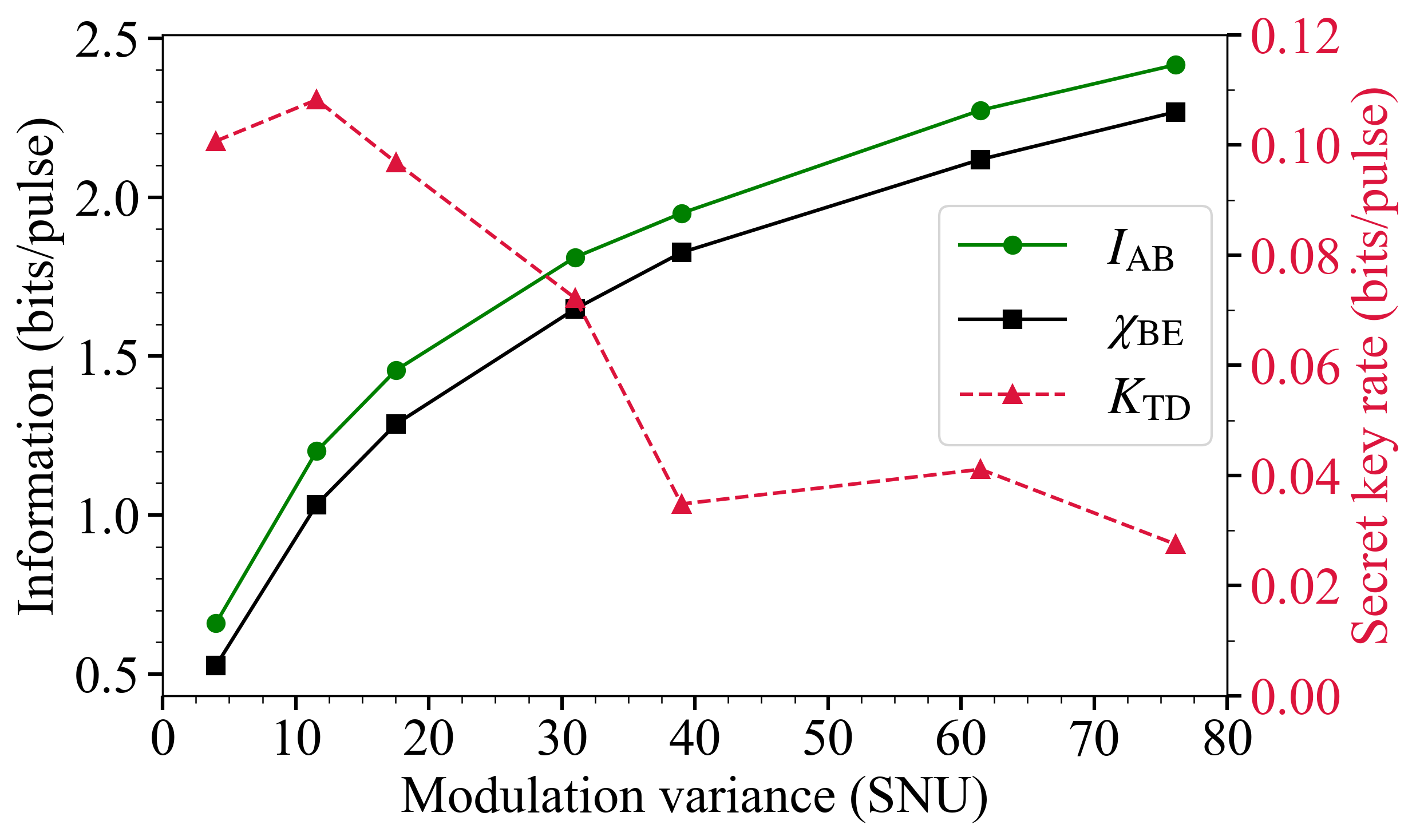
Figure 8: Theoretical and measured dependence of mutual information, Holevo bound, and TD key rate on Alice's modulation variance.
Moreover, achievable secure key rates and operational transmission distances dropped severely with increasing detector electronic noise. For the experimentally relevant χBE8 SNU, the maximum allowable channel loss is χBE9 dB (i.e., β0), corresponding to short-range links.
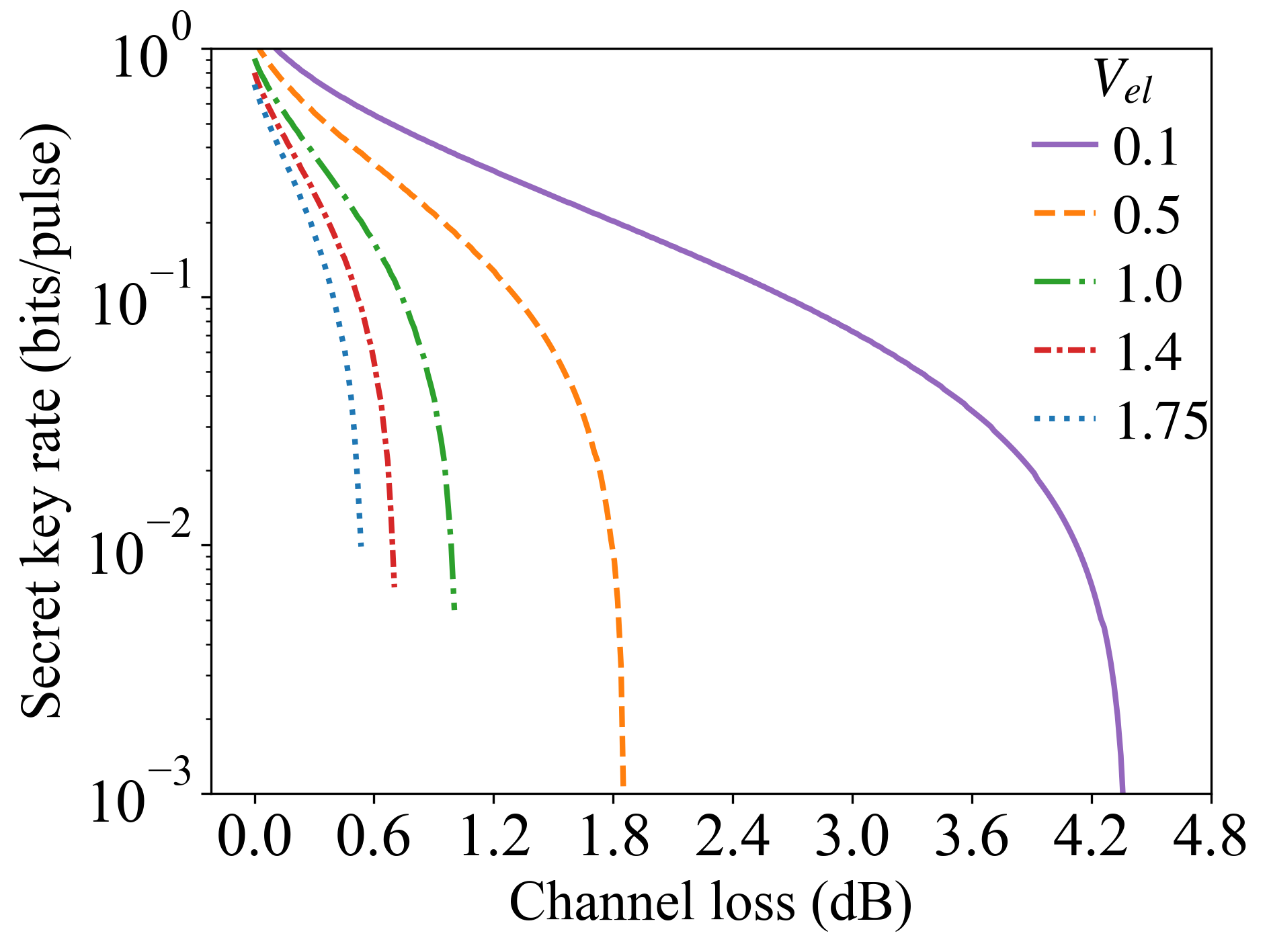
Figure 6: Simulated key rate (TD model) as a function of channel loss for several electronic noise levels, illustrating the substantial reduction in permitted distance as β1 increases.
Practical and Theoretical Implications
The empirical demonstration substantiates that free-space UD-CVQKD is feasible with resource-constrained, high-noise detectors—but only under the assumption of trusted detector models, and with severe penalties in channel range and required transmittance. The experiment confirms that even modest increases in untrusted noise eliminate secure operation, forming a strict boundary for practical deployment in environments where detector noise is hard to characterize or guarantee.
Practically, this work indicates that low-cost or high-bandwidth detectors with high intrinsic noise (or low dynamic range for high LO powers) may be usable for CV-QKD, provided meticulous calibration and trust in the detection system. The results also suggest that free-space implementations for short- to moderate-range links (e.g., between buildings, intra-campus, or terrestrial mobile QKD) are viable targets if detector trust is maintained.
Theoretically, the security framework reinforces the critical role of worst-case estimation in protocols with unobservable parameters and demonstrates the shrinking of the physically meaningful key-rate region under strong noise constraints. The need for trusted detection in high-noise scenarios may guide both future protocol design (favoring measurement-device-independent CV-QKD or composable security approaches that mitigate or eliminate such trust) and detector development (emphasizing improved noise performance for extended-range systems).
Future Directions
Likely extensions are:
- Development of low-noise, high-bandwidth photodiodes and electronics to extend secure operating distances,
- Integration of optical preamplification or noise subtraction to mitigate the impact of high β2,
- Investigation of real-time calibration and composable security to bolster detector trust requirements,
- Exploration of protocol modifications (e.g., adding a small modulation to the β3-quadrature) that may enable direct estimation of all security parameters.
Conclusion
The paper provides a clear experimental and theoretical analysis of UD-CVQKD performance subject to high detector noise over free-space channels. Security is fundamentally compromised under untrusted detector noise, but calibrated trusted detectors enable modest key rates and distances even in adverse noise conditions. The primary limiting factor is the shot-noise clearance of the detection system, which directly bounds the secure transmission region and achievable key rates. This result delineates the applicable regime for CV-QKD with unidimensional protocols using standard or high-noise detection hardware, further informing the choice of security model and system design for future practical quantum networks.
Citation: "Experimental Demonstration of Free-Space Unidimensional Continuous-Variable Quantum Key Distribution Under High Detector Noise" (2606.07206)