- The paper finds that tuning four-spin interactions in the extended CBJQ model yields a first-order AFM–FPS transition with robust emergent O(4) symmetry.
- Large-scale QMC simulations and Binder cumulant analysis confirm the absence of an intermediate EPS phase, validating the model's strict first-order behavior.
- The study offers practical observables, including VBS Binder cumulants, for precise transition detection and deeper insight into deconfined quantum criticality.
Phase Diagram and Emergent Symmetry in the Extended Chequerboard J-Q Model
Introduction
The study addresses the ground-state properties and critical behavior of the extended chequerboard J-Q (CBJQ) spin-1/2 model on the square lattice, a Hamiltonian that generalizes the paradigmatic CBJQ model by tuning independent four-spin interactions on full and empty plaquettes. Motivated by discrepancies between the original CBJQ model and experiments/theory on the Shastry-Sutherland (SS) compound SrCu2(BO3)2, particularly the nature of the transition between antiferromagnetic (AFM) and plaquette-singlet (PS) orders and the absence of empty plaquette-singlet (EPS) competition, the work extends the model's parameter space and systematically studies its phase diagram, critical properties, and symmetry enhancement via large-scale stochastic series expansion (SSE) quantum Monte Carlo (QMC) simulations.
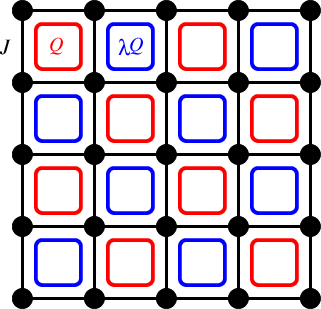
Figure 1: The extended CBJQ model features Heisenberg couplings (black lines), and two distinct four-spin plaquette interactions: full (FP, red, strength Q) and empty (EP, blue, strength λQ).
The Extended CBJQ Model
The model's Hamiltonian includes AFM Heisenberg interactions and two types of four-spin projection operators acting on different sets of 2×2 plaquettes, with respective coupling constants Q and λQ. The parameter Q0 interpolates from the original CBJQ (Q1) up to the symmetric Q2-Q3 model (Q4). The lattice is bipartite and the model remains sign-problem-free, allowing precise QMC computations.
Order parameters for the AFM and FPS phases, as well as the standard columnar valence-bond solid (VBS) and EPS, are defined in terms of Q5 operators and their associated Binder cumulants. These statistics enable compelling identification and finite-size scaling analysis of transitions, symmetry properties, and possible phase competition.
Phase Diagram and Transition Characterization
The computed phase diagram in the Q6 plane confirms that for all Q7 only a direct, strongly first-order transition separates the AFM and FPS phases. The transition line terminates at Q8, where the model becomes the Q9-J0 Hamiltonian known to host weakly first-order AFM–VBS transitions.
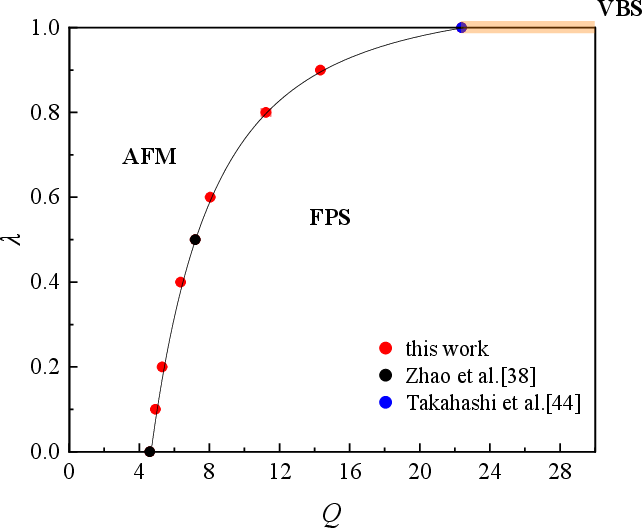
Figure 2: The phase diagram in J1-space shows a single AFM–FPS transition line (first-order throughout), with prior numerical estimates from literature for limiting cases.
Binder cumulant crossings of the AFM (J2) and FPS (J3) order parameters for various system sizes consistently locate a single transition, without evidence of intermediate, EPS, or quantum spin liquid phases throughout the parameter range.
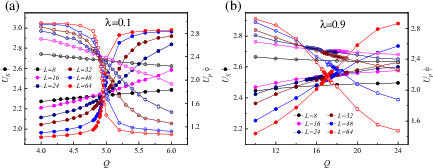
Figure 3: Binder ratios J4 and J5 vs J6 for two values of J7 and increasing system sizes confirm a single sharp crossing, characteristic of a first-order transition.
Finite-size scaling of the squared order parameters at the transition corroborates the discontinuity, with both AFM and FPS order parameters extrapolating to finite values in the thermodynamic limit.
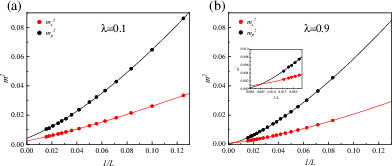
Figure 4: Squared order parameters J8 (AFM) and J9 (FPS) vs Q0 at Q1 demonstrate coexisting finite AFM and FPS order characteristic of strong first-order transitions for generic Q2.
An exhaustive search for competing EPS order (via Q3 analysis) reveals no EPS phase for any Q4, excluding an intervening phase between AFM and FPS across the entire diagram.
Emergent Symmetry at the AFM–FPS Transition
One of the central findings is the robust observation of emergent Q5 symmetry at the AFM–FPS transition line for all Q6. The probability distribution Q7 of the normalized order parameters collapses to a uniform disk, manifesting the four-component symmetry between AFM and FPS orders.
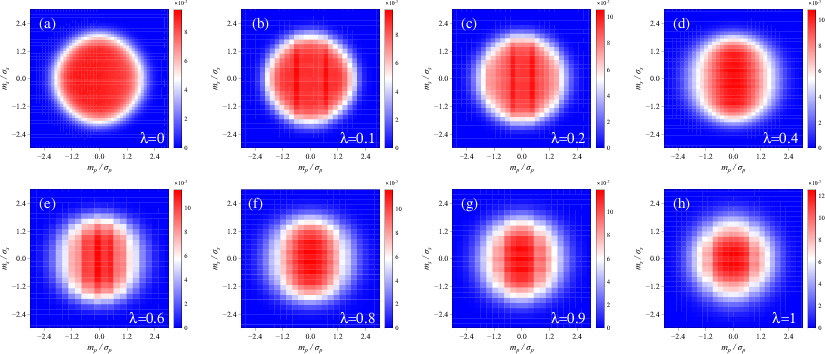
Figure 5: Distribution Q8 at Q9 and various 2(BO3)20 reveals 2(BO3)21-symmetric fluctuations at the transition for 2(BO3)22, transitioning to a distinct pattern at 2(BO3)23.
Projections of the VBS order distribution, 2(BO3)24, distinguish the FPS and EPS directions. For all 2(BO3)25, the critical distribution is anisotropic, favoring the FPS axis and lacking the 2(BO3)26 (or 2(BO3)27) symmetry required for 2(BO3)28, which is realized only at 2(BO3)29 (the Q0-Q1 point).
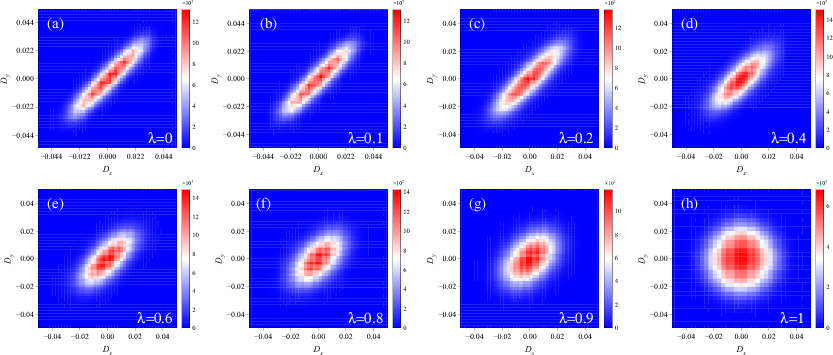
Figure 6: Distribution Q2 at Q3 demonstrates directional preference along the FPS axis for Q4 and emerging Q5 (rotational) symmetry only at Q6.
The results clarify that a genuine Q7 symmetry exists only at the Q8-Q9 point and that there is no tuning-induced multicritical point where an emergent symmetry enhancement from λQ0 to λQ1 emerges in the extended model.
Binder Cumulants and Order Parameter Optimization
A significant practical observation is that the VBS Binder cumulant λQ2 provides an efficient, monotonic finite-size scaling observable for transition point estimation. Unlike λQ3 and λQ4, which may exhibit nonmonotonicity for large λQ5, λQ6 remains robust, enabling reliable transition location in model extensions with strong first-order character.
Moreover, a detailed analysis indicates that the observed gradual increase in λQ7 within the AFM phase is a consequence of irrelevant field fluctuations associated with the EPS channel, not an indication of proximity to a weakly first-order or continuous transition.
Implications and Future Directions
This systematic study establishes that the extended CBJQ model, despite its increased parameter space and competition between FPS and EPS orderings, retains its stark first-order character across the AFM–FPS boundary, with emergent λQ8 symmetry persisting except at the λQ9-2×20 point. The absence of an intermediate EPS phase or continuous quantum criticality strongly constrains theoretical scenarios attempting to connect the CBJQ class with possible continuous transitions or proximate spin-liquid behavior as observed in the SS lattice or in SrCu2×21. The emergent symmetry results reinforce the relevance of designer Hamiltonians with tunable continuous symmetries for investigating deconfined quantum criticality and symmetry enhancement.
Open questions remain regarding the ultimate fate of the transition at even larger or negative 2×22 (not addressed in this study), and the possible realization of multicritical behavior in related two-dimensional designer spin systems. Future directions include the extension of such QMC studies to models with explicit ring-exchange or further competing multispin interactions and the computation of universal amplitude ratios and energy scales along the transition line to facilitate direct comparison with experiment.
Conclusion
The extended CBJQ model provides a comprehensive and quantitative setting to assess first-order AFM–PS transitions, emergent 2×23 symmetry, and order parameter selection in two-dimensional quantum magnets with competing multi-spin interactions. The numerical evidence excludes intermediate phases and multi-criticality within the explored parameter range and establishes robust procedures for transition detection and symmetry diagnostics. This work thus clarifies the role and limitations of designer CBJQ-type models as proxies for frustrated quantum magnets and offers valuable guidance for future exploration of quantum phase transitions and emergent symmetry phenomena.