- The paper demonstrates that dressed-CRAB optimal control overcomes the exponentially small spectral gap, yielding state preparation with annealing time that scales linearly with system size.
- It employs a finite Fourier basis for schedule optimization to enable strongly nonadiabatic transitions, significantly reducing residual energies compared to fixed protocols.
- The study reveals that counter-diabatic corrections provide no additional benefit under optimal control, emphasizing a distinct diabatic mechanism in quantum annealing.
Continuous-Time Quantum Control in a Frustrated Ising Ring: Optimizing Annealing Across Exponentially Small Gaps
Introduction
The frustrated Ising ring with an odd number of sites provides a canonical model for probing quantum annealing (QA) behavior in the presence of an exponentially small spectral gap, often termed the spin-glass bottleneck. Standard adiabatic QA in such models requires exponentially long annealing times for reliable ground state preparation, motivating investigations into whether optimized control methodologies can effect substantial improvements. This work demonstrates that optimal continuous-time schedule design, leveraging smooth parametric protocols via the dressed-CRAB approach, enables bypassing the exponentially small bottleneck by exploiting strongly nonadiabatic pathways, achieving efficient state preparation with only linear scaling in annealing time versus system size.
Frustrated Ising Ring: Model and Bottleneck Characterization
The system consists of a transverse-field Ising chain with an odd number of sites N, characterized by two weak ferromagnetic couplings and a single antiferromagnetic frustrating bond. The Hamiltonian interpolates between the drive term Hx and the target Ising coupling Hz under a schedule function s(t), where the standard linear ramp is s(t)=t/τ. Due to frustration, the system exhibits two critical features: a critical gap closing at sc∼0.5 scaling as $1/N$, and a much smaller, exponentially vanishing avoided crossing at sb∼0.9, which defines the quantum bottleneck.
Control Methodology: Dressed-CRAB Optimal Scheduling
Continuous-time control is realized by parameterizing s(t) in a finite Fourier basis with randomized frequencies (dressed-CRAB), iteratively refined in a finite-dimensional optimization landscape. The Jordan-Wigner transformation allows efficient simulation in the quadratic fermionic representation.
The key figures of merit are the residual energies after annealing, analyzed via logarithmic means over repetitions to account for wide dynamic variability.
Results: Bypassing the Bottleneck via Nonadiabatic Control
Schedule optimization via dressed-CRAB yields a substantial performance enhancement over fixed schedules (linear, cubic, sinusoidal), which become trapped at the bottleneck and fail to reduce residual energies except at exponentially large times. In stark contrast, optimized protocols exploit controlled population transfer into excited states and subsequent repopulation of the ground state near the bottleneck, forming a robust nonadiabatic mechanism for gap crossing.
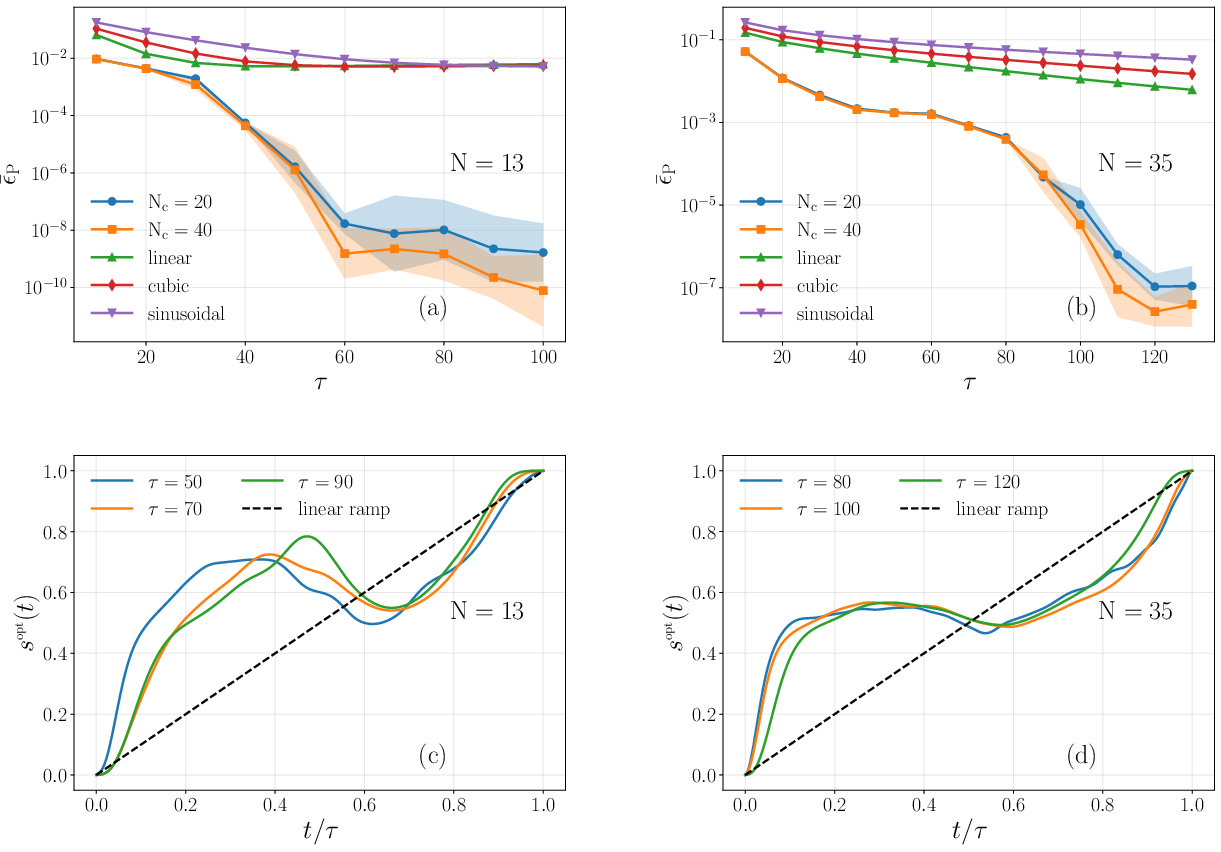
Figure 2: Optimized versus fixed-schedule annealing: residual energies and schedule profiles for N=13 and Hx0 for different protocols.
The data indicate a linear scaling of the threshold annealing time required to reach a fixed accuracy in residual energy, in marked contradiction to the exponential scaling dictated by the adiabatic theorem in the presence of a vanishing gap.
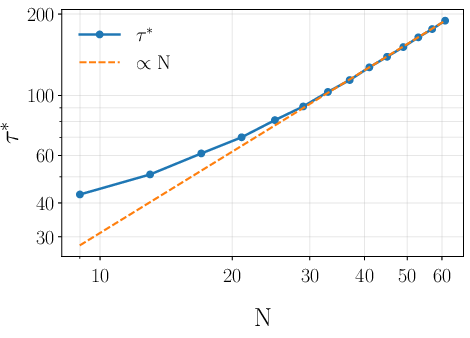
Figure 1: Threshold annealing time as a function of system size, showing linear scaling in Hx1 for the optimized protocol.
Analysis of the instantaneous eigenstate populations throughout the optimized schedule reveals the departure from the ground state early in the protocol, robust excited-state population across the bottleneck, and abrupt repopulation of the ground state at the critical avoided crossing.
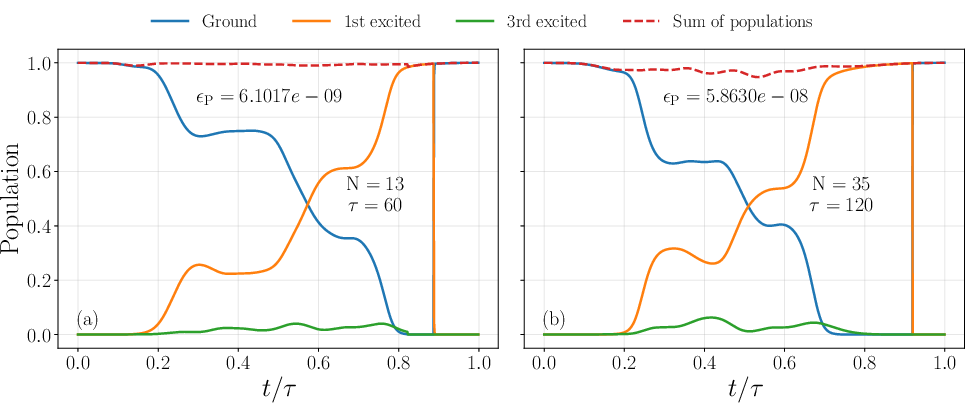
Figure 3: Time-evolution of ground and low-excited state populations under optimized protocols, illustrating the strongly nonadiabatic transition at the bottleneck.
Counter-Diabatic Corrections: Redundancy Under Schedule Optimization
A major claim of the work is that addition of local, lowest-order variational counter-diabatic (CD) terms to the Hamiltonian—a technique motivated by transitionless quantum driving—does not further improve residual energies once the schedule has already been optimized. This contrasts with slight improvements observed in previous studies for fixed (unoptimized) protocols with CD corrections. The result reflects the fundamentally diabatic mechanism of the optimized protocol: CD terms designed to suppress transitions are counterproductive in protocols that require deliberate diabatic transfer.
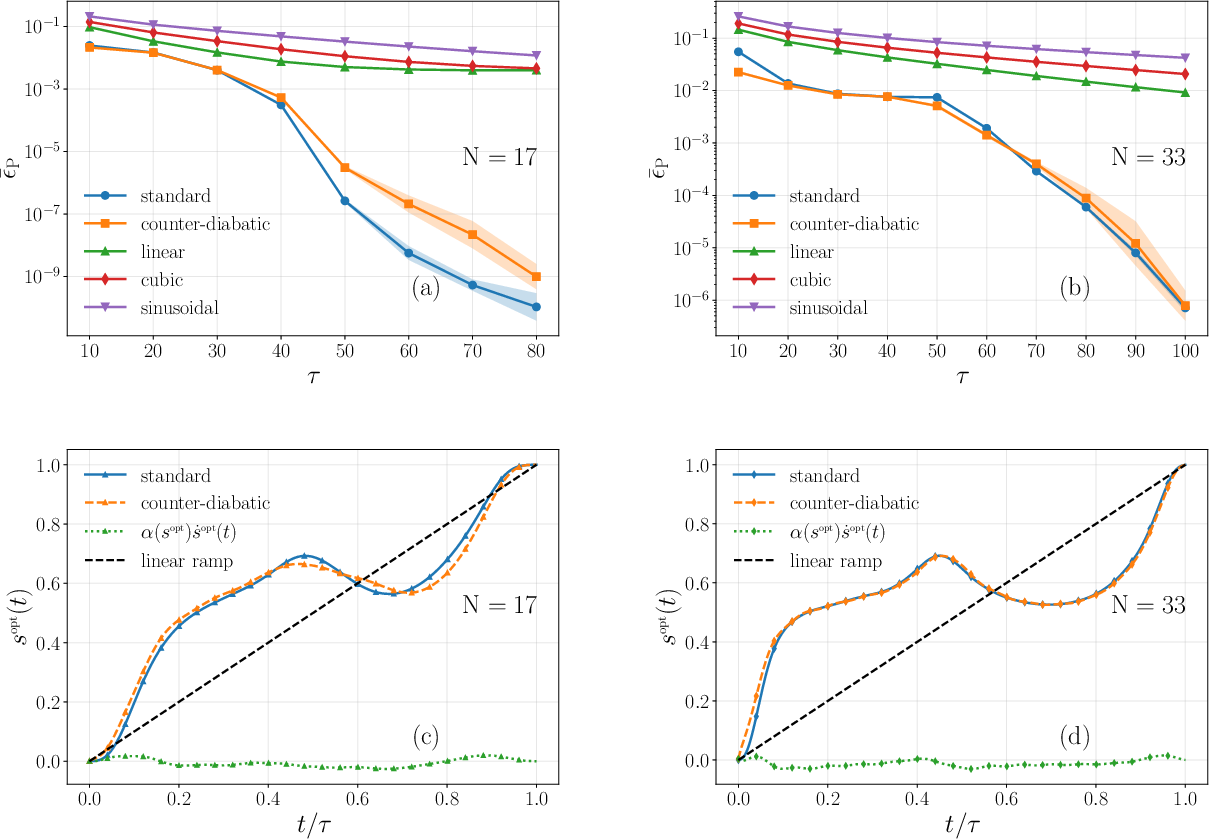
Figure 4: Residual energies for standard and counter-diabatic protocols (optimized and fixed), demonstrating no improvement from counter-diabaticity in the presence of optimal control.
Annealing Time and Digital-Analog Connections
The observed linear scaling for the required annealing time to achieve a fixed residual energy stands in contrast to the minimum number of QAOA steps needed in digitized approaches, which scales quadratically in Hx2 [wang2025exponential, Arezzodigital2025]. This underlines the qualitative difference between digital and analog approaches and the critical importance of protocol design.
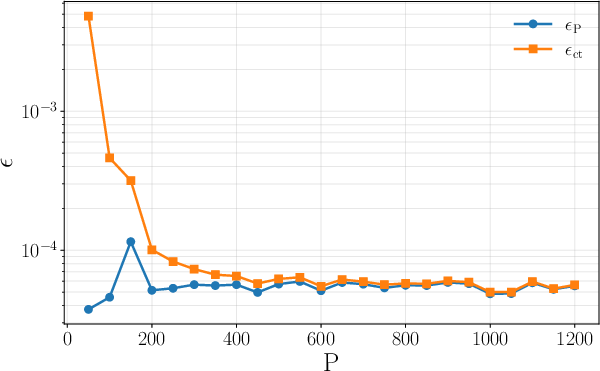
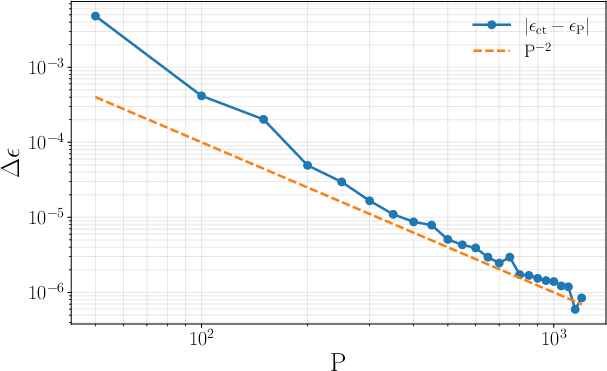
Figure 5: Convergence of digitized and continuous-time residual energies as a function of Trotter steps, confirming the validity of the digitized optimization procedure.
Implications and Future Directions
The demonstration that optimized continuous-time schedules exploit population transfer mechanisms to entirely bypass the exponential gap barrier has direct implications for scalable quantum ground state preparation in frustrated systems. The ineffectiveness of counter-diabatic corrections under optimal control shows that the standard paradigm of minimizing diabatic transitions may not be universally desirable.
The work suggests several forward paths:
- Extension of these optimization strategies to non-integrable and higher-dimensional frustrated models, especially using tensor network techniques.
- Investigation into possible emergence of bang-bang features or hybrid protocols incorporating both smooth and abrupt schedule segments, particularly below the controllability threshold.
- Refinement of the optimization interface between digitized and analog regimes, including higher-order Trotter corrections and exploration of classical control landscapes.
Conclusion
This study establishes that in the frustrated Ising ring, continuous-time optimal control realized through dressed-CRAB can overcome the bottleneck of exponentially small spectral gaps by orchestrating strongly nonadiabatic dynamics. The required annealing time increases only linearly with system size, and counter-diabatic protocols offer no advantage under optimal scheduling. The results define a new operational paradigm for quantum state preparation and invite further investigations into the generality and application of these principles in more complex many-body quantum systems.
References
- Arezzo et al., "Continuous-time quantum control across an exponentially small bottleneck in a frustrated Ising ring model" (2606.07168).
- Wang et al., "From Exponential to Quadratic: Optimal Control for a Frustrated Ising Ring Model" [wang2025exponential].
- Arezzo et al., "Digital controllability of transverse-field Ising chains" [Arezzodigital2025].
- Grabarits et al., "Fighting Exponentially Small Gaps by Counterdiabatic Driving".
- Kolodrubetz et al., "``Geometry'' and non-adiabatic response in quantum and classical systems" [KOLODRUBETZ20171].