- The paper introduces SES, a data-free symbolic regression framework that recovers explicit symbolic solutions directly from governing equations and constraints.
- The methodology involves optimizing differentiable symbolic networks using collocation points and iterative pruning to induce sparse, closed-form expressions.
- Empirical results on algebraic and differential equations demonstrate SES's ability to match known analytical solutions, enhancing interpretability in scientific computing.
Data-Free Symbolic Regression for Equation Solving with SES
Introduction
The paper "A Data-Free Symbolic Regression Approach for Solving Equations" (2606.07152) introduces the Symbolic Equation Solver (SES), a methodological framework that leverages differentiable symbolic models to recover explicit symbolic solutions to algebraic and differential equations, strictly from the governing equations and auxiliary constraints—entirely bypassing the necessity for paired training data. SES bridges the gap between classical analytical solvers, supervised symbolic regression methods, and neural residual minimization-based solvers by proposing direct equation-based symbolic optimization.
Methodology
SES parametrizes the unknown functions (scalars or vectors) as differentiable symbolic networks, using an EQL-inspired architecture where symbolic operators (i.e., {id,const,(.)2,exp(.),tanh(.),×}) are composed in a shallow but expressive two-layer fully-connected structure. The model parameters are optimized to minimize residuals of the governing equations and auxiliary (initial/boundary) conditions over collocation points distributed in the problem domain. Gradients are propagated through symbolic operations, enabling continuous optimization in symbolic function space.
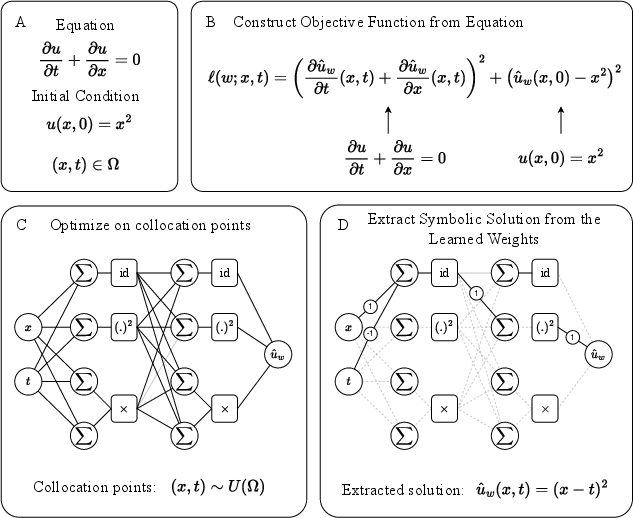
Figure 1: Schematic overview of SES, illustrating objective construction from equation residuals and optimization of the symbolic model at collocation points, resulting in explicit symbolic expressions.
The loss function aggregates the squared residuals of both the main and any auxiliary equations. Optimization proceeds in three phases: initial unconstrained minimization, ℓ1-regularized training with iterative pruning to induce sparsity, and fine-tuning on the remaining active weights. After training, the symbolic network is converted into a closed-form expression by traversing the computational graph. Model derivatives, required for differential residuals, are computed via automatic differentiation.
Experimental Results
The SES framework is empirically validated on a spectrum of problems—linear and nonlinear algebraic systems, transcendental equations, ODEs, and PDEs with various boundary conditions. SES is consistently shown to recover compact symbolic solutions consistent with known analytical solutions.
- For a linear system, SES extracts exact constant values (x^(t)=2.0, y^(t)=1.0).
- For a transcendental equation without algebraic isolation, SES yields x^(t)=1.0, matching the unique solution.
- For a nonlinear ODE (y˙=1−y2, y(0)=0), SES recovers y^(t)=tanht, correctly reconstructing both the functional form and parameterization.
- For the transport equation and two distinct boundary-conditioned Poisson equations, SES outputs precise polynomial expressions, matching the coupled multivariate analytical solutions up to numerical rounding.
Critically, in all cases, SES operates without exposure to explicit target solutions—relying only on residual satisfaction—thus demonstrating that symbolic structure can indeed be induced from equation constraints alone.
Theoretical and Practical Implications
SES substantiates that symbolic regression can be decoupled from supervised learning and instead formulated as direct equation-constrained optimization in symbolic function spaces. This positioning is theoretically significant: SES generalizes the concept of law discovery from data-driven regimes to equation-driven ones, connecting to mesh-free residual minimization paradigms such as PINNs [raissi2019physics] but yielding interpretable symbolic surrogates rather than opaque neural approximators.
Practically, this approach offers a toolset for cases where explicit symbolic forms are essential—scientific computing, analytical model reduction, and interpretability-driven domains—whereas classical solvers or neural approximators fall short either due to intractability or lack of semantic access. The compactness and clarity of recovered expressions facilitate further analyses, e.g., symmetry detection, invariance discovery, or direct substitution into larger analytical workflows.
Future Directions
Key future research avenues include scaling SES to higher-dimensional PDEs, more complex operator libraries (enabling rational, piecewise, or implicit solution architectures), and integrating prior physical knowledge or structural invariants to guide symbolic search. Anticipated challenges involve maintaining tractable optimization in the exponentially large symbolic search space, refining pruning strategies, and robustly distinguishing between numerically adequate and symbolically correct solutions under finite collocation sampling.
Further, augmenting SES with adaptive or hierarchical symbolic architectures could facilitate recovery of nested or modular symbolic relations in multi-scale scientific systems. The integration of SES-style optimization within hybrid symbolic-numeric AI pipelines is likely to be an influential trend in developing interpretable, scientifically-anchored machine learning models.
Conclusion
SES provides a principled data-free framework for symbolic regression that operates directly from equation and constraint specification, yielding explicit, sparse symbolic solutions in both algebraic and differential contexts. The demonstrated results highlight SES as a unifying structure between symbolic regression and residual-based learning, maintaining interpretability and equation-constrained generality. These developments have consequential implications for the expansion of interpretable AI methodologies in scientific discovery and computational mathematics.
Figure 1: The SES pipeline showing objective formation, optimization, and extraction of an explicit symbolic solution.

