- The paper’s main contribution is the development of a multi-nested WRF ensemble model for dark flight that quantifies positional uncertainties in meteorite and re-entry debris predictions.
- It employs a multi-start initialization strategy across four nested domains, accurately simulating wind-induced trajectory deviations with kilometer-scale resolution.
- The study demonstrates that finer resolution and optimized spin-up periods improve predictive fidelity, though inherent atmospheric variability imposes irreducible uncertainties.
High-Fidelity Atmosphere Modelling for Meteorite Falls and Spacecraft Re-Entries
Introduction
The accurate localization and recovery of meteorites and spacecraft debris post-atmospheric entry critically depends on high-fidelity modelling of atmospheric dynamics during the "dark flight" phase—when objects transition from high-speed luminous flight to subsonic free fall under wind influence. In "Freo Doctor: Atmospheric Modelling for Meteorite Falls and Spacecraft Re-Entries" (2606.07144), a set of advanced hindcast mesoscale Weather Research and Forecasting (WRF) model integrations is presented, targeted for meteorite and debris trajectory determination with kilometer-scale resolution. This work systematically quantifies the impact of atmospheric model choices and initializations on the fidelity and uncertainty in predicted ground positions—an aspect hitherto unresolved within the planetary entry community.
Modelling Framework and Methodology
The WRF ARW core (v4) is deployed in a multi-nested configuration (outer domains at 27 km, inner domains down to 1 km) with meteorological initial and boundary conditions sourced from the 1°-resolution NCEP Final Operational Model Global Tropospheric Analyses (FNL/GDAS). For each event, multiple independent runs are initiated from discrete FNL times (00z, 06z, 12z, 18z), bracketing the event window. This multi-start strategy, in combination with ensemble-like analyses, provides internal bounds on solution variability due to model spin-up and drift effects.
Spatial downscaling across four nested domains ensures regional wind and thermodynamic structure relevant for sub-100 m trajectory prediction. Domain design and integration time steps are dynamically managed to avoid numerical instability near orography or coastlines. Integration spin-up duration is left flexible (ranging up to 30 h), seeking a balance between under-dispersed fields (insufficient spin-up) and excessive model drift (very long runs).
Quantification of Model Uncertainties
A robust dataset comprising 1107 WRF models for 302 events (meteorite falls and re-entries) is released, yielding statistical insight into positional uncertainty as a function of mass and event type. The analysis focuses on the maximum ground position spread induced by atmospheric model choice for canonical vertical drops of objects of 10 g–1 kg from 30 km altitude.
The results demonstrate that for a 1 kg meteorite, the median shift in predicted ground position due to model initialization is 143 m, increasing to 307 m for a 10 g fragment. However, these metrics are characterized by high dispersion, with the range spanning more than two orders of magnitude (see below).
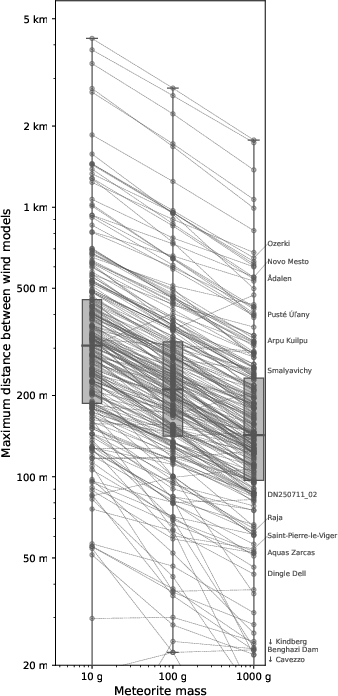
Figure 1: Maximum ground distance offset between hypothetical vertically dropped meteorites from 30 km altitude for different WRF initialization times. The spread demonstrates the pronounced event-to-event variability in model-predicted trajectory endpoints.
Notably, positional uncertainties induced by wind field modelling dominate over errors from reconstructed luminous-flight state vectors (typically <100 m). This exposes atmospheric model fidelity as the current limiting precision factor in fall line and strewn field predictions for both meteorites and re-entries.
Case Studies and Model Validation
Validation against meteorites with precisely known fall lines is conducted for a test set of prominent recoveries. For example, the Arpu Kuilpu, Dingle Dell, Murrili, and Pusté Úľany events are analyzed in detail, revealing both cases of tight model agreement and instances where model divergence, especially under unstable or rapidly evolving synoptic conditions, introduces errors exceeding hundreds of meters.
In the Arpu Kuilpu case, different WRF runs display significant variation, especially concerning the structure and direction of the jet stream between 9–13 km altitude. The longest initialization run (12z, t-22h) predicts a pronounced South-West jet, deviating substantially from ground truth.
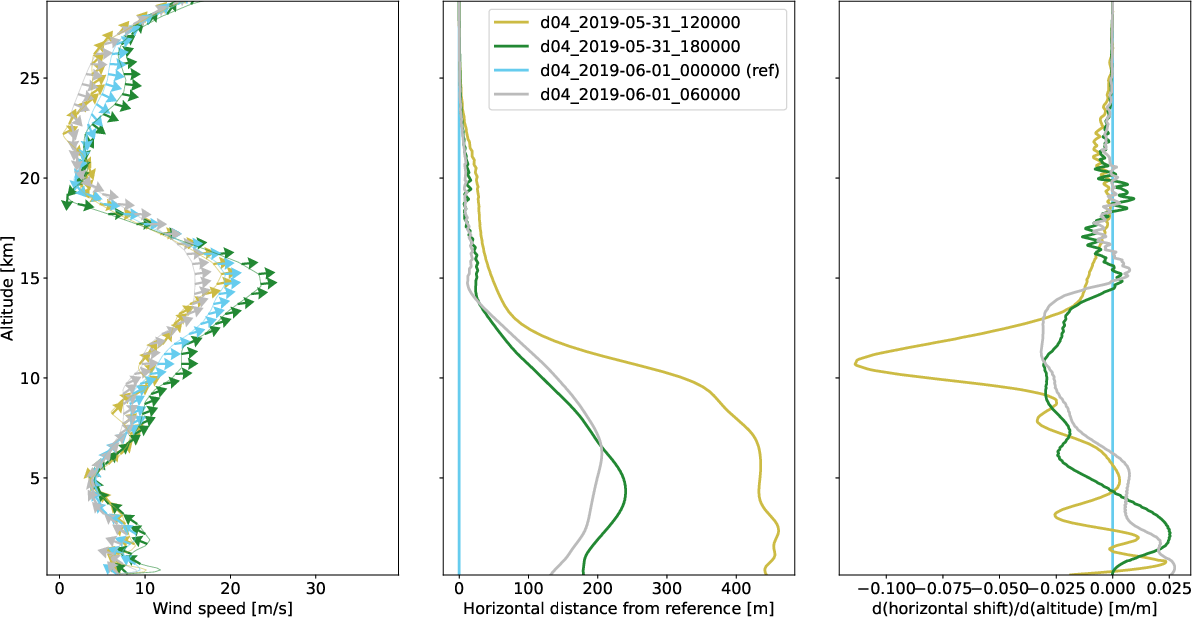
Figure 2: Profiles and dark flight simulations for Arpu Kuilpu, highlighting impact altitude bands where wind vector differences create ground position spread. The t-22h (12z) model is a clear outlier due to divergent high-altitude jet structure.
The progression of wind speed and directional bias over altitude for different initialization times is further detailed.
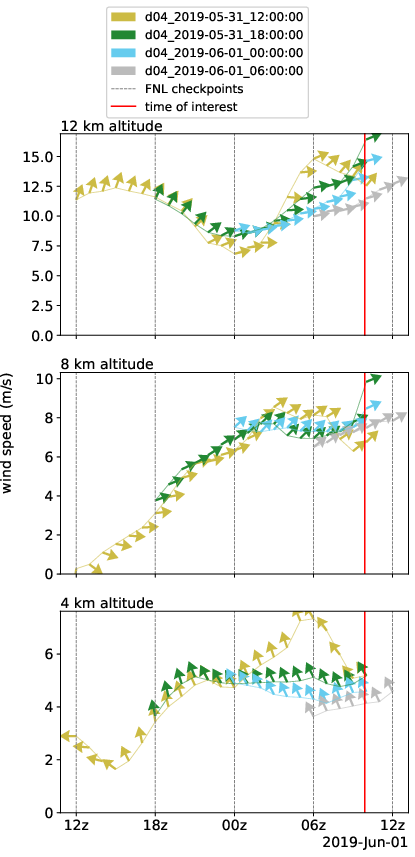
Figure 3: Wind speed and directional shear for Arpu Kuilpu, showing that the 12z model (gold) fails to match the ground find due to substantial jet stream misrepresentation.
Systematic comparison to closed-access models (e.g., Czech Hydrometeorological ALADIN) and radiosonde profiles, when available, further contextualizes WRF performance.
Model Drift, Spin-Up, and Spatial Resolution Effects
Model integration length emerges as a critical factor. Short spin-up runs (<6 h) exhibit signature underdevelopment of mesoscale features, while very long integrations drift from actuality, especially during extreme weather or synoptic transitions.
During the Pusté Úľany meteorite event, a sudden synoptic change induced model divergence; only those runs initialized within 12 hours bracket of the event matched the found meteorite location robustly.
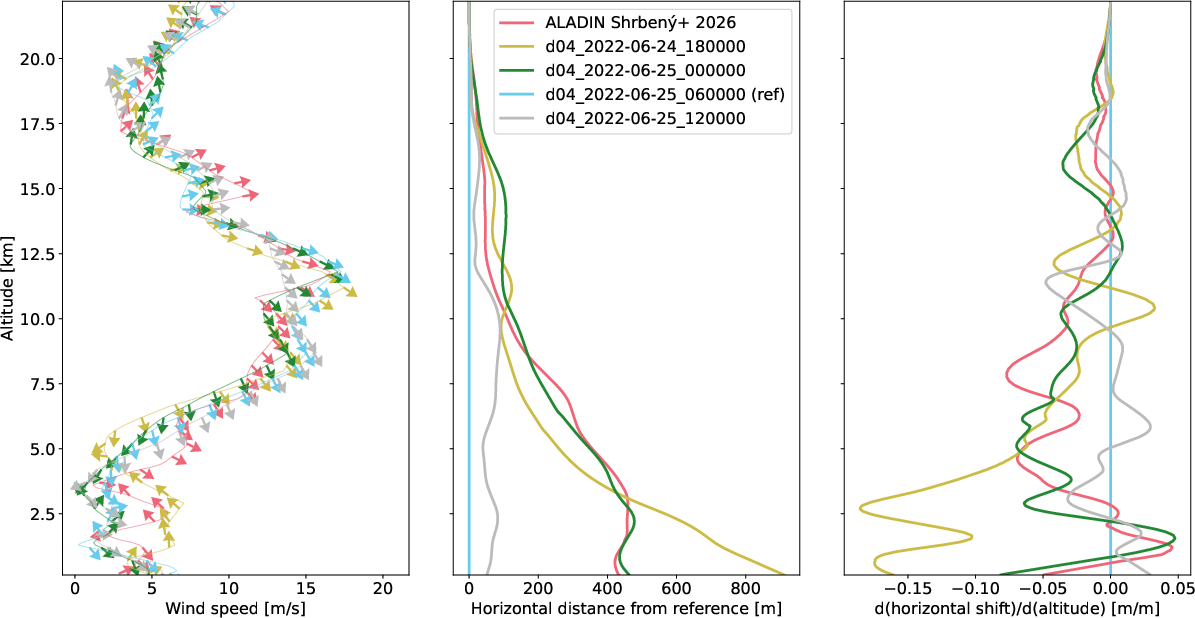
Figure 4: Wind profiles for Pusté Úľany—comparison between WRF models and ALADIN—demonstrate model drift for longer-run WRF initializations, especially in the lower troposphere.
The corresponding dark flight results manifest as large lateral ground offsets.
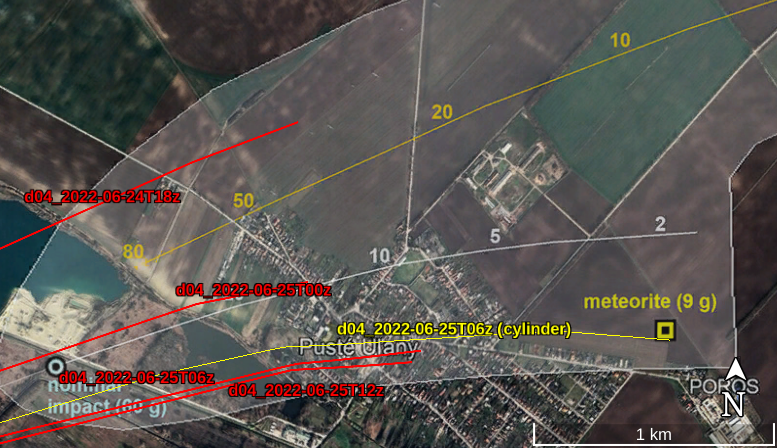
Figure 5: Strewn field results for Pusté Úľany across multiple WRF models and fragment shapes. Only certain initializations reproduce the observed find location; higher drag (cylinder) models provide improved lateral fits.
Assessment of spatial resolution via comparison of 1 and 3 km WRF integration indicates that finer grids generally yield higher predictive fidelity, particularly in heterogeneous orographic or convective settings.
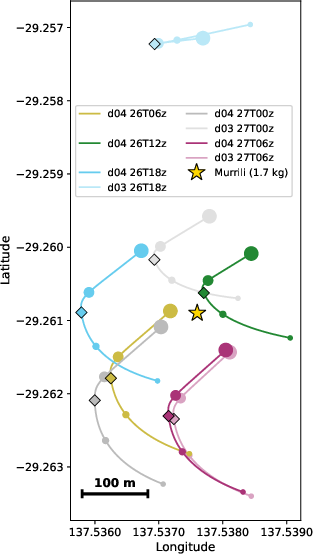
Figure 6: Ground tracks for Murrili, contrasting high- and low-resolution WRF models. The low-res (3 km) run (light blue) diverges markedly, emphasizing the necessity of 1 km resolution for robust localization.
Implications and Future Prospects
This systematic hindcast and model-blending framework provides the first quantification of meteorite fall/untracked re-entry dispersion due solely to realistic wind field uncertainty for a large event sample. The results are directly relevant for:
- Optimization of meteorite recovery campaigns (requiring <200 m search accuracy),
- Characterizing uncertainties in derived meteoritic, asteroidal, and orbital parameters,
- Forensic analysis of debris and sample return capsule ground impacts,
- Bolide infrasound propagation modelling, where wind-induced refraction and filtering can mimic fragmentation signatures.
The inability to routinely achieve sub-50 m positional accuracy—even with the highest-resolution open-access models—strongly motivates increased atmospheric observational density (e.g., radiosonde launches triggered by observed falls, commercial rapid-release met data), as well as data sharing with meteorological agencies.
Conclusion
The study establishes that kilometer-scale WRF hindcast ensembles, adequately initialized and spun-up, are currently the best available tool for operational meteorite recovery and forensic spacecraft re-entry analysis. Nevertheless, event-to-event variability—particularly during extreme weather—imposes irreducible uncertainty, typically ∼150 m for kg-class falls and doubling for cm-scale fragments. Finer model resolution improves accuracy but only within the limits set by atmospheric observation density and inherent predictability. The associated open data release (1107 models for 302 events) constitutes a valuable resource for both applied and fundamental meteoritics and atmospheric entry dynamics.
The continued enhancement of atmospheric observation strategies and computational resources is required before routinely achieving sub-50 m precision in dark flight predictions. The methodology and datasets provided also open avenues for machine learning assimilation, uncertainty quantification, and system identification approaches in planetary entry physics.