- The paper introduces new Fourier restriction estimates based on Lq-dimensions to sharpen the classical Stein–Tomas bounds.
- It leverages convolution-based characterizations and complex interpolation to account for multifractal fluctuations in singular measures.
- Implications extend to geometric problems, offering tighter bounds for distance sets and related harmonic analysis challenges.
Fourier Restriction Estimates Based on Lq-Dimensions: Beyond Stein–Tomas
Context and Motivation
The restriction problem in harmonic analysis deals with determining for which exponents p and r the Fourier transform of functions, or more generally, measures, can be meaningfully restricted to lower-dimensional sets or measures. The classical Stein–Tomas theorem characterizes Lp→L2 restriction for the Lebesgue surface measure on the sphere and was subsequently generalized to singular measures by Mockenhaupt, Mitsis, and Bak–Seeger via the introduction of Frostman and Fourier decay conditions. The Frostman condition controls the measure of small balls and becomes the endpoint of a family of finer geometric conditions: the Lq-dimensions, which capture multifractal and local-mass fluctuation effects that are undetectable to Frostman-type analysis.
This work establishes new Fourier restriction theorems in terms of the Lq-dimensions of μ, strictly refining the Stein–Tomas paradigm. The results interpolate between the (Frostman-based) endpoint and a multifractal continuum, fundamentally connecting harmonic analysis and fractal geometry (2606.07143). The technical core leverages convolution-based characterizations of Lq-dimensions and applies Stein’s complex interpolation, enabling endpoint results in this more nuanced setting.
Theoretical Framework
Restricting Fourier transforms to singular measures μ is only nontrivial in the range $1 < p' < 2$ (i.e., p0), since for p1 the transform is continuous, and for p2 restriction to a null set is always impossible. The classical Stein–Tomas theorem for singular measures provides an p3-based extension estimate,
p4
provided that, for all p5 and small p6, p7 (Frostman exponent) and
p8 (Fourier decay), with
p9
Sharpness is achieved on very regular Salem-type sets or those with arithmetic structure, but such Frostman-based bounds generally ignore substantial local variation.
The r0-dimension,
r1
with varying r2, encodes r3-moment fluctuations. As r4, one recovers the Frostman exponent; as r5, the r6 (correlation) dimension. The main innovation lies in replacing the Frostman hypothesis with precise r7-dimensional conditions, yielding a family of restriction theorems that adapt to multifractality.
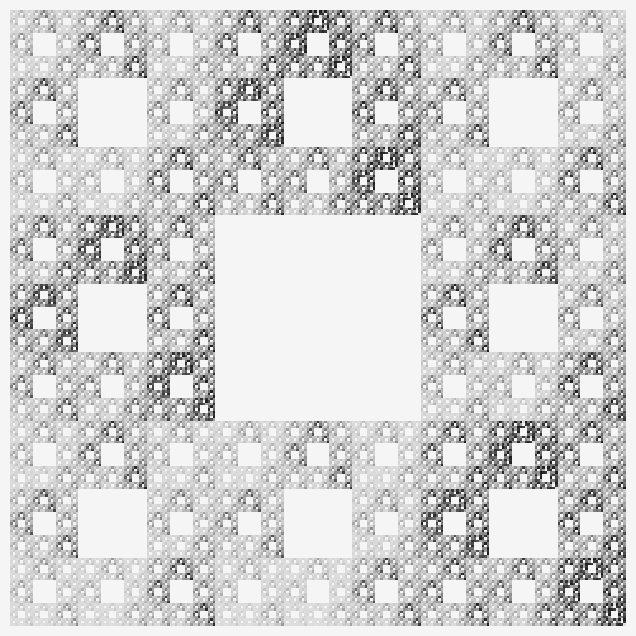
Figure 1: A multifractal measure supported on the Sierpiński carpet; dark regions denote areas of high local mass—the r8-dimensional approach is sensitive to such variance.
Main Results
General Restriction Theorem
Let r9 be a compactly supported Borel measure. Suppose for some Lp→L20 and Lp→L21
Lp→L22
with Lp→L23 and the Fourier spectrum parameter Lp→L24, for suitable Lp→L25.
Then
Lp→L26
implies
Lp→L27
where Lp→L28 can be optimized in Lp→L29 and Lq0, recovering Stein–Tomas for Lq1, Lq2.
In explicit Lq3-dimension terms (see Corollary 1.2): Lq4
where Lq5 is the Fourier spectrum parameter. For multifractal measures, one may strictly improve Lq6 compared to the Frostman-only bound, whenever
Lq7
for some Lq8.
This provides a direct path to finer extension estimates whenever the measure is multifractal (e.g., non-uniformly distributed self-similar measures, random cascades).
Convolution Characterization of Lq9-dimensions
A notable technical contribution is the equivalence (for Lq0)
Lq1
with the extreme Lq2 case corresponding to the Frostman potential condition. This description is highly compatible with convolution-based and harmonic analysis arguments.
Numerical and Probabilistic Examples
The framework is validated by application to Mandelbrot multiplicative cascades—a canonical family of multifractal random measures arising in turbulence theory and probability:
- The Lq3-dimension and (recently computed) Fourier dimension of the cascade are known, allowing explicit evaluation of the restriction threshold as a function of Lq4.
- In subcritical or suitably tuned cases, the optimal value of Lq5 for the restriction exponent may be finite (i.e., not the Frostman endpoint), demonstrating substantial gains over Stein–Tomas.
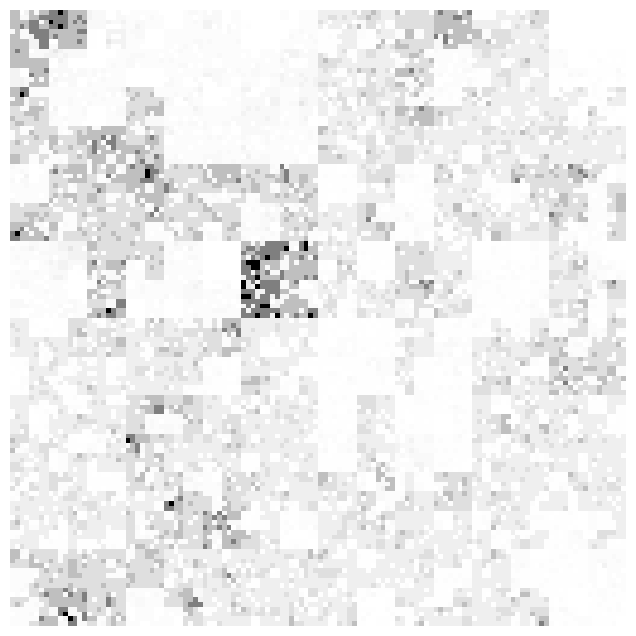
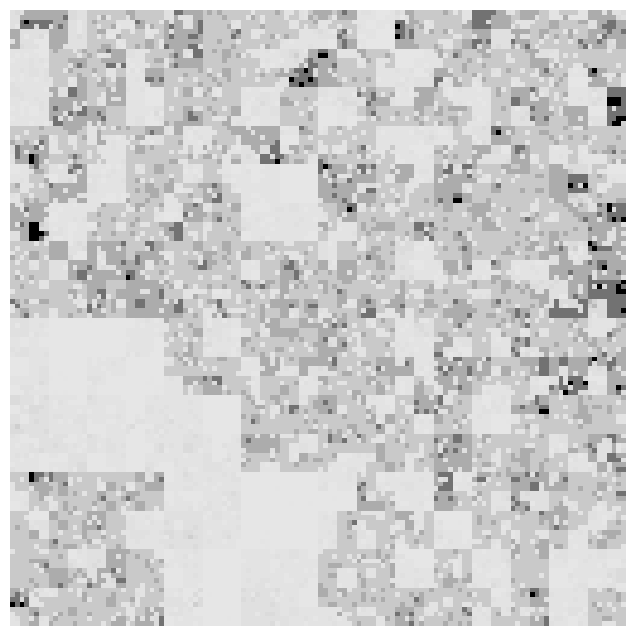
Figure 2: Two realizations of a Mandelbrot cascade; each realization exhibits a hierarchy of local mass concentrations absent in uniform-Salem sets.
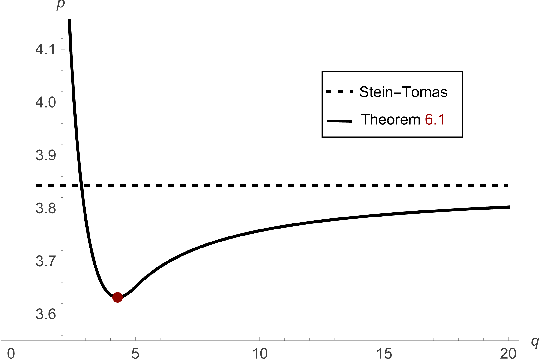
Figure 3: The threshold lower bound for Lq6 as a function of Lq7 for a Mandelbrot cascade; the value is optimized for an intermediate Lq8, with the dashed line marking the Stein–Tomas bound.
The authors also show that for any Lq9 one may construct cascades where the restriction estimate is optimized at that precise μ0, underscoring the necessity of a full μ1-dimensional continuum.
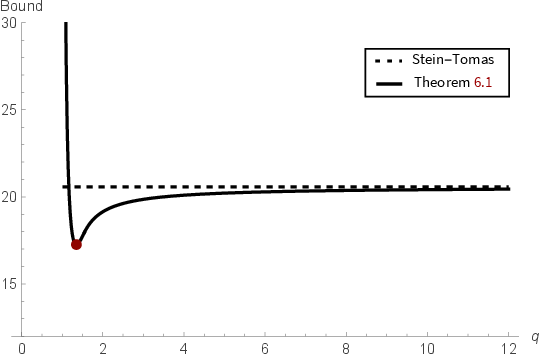
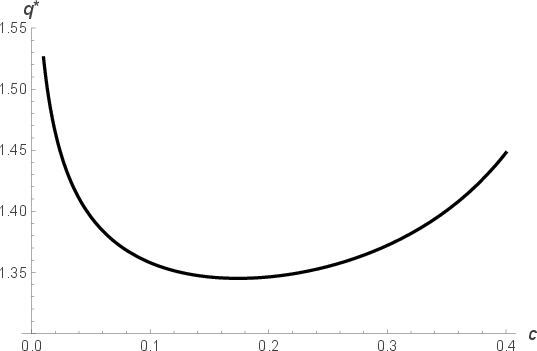
Figure 4: The bound for μ2 can be tuned to reach its minimal value at a prescribed μ3, depending on the choice of multiplicative weights in the cascade.
Implications and Future Directions
This work provides a direct, sharp conduit between harmonic analysis and geometric measure theory: harmonic analysts must now reckon with multifractal μ4-dimensions, rather than relying wholly on extreme-case (Frostman) control. From a geometric perspective, it yields new constraints and insights into the possible behavior of singular measures with respect to Fourier analytic quantities.
Practical consequences include potentially tighter bounds for geometric problems relating to sumsets, distance sets, and projections, as these restriction estimates are critical input to those applications. The convolution-based framework also unifies the landscape, enabling endpoint results via complex interpolation for multifractal measures, partially resolving an open question of Bak and Seeger.
Possible future directions include:
- Extending these techniques to multilinear restriction, decoupling, or more exotic ambient groups;
- Investigating the role of μ5-dimensions in distance set and Falconer-type problems;
- Exploring stochastic models (random cascades, random fractals) where the multifractal properties are pronounced.
Conclusion
This paper extends Fourier restriction theory by incorporating the full spectrum of μ6-dimensions into the analysis, thus moving "beyond Stein–Tomas" and capturing the local and multifractal nature of singular measures. The results generalize and improve classical bounds in many cases, especially for multifractal supports. The convolution-norm perspective supplies a robust analytic handle for future work in restriction-type problems, and the methodology is broadly transferable across analysis and geometric measure theory (2606.07143).