- The paper employs DFT and atomistic spin dynamics to demonstrate robust ferromagnetic interactions and high Curie temperatures in Cr chalcohalide Janus monolayers.
- The study reveals that specific 1T and 1H phases, especially CrSI and CrSeI, exhibit substantial perpendicular magnetic anisotropy through combined SOC and dipolar effects.
- The research offers a blueprint for integrating these 2D magnets with topological systems, indicating potential for next-generation spintronic and quantum devices.
Chromium Chalcohalide Janus Monolayer Ferromagnets: Perpendicular Magnetic Anisotropy and High TC
Introduction
This work delivers a comprehensive theoretical exploration into the magnetic, electronic, and topological properties of chromium chalcohalide Janus monolayers, CrXY (X=S,Se,Te; Y=Cl,Br,I), focusing on both the 1T and 1H polymorphs. The study leverages density functional theory (DFT) in tandem with atomistic spin dynamics (ASD) to elucidate the criteria underlying robust, intrinsic two-dimensional van der Waals ferromagnetism with perpendicular magnetic anisotropy (PMA) and high Curie temperatures. These properties are highly desirable for the design of next-generation spintronic and topological quantum devices.
The research presents a clear identification of Janus monolayer compositions and stacking polymorphs that manifest strong FM interactions, substantial PMA, and the ability to host non-trivial chiral magnetic textures, addressing outstanding ambiguities in prior studies regarding the combined microscopic origins of these features and benchmarking against prototypical 2D magnets.
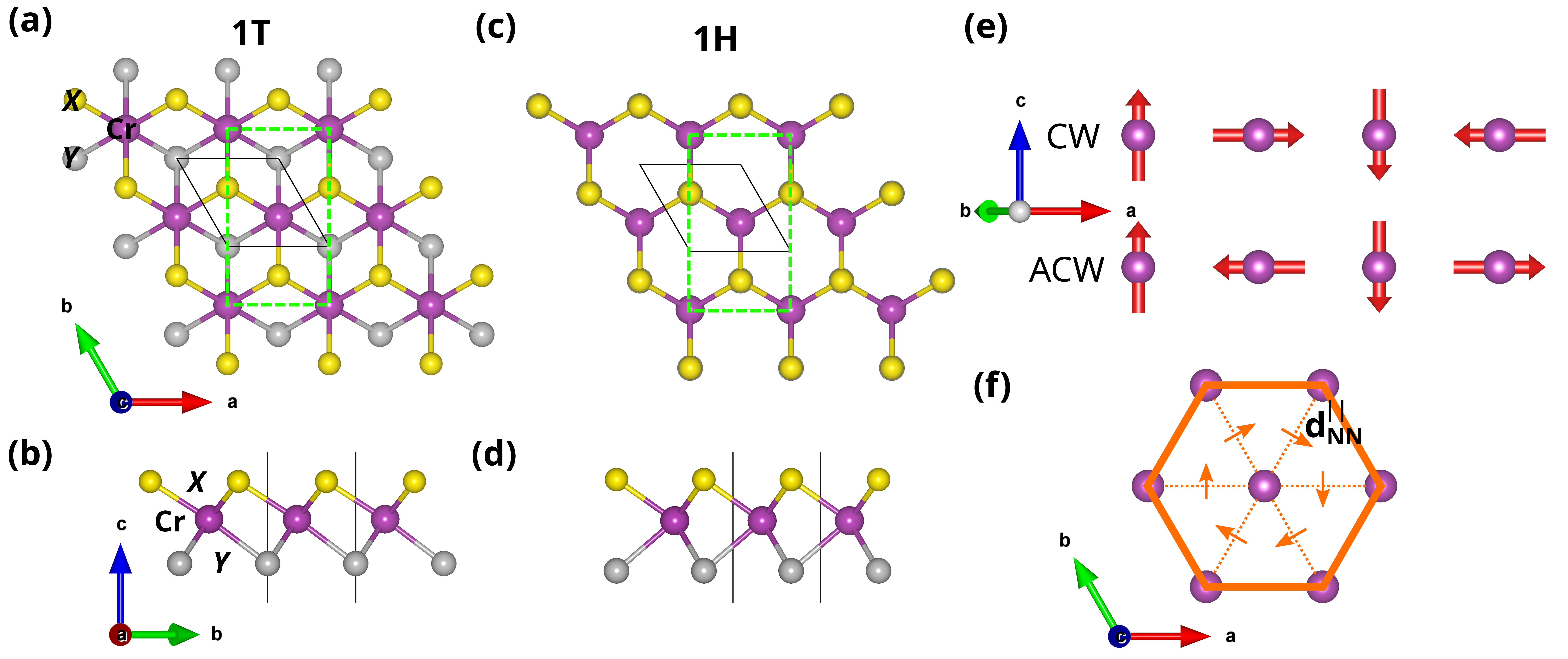
Figure 1: Top (a,c) and side (b,d) views of the crystal structures of the CrXY Janus MLs with the 1T (a,b) and 1H (c,d) structures. Panel (e) summarizes possible spin spiral configurations; panel (f) shows nearest-neighbor DMI vectors.
Structural and Dynamical Stability
Phonon dispersion calculations demonstrate that all 1T CrXY MLs and 1H CrXY with X= S, Se are dynamically stable, while the 1H-Te systems suffer from lattice instabilities and are thus excluded from subsequent analysis. The 1T polytype is consistently more thermodynamically favorable than the 1H analog by an energy gain exceeding 0.55 eV/f.u., yet the modest a0 difference (~2.5%) suggests both could, in principle, be accessible experimentally under nonequilibrium growth conditions.
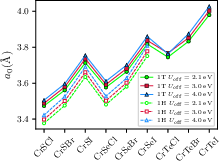
Figure 2: Optimized lattice constants a0 for 1T and 1H CrXY Janus MLs as a function of X/XY0 composition and Hubbard XY1 parameter.
Magnetic Exchange, Anisotropy, and Interaction Hierarchy
Heisenberg Exchange
All dynamically stable CrXY2 MLs exhibit robust FM nearest-neighbor Heisenberg coupling, with XY3 in the range 1.5–2.5 meV/XY4—an order of magnitude above MnBiXY5TeXY6 and 3–5XY7 that of CrIXY8. The FM interaction arises from XY9-mediated X=S,Se,Te0 superexchange for insulating systems or double-exchange for half-metallic 1H-CrX=S,Se,Te1I (X=S,Se,Te2 S, Se), with negligible direct Cr–Cr overlap.
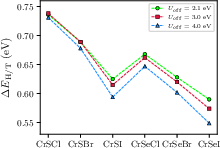
Figure 3: Total energy difference X=S,Se,Te3 between the 1H and 1T phases, confirming energetic preference for the 1T polytype.
Magnetic Anisotropy Energy (MAE)
Systematic inclusion of both SOC (magnetocrystalline) and dipolar shape anisotropy yields the critical result that only CrSI and CrSeI (both 1T and 1H) maintain a robust out-of-plane easy-axis, contrary to earlier works that omitted dipolar contributions and thus made erroneous predictions for other compositions. Notably, the 1H variants exhibit pronounced enhancements in single-ion (X=S,Se,Te4) and exchange (X=S,Se,Te5) anisotropy, rooted in reduced crystal field splitting and larger local moments.
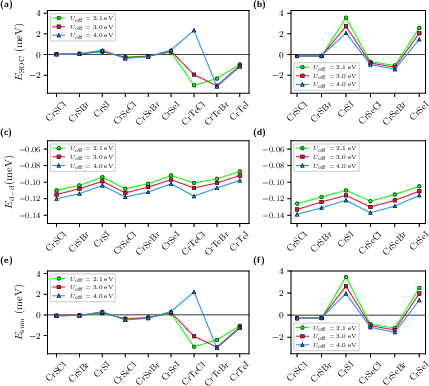
Figure 4: Out-of-plane vs. in-plane MAE X=S,Se,Te6 and classical dipolar energy X=S,Se,Te7 for 1T and 1H structures, with X=S,Se,Te8 indicating the favored magnetization orientation.
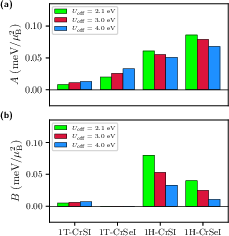
Figure 5: (a,b) DFT-derived single-ion X=S,Se,Te9 and exchange Y=Cl,Br,I0 anisotropy parameters demonstrating strong PMA in CrSI/CrSeI, especially for 1H stacking.
Dzyaloshinskii–Moriya Interaction (DMI)
The in-plane DMI is substantial only for 1T-CrSeI (Y=Cl,Br,I1 meV/Y=Cl,Br,I2, Y=Cl,Br,I3), placing it above the threshold typically associated with skyrmion stabilization, while all other PMA phases exhibit weak DMI compared to Y=Cl,Br,I4. This ratio is central to the emergence of topologically protected non-collinear spin textures.
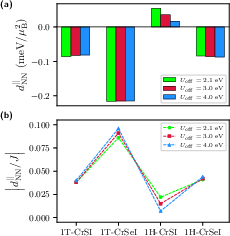
Figure 6: Calculated DMI strengths Y=Cl,Br,I5 and the Y=Cl,Br,I6 ratio, identifying 1T-CrSeI as skyrmion-favorable.
Atomistic Spin Dynamics and Finite-Temperature Behavior
Large-scale LLG-based ASD simulations, parameterized from ab initio calculations, yield the following Y=Cl,Br,I7 predictions:
- 1T-CrSI: Y=Cl,Br,I8 K (weak DMI, domain condensation above Y=Cl,Br,I9)
- 1H-CrSI: XY0 = 370–410 K (negligible DMI; uniform FM order to well above room temperature)
- 1H-CrSeI: XY1 = 235–260 K (minor domain instability at extreme XY2)
- 1T-CrSeI: DMI-induced worm-like domain ground state at low XY3; field-induced skyrmion lattice observed
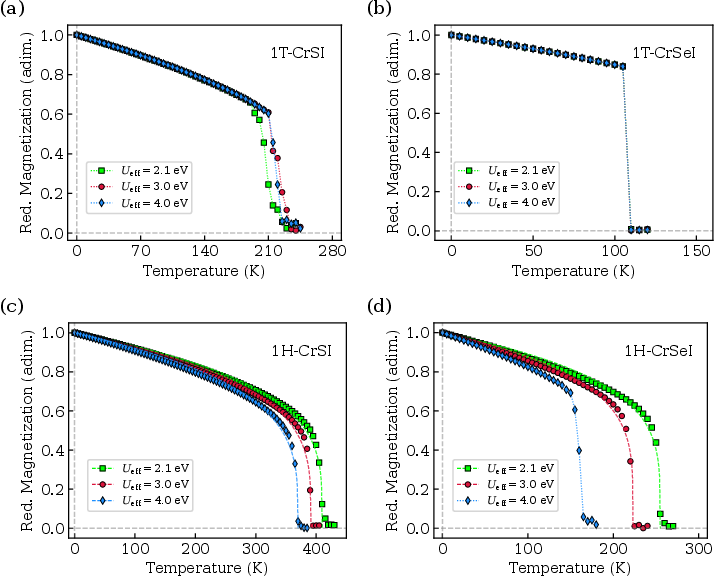
Figure 7: Temperature dependence of reduced magnetization for 1T-CrSI, 1T-CrSeI, 1H-CrSI, and 1H-CrSeI from LLG-ASD simulations.
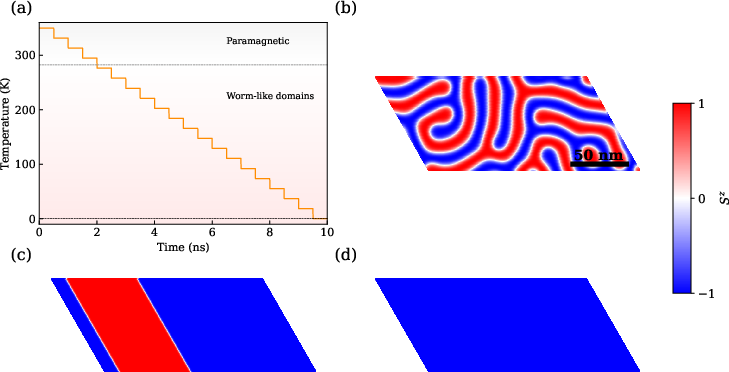
Figure 8: Low-temp magnetic texture snapshots—worm-like domain states in 1T-CrSeI, contrasting with uniform FM order in low-DMI systems.
The magnitude of both exchange and anisotropy constants in 1H-CrSI leads to a Curie temperature exceeding room temperature by a significant margin—well above that of all experimentally confirmed 2D vdW magnets to date.
Electronic Structure and Functional Heterostructures
Ab initio band structure calculations confirm that 1H-CrXY4I monolayers are half-metals, favoring spin-polarized transport, whereas 1T systems are (indirect) semiconductors. Of specific technological interest is 1T-CrSI, which integrates favorably with BiTeI (a prototypical giant Rashba system) due to excellent in-plane lattice matching. First-principle calculations demonstrate strong hybridization between the magnetic adlayer and the Rashba-split topological surface state of BiTeI, leading to a substantial exchange gap (XY543 meV) at the Dirac point and altering the spin-momentum locking—a key criterion for Majorana platform proposals.
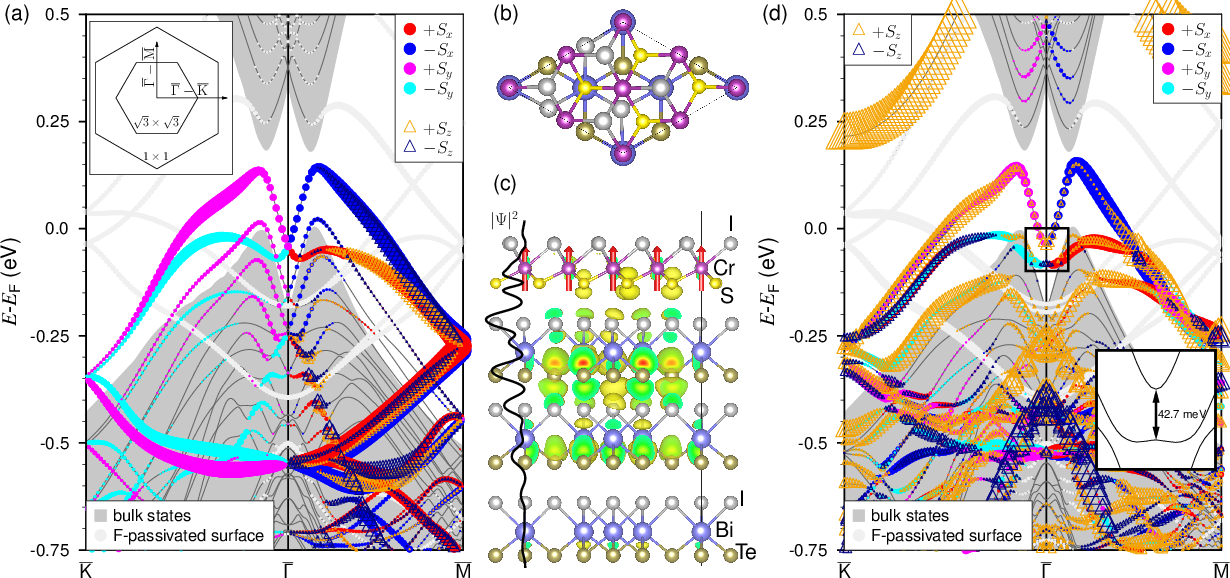
Figure 9: (a) Rashba-split surface state in pristine BiTeI and (d) hybridization-induced exchange gap in the BiTeI/1T-CrSI heterostructure.
Further calculations for 1T-CrSI/MnBiXY6TeXY7 vdW interfaces reveal that the robust CrSI layer promotes FM interlayer coupling and elevates the critical temperature above that of intrinsic MnBiXY8TeXY9 thin films, without destroying non-trivial Chern topology or axion insulator phases in the magnetic topological insulator.
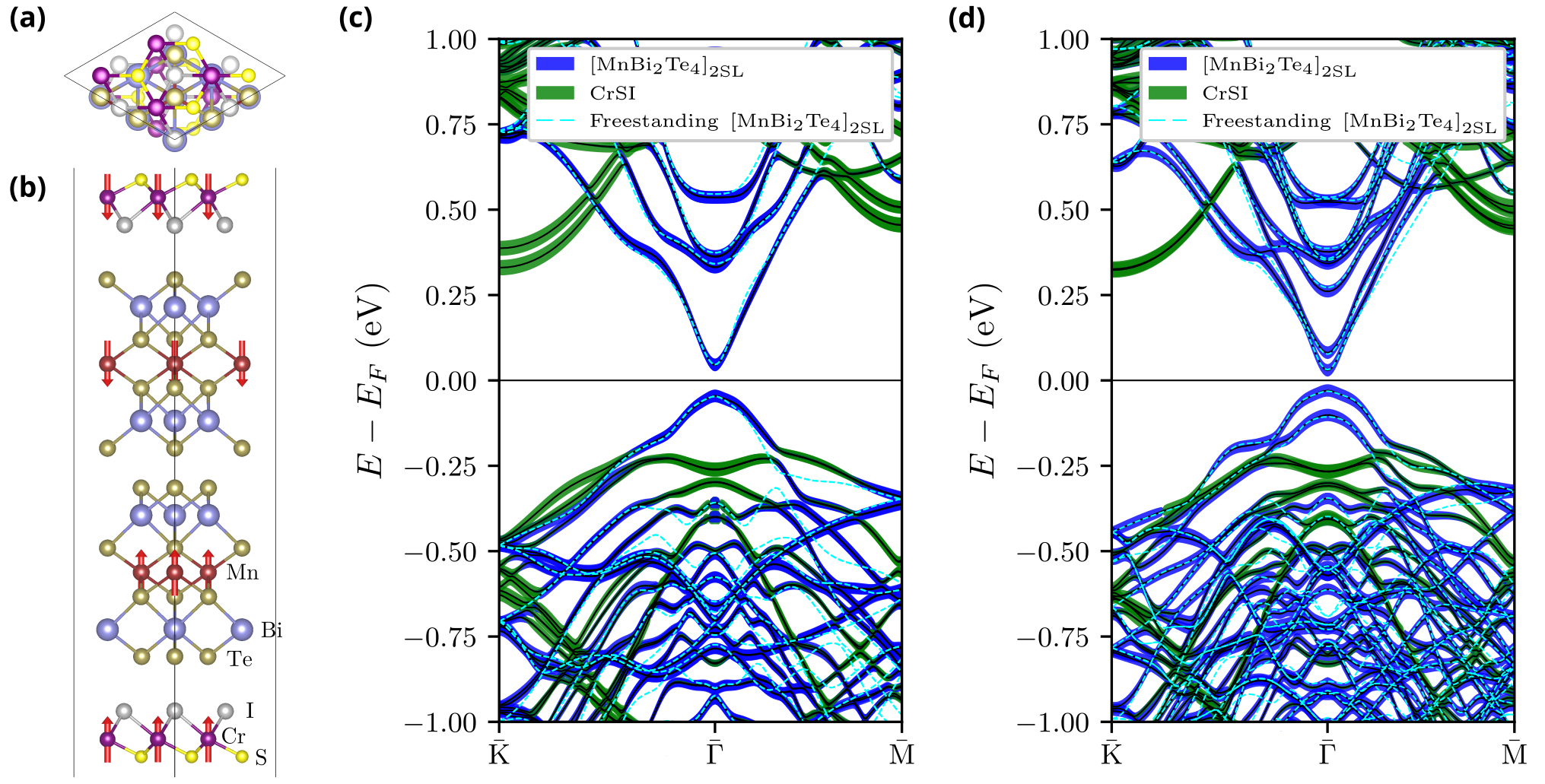
Figure 10: (a,b) Structural motif and (c,d) band structure decompositions for CrSI/MnBiXY0TeXY1 sandwiches preserving both AFM and QAHE states.
Theoretical and Practical Implications
- Microscopic Origin of PMA: The analysis rigorously establishes that the constructive combination of single-ion and anisotropic exchange anisotropy is necessary but not always sufficient for PMA; dipole-dipole interactions must be incorporated for quantitative accuracy.
- Robust Room-Temperature 2D FM Candidates: 1H-CrSI, by virtue of enhanced XY2, XY3, XY4, and minimal DMI, surpasses the limitations encountered in established vdW FMs, pointing to a new materials class for high-XY5 2D spintronics.
- Topology and Heterointerface Engineering: Demonstration of exchange gap opening in Rashba systems and enhancement of magnetic order in vdW topological insulator films point to a pathway toward room-temperature quantum anomalous Hall effects and topological superconductivity.
- Correlation- and Structure-Dependent Uncertainties: For systems where PMA is finely tuned by XY6, predictions are marked as inconclusive, highlighting the need for experimental feedback and further theoretical work on quantum many-body effects.
Conclusion
This systematic study confirms the existence of a select subset of Cr chalcohalide Janus monolayers—CrSI and CrSeI (1T/1H polymorphs)—with intrinsic FM order, out-of-plane anisotropy, and substantial XY7, spanning well above liquid nitrogen and, for 1H-CrSI, into the technologically relevant room-temperature regime. The work resolves prior ambiguities regarding easy-axis stability by fully accounting for all anisotropy terms and quantifying the interplay between exchange, anisotropy, and DMI from first principles. Functional interface calculations support direct applications as spin injectors or as exchange-proximity layers for topological quantum devices. These results provide a design blueprint for next-generation 2D spintronic, magnetoelectric, and topological platforms and underline the essential role of ab initio-informed multiscale modeling in 2D magnet discovery and engineering.