- The paper identifies that skyrmion collapse in SAFs follows a sequential, layer-by-layer mechanism, with energy barriers increasing from nearly zero in small islands to 3–6 J in larger ones.
- The study reveals that the reverse nucleation barrier remains high at 23–24 J regardless of island size or applied field, emphasizing the need for assisted writing protocols.
- The research highlights that lateral confinement and pinned boundaries critically modulate the energy landscape, affecting both thermal retention and writability in spintronic devices.
Skyrmion Collapse and Nucleation in Synthetic Antiferromagnets: Energy Landscapes and Writing Protocols
Introduction and Motivation
Magnetic skyrmions in synthetic antiferromagnets (SAFs) have emerged as promising candidates for nonvolatile, high-density spintronic memory due to their suppressed stray fields, minimized skyrmion Hall effect, and tunable properties via multilayer engineering. The retention and creation of skyrmion-pair bits, however, are fundamentally constrained by their collapse and nucleation energetics in finite structures. Precise knowledge of these energy barriers is essential for device reliability, as these quantities dictate both data retention (thermal robustness) and writability (nucleation feasibility).
This study employs a reduced lattice spin model, parameterized on realistic experimental SAF stacks, to calculate minimum energy paths (MEPs) for both collapse and nucleation (reverse process) of antiferromagnetically bound skyrmion pairs in pinned islands. The work dissects how lateral confinement, boundary pinning, and applied field modulate the energy landscape, focusing on the sequential (layer-by-layer) nature of collapse and the implications for technologically plausible, assisted writing protocols.
The physical system is modeled as two ferromagnetic layers with antiferromagnetic RKKY interlayer exchange, interfacial DMI, and Zeeman terms (both uniform and layer-selective), capturing the minimal ingredients for skyrmion stability and collapse in SAFs. Perpendicular anisotropy and long-range dipole interactions are omitted, thus rendering the results as upper-bound trends and mechanism maps rather than direct quantitative predictions for specific stacks.
Key computational methods include:
- Nonlinear conjugate-gradient minimization for local minima (skyrmion pair, single skyrmion, collinear AF reference).
- Constrained MEP search for first-order saddle points (collapse/nucleation events), employing a climbing-image protocol.
- Analysis of system sizes (S=100,300,500 sites; ≈25, 75, 125 nm) and applied fields (−25 to +30 mT), with lateral confinement enforced via pinned antiferromagnetic boundaries.
Sequential Collapse Mechanism in SAF Islands
Collapse transitions proceed via a layer-by-layer route rather than a simultaneous collapse of both skyrmions. The typical path initiates with the collapse of the lower-layer skyrmion, followed by the existence of a single-skyrmion intermediate in the upper layer, and then final decay to the collinear state.
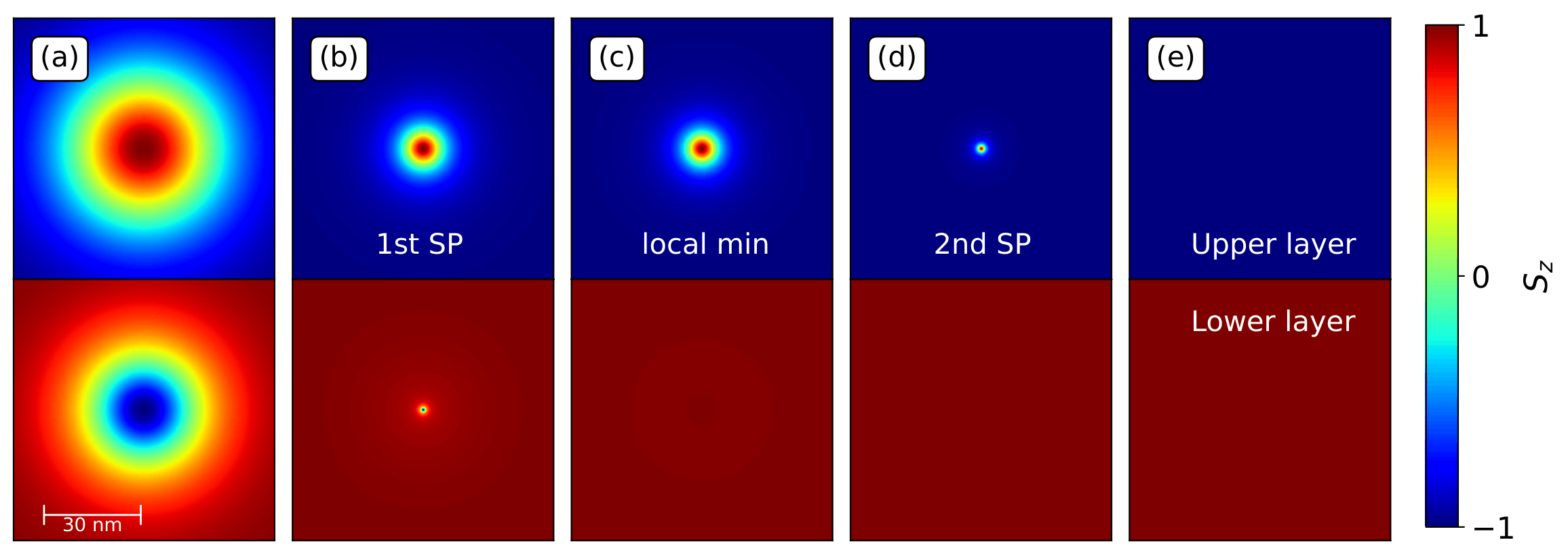
Figure 1: Representative MEP states for skyrmion-pair collapse at B=30 mT and S=500, illustrating sequential layer-resolved collapse and the transient single-skyrmion intermediate.
This mechanism is robust for sufficiently large lateral sizes and in portions of the size-field phase space where the single-skyrmion intermediate is a well-defined local minimum. The existence and stability of this intermediate are sensitive to applied field and lateral confinement.
Energy Barrier Scalings: Collapse Versus Nucleation
Strong numerical results indicate a pronounced dependence of the collapse barrier on island size, almost entirely due to the boundary penalization of the skyrmion-pair minimum rather than variations in the interior saddle point.
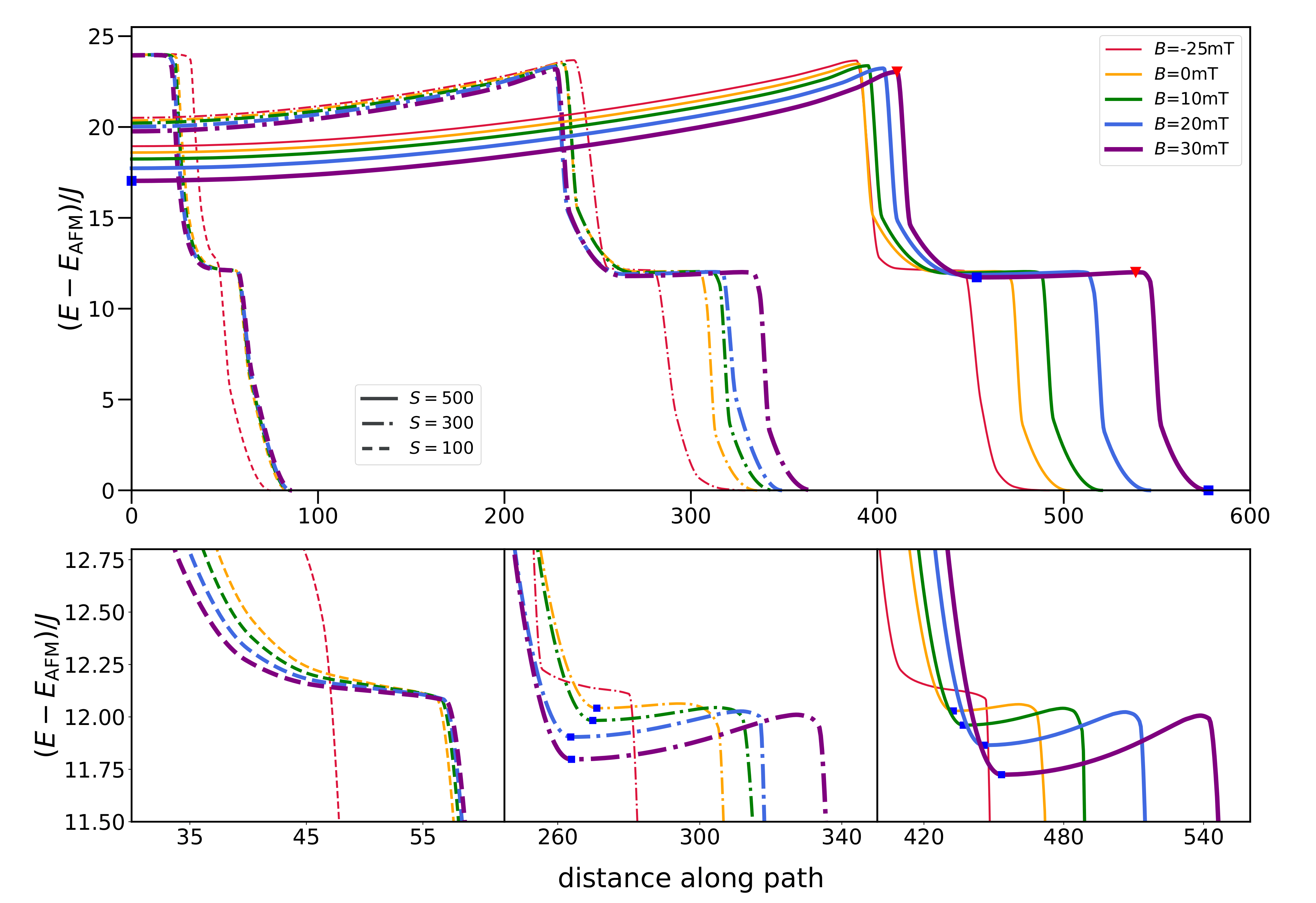
Figure 2: Minimum energy paths for differing S and B, showing two-stage collapse for large islands with clear local minima and saddles.
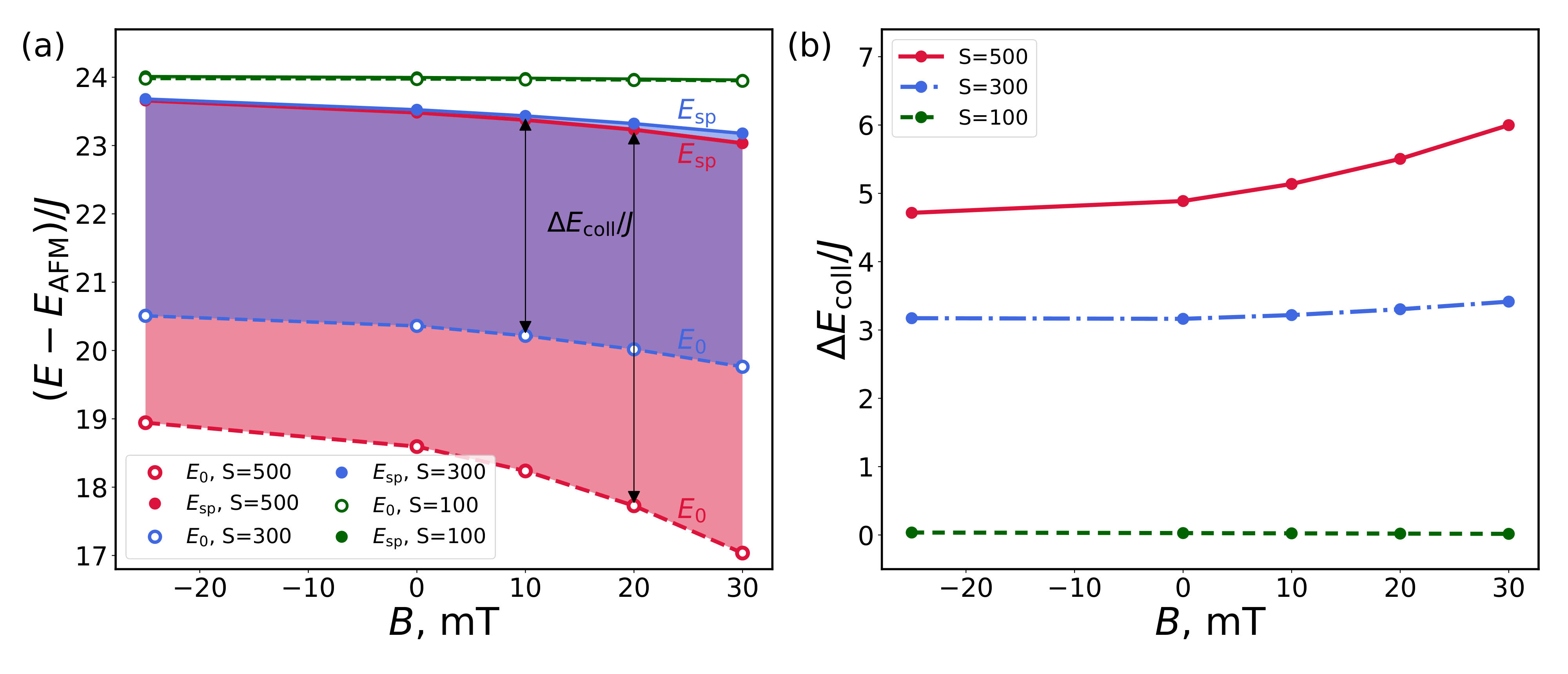
Figure 3: (a) Skyrmion-pair minimum and main saddle energies as a function of B; (b) Collapse barrier evolution with S and ≈0.
Key quantitative findings include:
- For ≈1, the collapse barrier is nearly zero even though a skyrmion pair is locally stabilized.
- For ≈2 and ≈3, the collapse barrier grows to ≈4 (≈5–≈6 eV for ≈7 meV), yielding retention exponents of ≈8–≈9 at room temperature.
- The applied field modulates the barrier, but the effect is subordinate to the island size.
In marked contrast, the reverse nucleation barrier—from the collinear antiferromagnetic state to the pair along the same MEP—remains high at −250–−251 (−252 eV) regardless of −253 and −254.
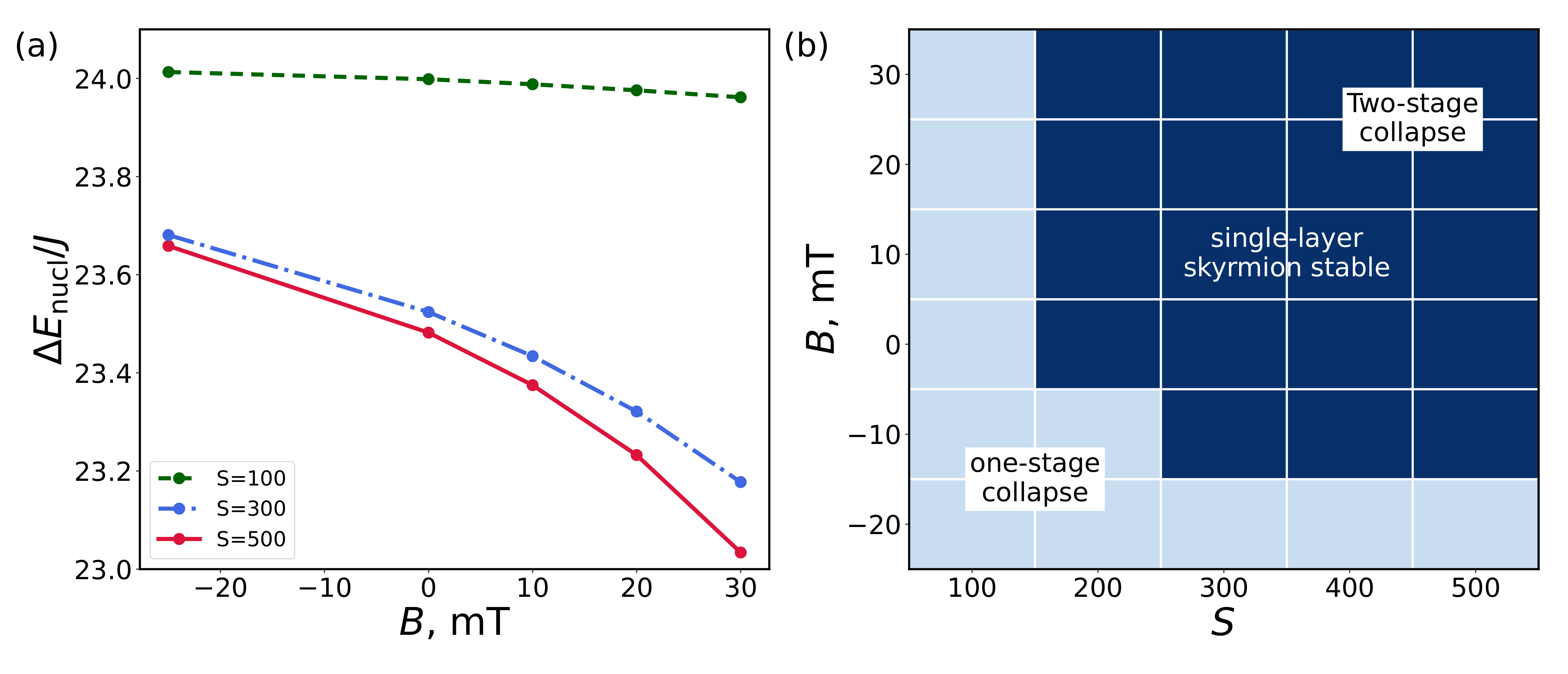
Figure 4: (a) Reverse nucleation barrier vs. −255 and −256; (b) Stability domain for the upper-layer single-skyrmion intermediate.
The ratio of nucleation to collapse barriers underscores a stark asymmetry: thermal activation can erase skyrmions orders of magnitude faster than it can nucleate them, underlining the necessity for non-equilibrium, driven writing protocols in realistic devices.
Implications for Writing Protocols and Assisted Nucleation
The energy landscape supports a layer-by-layer or “sequential” writing scenario—external drive prepares the upper-layer skyrmion, which then facilitates rapid creation of the lower-layer partner via interlayer exchange, traversing a second-step barrier much lower than the full nucleation barrier from the homogeneous state.
The single-layer intermediate is shallow: its own thermal decay barrier is only −257–−258 (−259), pointing to the necessity of active stabilization or rapid progression to the fully bound pair. The calculated stability diagram for this state presents operational guidelines for writing schemes—specifically, for which sizes and fields a transient upper-layer seed can be reliably sustained long enough for conversion to a SAF pair.
While the details of the boundary condition (pinned antiferromagnetic edge, suppressed edge escape/twisting) elevate the absolute energies of the skyrmion pairs, the qualitative results—strong size dependence, sequential mechanism, barrier asymmetry—are expected to persist even with boundary and full micromagnetic corrections.
Theoretical and Practical Outlook
These findings delineate energetic scenarios for memory retention and controlled writing in SAF-based skyrmion devices:
- Size Scaling: There exists a threshold lateral dimension below which thermally activated collapse is essentially unhindered, independent of the apparent metastability of the skyrmion pair.
- Asymmetry of Barriers: The much higher nucleation barrier enforces a need for drive-assisted (current, voltage, laser, etc.) writing protocols, with layer-by-layer paths leveraging the energetic topology of the landscape.
- Transient Intermediates: The ephemeral nature of the single-layer skyrmion intermediate necessitates carefully engineered pulse sequences or device geometries (e.g., FM/SAF hybrids [Deng23]) to facilitate efficient bit writing.
Future theoretical developments must incorporate full micromagnetic features—explicit perpendicular anisotropy, dipolar fields, edge relaxation—to further refine quantitative predictions for practical devices. Experimentally, the insights into size and field scaling, as well as optimal protocols for sequential writing, can inform material engineering and device design in high-density, low-power skyrmion memory applications.
Conclusion
The reduced-lattice MEP analysis of skyrmion collapse and nucleation in SAF islands elucidates the crucial role of boundary conditions and lateral confinement in controlling energy barriers. Sequential, layer-resolved transition mechanisms and marked collapse/nucleation asymmetry define operational constraints and motivate assisted, layer-selective writing protocols. The energetic landscape mapped here supplies a theoretical foundation for optimizing both retention and writability in next-generation skyrmion-based spintronic memory architectures (2606.07112).

