Gravitational waveforms from binaries in higher-derivative gravity: a Love story
Published 5 Jun 2026 in gr-qc and hep-th | (2606.07070v1)
Abstract: We study the emission of gravitational waves by a test particle orbiting a non-rotating black hole in higher-derivative gravity theories with cubic and quartic contractions of the Riemann tensor. To this aim, we first derive the master equations describing even- and odd-parity perturbations in the presence of an arbitrary source term, and then construct a Post-Minkowskian expansion of the solutions to the homogeneous master equations. Specializing to a circular binary system, we compute the Post-Newtonian expansion of the waveform, as well as the energy and angular-momentum fluxes at infinity. We show that higher-derivative corrections to the waveform and to the fluxes always appear at 5PN order, and are universally proportional to the Love number describing the deformability of the geometry under the $\ell=2$ mode perturbation. These analytical results are validated against numerical computations, which also allow us to extend the analysis to larger velocities.
The paper demonstrates that the leading 5PN correction to gravitational waveforms is governed by nonzero tidal Love numbers, a marked departure from GR.
It employs an effective field theory framework with cubic and quartic Riemann contractions to analytically derive modifications in orbital dynamics and energy flux in EMRIs.
Numerical validation confirms that higher-derivative corrections scale as v^10 for the dominant quadrupole mode, implying that next-generation detectors could observe these finite-size effects.
Gravitational Waveforms from Binaries in Higher-Derivative Gravity
Introduction and Motivation
The study titled "Gravitational waveforms from binaries in higher-derivative gravity: a Love story" (2606.07070) provides a comprehensive analysis of gravitational wave (GW) generation in the context of effective field theory (EFT) extensions to general relativity (GR) that include up to quartic contractions of the Riemann tensor. The focus lies on how higher-derivative couplings—parametrized by λ3,λ4,λ~4—modify the GW signatures in extreme-mass-ratio inspirals (EMRIs), with a detailed investigation into the explicit connection between tidal Love numbers and waveform corrections.
Non-GR corrections to binary GW signals can manifest via new finite-size effects, especially encoded by non-vanishing tidal Love numbers even for black holes, in contrast to GR, where black hole Love numbers vanish. The precise scaling of these corrections in post-Newtonian (PN) and post-Minkowskian (PM) expansions can in principle be mapped to signatures observable by next-generation GW detectors, motivating a rigorous analysis.
Theoretical Framework and Black Hole Solutions
The EFT considered includes curvature terms of schematic form
SEFT=2κ21∫d4x−g[R+λ3C3+λ4C22+λ~4C~22+…],
where C3 is the cubic contraction of Riemann tensors, and C22,C~22 are quadratic contractions (the latter involving duals, preserving parity).
Static, spherically symmetric black hole backgrounds including linear-order higher-derivative corrections are constructed, with metric functions f(r) and N(r) modified at orders scaling as λ3M2/r6 and λ4M3/r9 for appropriate couplings (with M the mass parameter). The horizon radius and Hawking temperature receive characteristic shifts determined by these couplings.
Master Equations for Perturbations and GW Emission
The formalism develops Regge-Wheeler–Zerilli–type master equations for odd and even parity perturbations atop the deformed black hole geometry, incorporating arbitrary sources. The system makes explicit use of spherical harmonic decompositions, exploiting parity splitting—which remains in these curvature-corrected actions.
Specialized to a particle on a circular orbit (the "test mass" limit of EMRIs), corrections to geodesic motion and GW sourcing are analytically derived, with orbital frequencies and energy/angular momentum relationships expanded in v2=M/r0. The hierarchy of corrections from cubic and quartic terms is elucidated: cubic contractions introduce modifications at 6PN, quartic at 8PN.
Tidal Love Numbers and the Onset of Corrections
A central result is identifying that, irrespective of the higher-derivative coupling structure, the leading deviation from GR in the waveform for the dominant SEFT=2κ21∫d4x−g[R+λ3C3+λ4C22+λ~4C~22+…],0 (quadrupole) parity-even mode appears at 5PN order. Importantly, this leading correction is universally proportional to the static (dimensionless) Love number SEFT=2κ21∫d4x−g[R+λ3C3+λ4C22+λ~4C~22+…],1, capturing the black hole’s response to external tidal fields:
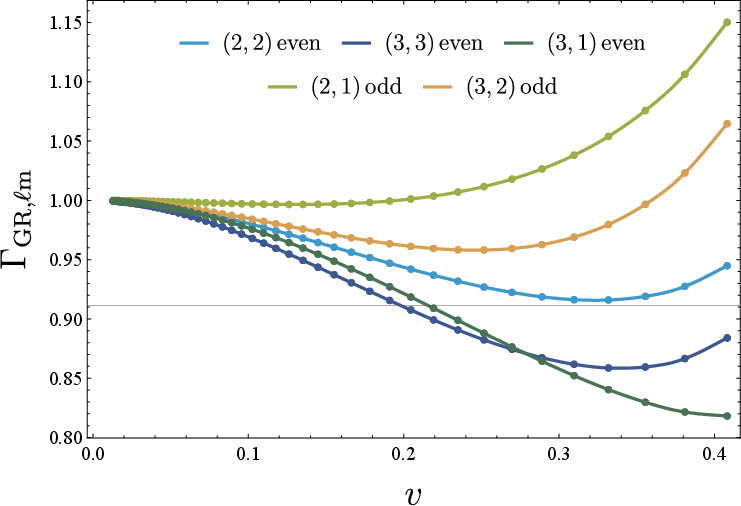
Figure 1: Amplitude of each SEFT=2κ21∫d4x−g[R+λ3C3+λ4C22+λ~4C~22+…],2 mode in the GW signal for GR, normalized by the leading PN behavior; the onset of corrections is manifest at 5PN for higher-derivative regimes.
Mathematically, the leading waveform correction is encoded as
and similar expressions for the odd sector and higher SEFT=2κ21∫d4x−g[R+λ3C3+λ4C22+λ~4C~22+…],5.
Numerical Validation and PN Scaling
Analytical expansions are cross-validated against direct numerical integration of the perturbation equations. The figures confirm that corrections proportional to the Love numbers are the leading effect for the relevant GW multipoles:
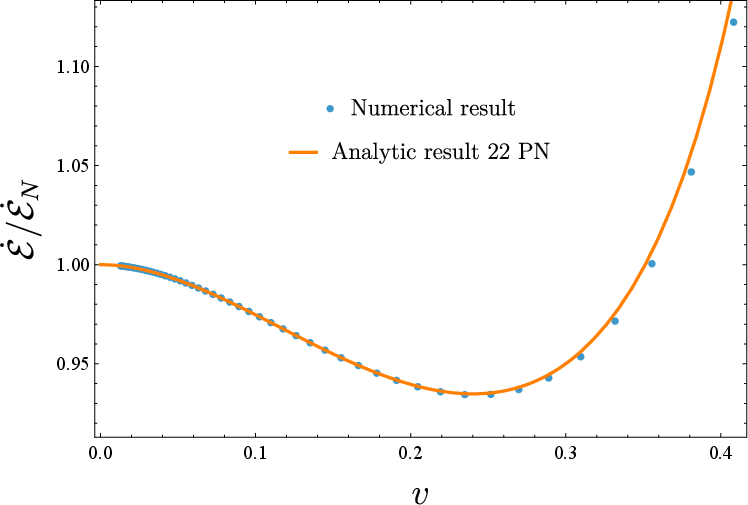
Figure 2: Energy flux in GR, normalized by the leading-order quadrupole term; 5PN effects are numerically unresolved in pure GR due to vanishing Love numbers, but manifest when SEFT=2κ21∫d4x−g[R+λ3C3+λ4C22+λ~4C~22+…],6 are present.
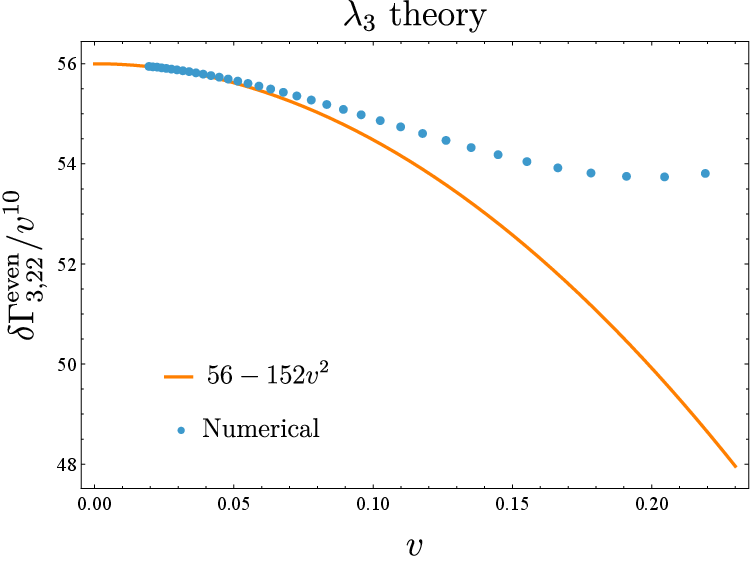
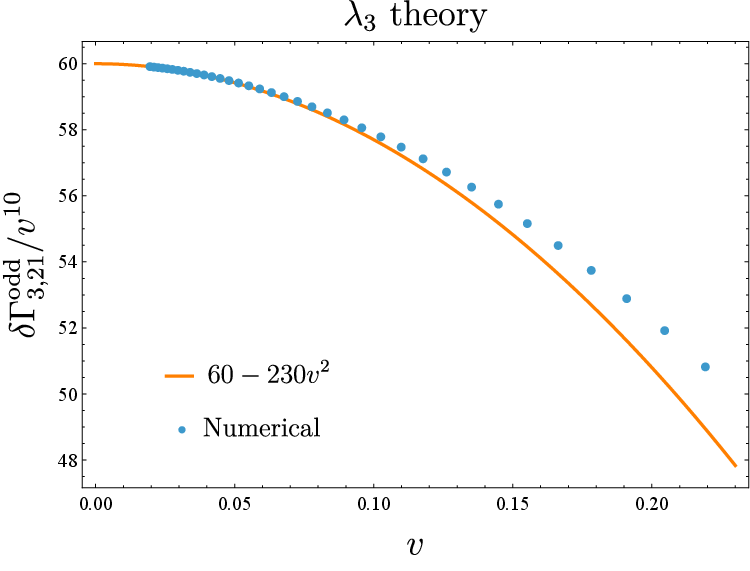
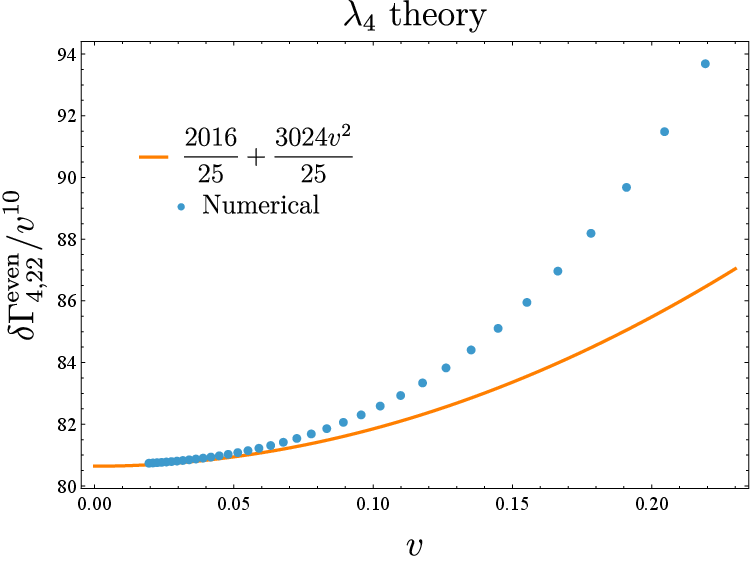
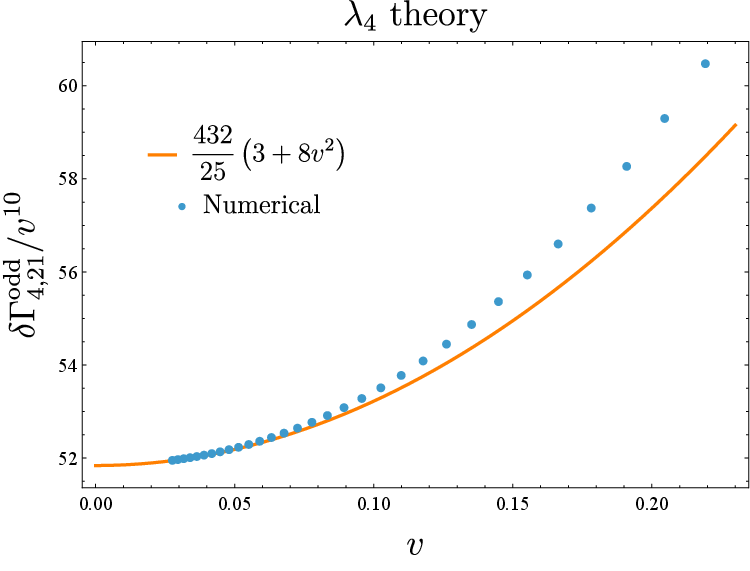
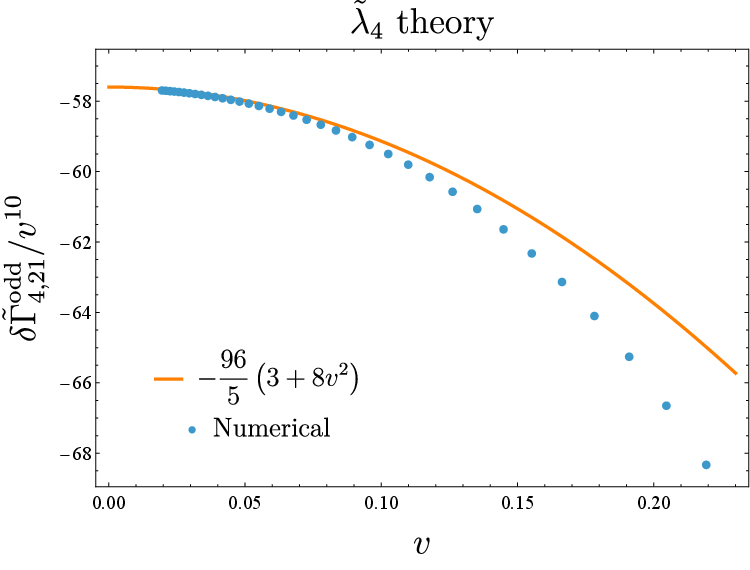
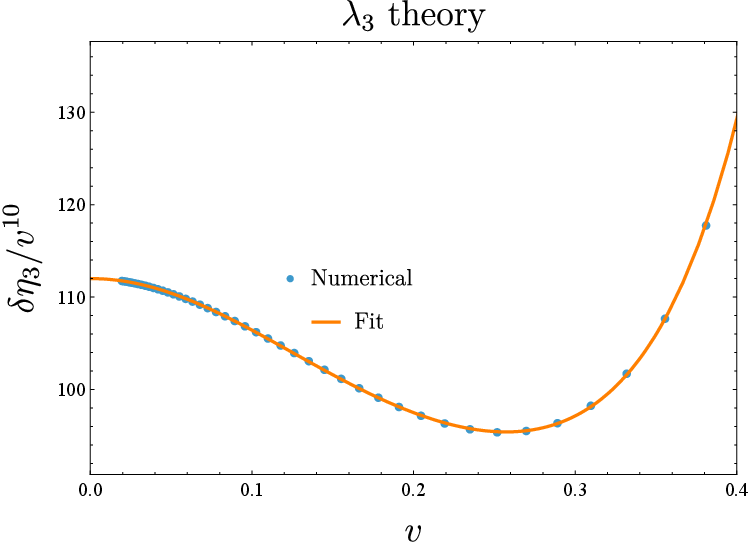
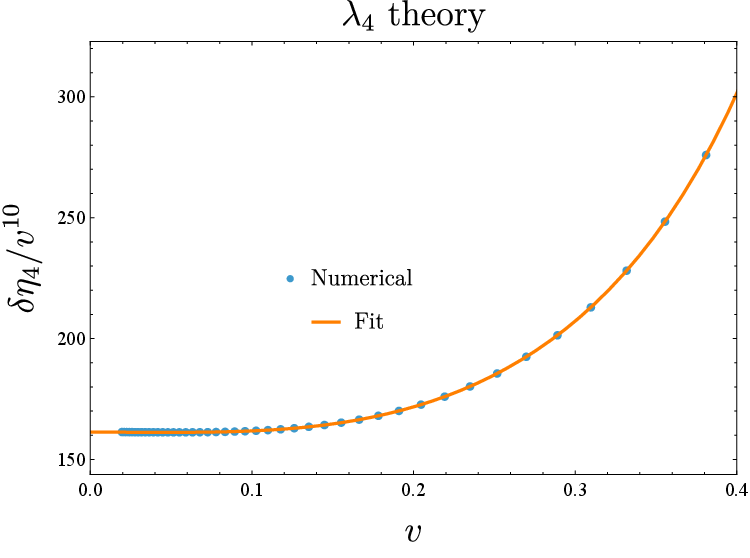
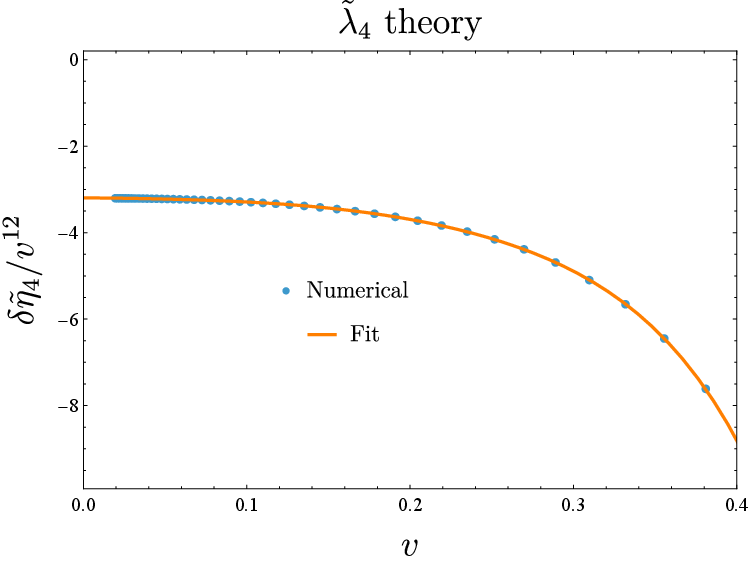
Higher-derivative corrections for the SEFT=2κ21∫d4x−g[R+λ3C3+λ4C22+λ~4C~22+…],7 modes scale as SEFT=2κ21∫d4x−g[R+λ3C3+λ4C22+λ~4C~22+…],8, while for higher SEFT=2κ21∫d4x−g[R+λ3C3+λ4C22+λ~4C~22+…],9 the correction starts at C30. This regime is illustrated in both amplitude and flux corrections, with polynomial fits available for practical waveform modeling.
Figure 3: Corrections to the amplitudes C31 and other select modes due to cubic and quartic higher-derivative terms, validating the analytic C32 scaling.
Energy and Angular Momentum Fluxes
The energy and angular momentum luminosities at infinity, extracted from the waveform amplitudes, are derived up to 6PN order:
C33
with
C34
underscoring the paramount role of Love numbers in the 5PN correction to GW flux:
Figure 4: Correction to the energy flux, relative to the GR quadrupole term, showing the C35 scaling for finite C36.
Implications and Perspective
The findings establish that, for EFTs extending GR with arbitrary higher-derivative (up to quartic) terms, the dominant observable modification in the GW signal from EMRIs arises directly from the induced Love numbers, entering precisely at 5PN order. This result contradicts prior claims that such modifications appear only at higher-PN orders and emphasizes that finite-size effects inherent in the modified horizon-scale geometry dominate over "short-distance" PN corrections from radiation processes.
From a data analysis perspective, these results imply that next-generation GW observatories will be directly sensitive to the curvature response of black holes in modified gravity—provided that non-vanishing Love numbers are realized in nature. Theoretically, the work solidifies the robustness of black hole Love numbers as physically meaningful and observable parameters beyond the degenerate zero-value imposed by GR.
Further, the formal techniques developed—combining PM matching, asymptotic expansions, and numerical validation—establish a methodological standard for waveform predictions in beyond-GR gravity, potentially extensible to spinning systems, non-circular orbits, and broader classes of theories.
Conclusion
This paper demonstrates that, in higher-derivative gravity theories without additional LDOFs, the leading correction to gravitational waveforms and energy fluxes from EMRIs is governed by black hole tidal Love numbers, appearing at the accessible 5PN order. Analytical results are rigorously validated by numerical integration for arbitrary mass ratios and velocities within the PN regime. The explicit connection between EFT couplings and observable Love numbers provides a direct theoretical bridge to GW phenomenology, motivating both detailed waveform modeling and dedicated data analysis searches for such beyond-GR signatures in future GW observations.