- The paper introduces a unified taxonomy categorizing autoscaling triggers, prediction models, and evaluation metrics for dynamic cloud-edge environments.
- It presents an integrated MAPE-guided architecture leveraging Kubernetes-native automation and advanced forecasting techniques.
- It analyzes drift-aware and uncertainty-aware strategies to optimize resource utilization and ensure robust federated learning performance.
Predictive Autoscaling in Cloud-Native and Federated Cloud-Edge Environments: Taxonomy, Architecture, and Research Directions
Introduction
The paper "Predictive Autoscaling in Cloud-Native and Federated Cloud-Edge Computing Environments: A Taxonomy and Future Directions" (2606.07046) provides a comprehensive review and synthesis of contemporary advances in intelligent autoscaling techniques for distributed computing. It systematically introduces a unified taxonomy covering core components—scaling triggers, scaling targets, prediction models, and evaluation metrics—while integrating advances in Kubernetes-native orchestration and predictive workload forecasting. The analysis encompasses proactive, hybrid, and drift-aware autoscaling mechanisms, targeting both traditional cloud-native and emergent federated cloud-edge workflows with heterogeneous, latency-sensitive, and privacy-preserving load profiles.
Systematic Literature Analysis and Taxonomy Construction
The survey applies a rigorous, parameter-based filtering across major scientific databases to extract relevant autoscaling literature. Research is classified according to multiple feature dimensions, supporting the development of a four-dimensional taxonomy that captures the operational differences and strengths of existing approaches.
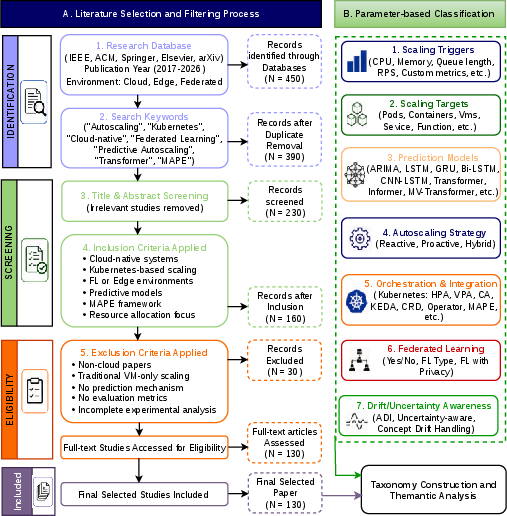
Figure 1: Systematic literature selection and filtering methodology for intelligent predictive autoscaling studies in cloud-native and federated cloud environments.
The taxonomy explicitly compares the efficacy of reactive, proactive, and hybrid scaling strategies, as well as distinguishing orchestration mechanisms such as HPA, VPA, CA, KEDA, CRDs, and Operators. It further classifies prediction models spanning statistical baselines (ARIMA), conventional ML (RF, SVR), deep sequence models (LSTM, GRU, Bi-LSTM, CNN-LSTM), and advanced attention-based architectures (Informer, MV-Transformer).
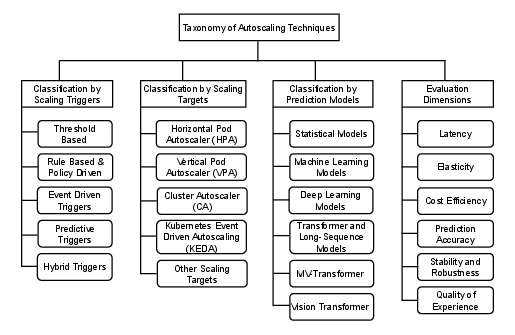
Figure 2: Overview of the autoscaling taxonomy, illustrating the relationships among scaling triggers, scaling targets, prediction models, and evaluation dimensions.
This enables a nuanced analysis of the conditions under which autoscaling strategies perform optimally, their failure modes, and the operational characteristics required for deployment in dynamic or federated cloud-edge environments.
Unified Predictive Autoscaling Framework: Architecture and MAPE Integration
A key contribution is the presentation of an integrated architecture for predictive autoscaling in heterogeneous cloud-edge and federated systems. This framework connects diverse workload sources (microservices, IoT, FL clients) to automated orchestration on a Kubernetes control plane, incorporating advanced workload forecasting, MAPE-guided monitoring and control, and adaptive reconciliation using custom resource definitions and Operators.
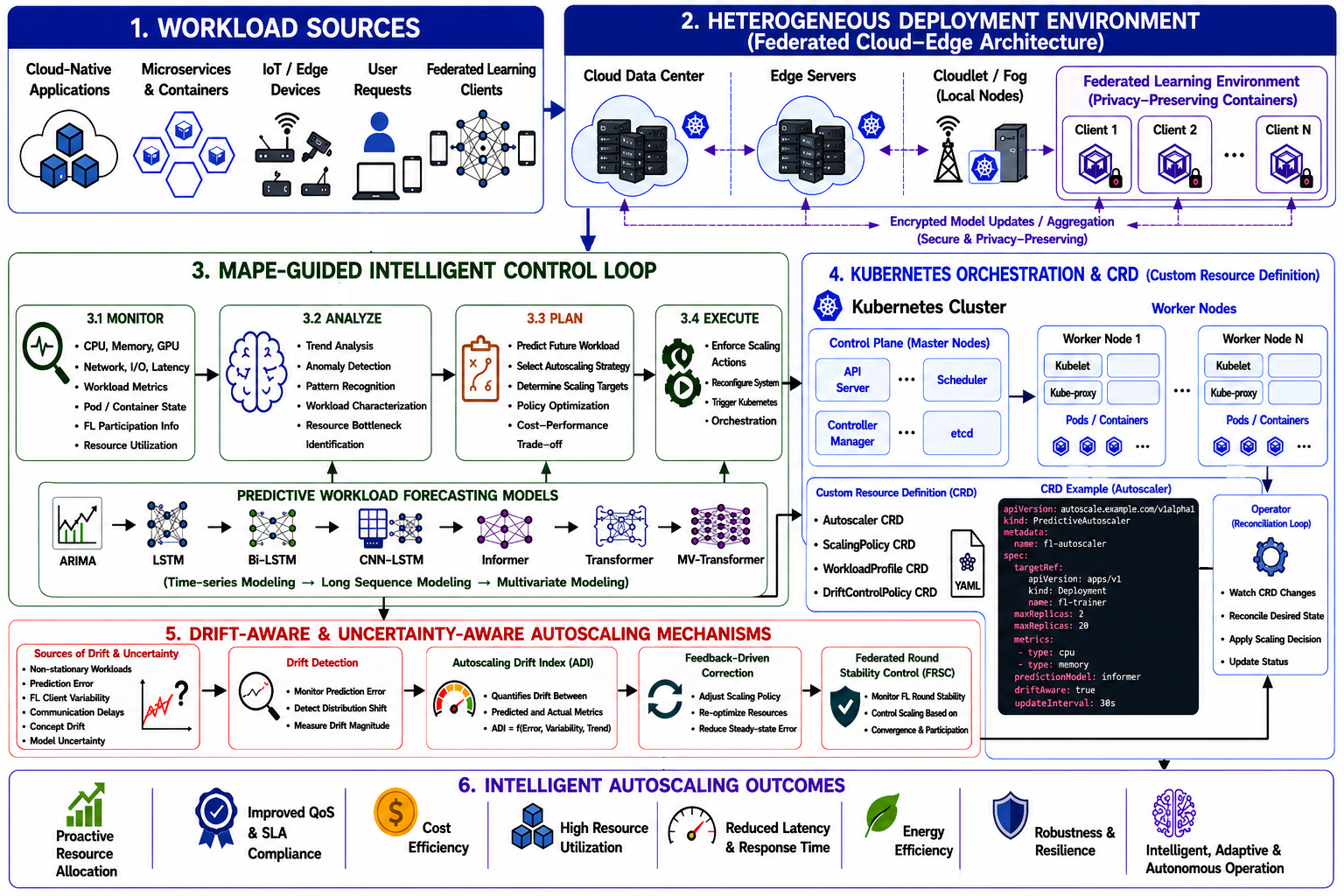
Figure 3: Unified Intelligent predictive Autoscaling Framework for Cloud-Native and Federated Cloud-Edge Environments
Within this architecture, the MAPE loop (Monitor-Analyze-Plan-Execute) acts as the central engine for adaptive resource management. Real-time metrics and workload traces—collected via robust telemetry (e.g., Prometheus)—are processed by embedded deep learning and transformer-based predictors. The resulting autoscaling signals are enforced at various stack levels by Kubernetes-native mechanisms, with declarative configuration and runtime extensions realized via CRDs and Operator patterns.
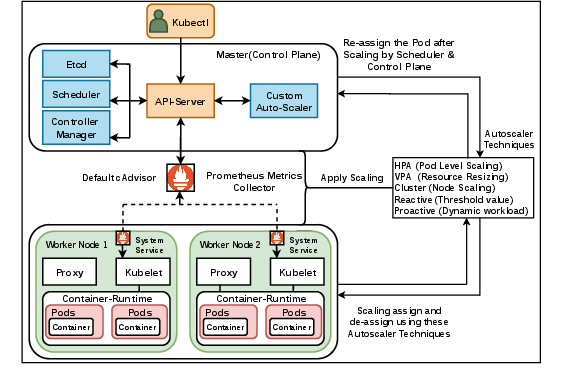
Figure 4: Kubernetes autoscaling workflow showing metric flow from worker nodes to autoscalers and scaling actions via the API Server, Scheduler, and nodes.
The role of enhanced architecture, multi-level feedback, privacy-preserving extensions (DP-aware orchestration), and the use of container-level isolation (Docker/CRI-O-based sandboxing) is addressed for robust operation under privacy and multi-tenancy constraints.
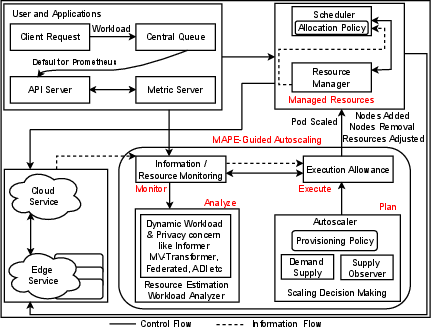
Figure 5: Enhanced MAPE-guided autoscaling architecture for cloud–edge and federated environments, showing workload flow and adaptive, privacy-aware scaling across distributed systems.
Proactive Predictive Autoscaling Pipelines and Operator-Orchestrated Control
The pipeline for predictive autoscaling is detailed, showcasing integration of advanced time-series models (Informer, MV-Transformer) with the Kubernetes resource lifecycle through CRDs and Operator reconciliation loops. The process delivers containerized, portable, and scalable forecasting microservices, observed and actuated via standard Kubernetes APIs.
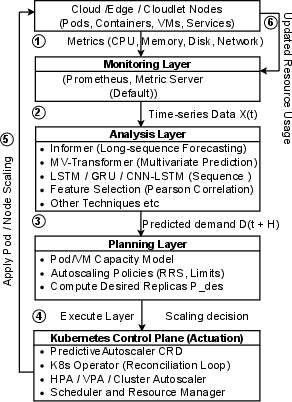
Figure 6: Predictive autoscaling pipeline integrating Informer and MV-Transformer with Kubernetes CRDs and Operators in a MAPE-guided workflow for proactive resource management across cloud–edge environments.
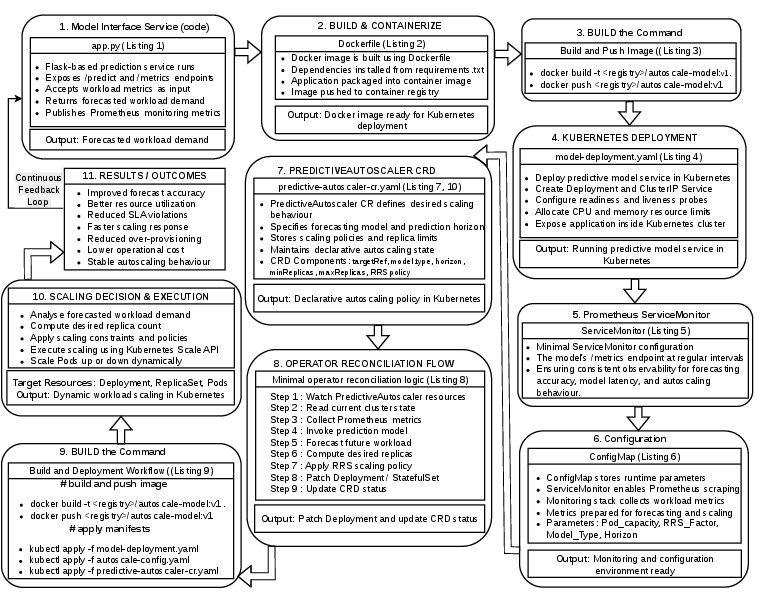
Figure 7: End-to-end predictive autoscaling workflow integrating forecasting services, Kubernetes deployment, monitoring, CRD-based policy management, Operator reconciliation, scaling execution, and continuous feedback for autonomous cloud-native resource management.
Key implications include:
- Direct integration of prediction outputs into control-plane state for continuous reconciliation.
- Support for multi-model selection strategies (model controller ranking by recent predictive performance).
- Runtime policy adaptation and observability for auditability and explainability.
Autoscaling for Federated Learning: Orchestration, Privacy, and Drift-Awareness
A significant advance over prior literature is explicit focus on autoscaling for privacy-preserving, heterogeneous federated learning (FL) workloads. The system pipeline captures FL dynamics, including resource bursts from global aggregation, heterogeneity stemming from diverse client capabilities, and communication irregularities.
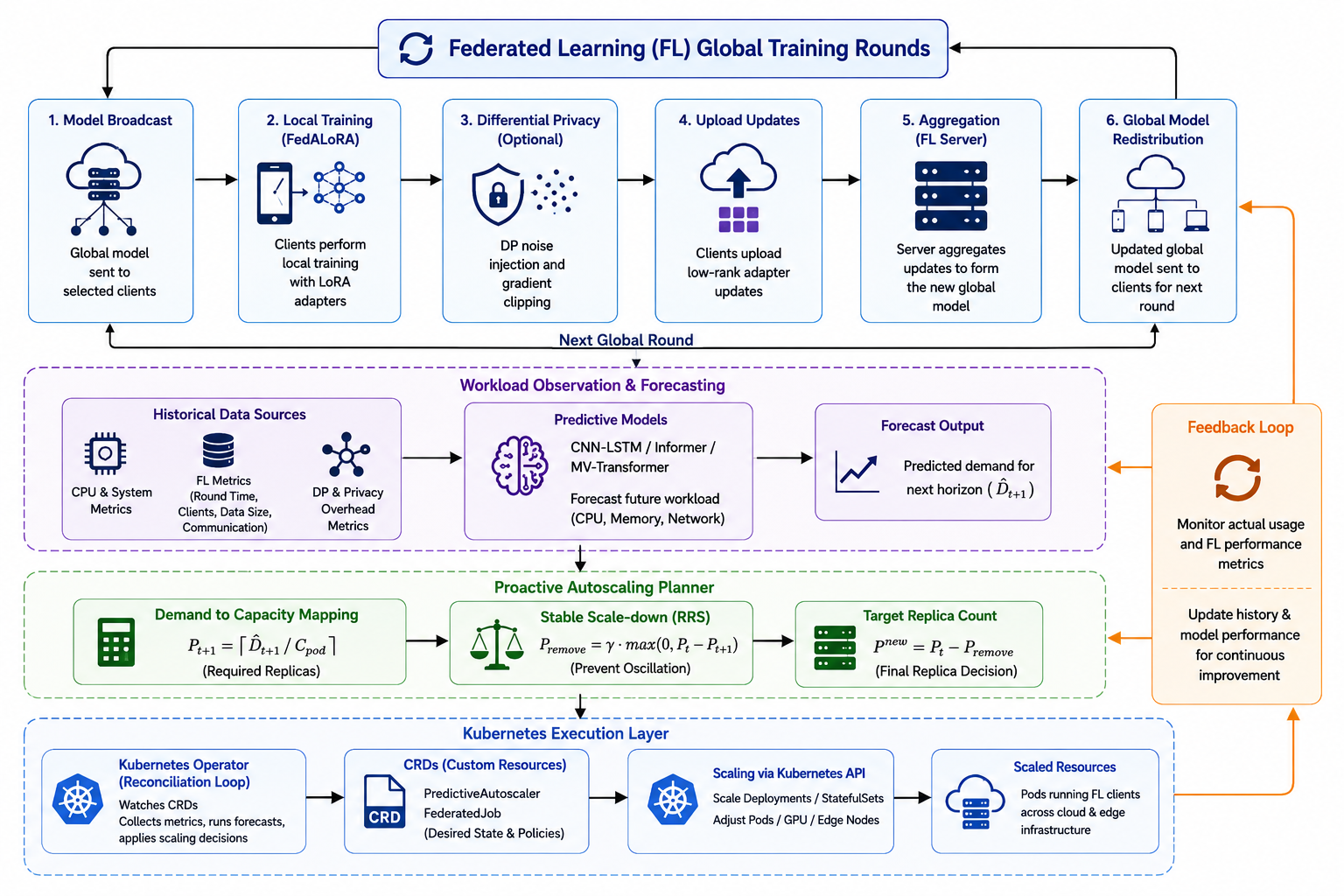
Figure 8: Interactive workflow of predictive autoscaling for federated learning (FL) in cloud–edge environments using forecasting models, Kubernetes Operators, and proactive resource management.
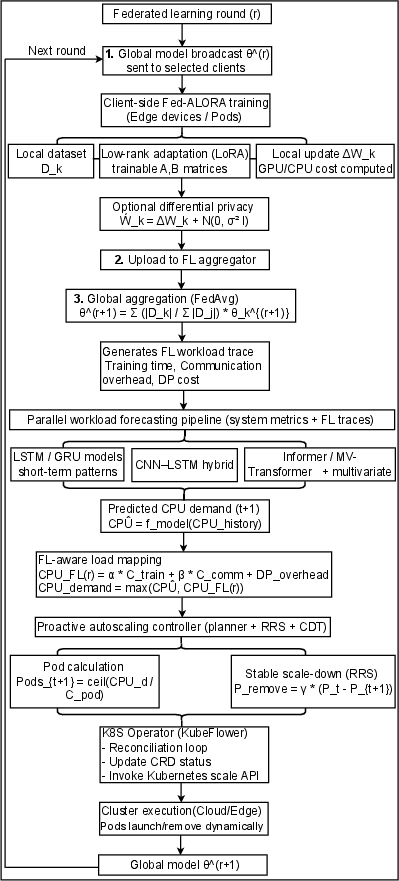
Figure 9: End-to-end FL autoscaling pipeline: forecasting-driven scaling via Kubernetes Operators and CRDs.
Novel mechanisms address:
- Implementation of KubeFlower-style Operators that integrate FL lifecycle orchestration, workload monitoring, and proactive resource planning through CRD-driven control.
- Differential privacy-aware scaling that incorporates DP-induced computational overhead into demand forecasting.
- Multi-region/cross-cluster predictive orchestration, enabling geo-distributed or mobility-driven federated deployments to benefit from globally coordinated, predictive scaling.
Drift-Aware and Uncertainty-Aware Autoscaling
Addressing prediction error accumulation and non-stationarity in workloads, the survey introduces the concept of Autoscaling Drift Index (ADI) for closed-loop correction, together with advanced feedback-driven uncertainty-aware correction cycles.
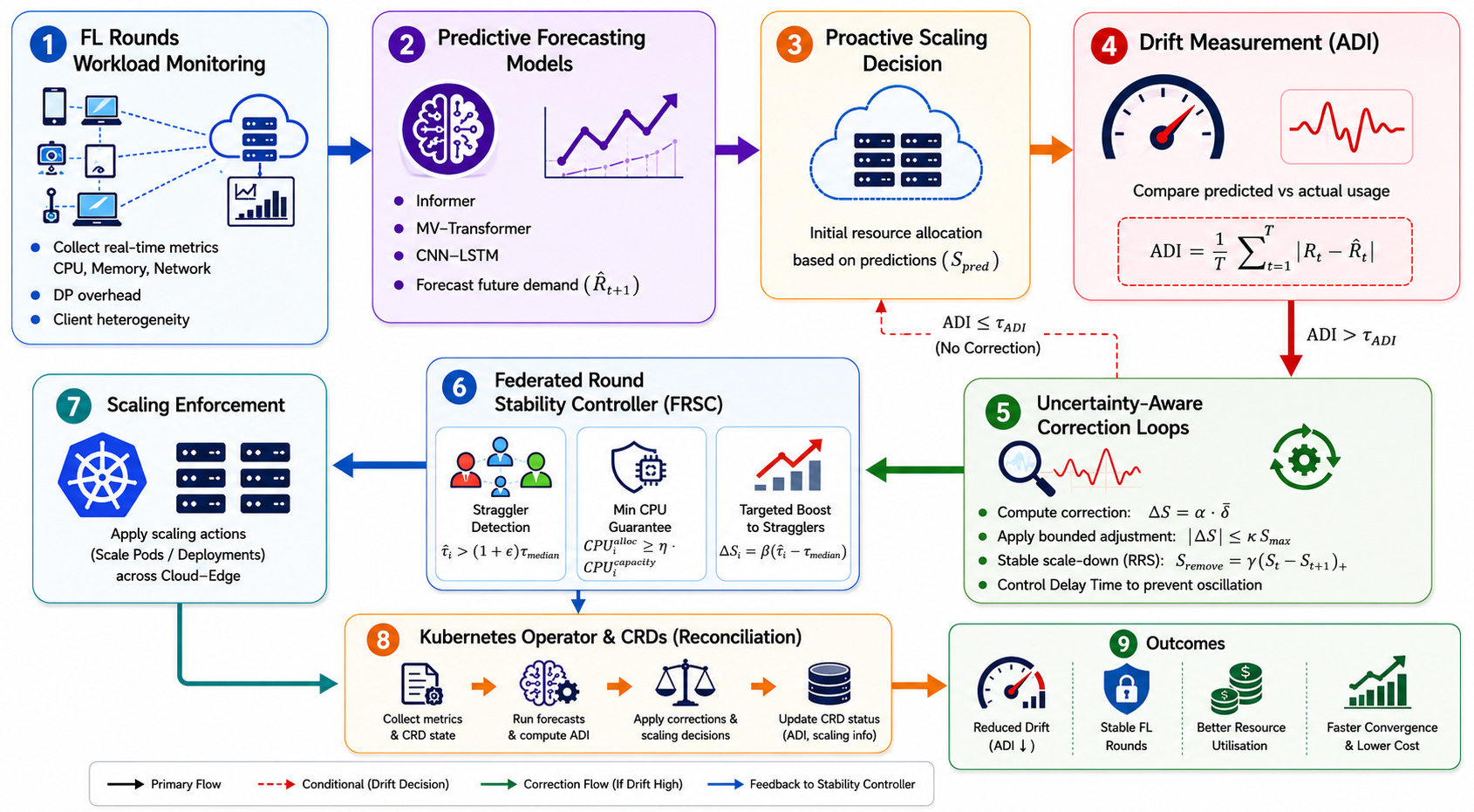
Figure 10: Drift-aware and uncertainty-aware autoscaling workflow for federated learning in cloud–edge environments.
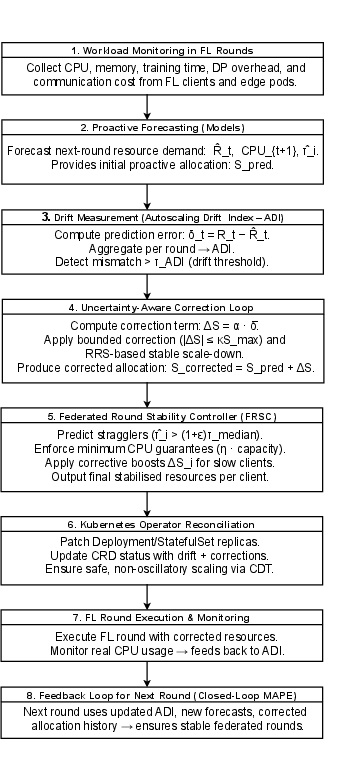
Figure 11: Drift-aware and uncertainty-aware autoscaling pipeline for federated learning.
The core mechanism involves measuring round-level prediction-resource discrepancies, activating bounded correction mechanisms (control delay, resource removal strategy for safe scale-in), and real-time straggler mitigation (Federated Round Stability Controllers). This addresses performance collapse during straggling rounds arising from DP noise or device heterogeneity, and directly impacts convergence and resource utilization guarantees in synchronous FL.
Research Implications, Open Challenges, and Future Directions
The paper summarizes unresolved challenges and research opportunities, both practical (multi-cluster deployment, production noise, CRD concurrency/safety, energy/cost-awareness) and theoretical (drift metric development, causal/multivariate forecasting, RL/meta-learning based controllers, privacy/sustainability in scaling policies).
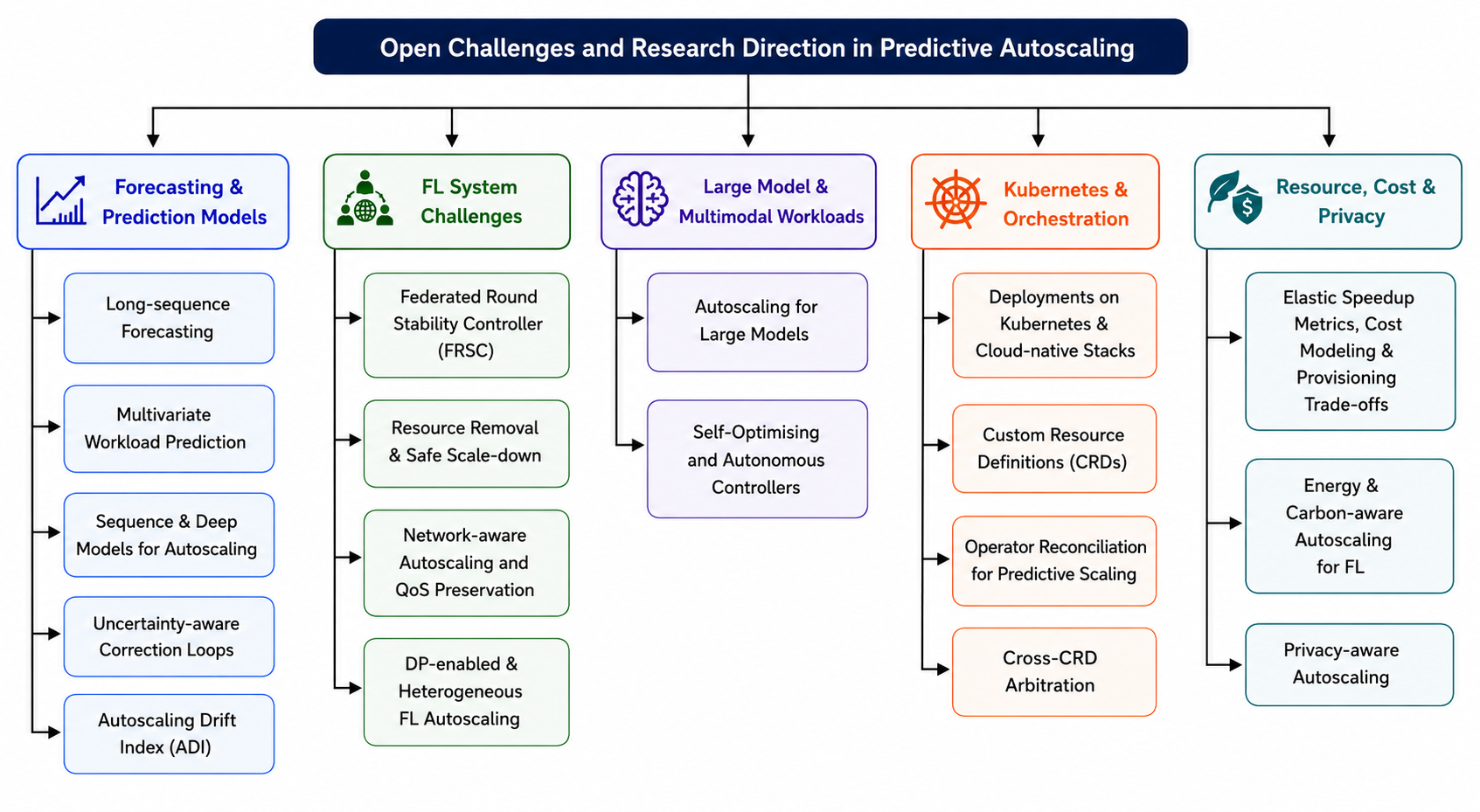
Figure 12: Hierarchical taxonomy of challenges and future research directions in predictive autoscaling for cloud-native and federated cloud–edge environments.
Prominent directions are:
- Online learning for drift adaptation in transformer-based forecast models.
- Hierarchical scheduling to manage multi-modal and LLM-centric workflows.
- Security, privacy, and energy-aware predictive autoscaling with explicit regulatory and compliance constraints.
- Cross-layer coordination to integrate compute, storage, and networking into holistic scaling actions.
Conclusion
This work provides a rigorous, multi-dimensional survey and taxonomy of predictive autoscaling across cloud-native and federated cloud-edge paradigms, emphasizing the convergence of advanced forecasting, Kubernetes-native orchestration, and federated learning-aware resource management. The introduction of drift- and uncertainty-aware correction mechanisms, practical operator-based control plane extensions, and explicit handling of privacy and heterogeneity places this survey as a foundational reference for both applied research and architecture design of next-generation autoscaling systems. The adoption of these approaches is likely to drive the development of more robust, adaptive, and efficient cloud-edge infrastructure, supporting the deployment of sophisticated AI, FL, and LLM workloads at scale.
Reference:
Bablu Kumar, Anshul Verma, and Rajkumar Buyya, "Predictive Autoscaling in Cloud-Native and Federated Cloud-Edge Computing Environments: A Taxonomy and Future Directions" (2606.07046).